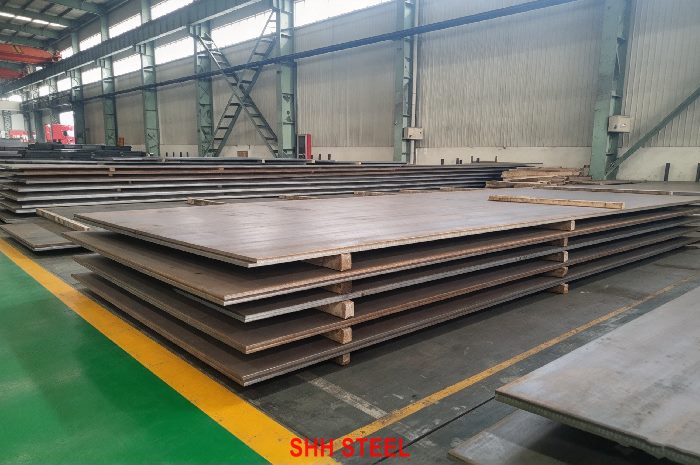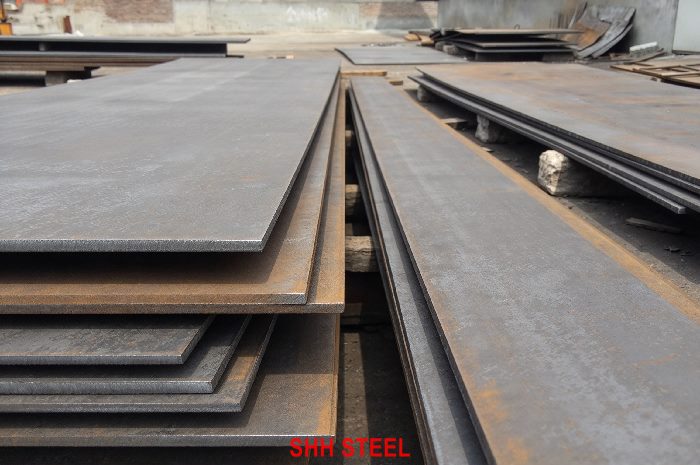

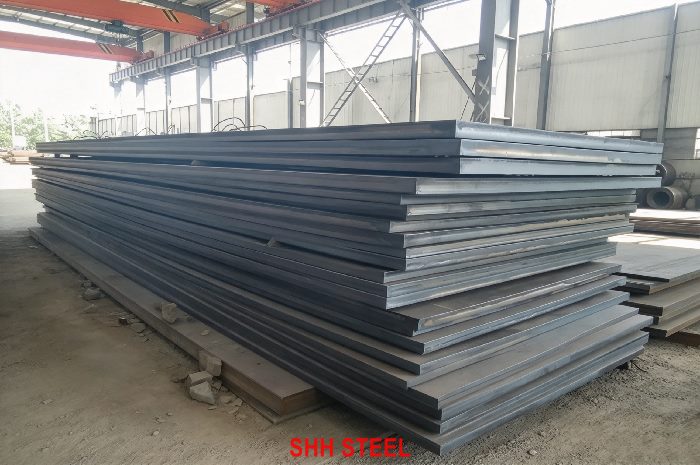
KR RA70 Shipbuilding Steel Plate
KR RA70 / KR RA70 shipbuilding steel plate — overview
Korean Register titles its 0 °C extra-high-strength plate in the 690 N/mm² band KR RA70 — official-style KR designation RA70, using a yield-class number (70) rather than the 420…690 numbers used by DNV, BV and KR. The strength band follows IACS Unified Requirement W16; KR implements it in the Rules for the Classification of Steel Ships, Pt 2 (Materials). Minimum yield is 690 N/mm², tensile 770–940 N/mm², elongation 14 % min., Charpy at 0 °C. It sits above the RA–RF 40 higher-strength family (max. 390 N/mm² under UR W11). Commercial enquiries use KR RA70 or KR RA70 shipbuilding steel plate.
Equivalent grades: KR RA70 ≈ ASTM A131 (no direct grade at this strength) ≈ ABS AH70 / AQ70 ≈ DNV NV A690 ≈ LR AH69 ≈ BV A690 ≈ CCS AH690 ≈ NK KA690 ≈ RINA A690 ≈ GB 712 Grade AH690 (all class-approved, stamped by the issuing society).
Naming note: KR’s EHS numbers 43 / 47 / 51 / 56 / 63 / 70 follow the ABS-style official yield-class numbering (420 → 43, 460 → 47, 500 → 51, 550 → 56, 620 → 63, 690 → 70), so 690 N/mm² becomes RA70. ABS titles the same band AH70 commercially (official AQ70); DNV and CCS use AH690; BV uses A690 (no H); LR uses AH69. ASTM A131 has no grade at this strength. The 43…70 mapping is consistent with ABS practice but is UNCERTAIN against a local KR Rules text — confirm the exact designation on the mill’s KR approval certificate before ordering.
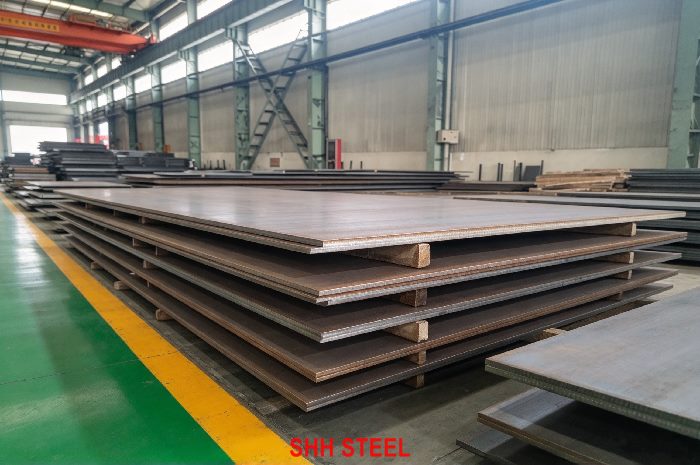
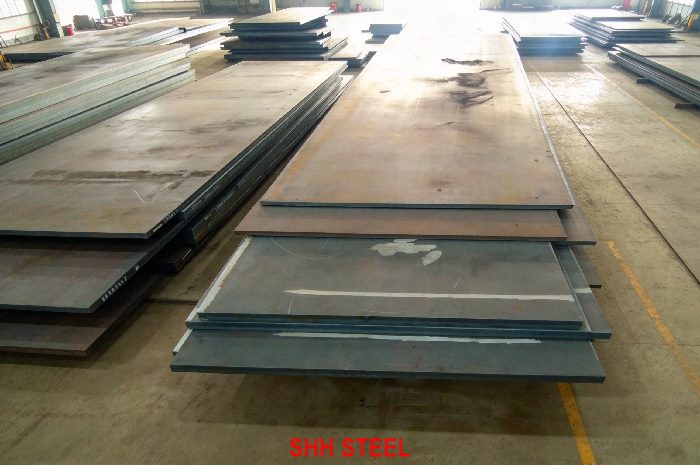
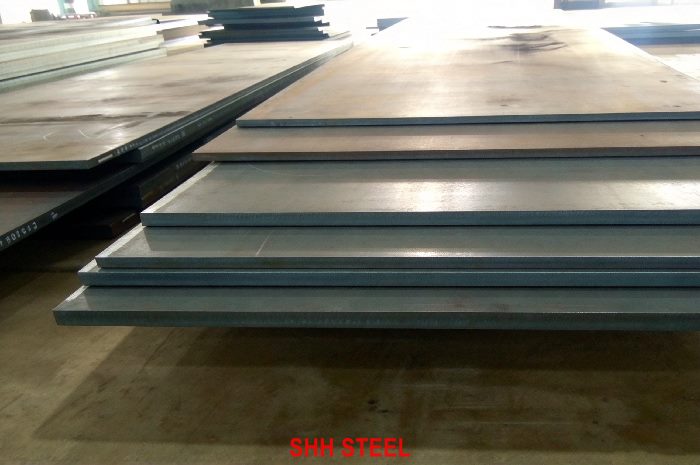
KR RA70 is almost always produced TM or QT by a KR-approved mill to order rather than taken from open stock. SHH STEEL sources extra-high-strength plate from mills with Korean Register approval for the grade, under Surveyor attendance, with optional multi-class (ABS/DNV/LR/BV) and EN 10204 3.2.
KR RA70 plate: specification summary
| Item | KR RA70 / RA70 data |
|---|---|
| Rule basis | KR Rules Pt 2 (extra-high / high-strength hull steel); IACS UR W16 strength band (see UNCERTAIN for KR Rules Pt 2 paragraph cross-refs without local KR Rules text) |
| Official KR designation | RA70 (R prefix + ABS-style yield-class number 70; = 690 N/mm² band) — UNCERTAIN vs local KR text |
| IACS strength band | UR W16, yield 690 N/mm² (AH690 in DNV/CCS naming) |
| Yield / tensile / elongation | 690 / 770–940 N/mm² / 14 % min. |
| Impact | 0 °C; ≈ 69 J L or 46 J T average (IACS UR W16 / aligned tables — confirm on mill certificate) |
| Deoxidation | fully killed, fine grain; N-binding elements per manufacturing specification |
| Delivery condition | TM or QT (N/CR routes only where specifically approved) — within mill approval thickness limits |
| Marking | KR RA70 / KR RA70 (plus delivery-condition / Z / U where ordered) |
| UT | commonly required for thicker EHS plate (e.g. ≥15 mm) — agree standard (EN 10160 / ASTM A578) on PO |
| Thickness tolerance | IACS UR W13 as adopted by KR (confirm class on PO; see UNCERTAIN) |
| Certificate | mill certificate endorsed by the KR Surveyor; includes Ceq/CET/Pcm as applicable; EN 10204 3.1 / 3.2 on request |
Maximum plate thickness depends on delivery condition and the mill’s KR approval sheet — typically TM up to about 100–150 mm and QT higher, but treat the approval limit as governing (UNCERTAIN without local KR Rules text). Primary commercial scope we quote is within ~100 mm unless the mill approval and KR survey confirm otherwise.
KR RA70 chemical composition (heat analysis — full alloy set)
| Element | Heat (ladle) analysis, % | Product (check) analysis, % | Note |
|---|---|---|---|
| C | 0.21 max. (often 0.14–0.20 by route/condition; TM/QT may tighten) | numeric tolerance not tabulated in KR Rules (Part 2) – agree on order / mill certificate | TM/QT and letter routes may tighten C — UNCERTAIN exact KR Rules Pt 2 table without local PDF |
| Mn | 1.70 max. (typically 1.00–1.70; QT route may differ) | numeric tolerance not tabulated in KR Rules (Part 2) – agree on order / mill certificate | as per mill approval / UR W16 envelope |
| Si | 0.55 max. (QT may allow up to ~0.80 — confirm on mill approval) | numeric tolerance not tabulated in KR Rules (Part 2) – agree on order / mill certificate | |
| P | 0.025 max. (some EQ-style routes tighter — confirm) | numeric tolerance not tabulated in KR Rules (Part 2) – agree on order / mill certificate | EQ-style routes may be tighter |
| S | 0.025 max. (some EQ-style routes tighter — confirm) | numeric tolerance not tabulated in KR Rules (Part 2) – agree on order / mill certificate | EQ-style routes may be tighter |
| Al (acid soluble / total) | 0.015 min. acid-soluble / ≈0.020 total Al (fine-grain; Al/N control unless other N-binders) | numeric tolerance not tabulated in KR Rules (Part 2) – agree on order / mill certificate | grain refining / N control |
| Nb | 0.05 max. (when used; combined microalloy caps apply) | numeric tolerance not tabulated in KR Rules (Part 2) – agree on order / mill certificate | when intentionally added |
| V | 0.10 max. (when used; combined caps apply) | numeric tolerance not tabulated in KR Rules (Part 2) – agree on order / mill certificate | when intentionally added |
| Ti | 0.05 max. (when used; combined caps apply) | numeric tolerance not tabulated in KR Rules (Part 2) – agree on order / mill certificate | when intentionally added |
| Cu | 0.50 max. (route-dependent; often ≤0.35 in practice) | numeric tolerance not tabulated in KR Rules (Part 2) – agree on order / mill certificate | |
| Cr | 0.20–0.25 max. (route-dependent) | numeric tolerance not tabulated in KR Rules (Part 2) – agree on order / mill certificate | |
| Ni | 2.00 max. or per mill approval (often lower on AH/DH routes) | numeric tolerance not tabulated in KR Rules (Part 2) – agree on order / mill certificate | |
| Mo | 0.08–0.50 (route-dependent; QT may allow higher) | numeric tolerance not tabulated in KR Rules (Part 2) – agree on order / mill certificate | |
| B | 0.005 max. (when intentionally added) | numeric tolerance not tabulated in KR Rules (Part 2) – agree on order / mill certificate | report when intentionally added |
| N | 0.015 max. (tighter control when Al is the sole N-binder) | numeric tolerance not tabulated in KR Rules (Part 2) – agree on order / mill certificate | Al/N practice unless other N-binders |
| Nb+V+Ti (combined) | Nb+V+Ti typically < 0.26 % for N/TM routes (not QT) — confirm UR W16 / mill approval | not applicable (calculated from heat analysis) | combined microalloy cap |
| Ceq / CET / Pcm | Ceq / CET / Pcm maxima by category and condition on mill approval — report on certificate | not applicable (calculated from heat analysis) | report on certificate; choice agreed mill/purchaser |
Product (check) analysis column: KR Rules (Part 2) specify heat (ladle) limits; no numeric product-analysis tolerance is tabulated in the rule text reviewed, so product (check) limits are agreed on the order or taken from the approved mill specification and certificate.
Source: IACS UR W16 chemistry envelope (ABS 2-1-8 Table 4A aligned — the same yield-class numbering KR follows) as implemented by Korean Register for KR RA70 — exact ladle limits depend on delivery condition (TM vs QT) and toughness letter. Class work follows the KR / UR W16 envelope on the mill approval. Values above are the rule envelope with every alloy / microalloy row listed; the purchase order and mill approval sheet govern. Product analysis: as per standard and mill certificate. All intentionally added elements and Ceq (or CET/Pcm) are to be reported. Flagged UNCERTAIN where a local KR Rules text was not available to quote paragraph numbers.
KR RA70 tensile and impact properties
| Property | Requirement (IACS UR W16 aligned) |
|---|---|
| Yield strength ReH (or Rp0.2) | 690 N/mm² min. |
| Tensile strength Rm | 770–940 N/mm² |
| Elongation (transverse, 5.65√A) | 14 % min. |
| Impact test temperature | 0 °C |
| Impact energy (indicative) | 69 J L or 46 J T average |
Final acceptance values are as per standard and mill certificate under KR survey. For thick plate, additional mid-thickness tensile/impact positions may apply — confirm at enquiry. Test frequency is typically each heat-treatment batch of same cast/condition/thickness.
Delivery condition and toughness for KR RA70
Charpy temperature is fixed by the grade letter: AH → 0 °C. Indicative average energy 69 / 46 J (L/T) from IACS UR W16 aligned tables — confirm exact figures on the KR-endorsed certificate. Unlike UR W11 higher-strength tables, EHS energies are usually stated as a single pair rather than rising through many thickness bands; thick-plate mid-thickness rules may still apply.
Allowed delivery conditions are primarily TM and QT within the mill’s approved thickness. Vacuum degassing is commonly required for higher categories and for thicker plate — follow the mill approval. State TM or QT on the PO; do not leave delivery condition blank for RA70.
Thickness tolerance and surface condition
Korean Register applies IACS UR W13 unless the PO states otherwise (confirm minus class on PO; see UNCERTAIN). Surface repair limits follow the applicable KR / UR rules; state primer/surface class on receipt if needed. For QT plate, avoid notching cut edges; follow mill cutting recommendations.
KR RA70 plate — mill-roll supply in China
| Thickness (mm) | Width (mm) | Length (mm) | Condition | Approx. quantity | Location |
|---|---|---|---|---|---|
| 10 | 2000 / 2200 | 8000 / 12000 | TM / QT | 200+ t | China |
| 12 | 2000 / 2200 / 2500 | 12000 | TM / QT | 200+ t | China |
| 14 | 2000 / 2200 | 12000 | TM / QT | 100+ t | China |
| 16 | 2000 / 2500 | 12000 | TM / QT | 200+ t | China |
| 20 | 2000 / 2500 | 12000 | TM / QT | 100+ t | China |
| 25 | 2200 / 2500 | 12000 | TM / QT | 100+ t | China |
| 30 | 2200 | 10000 / 12000 | TM / QT | 100+ t | China |
| 40 | 2200 | 10000 | TM / QT | 50+ t | China |
| 50 | 2200 | 8000 / 10000 | TM / QT | 50+ t | China |
Extra-high grades such as KR RA70 are rarely held as open stock; the table shows the size bands we quote against scheduled mill rolls. Quantities are indicative. All plates sold as KR class carry KR RA70 marking and a Korean Register–endorsed mill certificate. Typical mill lead time including KR survey is about 6–10 weeks (commercial estimate — confirm per quote). Send your size list and we will reply with the next available rolling slot.
Packing. Plates are bundled by size with steel strapping, marked with heat number, grade and KR stamp, and shipped in containers (up to about 11.8 m) or break bulk for longer plates.
KR RA70 equivalents in other rules and standards
| Standard / society | Designation | Comment |
|---|---|---|
| KR (Korean Register) | KR RA70 | this page; KR uses RA43…RF70 (ABS-style class numbers — UNCERTAIN) |
| GB 712 | GB 712 Grade AH690 | Chinese product standard EHS band; not class approval |
| ASTM A131/A131M | ASTM A131/A131M — no direct Grade RA70 | A131 stops at FH40 |
| ABS | ABS AH70 / AQ70 | commercial AH70 / official AQ70 |
| DNV | DNV NV A690 | DNV titles AH690 for this yield band |
| LR | LR AH69 / LR/AH69 | LR titles AH69 (AH69 not AH70 / AH690) |
| BV | BV A690 | BV titles A690 (no H — A420 not AH420) |
| NK (ClassNK) | NK KA690 | NK KA690 |
| CCS | CCS AH690 | IACS UR W11; live CCS product page |
| RINA | RINA (per rules) | EHS name not verified from local RINA PDF |
These are comparisons, not substitutions. Always write the KR stamp KR RA70 on the PO, plus any additional society stamps you need. Other KR EHS siblings are linked via KR until each product page is live.
KR RA70 vs higher-strength and other EHS grades
Use RA70 when scantlings need yield 690 N/mm². Do not substitute RA40/RE40 (390 N/mm² under UR W11) without redesign. Within the 70 class, letter choice is toughness: RA 0 °C → RD −20 °C → RE −40 °C → RF −60 °C. Neighbouring KR strengths are RA63 / top of the KR EHS band — swapping strength needs class approval of the drawing change.
When KR RA70 is the right choice: typical uses are extra-high-strength hull girder plating and primary members on KR-classed ships and offshore units where 0 °C toughness and yield above 390 N/mm² are specified at extra-high yield — weight-critical hull girder strakes, polar and ice-class primary structure, and offshore units where 690 N/mm² is specified. See offshore platform steel plates for related offshore grades.
Applications and welding notes for KR RA70
Typical uses: extra-high-strength hull girder plating and primary members on KR-classed ships and offshore units where 0 °C toughness and yield above 390 N/mm² are specified at ReH 690 N/mm²; strength deck and shell of large container ships and gas carriers where EHS is specified; ice-belt and polar primary structure; selected offshore members. See offshore platform steel plates.
Welding: KR RA70 is an extra-high-strength steel supplied TM or QT. Welding must follow a procedure qualified for this grade and approved by KR. Ceq/CET/Pcm from the ladle analysis govern hydrogen control, preheat, interpass and heat-input windows. Too much heat input can lower HAZ strength and toughness in QT plate. We send the certificate values before shipment so your welding engineer can confirm the procedure fits. We do not give generic preheat temperatures.
Processing notes: KR RA70 owes its strength to TM or QT processing. Hot forming or stress relieving above the tempering temperature can lower the properties, so any heat treatment after delivery must be agreed with the mill and KR. Cold forming and bending radii should follow the mill’s data sheet. Thermal cutting parameters follow mill recommendations so the cut edge is not damaged.
Certificates, KR survey and third-party inspection
KR survey at the mill; certificate includes ladle chemistry (full alloy set + Ceq/CET/Pcm as applicable), tensile (ReH ≥ 690, Rm 770–940, A ≥ 14 %), Charpy at 0 °C, delivery condition, UT if ordered, and plate identity. Optional EN 10204 3.2 and multi-class with ABS/DNV/LR/BV.
On receipt: verify KR RA70 stamp, 0 °C impact data, energies ≥ ordered/certified minima, thickness within tolerance, KR Surveyor endorsement, UT report if required.
Charpy acceptance for KR RA70 (IACS UR W16 aligned; actual results as per standard and mill certificate):
| Thickness t (mm) | Test temperature | Average energy, longitudinal (J min.) | Average energy, transverse (J min.) |
|---|---|---|---|
| as per UR W16 / mill approval (typically t/4 position) | 0 °C | 69 | 46 |
For thickness above ~100 mm, additional mid-thickness rules may apply — confirm at enquiry. If the PO asked for 3.2, the inspector’s report must name the witnessed tests and plate numbers.
Common mistakes when ordering KR RA70 / KR RA70
- Ordering “KR 70” or “KR 690” without the letter — toughness class missing
- Writing AH690 or A690 on a KR PO — the KR designation is RA70; the mill must stamp KR RA70
- Writing ABS AH70 or DNV AH690 or LR AH69 or BV A690 on a KR-class PO without arranging that society’s survey (wrong stamp)
- Leaving delivery condition blank (TM vs QT changes price, mill and properties)
- Expecting ASTM A131 dual certification at this strength (A131 has no EHS grade)
- Skipping UT on thick EHS plate when the yard specification requires it
- Missing KR Surveyor endorsement on the mill certificate (mill-only or product-standard papers are not KR class approval)
- Omitting alloy / microalloy rows (Al, Nb, V, Ti, Cu, Cr, Ni, Mo, B, N) from the certificate check
Write the KR grade (RA70), TM/QT, impact temperature, UT level and certificate type into the PO.
Sourcing KR RA70: buyer concerns and SHH STEEL solutions
| Concern | How SHH STEEL handles it |
|---|---|
| Fake class plate | KR-approved mills only; traceable KR RA70 stamp + certificate; 3.2 on request |
| Payment risk | T/T or L/C; inspection before balance |
| Mill minimum / long lead time | combine sizes on one heat where possible; weekly photo updates; clear rolling-slot confirmation before deposit |
| Welding / heat-input risk | send ladle Ceq/CET/Pcm before shipment; support WPS review with mill data |
| Prep before ship | cutting, bevelling, drilling, machining in our workshop (follow mill cutting notes for QT) |
How to order KR RA70 plate
Specify KR RA70 (KR RA70), delivery condition TM or QT, thickness × width × length × qty, Z/U/UT level, multi-class, certificate type, port. Send to SHH STEEL.
Sample PO line: “Steel plate to KR Rules for the Classification of Steel Ships, Pt 2, Grade RA70 (KR RA70), delivery condition [TM/QT], 30 × 2500 × 12000 mm, 10 pcs, marked KR RA70 / KR RA70, certificate endorsed by KR Surveyor, EN 10204 3.2 [if required], UT [EN 10160 / ASTM A578 level], CIF [port].”
FAQ
Conclusion
KR RA70 is extra-high-strength hull steel (IACS UR W16 band; KR yield-class number 70): yield 690 N/mm², tensile 770–940 N/mm², Charpy at 0 °C, marking KR RA70. Whatever the IACS family name, only a KR Surveyor-endorsed certificate makes it KR class steel. Lock on the order: TM or QT, UT level, Ceq/CET/Pcm reporting, multi-class and 3.2.
SHH STEEL supplies KR RA70 plate rolled by Chinese mills that hold Korean Register works approval for the grade, so every plate carries the KR RA70 stamp and a Surveyor-endorsed certificate traceable to its heat. Sizes are scheduled into the mill rolling cycle with KR survey arranged at the mill. On request we add EN 10204 3.2 certificates with third-party witness (TÜV, SGS, LR or another agency) and joint certification with ABS, DNV, LR, BV, NK, KR or RINA.
We accept T/T or L/C payment, with inspection before the balance is paid. Small quantities in several sizes, or KR RA70 with neighbouring KR EHS sizes or RA–RF 40 where the drawing allows, can be combined in one container. A dedicated coordinator sends production and shipping updates with photos, and our own workshop cuts to size, bevels, drills and machines plates before shipment so they arrive ready for fabrication.
Request a quotation: send SHH STEEL the grade (KR RA70 / KR RA70), thickness, width, length, quantity per size and destination port, plus any multi-class, Z/U or 3.2 certificate requirement. We reply with price, available stock and lead time.
Quality Steel Needed? Inquire for Offers
Related Products