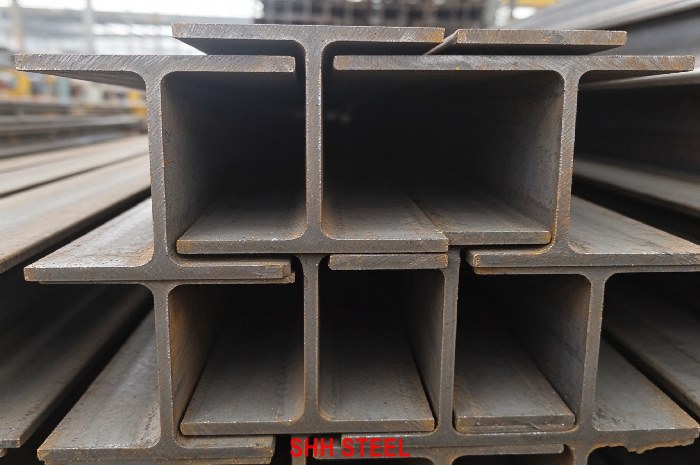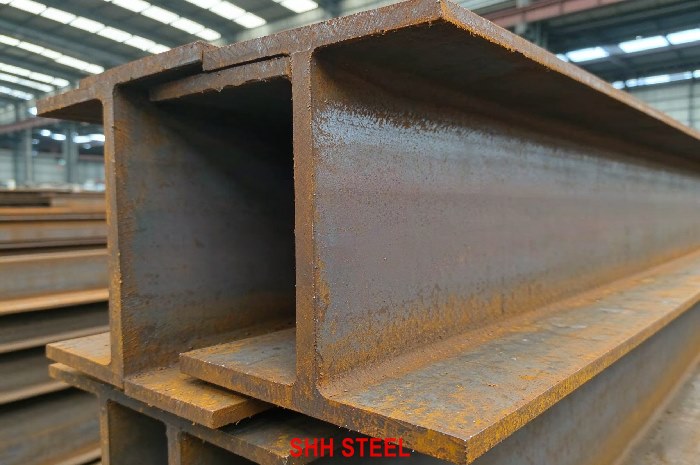
JIS G 3106 SM570 H-Beam
What is JIS G 3106 SM570 H-Beam?
JIS G 3106 SM570 H-beam is a hot-rolled Japanese H-section whose material grade is SM570 under JIS G 3106 and whose shape, mass and tolerances are ordered to JIS G 3192. SM stands for rolled steel for welded structure, and 570 is the nominal tensile-strength class (570–720 N/mm² in the tabulated thickness range). In the first thickness band the minimum yield or proof stress is 460 N/mm², and the grade carries a Charpy V-notch requirement of 47 J at −5 °C when impact testing applies.
This page covers the JIS G 3106 grade SM570 in H-section form, not plate and not SM490. The lower-strength sister is JIS G 3106 SM490 H-beam. Related Taiwan designations SM570MB and SM570MC are named only as related grades; they are not tabulated here.
These beams are filed under steel beam profiles in the steel structural profiles category. They are designated in millimetres, for example H 300×300×10×15. They are not GB/T 11263 HW, HM or HN sections, and they are not European HEA, HEB or IPE sections of a similar depth.
Material, Dimensions and Tolerances for SM570 Sections
The purchase order and the inspection document should name, separately:
- JIS G 3106 and its edition (this page uses the 2020 edition as the numeric basis; the edition named on the order governs), and the grade SM570;
- the JIS G 3192 H designation (H × B × t1 × t2);
- any agreed heat-treatment suffix (N, T, Q or TMC), and any agreed Ceq or PCM limit.
The default applicable thickness for SM570 sections is 100 mm or less, measured at t or t2 in JIS G 3192 as the standard directs. A plate-agreement thickness extension is not a default for H-beams.
SM570 H-Beam Sizes: JIS G 3192 Standard H-Sections
The table is the JIS G 3192 Table 15 standard H-section series already used on the SM490 H-beam page: 53 sizes, from H 100×50×5×7 to H 918×303×19×37. Rows marked * are the 20 sizes that Table 15 identifies as other than general-purpose. Constant outside-dimension H-sections and I-beams can be reviewed when they are named on the enquiry. Chinese HW, HM and HN names belong to GB/T 11263; European series belong to EN 10025-2 practice.
Not every mill rolls every designation in SM570. The order should name the sections actually required.
Swipe horizontally to view all dimensions.
SM570 Chemical Composition (Heat Analysis)
The figures below are heat-analysis maxima from JIS G 3106:2020 Table 2 for SM570 with thickness of 100 mm or less. Elements not listed, or listed without a limit, may be added as necessary and shall be reported when they are added. For these H-sections the relevant thickness is t or t2 at the test-piece location, ordinarily the flange t2.
SM570 Carbon Equivalent and Weld-Crack Sensitivity
Clause 7.1 of JIS G 3106:2020 publishes Ceq and PCM tables for SM570. The standard states that the carbon equivalent shall apply to quenched and tempered steel products. PCM may be used in place of Ceq by agreement. These limits are not a default as-rolled H-beam CEV, and they are not the TMCP plate tables in clause 7.2.
Ceq is calculated as C + Mn/6 + Si/24 + Ni/40 + Cr/5 + Mo/4 + V/14 from the heat analysis. PCM is calculated as C + Si/30 + Mn/20 + Cu/20 + Ni/60 + Cr/20 + Mo/15 + V/10 + 5B. If a Ceq or PCM limit is required on an as-rolled section order, it must be agreed and stated on the certificate.
SM570 Mechanical Properties: Yield, Tensile and −5 °C Impact
Table 7 of JIS G 3106:2020 gives the following values. Thickness is that at the location of the test pieces, ordinarily the flange t2 for these H-sections.
Elongation is as follows:
When impact testing applies (steel products of the Table 8 symbols with thickness over 12 mm), SM570 requires a mean Charpy V-notch result of 47 J at −5 °C, in the rolling direction. A lower test temperature may be agreed. This is not the 0 °C / 27 J test used for SM490B, and it is not a CNS 2947 SM570MB value.
Delivery Conditions, Inspection and Identification
SM570 may be supplied as-rolled, or with an agreed heat-treatment suffix such as Q or TMC. The inspection document should identify JIS G 3106 and its edition, the grade SM570 and any suffix, the JIS G 3192 designation, heat analysis, Ceq or PCM when they apply, and mechanical results including the −5 °C impact test when it is required, against the thickness at the test location. An SM490 certificate or a plate certificate does not, by itself, identify an SM570 H-beam.
Weldability of SM570 H-Beams
SM570 is specified as a highly weldable rolled steel for welded structures. Preheat and consumable choice should use the certified heat analysis, any agreed Ceq or PCM, the actual thickness and the joint design. Repair-by-welding rules for SM570 plates in the standard are a matter for agreement; they should not be assumed for an H-section enquiry.
JIS G 3192 Shape Tolerances and Theoretical Mass
Shape, mass and tolerances belong to the ordered edition of JIS G 3192. Mass in the size table is the published theoretical figure. Millimetre tolerance tables are not reproduced here. The tabulated dimensions are representative; other section sizes may be used by agreement.
Applications and Service Limits
SM570 H-beams are used in welded structures — bridges, industrial frames and similar work — where the 570 N/mm² tensile class and the −5 °C / 47 J impact quality are specified. They are not a silent substitute for SM490, for CNS 2947 SM570MB, or for a 355 MPa European or Chinese grade. A JIS H designation is not a GB/T 11263 or EN 10365 section of similar depth.
SM570 Compared with SM490, Q355B and S355JR
The comparisons below are an orientation only; they are not automatic substitutes.
Near-Equivalents: Not Automatic Substitutes
A near-equivalent is a starting point for a discussion, not a licence to swap certificates. JIS G 3106 SM490 H-beam is a different grade in the same standard. JIS G 3101 SS400 steel plate is a general-structure plate grade. If a project names SM570 or SM570MB, keep that name and the dimensional standard on the order.
Sourcing SM570 H-Beams from SHH STEEL
SHH STEEL supplies JIS G 3106 SM570 H-beams against a named designation list, the material edition, any heat-treatment suffix and the inspection document type. Enquiries should state the H × B × t1 × t2 designations, cut lengths or mill lengths, any processing, and whether JIS G 3106 SM490 H-beam is acceptable on part of the list.
The size table is the standard series, not a claim that every designation is rolled in every heat. Once the list is clear, a quotation can be prepared against the stated edition and certificate.
SM570 H-Beam FAQs
-
Is SM570 the same as SM490 or SM570MB?
- No. SM570 is a higher tensile class in JIS G 3106, with its own chemistry, yield table and a −5 °C / 47 J impact requirement. SM570MB is a CNS 2947 designation and is not tabulated on this page. An SM490 certificate is not an SM570 certificate.
-
Does the Ceq table apply to every SM570 H-beam?
- Clause 7.1 states that the carbon equivalent applies to quenched and tempered SM570. PCM may replace Ceq by agreement. Those tables are not a default as-rolled H-beam CEV. If a limit is required on an as-rolled section, it should be agreed and written on the order.
-
Which thickness is used for yield and impact?
- Thickness is that at the location of the test pieces, ordinarily the flange t2 for these H-sections. The default applicable thickness for SM570 sections is 100 mm or less. Impact testing, when it applies, is written for thickness over 12 mm.
-
Which edition of JIS G 3106 is used on this page?
- The numeric tables use JIS G 3106:2020. A later edition may be named on the order; the ordered edition governs.
Request a Quotation for JIS G 3106 SM570 H-Beam
JIS G 3106 SM570 H-beam is a welded-structure H-section with 460 N/mm² minimum yield in the first thickness band and a 47 J impact requirement at −5 °C when testing applies. Nominate the JIS G 3192 designation (for example H 300×300×10×15), JIS G 3106:2020 or the edition on the order, any heat-treatment suffix, and the inspection document type. Send the size list, edition, certificate type and any processing notes; SHH STEEL will review the package and quote accordingly.
Quality Steel Needed? Inquire for Offers