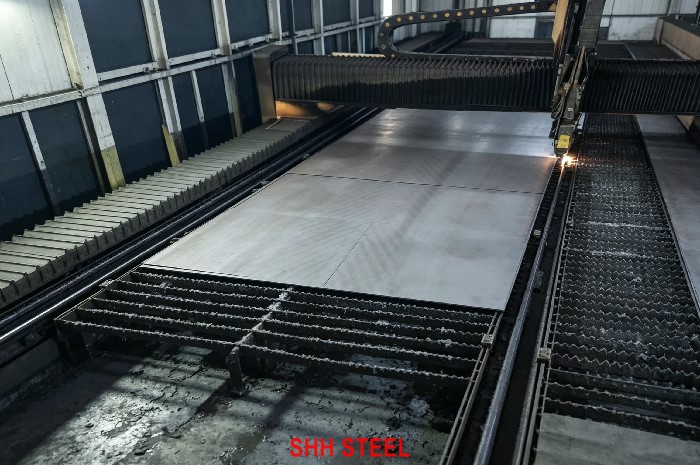
GB/T 700 Q235D Steel Plate
What is GB/T 700 Q235D Steel Plate?
GB/T 700 Q235D Steel Plate is a carbon structural steel under GB/T 700, Carbon structural steels. Figures on this page follow Table 1 (heat analysis), Table 2 (tensile, elongation and impact) and Table 3 (cold bending) of GB/T 700-2006. That edition is the current final listing. A later replacement plan is in approval and is not used here as the acceptance table. The formal grade-and-quality set is Q195, Q215A, Q215B, Q235A, Q235B, Q235C, Q235D, Q275A, Q275B, Q275C and Q275D. This page is Q235D. Deoxidation symbols F, Z and TZ, and the hot-rolled, controlled-rolled or normalized delivery states, are not extra grades.
The name begins with Q for yield strength. The number is the yield class in N/mm² (1 N/mm² = 1 MPa). Quality D is a formal designation and is not interchangeable with the other qualities of the Q235 strength class. The standard covers hot-rolled steel sheets, strips, sections and bars for welded, riveted or bolted structures. This article is written for plate supply.
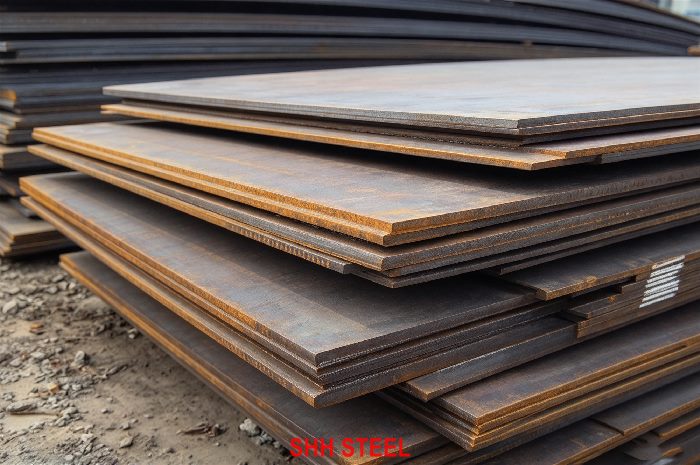
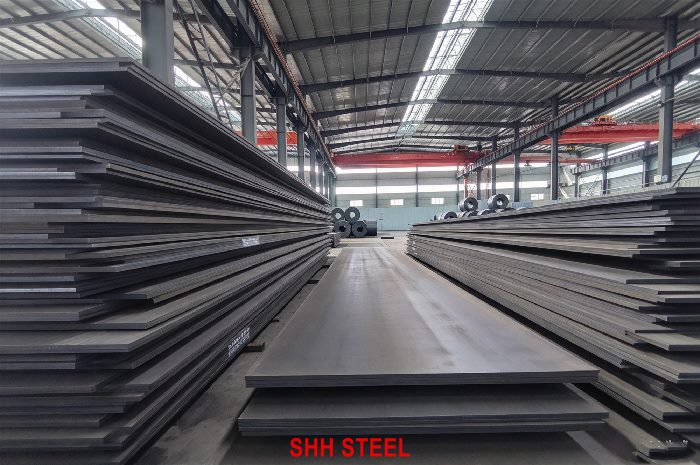
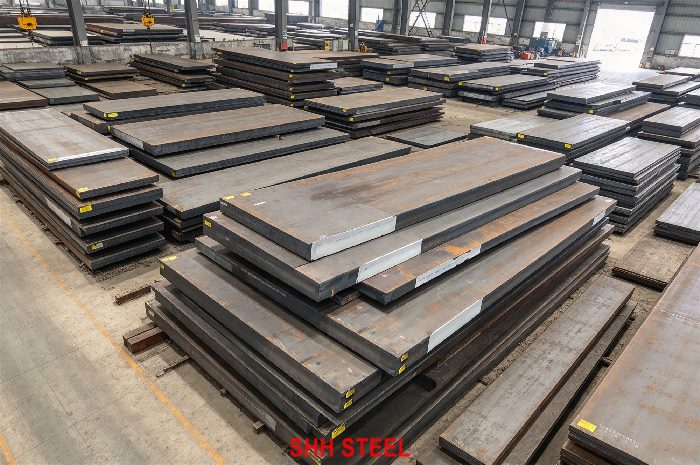
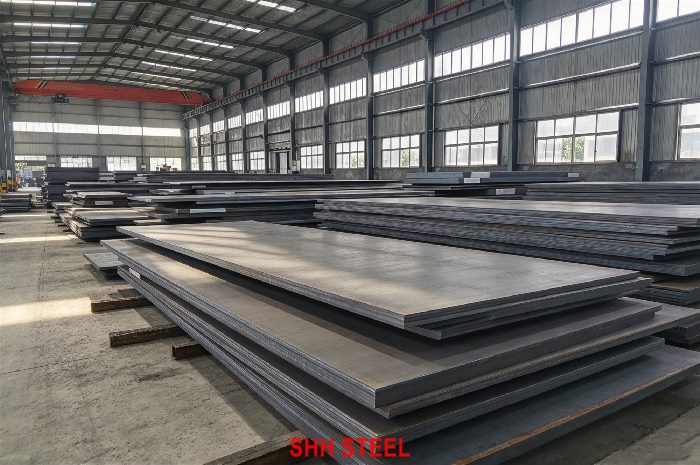
SHH STEEL produces and exports GB/T 700 Q235D Steel Plate to the ordered thickness, tests and documentation. A related published range is Structural Steel Plates.
Material specification for GB/T 700 Q235D Steel Plate
The items below follow GB/T 700-2006. Thickness, width, length and the inspection document are stated on the enquiry rather than listed here as stock or capacity ranges.
| Parameter | Detail |
|---|---|
| Standard | GB/T 700, Carbon structural steels. Technical tables: GB/T 700-2006 (current final edition). A replacement plan in approval is not used here as the acceptance table |
| Designation | Q235D. Quality D. The number is the yield class in N/mm², not a tensile class |
| Formal set | Eleven grade-and-quality designations: Q195, Q215A, Q215B, Q235A, Q235B, Q235C, Q235D, Q275A, Q275B, Q275C and Q275D. This page is Q235D. F, Z and TZ are deoxidation methods, not extra product pages |
| Product form | Hot-rolled steel sheets, strips, sections and bars. This page is written for plate |
| Delivery condition | Generally hot-rolled, controlled-rolled or normalized (clause 5.3) |
| Chemistry basis | Table 1 heat analysis (smelting analysis). Product-analysis deviations follow GB/T 222-2006 Table 1 and are not reprinted here. Rimmed-steel product-analysis deviations are not guaranteed |
| Mechanical basis | Table 2 for tensile, elongation and impact; Table 3 for the 180° cold-bending test |
| Sampling direction | Clause 5.4.3: steel sheets and strips use transverse tensile and bend specimens (elongation may be 2 % lower, absolute, than Table 2); sections and bars use longitudinal specimens |
| Our supply | We produce and export Q235D as steel plate to the thickness, tests and documentation agreed on the order |
Chemical composition of GB/T 700 Q235D Steel Plate
The heat analysis shall comply with Table 1 of GB/T 700-2006. The row below is the Q235D heat-analysis row of that table. Values are maxima, mass %.
| Element | Q235D heat analysis, GB/T 700-2006 Table 1 |
|---|---|
| C | 0.17 max. |
| Si | 0.35 max. |
| Mn | 1.40 max. |
| P | 0.035 max. |
| S | 0.035 max. |
| Deoxidation method | TZ (the TZ symbol may be omitted from the designation). Z and TZ may be omitted from the designation and are not separate grades |
Residual chromium, nickel and copper shall each be 0.30 % max., and nitrogen 0.008 % max., unless the supplier can guarantee those contents without analysis (5.1.1.2). Arsenic shall be 0.080 % max. (5.1.1.3). With the purchaser’s consent, copper in quality-A steel may be 0.35 % max. and must then be reported (5.1.1.2.2).
Quality D shall contain sufficient grain-refining elements, and those contents shall be stated on the quality certificate. When the steel is aluminium-deoxidized, acid-soluble aluminium shall be at least 0.015 %, or total aluminium at least 0.020 % (5.1.1.1).
This page does not invent product-analysis deviation numbers from GB/T 222.
Mechanical properties and thickness limits
Under clause 5.4.1 of GB/T 700-2006, tensile and impact results shall comply with Table 2 and the bending result shall comply with Table 3. The figures below are the Q235D rows of those tables. Values are in N/mm²; 1 N/mm² = 1 MPa. Q235D is not an automatic substitute for another quality of the Q235 strength class.
| Property, Table 2 of GB/T 700-2006 (Q235D) | Q235D |
|---|---|
| Yield strength ReH, 16 mm or less | 235 N/mm² min. |
| Yield strength ReH, over 16 mm up to 40 mm | 225 N/mm² min. |
| Yield strength ReH, over 40 mm up to 60 mm | 215 N/mm² min. |
| Yield strength ReH, over 60 mm up to 100 mm | 215 N/mm² min. |
| Yield strength ReH, over 100 mm up to 150 mm | 195 N/mm² min. |
| Yield strength ReH, over 150 mm up to 200 mm | 185 N/mm² min. |
| Tensile strength Rm | 370–500 N/mm² |
| Elongation after fracture A, Table 2, 40 mm or less | 26 % min. |
| Elongation A for steel sheets and strips (transverse), 40 mm or less | 24 % min. (Table 2 value minus the 2 % absolute allowance in 5.4.3) |
| Elongation after fracture A, Table 2, over 40 mm up to 60 mm | 25 % min. |
| Elongation A for steel sheets and strips (transverse), over 40 mm up to 60 mm | 23 % min. (Table 2 value minus the 2 % absolute allowance in 5.4.3) |
| Elongation after fracture A, Table 2, over 60 mm up to 100 mm | 24 % min. |
| Elongation A for steel sheets and strips (transverse), over 60 mm up to 100 mm | 22 % min. (Table 2 value minus the 2 % absolute allowance in 5.4.3) |
| Elongation after fracture A, Table 2, over 100 mm up to 150 mm | 22 % min. |
| Elongation A for steel sheets and strips (transverse), over 100 mm up to 150 mm | 20 % min. (Table 2 value minus the 2 % absolute allowance in 5.4.3) |
| Elongation after fracture A, Table 2, over 150 mm up to 200 mm | 21 % min. |
| Elongation A for steel sheets and strips (transverse), over 150 mm up to 200 mm | 19 % min. (Table 2 value minus the 2 % absolute allowance in 5.4.3) |
| Charpy V-notch impact temperature | −20 °C |
| Charpy V-notch absorbed energy (longitudinal) | 27 J min. |
Table 2 note b: for thickness greater than 100 mm, the lower limit of tensile strength may be reduced by 20 N/mm². The upper tensile limit of wide strip, including sheared plate, is not a delivery term.
Impact testing is required for thickness not less than 12 mm or diameter not less than 16 mm, using a 10 mm × 10 mm × 55 mm specimen (5.4.5). By agreement, thickness 6 mm to 12 mm or diameter 12 mm to 16 mm may be tested on a 10 mm × 7.5 mm × 55 mm, 10 mm × 5 mm × 55 mm, or 10 mm × product-thickness × 55 mm specimen. Annex A Figure A.1 gives the minimum energy for 5 mm to 10 mm wide specimens; 5.4.5 states that a 10 mm × 5 mm × 55 mm specimen shall reach at least 50 % of the specified value. The impact specimen axis is parallel to the rolling direction (6.3).
The reported energy is the arithmetic mean of three specimens. One single value may fall below the specified minimum but not below 70 % of that minimum. If that rule is not met, three further specimens are taken from the same product; the mean of all six shall meet the specified minimum, not more than two singles may fall below it, and only one of those may fall below 70 % (5.4.6).
| Cold-bending test, Table 3 of GB/T 700-2006 (180°, B = 2a) | Q235 |
|---|---|
| Longitudinal, thickness or diameter 60 mm or less | bending diameter d = a |
| Transverse, thickness or diameter 60 mm or less | bending diameter d = 1.5a |
| Longitudinal, over 60 mm up to 100 mm | bending diameter d = 2a |
| Transverse, over 60 mm up to 100 mm | bending diameter d = 2.5a |
In Table 3, B is the specimen width and a is the specimen thickness or diameter. For thickness or diameter greater than 100 mm, the bend test is agreed by the parties (Table 3 note b). Steel sheets and strips take transverse bend specimens; sections and bars take longitudinal specimens (5.4.3). The bend inspection may be omitted if the supplier can guarantee Table 3. If quality-A steel passes the cold-bending test, the upper tensile limit may be omitted as a delivery term (5.4.4).
Delivery conditions for GB/T 700 Q235D Steel Plate
GB/T 700-2006 clause 5.3 says the steels are generally delivered in the hot-rolled, controlled-rolled or normalized state:
- Name the required state on the order if one of those three must be fixed.
- Do not treat quenching and tempering, or a pressure-vessel normalizing cycle, as the automatic delivery condition of this grade.
- Deoxidation may be TZ (the TZ symbol may be omitted from the designation). F, Z and TZ are methods, not extra grades. Z and TZ may be omitted from the designation.
We produce and export Q235D as hot-rolled steel plate to the ordered condition.
Welding and fabrication
GB/T 700 does not prescribe preheat temperatures, heat-input limits or a carbon-equivalent maximum for Q235D. This page does not invent a welding procedure or a calculated CEV. The Table 1 carbon maximum for this designation is 0.17 %.
Building-structure names such as Q235GJB under GB/T 19879, and weathering names such as Q235NH under GB/T 4171, are written to other standards. They are not automatic substitutes for Q235D.
Form, finish and dimensions
Dimensions, shape, weight and permissible deviations of steel sheets, strips, sections and bars follow the corresponding product standards named by GB/T 700 clause 4. This page does not reprint those tolerance tables and does not list stock sizes or mill-capacity ranges.
We produce and export Q235D to the dimensions and surface requirements agreed on the enquiry.
Applications and specification limits
Q235D is specified for general welded, riveted or bolted structural parts that name GB/T 700 and this designation. Allowable design stresses and any further toughness rule come from the construction code or the purchaser specification.
Table 3 requires a 180° cold-bending test with B = 2a. For plate, use the transverse bending diameter 1.5a at 60 mm thickness or less and 2.5a over 60 mm up to 100 mm.
This page is not ASTM A36 plate, not EN 10025-2 S235JR or S275JR plate, and not another GB/T 700 quality of the same strength class.
Compare GB/T 700 Q235D Steel Plate with other steel products
GB/T 700 Q235D Steel Plate is a GB/T 700-2006 carbon structural steel identified by its yield class and quality. The comparison uses three products we already publish. They are related by engineering use or similar names, not equivalents. Unpublished GB/T 700 sibling designations are not linked here.
| Material | Alloy / type | Delivery condition | Mechanical requirements | Typical service | Substitution limit |
|---|---|---|---|---|---|
| GB/T 700 Q235D Steel Plate (this product) | GB/T 700 Q235D; heat analysis to Table 1; Quality D | Generally hot-rolled, controlled-rolled or normalized | Table 2: tensile 370–500 N/mm²; yield 235 N/mm² min. at 16 mm or less; Charpy 27 J min. at −20 °C | General structural plate specified to GB/T 700 Q235D | Not interchangeable with A36, S235JR, S275JR or another GB/T 700 quality unless the project specification allows it |
| ASTM A36 Steel Plate | From our A36 page: A36 carbon structural steel plate | From our A36 page: carbon structural steel plate | From our A36 page: min yield 250 MPa | From our A36 page: construction, bridges and general fabrication | Not an equivalent. A36 is identified by a yield minimum on that page; Q235D is ordered to GB/T 700 and to this quality |
| EN 10025-2 S235JR Steel Plate | From our S235JR page: EN 10025-2 non-alloy structural steel | From our S235JR page: non-alloy structural steel | From our S235JR page: 235 MPa yield strength | Structural plate specified to EN 10025-2 S235JR | Not an equivalent. A 235 N/mm² yield class does not make Q235D the same as S235JR |
| EN 10025-2 S275JR Steel Plate | From our S275JR page: EN 10025-2 non-alloy structural steel | From our S275JR page: non-alloy structural steel | From our S275JR page: 275 MPa yield strength | Structural plate specified to EN 10025-2 S275JR | Not an equivalent. A similar yield band on one thickness does not make the two stamps interchangeable |
A related published range: Structural Steel Plates.
Equivalent and related grades by country
The designations below are near names or related national plates, not certified or automatic equivalents. Chemistry, quality, thickness, delivery condition, bend rules and the required stamp must match the project specification before a substitution is considered. Unpublished GB/T 700 siblings are named as plain text only.
| Country / region | Standard | Grade | Similarity and key differences | Substitution caveat |
|---|---|---|---|---|
| China | GB/T 700-2006 | Q235D | This carbon structural steel. The formal list is Q195, Q215A, Q215B, Q235A, Q235B, Q235C, Q235D, Q275A, Q275B, Q275C and Q275D. Qualities A, B, C and D are distinct where Table 1 lists them. | Specify GB/T 700, this named designation, product form, thickness and the required quality letter. |
| China | GB/T 19879 | Q235GJB and other GJ names | Building structural steels, not GB/T 700 carbon structural steels. This site already publishes Q235GJB, Q235GJC, Q235GJD and Q235GJE pages under that other standard. | Do not treat a Q235GJ name as an automatic GB/T 700 Q235D match. |
| China | GB/T 4171 | Q235NH or Q235GNH | Weathering steels, not GB/T 700. This site already publishes those names under GB/T 4171. | Do not treat a weathering Q235 name as an automatic Q235D match. |
| Europe | EN 10025-2 | S235JR or S275JR | From our live pages: S235JR has a 235 MPa yield; S275JR has a 275 MPa yield. | Not an automatic equivalent. See EN 10025-2 S235JR Steel Plate and EN 10025-2 S275JR Steel Plate. |
| United States | ASTM A36/A36M | A36 | From our A36 page: min yield 250 MPa, used in construction, bridges and general fabrication. | Not an automatic equivalent. See ASTM A36 Steel Plate. |
Why choose SHH STEEL for GB/T 700 Q235D Steel Plate
- We produce and export GB/T 700 Q235D steel plate
- We review the enquiry for edition, designation, quality and thickness
- We keep Q235D distinct from the other GB/T 700 qualities and from Q235GJ or Q235NH names
- We do not copy another quality’s Charpy temperature or carbon maximum onto this designation
- We match documentation to what the purchase order requires
How to enquire for GB/T 700 Q235D Steel Plate
| Item | What to specify |
|---|---|
| Standard and designation | GB/T 700, Q235D. Name the edition required by the project. Figures on this page follow GB/T 700-2006 Table 1, Table 2 and Table 3 |
| Quality | Quality D. Do not treat another quality of Q235 as the same order |
| Product form | Plate, strip, section or bar. State which form is required. Plate uses transverse tensile and bend specimens |
| Thickness and dimensions | Thickness, width and length |
| Delivery condition | Generally hot-rolled, controlled-rolled or normalized. Name the required state if it must be fixed |
| Chemistry | Table 1 heat analysis, including the Q235D carbon maximum of 0.17 % |
| Mechanical tests | Table 2 tension and the −20 °C Charpy test, and Table 3 bending unless the supplier guarantee in 5.4.4 is accepted |
| Documentation | State the inspection document and any quality-A optional reporting if they differ from the default |
| Processing | Cutting or other processing only when requested |
FAQ
-
How many formal GB/T 700 designations are there?
- GB/T 700-2006 Table 1 and Table 2 list eleven grade-and-quality designations: Q195, Q215A, Q215B, Q235A, Q235B, Q235C, Q235D, Q275A, Q275B, Q275C and Q275D. This page is Q235D. F, Z and TZ, and the delivery states, are not extra grades.
-
Is GB/T 700 Q235D the same as the other qualities of this strength class?
- No. Q235D is quality D of the Q235 strength class. Carbon, phosphorus, sulfur, deoxidation and Charpy rules differ by quality. Do not treat Q235A as Q235B, or any other pair, as automatic equivalents.
-
Does GB/T 700 Q235D require a Charpy test?
- Yes, for this quality. Table 2 specifies 27 J minimum at −20 °C on a longitudinal V-notch specimen. The full-size piece is 10 mm × 10 mm × 55 mm for thickness not less than 12 mm (5.4.5).
-
Is GB/T 700 Q235D the same as Q235GJB, S235JR or ASTM A36?
- No. Those names are not automatic equivalents. Q235GJB is a GB/T 19879 building steel. From our S235JR page: 235 MPa yield strength. From our S275JR page: 275 MPa yield strength. From our A36 page: min yield 250 MPa. Q235D is ordered to GB/T 700-2006.
-
What should a quotation enquiry include?
- GB/T 700 and Q235D, the required edition, product form, thickness by width by length, quantity, delivery state if it must be fixed, whether the bend test must be performed, and the inspection document.
Request a quotation
Contact SHH STEEL for a quotation for GB/T 700 Q235D steel plate. Please include your required quantity, thickness, width and length, delivery destination and preferred delivery schedule so we can review your production and export requirements.
Specify GB/T 700, Q235D, and the edition required by the project. Figures on this page follow GB/T 700-2006 Table 1, Table 2 and Table 3. The designation is a yield class with quality d.
If your enquiry compares Q235D with ASTM A36, EN 10025-2 S235JR or EN 10025-2 S275JR, identify each product clearly. We will review the differences in standard, quality, yield-by-thickness rules and chemistry rather than assume that similar names are interchangeable.
For a detailed quotation, email your material specification, quantity and delivery requirements to our team.
Contact: admin@steelspecs.com
Quality Steel Needed? Inquire for Offers
Related Products