

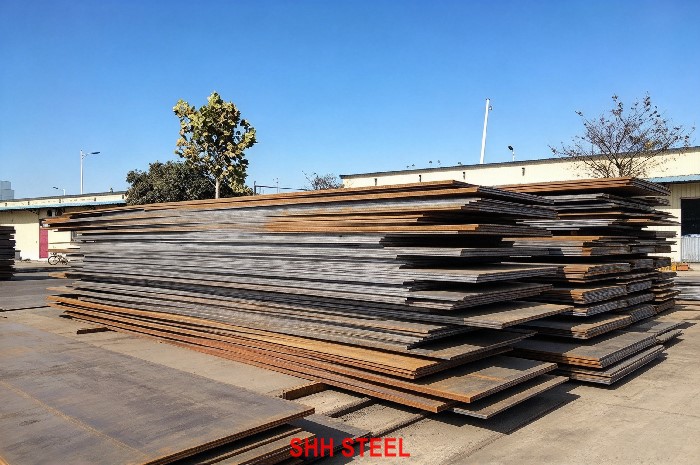
ASTM A353 9% Nickel Steel Plate
What is ASTM A353 9% nickel steel plate?
ASTM A353 is double-normalized and tempered 9% nickel alloy steel plate to ASTM A353/A353M-17(2022). The official title is Standard Specification for Pressure Vessel Plates, Alloy Steel, Double-Normalized and Tempered 9% Nickel. There is no Grade, Type or Class split inside this specification: the specification itself is the 9% nickel double-normalized and tempered plate.
The plates are intended particularly for welded pressure vessels for cryogenic service. Heat and product analysis, tensile testing and impact testing are part of the specification. This page does not claim Code stamping or dual ASTM plus ASME compliance unless those items are written on the order and met by the documents.
SHH STEEL produces and exports ASTM A353/A353M-17(2022) 9% nickel steel plate to the ordered edition, heat treatment, dimensions and extra tests written on the enquiry. This plate belongs to our Boiler & Pressure Vessel Steel Plates range under ASTM A353.
Material specification for ASTM A353
The items below follow ASTM A353/A353M-17(2022) and its reference to ASTM A20/A20M. Thickness, width, length and the inspection document are stated on the enquiry rather than listed here as stock or capacity ranges.
| Parameter | Detail |
|---|---|
| Standard | ASTM A353/A353M-17(2022), Standard Specification for Pressure Vessel Plates, Alloy Steel, Double-Normalized and Tempered 9% Nickel |
| Designation system | No grade, type or class. The specification itself is the 9% nickel double-normalized and tempered plate |
| Product form | Pressure-vessel steel plate |
| General requirements | ASTM A20/A20M; where this specification conflicts with A20/A20M, A353/A353M prevails |
| Steelmaking | Killed steel; fine austenitic grain size to A20/A20M |
| Chemical analysis | Heat and product analysis to Table 1 (carbon, manganese, phosphorus, sulfur, silicon and nickel) |
| Delivery condition | Double-normalized and tempered to clause 5.2 |
| Thickness | Maximum thickness is limited only by the capacity of the material to meet the specified mechanical property requirements |
| Impact testing | Mandatory Charpy V-notch at −320 °F [−195 °C] unless another temperature is agreed; lateral expansion not less than 0.015 in. [0.381 mm] |
| Units | Inch-pound and SI values are separate standards; do not combine the two systems |
| Magnetization | The material is susceptible to magnetization; the specification warns against using magnets in handling after heat treatment if residual magnetism would be detrimental |
| Supplementary requirements | Optional unless specified on the order, including A20/A20M items such as vacuum treatment, extra product analysis, drop-weight, ultrasonic examination, vacuum carbon-deoxidized steel, and A353 S55/S56 energy-absorption tests |
| Our supply | We produce and export ASTM A353 9% nickel plate to the ordered edition, heat treatment, dimensions and extra tests |
Chemical composition of ASTM A353 9% nickel plate
ASTM A353/A353M-17(2022) requires the steel to conform to Table 1. Carbon, phosphorus and sulfur limits apply to both heat and product analyses. Manganese, silicon and nickel have separate heat-analysis and product-analysis limits. The ASTM store abstract states that plates undergo heat and product analysis. These figures are the specification Table 1 values, not a manufacturer extra guarantee and not an SHH STEEL proprietary chemistry.
| Element | Heat analysis (wt. %) | Product analysis (wt. %) |
|---|---|---|
| Carbon (C), max | 0.13 | 0.13 |
| Manganese (Mn), max | 0.90 | 0.98 |
| Phosphorus (P), max | 0.015 | 0.015 |
| Sulfur (S), max | 0.015 | 0.015 |
| Silicon (Si) | 0.15–0.40 | 0.13–0.45 |
| Nickel (Ni) | 8.50–9.50 | 8.40–9.60 |
The specified silicon minimum does not apply if total aluminum is 0.030% or more, or if acid-soluble aluminum is 0.025% or more. Table 1 chemistry may be modified only in accordance with Supplementary Requirement S17, Vacuum Carbon-Deoxidized Steel, in ASTM A20/A20M, when that supplementary requirement is invoked.
Tensile and impact requirements for ASTM A353
ASTM A353/A353M-17(2022) Table 2 and clause 7.2 set the tensile and impact requirements below. Yield strength may, by agreement, be determined by the extension-under-load method using 0.005 in./in. [0.005 mm/mm] total extension. For nominal thicknesses of 3/4 in. [20 mm] and under, a 1 1/2 in. [40 mm] wide rectangular tension specimen may be used, with elongation measured in a 2 in. [50 mm] gage length that includes the fracture. One tension test shall be taken from each plate as heat treated.
| Property | Requirement |
|---|---|
| Tensile strength | 100–120 ksi [690–825 MPa] |
| Yield strength (0.2% offset), min | 75 ksi [515 MPa] |
| Elongation in 2 in. [50 mm], min | 20.0% (see A20/A20M for elongation adjustment) |
| Impact test method | Charpy V-notch to A20/A20M |
| Specimen orientation | Longitudinal axis of the specimen transverse to the final rolling direction |
| Default test temperature | −320 °F [−195 °C], unless otherwise agreed |
| Mandatory acceptance | Each specimen: lateral expansion opposite the notch not less than 0.015 in. [0.381 mm] |
Optional Supplementary Requirements S55 and S56 add energy-absorption minima (longitudinal 25 ft·lbf [34 J]; transverse 20 ft·lbf [27 J] at the specified temperature, with the stated individual-specimen floor values). Those energy figures apply only when S55 or S56 is ordered. They are not the default mandatory impact criterion.
Heat treatment for ASTM A353 plate
All plates shall be heat treated to the double-normalize-and-temper cycle in the specification. Shell plates and other parts that are heated for forming, including heads and reinforcing pads, shall be heat treated after forming to the same cycle.
- First normalizing: heat to a uniform temperature of 1650 ± 25 °F [900 ± 15 °C], hold at least 1 h/in. [2.4 min/mm] of thickness and not less than 15 min, and cool in air.
- Second normalizing: reheat to a uniform temperature of 1450 ± 25 °F [790 ± 15 °C], hold at least 1 h/in. [2.4 min/mm] of thickness and not less than 15 min, and cool in air.
- Tempering: reheat to a uniform temperature in the range 1050–1125 °F [565–605 °C], hold at least 1 h/in. [2.4 min/mm] of thickness and not less than 15 min, then cool in air or water quench at a rate not less than 300 °F/h [165 °C/h].
If hot forming is performed after heating in the range 1650–1750 °F [900–955 °C], the first normalizing treatment may be omitted. When the fabricator heat-treats the plates, the fabricator is responsible for applying the proper heat treatment and for tests needed to show that the specified properties are attained. This page does not offer heat-treatment or fabrication services.
Double-normalized and tempered: 1650 ± 25 °F [900 ± 15 °C] air cool; then 1450 ± 25 °F [790 ± 15 °C] air cool; temper 1050–1125 °F [565–605 °C], then air cool or water quench at not less than 300 °F/h [165 °C/h]. Hold each stage at least 1 h/in. [2.4 min/mm] of thickness, and not less than 15 min.
Welding and handling notes
The specification covers plates intended particularly for welded pressure vessels for cryogenic service. Welding procedures, consumables and any post-weld heat treatment belong to the project specification and the fabricator. This page does not offer fabrication, welding procedure qualification or certification services.
After heat treatment the steel can become magnetized. The specification warns against using magnets in handling if residual magnetism would harm later fabrication or service. Residual-magnetism limits, if required, should be written on the enquiry.
General requirements, marking and dimensions
Material supplied to ASTM A353/A353M shall conform to ASTM A20/A20M for testing and retesting methods, permitted variations in dimensions and mass, quality and repair of defects, marking, loading and ordering information, except where A353/A353M prevails in a conflict. Numeric thickness, width, length and flatness tolerances are those of the ordered A20/A20M edition and the mill documents, not a stock list on this page. Plates shall be descaled by the producer after heat treatment; if the purchaser will heat-treat the plates, they shall be descaled by the producer before shipment.
Applications and specification limits
We produce and export this plate for projects that specify ASTM A353/A353M 9% nickel double-normalized and tempered plate. The specification itself names welded pressure vessels for cryogenic service as the intended use. Project design temperatures, Code of construction and any extra toughness package must be written on the order.
ASTM A353 is not ASTM A553, and it is not an EN 10028-4 or GB/T 713.4 designation. Related 9% nickel plates are compared below; they are not automatic substitutes.
Compare ASTM A353 with related nickel steel plates
ASTM A353 is 9% nickel plate delivered double-normalized and tempered. ASTM A553 Type I is the related 9% nickel plate delivered water-quenched and tempered. They are not the same specification and they do not share the same minimum yield strength. The European and Chinese 9% nickel plates below are near, not identical. Figures marked from our page come from those live product pages.
| Material | Alloy / type | Delivery condition | Mechanical requirements | Typical service | Substitution limit |
|---|---|---|---|---|---|
| ASTM A353 9% nickel (this plate) | 9% nickel pressure-vessel plate; no grade, type or class split in A353/A353M | Double-normalized and tempered to the temperatures above | Tensile 100–120 ksi [690–825 MPa]; yield (0.2% offset) 75 ksi [515 MPa] min; elongation in 2 in. [50 mm] 20.0% min (A20/A20M elongation adjustment may apply). Mandatory impact: Charpy V-notch, specimen axis transverse to final rolling, −320 °F [−195 °C] unless agreed otherwise; each specimen lateral expansion opposite the notch not less than 0.015 in. [0.381 mm]. | Welded pressure vessels for cryogenic service, as written in the A353 scope | Do not treat it as quenched-and-tempered A553 Type I plate, and do not treat an ASME SA-353 Code order as automatically filled by an ASTM-only mark |
| ASTM A553 Type I (related 9% nickel plate; separate product page) | Nominal 9% nickel; official split is Type, not Grade or Class | Water quenched and tempered (optional intermediate treatment marked QTT) | Same tensile range 100–120 ksi [690–825 MPa], but yield 85 ksi [585 MPa] min (A553/A553M-17 Table 2 as reproduced in ASME SA-553). Default impact −320 °F [−195 °C], same lateral-expansion floor of 0.015 in. [0.381 mm] | Welded pressure vessels; Type I is the 9% nickel quenched-and-tempered route | Related nickel level, different heat-treatment path and a higher specified minimum yield. Not an automatic substitute for A353 |
| EN 10028-4 X8Ni9 | European 9% nickel grade, steel number 1.5662 | Usually quenched and tempered on our X8Ni9 page | From our live X8Ni9 page: steel number 1.5662; nickel about 8.50–9.50% (the 8 in X8Ni9 is not 8% nickel); delivery usually quenched and tempered; yield in the 490 MPa class after QT; tensile 640–840 MPa; Charpy specified at −196 °C when the order follows that grade. | 9Ni cryogenic vessel plate under EN 10028-4 | Near equivalent only. X8Ni9 is not 8% nickel. EN impact temperature, tensile window and delivery rules differ from A353 |
| EN 10028-4 X7Ni9 | European 9% nickel sister grade, steel number 1.5663 | Usually quenched and tempered on our X7Ni9 page | From our live X7Ni9 page: steel number 1.5663; nickel about 8.50–9.50%; tighter carbon band than X8Ni9; usually QT; yield in the 490 MPa class after QT; tensile 640–840 MPa. | 9Ni cryogenic vessel plate under EN 10028-4 | Near equivalent only. Tighter carbon than X8Ni9; still not an A353 double-normalize specification |
| EN 10028-4 X10Ni9 | Third EN 10028-4 9% nickel name, steel number 1.5665 | Usually quenched and tempered on our X10Ni9 page | From our live X10Ni9 page: steel number 1.5665; nickel about 8.50–9.50%; usually QT; yield in the 490 MPa class after QT; tensile 640–840 MPa. | 9Ni cryogenic vessel plate under EN 10028-4 | Near equivalent only. Do not treat the three EN 9Ni names as interchangeable with A353 or with each other without checking the ordered EN grade |
| GB/T 713.4-2023 06Ni9DR | Chinese 9% nickel low-temperature vessel plate | Quenched and tempered or double-quenched and tempered on our 06Ni9DR page | From our live 06Ni9DR page: current rules in GB/T 713.4-2023 (this name left GB/T 24510-2017 and GB/T 3531-2014); nickel 8.50–10.00%; yield 560 MPa at 5–30 mm; tensile 680–820 MPa; delivery quenched and tempered or double-quenched and tempered; impact −196 °C; lateral expansion not less than 0.64 mm. | 9Ni low-temperature pressure-vessel plate under GB/T 713.4-2023 | Near equivalent only. Nickel window, yield, impact temperature (−196 °C vs −195 °C) and lateral-expansion floor (0.64 mm vs 0.381 mm) differ from A353 |
Related published ranges: EN 10028-4 and GB/T 713.4-2023.
Equivalent and related grades by country
The designations below are near equivalents or related nickel pressure-vessel plates, not certified or automatic equivalents. Chemistry windows, heat treatment, impact temperature and documentation must match the project specification before a substitution is considered. Grades without a live page on this site are shown as plain text.
| Country / region | Standard | Grade or designation | Similarity and key differences | Substitution caveat |
|---|---|---|---|---|
| United States | ASTM A353/A353M-17(2022) | 9% nickel plate (no Type or Class) | This plate specification. Double-normalized and tempered 9% nickel steel plate for welded cryogenic pressure vessels. | This product |
| United States | ASME SA-353/SA-353M (BPVC Section II, Part A) | SA-353 / SA-353M | ASME BPVC.II.A-2023 marks SA-353/SA-353M identical with ASTM A353/A353M-17. The current ASTM publication is the 2017 text reapproved in 2022. Table values compared in this research match, but the edition identifiers are not the same wording. | Not an automatic dual stamp. A Code order should name the Section II edition and the SA designation. No dedicated ASME product page should be assumed live at the moment this ASTM page is first published. |
| United States | ASTM A553/A553M and ASME SA-553/SA-553M | Type I (nominal 9% nickel) | Same nominal nickel level and the same default −320 °F [−195 °C] impact temperature, but water quenched and tempered, with a higher specified minimum yield (85 ksi [585 MPa] vs 75 ksi [515 MPa]). | Related, not interchangeable. Type I is a Type designation, not a Grade or Class. |
| Europe | EN 10028-4 | X8Ni9 (1.5662), X7Ni9 (1.5663), X10Ni9 (1.5665) | From our live X8Ni9 page: steel number 1.5662; nickel about 8.50–9.50% (the 8 in X8Ni9 is not 8% nickel); delivery usually quenched and tempered; yield in the 490 MPa class after QT; tensile 640–840 MPa; Charpy specified at −196 °C when the order follows that grade. From our live X7Ni9 page: steel number 1.5663; nickel about 8.50–9.50%; tighter carbon band than X8Ni9; usually QT; yield in the 490 MPa class after QT; tensile 640–840 MPa. From our live X10Ni9 page: steel number 1.5665; nickel about 8.50–9.50%; usually QT; yield in the 490 MPa class after QT; tensile 640–840 MPa. | Near equivalents only. Do not interpret X8Ni9 as 8% nickel. EN and ASTM specifications, delivery conditions and impact rules differ. |
| China | GB/T 713.4-2023 | 06Ni9DR | From our live 06Ni9DR page: current rules in GB/T 713.4-2023 (this name left GB/T 24510-2017 and GB/T 3531-2014); nickel 8.50–10.00%; yield 560 MPa at 5–30 mm; tensile 680–820 MPa; delivery quenched and tempered or double-quenched and tempered; impact −196 °C; lateral expansion not less than 0.64 mm. | Near equivalent only. Confirm the GB/T 713.4 edition and the ordered delivery and impact package. |
| Japan | JIS G3127 | 9% nickel pressure-vessel plate (SL9N590 is cited on our 06Ni9DR page) | JIS G3127 is the Japanese nickel steel plate specification for pressure vessels for low-temperature service. A complete official JIS grade list is not restated here; dedicated JIS G3127 product pages are not published on this site yet. | Near equivalent only. Do not treat a JIS mark as an ASTM A353 stamp. |
| Unified numbering | UNS | K81340 | A chemistry-family number commonly used for 9% nickel steel. UNS K81340 is not itself a plate specification. | Do not order plate by the UNS number alone. |
Why choose SHH STEEL for ASTM A353 plate
- We produce and export ASTM A353/A353M-17(2022) 9% nickel steel plate
- We review the enquiry for the named standard edition, type or designation, heat treatment, dimensions and any extra tests
- We keep ASTM and ASME orders distinct unless the purchase order requires dual documentation and both texts can be met
- We keep A353 double-normalizing distinct from A553 quenching and tempering, and Type I distinct from Type II
- We match the inspection document to what the purchase order requires
How to enquire for ASTM A353 plate
| Item | What to specify |
|---|---|
| Standard and designation | ASTM A353/A353M-17(2022) 9% nickel plate (no Type or Class) |
| Heat treatment | Double-normalized and tempered to the specification cycle |
| Dimensions | Required thickness, width and length; we confirm production and export feasibility against the enquiry |
| Chemistry | Heat and product analysis to Table 1 of the ordered edition |
| Mechanical tests | Tension to Table 2; Charpy V-notch at −320 °F [−195 °C] unless another temperature is agreed; state any S55/S56 energy requirement |
| Other tests | Ultrasonic examination or other NDE only when written on the order |
| Documentation | State the inspection document type required by the project |
| Code documents | If ASME SA-353 documentation is also required, say so explicitly; do not assume an ASTM-only mark satisfies a Code order |
Thickness, width and length are taken from the enquiry. This page does not list stock sizes, mill capacity or fabrication services.
Request a quotation
Contact SHH STEEL for a quotation for ASTM A353/A353M-17(2022) 9% nickel steel plate. Please include your required quantity, plate thickness, width and length, delivery destination and preferred delivery schedule so we can review your production and export requirements.
Specify double-normalized and tempered delivery to ASTM A353/A353M. If your project requires a test temperature other than −320 °F [−195 °C], supplementary impact energy (S55 or S56), ultrasonic examination or ASME SA-353 documentation, include those acceptance criteria and the inspection document required.
If you are considering a related European, Chinese or Japanese nickel steel grade as an alternative, send the applicable standard and project specification with your enquiry. We will review the differences in chemistry, heat treatment, impact rules and documentation rather than assume that related grades are interchangeable.
For a detailed quotation, email your material specification, quantity and delivery requirements to our team.
Contact: admin@steelspecs.com
Quality Steel Needed? Inquire for Offers
Related Products

