ASME SA240 UNS S40930 Stainless Steel Plate
What is ASME SA240 UNS S40930 Stainless Steel Plate?
Equivalent grades: UNS S40930 ≈ EN 1.4512 X2CrTi12 (nearest) ≈ GB/T 022Cr11NbTi (S11173).
UNS S40930 is a 11Cr dual-stabilised ferritic grade. S40930 is the dual-stabilised (Ti + Nb) Type 409 variant. Adding niobium to titanium improves weld-zone toughness and formability compared with titanium-only 409, which is why it is common in welded exhaust tubing.
ASME SA-240 is the Boiler and Pressure Vessel Code version of ASTM A240, published in Section II Part A. It is ordered when plate will be used in Code construction such as Section VIII pressure vessels, Section I boilers or B31.3 piping components made from plate. Chemistry and tensile limits are the same as in A240, but the certificate and marking must state SA-240 so the Authorized Inspector can accept the material.
This page sets out the ASME SA-240/SA-240M requirements for UNS S40930 plate: specification summary, chemistry, mechanical properties, corrosion resistance, heat treatment, finishes and tolerances, current stock, equivalents, fabrication and testing. SHH STEEL supplies it mill-direct from China with EN 10204 3.1 certificates, optional third-party inspection and in-house cutting.
UNS S40930 plate: specification summary
| Item | UNS S40930 data |
|---|---|
| Standard | ASME BPVC Section II Part A, SA-240/SA-240M (identical with or adapted from ASTM A240/A240M) |
| General requirements | SA-480/SA-480M |
| Product form | plate 5.00 mm (3/16 in.) and over; sheet and strip also covered |
| Typical thickness | 5–80 mm hot-rolled; heavier by mill enquiry |
| Widths | 1500, 2000, 2500 mm; wider by enquiry |
| Lengths | 6000 mm standard; up to 12000 mm or cut to size |
| Finish | No.1 (hot-rolled, annealed and pickled) |
| Marking | SA-240 with grade, heat and plate number; dual A240/SA-240 marking common |
| Certificates | EN 10204 3.1 stating SA-240; 3.2 with third-party or AI witness on request |
| Grade family | ferritic |
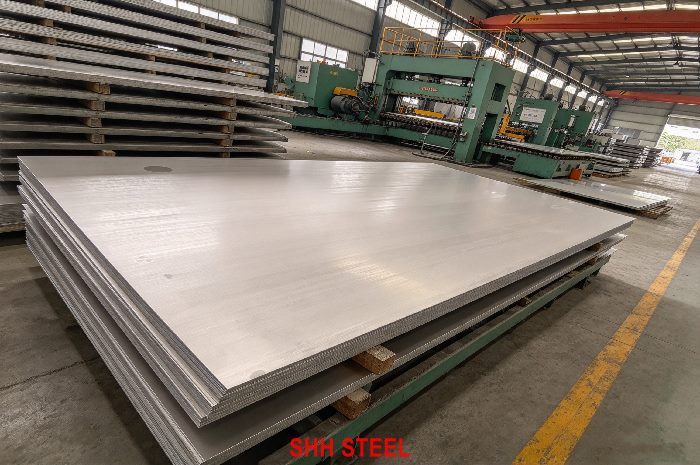
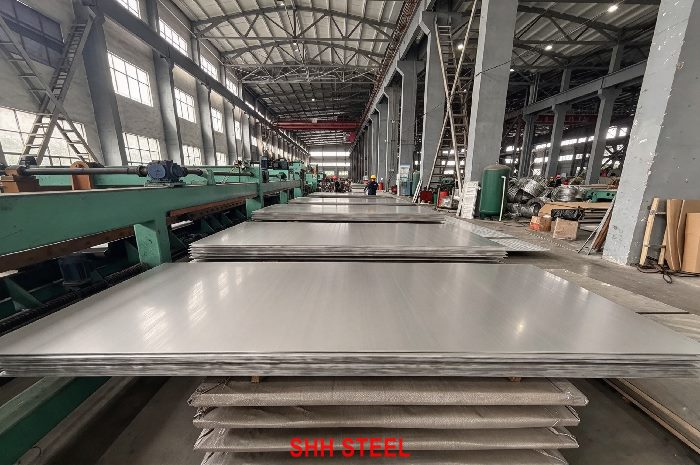
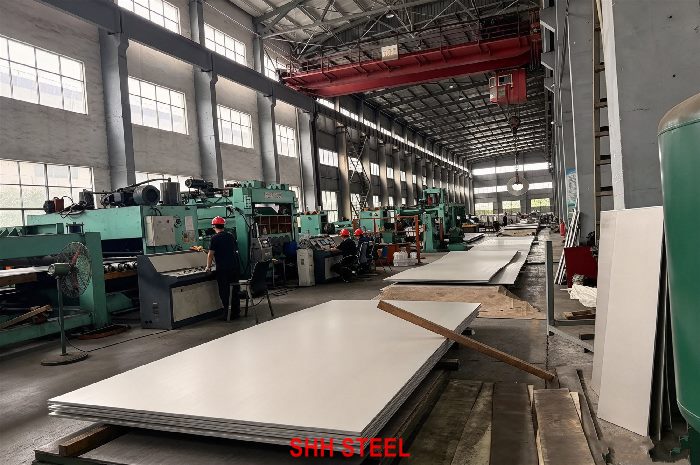
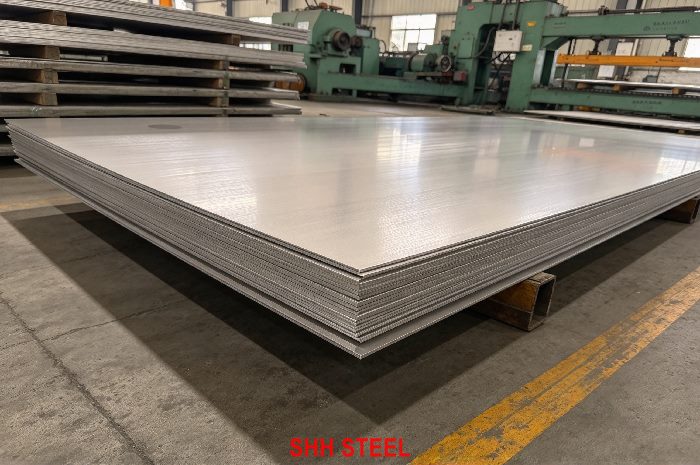
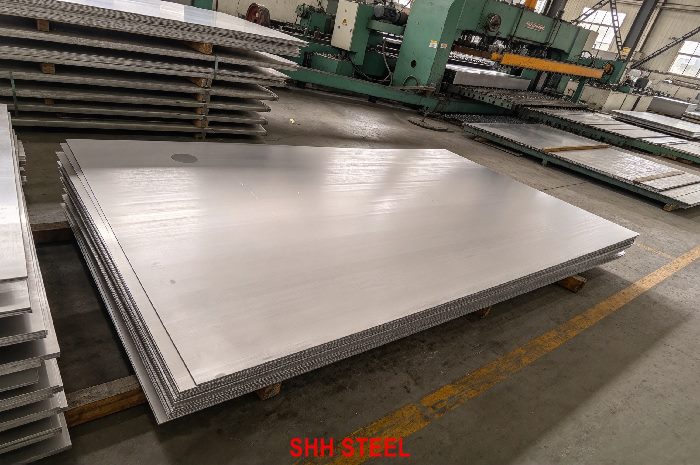
Size range. Plate is produced on Steckel or reversing mills from about 5 mm up to 80–100 mm depending on grade, with widths of 1500–2500 mm and lengths up to 12 m; thinner plate of 3–12 mm is often cut from hot-rolled coil. Very heavy or wide plates, and plates with tight flatness, should be confirmed before ordering. UNS S40930 is produced regularly by several mills; common sizes are held in stock, and other sizes are rolled in the mill’s scheduled campaigns for the grade.
Chemical composition of UNS S40930 (ASME SA-240/SA-240M)
| Element | wt % |
|---|---|
| C | 0.030 max |
| Si | 1.00 max |
| Mn | 1.00 max |
| P | 0.040 max |
| S | 0.020 max |
| Cr | 10.5–11.7 |
| Ni | 0.50 max |
| N | 0.030 max |
| Ti | 0.05 min |
| Nb | Ti+Nb [0.08+8×(C+N)] min, 0.75 max |
Single values are maximums unless marked min. Ranges are heat (cast) analysis limits.
Low carbon and nitrogen, together with titanium and/or niobium where specified, are what make modern ferritic grades weldable. Check that the stabiliser content on the certificate meets the formula in the standard for the actual C and N.
Mechanical properties of UNS S40930 plate
| Condition / thickness | Tensile strength, min | Yield strength 0.2 %, min | Elongation in 50 mm, min | Hardness, max |
|---|---|---|---|---|
| all thicknesses | 380 MPa (55 ksi) | 170 MPa (25 ksi) | 20 % | 179 HBW / 88 HRB |
The minimum proof strength is 170 MPa. Ferritic grades have lower elongation than austenitic grades and work-harden less, which helps in stretch forming but limits deep drawing. Tension tests are taken in the direction stated in the standard; where a hardness limit is given, it is a maximum that confirms correct annealing.
Corrosion resistance of UNS S40930: PREN and limits
Ferritic stainless steels contain chromium but little or no nickel, so they are magnetic, cheaper and less sensitive to nickel price swings. They have good resistance to chloride stress-corrosion cracking, lower thermal expansion and higher thermal conductivity than austenitic grades, which helps in thermal cycling. Stabilisation with titanium and/or niobium ties up carbon and nitrogen and protects welds against intergranular corrosion.
The limits are toughness and formability in heavy sections: ferritic grades have a ductile-to-brittle transition, grain growth in the weld zone, and 475 °C embrittlement in the higher-chromium grades. They are therefore supplied mainly as sheet and light plate, and they are welded with low heat input.
How UNS S40930 compares with related grades
| Grade | Cr | Ni | Mo | N | PREN (min) | YS / Rp0.2 min, MPa |
|---|---|---|---|---|---|---|
| UNS S40930 | 10.5–11.7 | 0.50 max | — | 0.030 max | 10.5 | 170 |
| UNS S44100 | 17.5–19.5 | 1.00 max | — | 0.030 max | 17.5 | 241 |
| UNS S43940 | 17.5–18.5 | — | — | — | 17.5 | 250 |
| UNS S44600 | 23.0–27.0 | 0.75 max | — | 0.25 max | 23.0 | 275 |
| UNS S40910 | 10.5–11.7 | 0.50 max | — | 0.030 max | 10.5 | 170 |
Choose UNS S40930 when nickel-free cost, thermal-cycling behaviour or resistance to chloride stress-corrosion cracking matters more than toughness in heavy sections. It is not a good choice for heavy welded plate or for cryogenic service.
The table uses specification limits, not typical mill values, so it shows the guaranteed position of each grade. Final selection should also consider product availability in the thickness you need, welding consumables, and the inspection requirements of your project.
Heat treatment and delivery condition of UNS S40930
Heat treatment: anneal, air cool.
Ferritic grades are annealed and cooled rapidly or in air; they are not hardenable by quenching. Avoid long holding in the 400–550 °C range, which causes 475 °C embrittlement in higher-chromium grades.
Surface finishes for UNS S40930 plate
Plate to SA-240 is normally supplied with a No.1 finish: hot rolled, solution annealed and pickled, with a matt grey surface. Shot-blasted and pickled surfaces are the norm on heavy plate. Ground or polished faces, and plates with protective film for the process side, can be produced after delivery in our workshop. Surface defects are judged against the A480/SA-480 workmanship clause; for vessel internals the purchaser may add surface-roughness or cleanliness requirements.
Dimensions, tolerances and flatness
Thickness, width, length, flatness and camber tolerances follow SA-480/A480 tables for hot-rolled plate; ordered thickness is a minimum unless the order states nominal. For pressure parts, the thickness at any point must not fall below the ordered minimum, so heavy plate is often ordered with a small plus allowance. Flatness of thin plate cut from coil should be checked after cutting. Mill edge, sheared, plasma or waterjet-cut edges and bevelling for welding are available.
Code use of SA-240 plate. Before welding, the manufacturer must identify the P-Number and group number of S40930 from ASME Section IX (QW/QG-422) for the welding procedure qualification, and the designer takes allowable stresses from Section II Part D. Impact-test exemptions for austenitic and duplex plate are given in Section VIII Division 1 (UHA-51) and depend on grade, thickness and minimum design metal temperature, so cryogenic or low-temperature duty should be stated when you order. For heavy plate, ultrasonic examination to SA-578 and PMI of each plate are common supplementary requirements. Ask for the plate number to be hard-stamped or stencilled so traceability survives cutting.
UNS S40930 plate stock in China
| Thickness (mm) | Width (mm) | Length (mm) | Finish | Approx. quantity | Location |
|---|---|---|---|---|---|
| 6 | 1500 / 2000 | 6000 | No.1 | 200+ t | China |
| 8 | 1500 / 2000 | 6000 | No.1 | 200+ t | China |
| 10 | 2000 | 6000 | No.1 | 100+ t | China |
| 12 | 2000 | 6000 | No.1 | 100+ t | China |
| 16 | 2000 / 2500 | 6000 | No.1 | 100+ t | China |
| 20 | 2000 / 2500 | 6000 / 8000 | No.1 | 100+ t | China |
| 30 | 2000 / 2500 | 6000 | No.1 | 100+ t | China |
Quantities are approximate and stock changes daily. Send your size list for current availability; other thicknesses, widths and cut sizes can be supplied from mill production.
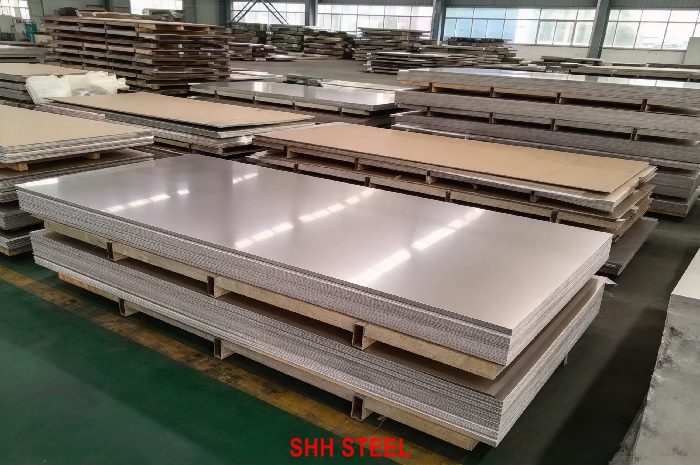
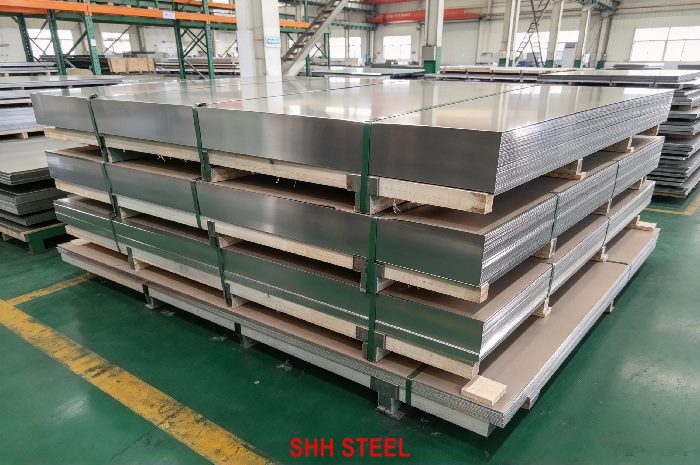
Packing and logistics. Plate is bundled on steel or wooden skids with steel bands and edge protection, typically 3–8 t per bundle, and marked with heat and plate numbers. Cut pieces are crated. Heavy and wide plate ships in open-top or flat-rack containers or by break-bulk; we send loading photos with the shipping documents.
UNS S40930 equivalents in other standards
| Standard | Designation | Comment |
|---|---|---|
| EN | 1.4512 X2CrTi12 | nearest grade only; limits differ, check before substituting |
| GB/T | 022Cr11NbTi (S11173) | same alloy family and limits closely matched; compare each limit on the certificate |
Equivalents are close, not identical. When a project names one standard, order to that standard or ask for multiple certification and check every limit on the certificate.
Related grades by alloy family
Ferritic
Nickel-free, magnetic grades for heat and mild corrosion: SA-240 S43000, SA-240 S43932, SA-240 S44400, SA-240 S40920, 1.4509 plate, 1.4016 plate, 1.4510 plate, SA-240 S40910, SA-240 S44100, SA-240 S43940.
Austenitic
General-purpose austenitic grades for comparison: SA-240 S30400, SA-240 S30403.
Same grade, other specification
Applications, forming and welding of UNS S40930
Typical uses: welded exhaust tubing, mufflers and resonators, and other formed hot-end parts.
Ferritic sheet is formed cold; heavy gauges should be warmed to 100–200 °C before bending in cold weather. Cut by plasma, laser or waterjet and remove heat tint by pickling or grinding. For welding use a stabilised ferritic filler such as ER409Nb or ER430LNb, or an austenitic ER309L where weld ductility matters more than matching expansion. Keep the weld area clean and free of carbon-steel contamination, and pickle and passivate after welding where corrosion resistance matters.
Welding practice. Use low heat input and avoid preheat above about 200 °C to limit grain growth in the HAZ. Stabilised grades do not need post-weld heat treatment for corrosion resistance. Thin sheet is commonly joined by GTAW, plasma, laser or resistance welding. Cold forming should be done above room temperature for thicker gauges to avoid brittle fracture.
Certificates, testing and receiving inspection
Every delivery carries a mill certificate to ASME SA-480/SA-480M with heat analysis, tensile results and hardness, and the grade and standard as ordered. Supplementary tests we can arrange: intergranular corrosion testing (ASTM A763 or equivalent), bend test, hardness, and PMI. Third-party witness by SGS, BV, TÜV, DNV, ABS or LR is available with EN 10204 3.2 certificates.
On receipt, check marking and heat number against the certificate, measure thickness at several points and confirm the finish and edge condition before cutting.
Common mistakes when specifying UNS S40930
- Ordering heavy plate for welded pressure parts, where toughness is limited.
- Assuming all ferritic grades are stabilised; check Ti and Nb on the certificate.
- Using a ferritic grade in hot chloride solutions without checking pitting resistance.
Each of these can be avoided by writing the requirement into the purchase order and checking it on the certificate before the material is cut.
Sourcing UNS S40930: buyer concerns and SHH STEEL solutions
| Concern | How SHH STEEL handles it |
|---|---|
| Toughness of heavy gauges | thickness range agreed; bend tests on the heat |
| Weld-zone grain growth | low-heat-input welding advice and stabilised filler |
| Small quantities across many sizes | mixed thicknesses and grades combined in one shipment |
| Cutting and edge preparation | in-house shearing, plasma, laser and waterjet cutting, bevelling |
| Delivery delays | weekly production and shipping updates with photos |
How to order UNS S40930 plate
State the standard and edition (ASME SA-240/SA-240M), the grade (UNS S40930), thickness, width and length or coil, finish, quantity, tolerance class, any added chemistry limits, the supplementary tests and acceptance values from your specification, the certificate type and inspection agency, and packing. Send the list to SHH STEEL and we will reply with price, available stock and lead time.
FAQ
-
What is the difference between SA-240 and A240 for S40930?
- The chemistry and tensile requirements are the same. SA-240 is the ASME Code edition, so plate for pressure vessels must be certified and marked SA-240; dual-certified A240/SA-240 plate covers both.
-
Is UNS S40930 equivalent to EN 1.4512 X2CrTi12?
- They are the nearest match, but limits differ; check each element and the property table before substituting.
-
Is UNS S40930 magnetic?
- Yes. Ferritic grades are magnetic in all conditions.
-
Can I order small quantities or cut sizes?
- Yes. We combine mixed thicknesses and grades into one shipment and cut plate and sheet to size in our workshop.
-
Which certificates and tests can you provide?
- Every order ships with a mill certificate (EN 10204 3.1 type) showing heat analysis and mechanical tests. Supplementary tests and 3.2 certificates with SGS, BV, TÜV or another agency are available by agreement.
Conclusion
UNS S40930 plate should be ordered with the points the standard leaves open written into the contract: finish, tolerance class, any extra chemistry limits and the supplementary tests your application needs. With those fixed, stock material from China is a fast and reliable route.
Quality Steel Needed? Inquire for Offers
Related Products