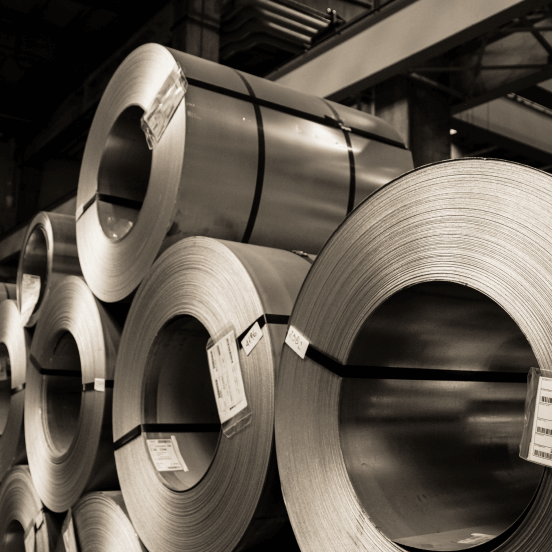

EN 10088-2 X2CrTi12 1.4512 Stainless Steel Plate
1.4512 stainless steel plate: Ti-stabilised ferritic grade for exhaust and thin-gauge parts
X2CrTi12, steel number 1.4512, is a titanium-stabilised ferritic stainless steel supplied as sheet, plate and strip to EN 10088-2, the European standard for corrosion resisting flat products for general purposes. The steel behind every 1.4512 stainless steel plate contains 10.5 – 12.5 % chromium, no more than 0.030 % carbon and enough titanium to tie up carbon and nitrogen, so it is magnetic, welds without heavy chromium-carbide formation at the grain boundaries, and costs far less than nickel-bearing grades. It is the European counterpart of the 409 stainless steel family, and its main home is the automotive exhaust line: mufflers, silencer shells, tail pipes, catalytic converter housings and heat shields, together with other thin-gauge parts that see warm, mildly corrosive conditions.
SHH STEEL works as a steel sourcing partner with long-term relationships with Chinese stainless mills that roll 409-type ferritic coil. For large tonnages, the buyer can contract directly with a suitable mill, with SHH STEEL assisting for a modest service fee and handling follow-up and documents. For small orders we consolidate demand, so that 1 – 5 t lots are placed against genuine mill production instead of stock of unknown origin. Each shipment can be released after third-party inspection by TUV, ABS, BV, DNV, CCS or an agency the buyer nominates, and payment by TT or LC is accepted. The rest of this page covers the technical side of EN 10088-2 1.4512 and the steps we take so that the material that arrives is the material that was ordered.
The table below lists the concerns buyers raise most often when sourcing EN 10088-2 X2CrTi12 sheet and plate from China, and how SHH STEEL deals with each of them.
| Buyer Concern | SHH STEEL Solution |
|---|---|
| Fake material or certificate mismatch | 1.4512 is easily confused with 1.4003, 410S or unstabilised 409-type coil. Heat numbers are matched to the mill certificate, and PMI checks both chromium (10.5 – 12.5 %) and titanium, which separates genuine X2CrTi12 from unstabilised substitutes. Partner laboratories carry out chemical analysis including carbon and nitrogen on request. EN 10204 3.1 is standard; 3.2 certificates with third-party witness are available. |
| Unsafe deposit | TT, LC or a TT + LC combination is accepted, so payment can be linked to shipping documents. For large exhaust programmes the buyer can choose to contract directly with the mill, with SHH STEEL assisting for a small service fee. |
| Mill MOQ too high | Mills roll 1.4512 in coil campaigns, yet prototype exhausts, aftermarket silencers and repair shops often need only a few tonnes in two or three gauges. SHH STEEL consolidates 1 – 5 t orders against genuine mill production of the same grade. |
| Delivery delays | A dedicated person follows up the delivery schedule with the mill through rolling, annealing, slitting or cutting, testing and packing, and keeps the buyer informed at each stage. |
| Material not ready for production | Our own workshop provides cut-to-length sheets, slitting, laser cutting of blanks, bending and surface protection film, so thin 1.4512 parts arrive ready for forming and welding lines. |
EN 10088-2 vs ASTM A240 and EN 10028-7: standard selection for X2CrTi12 plate
X2CrTi12 1.4512 is a European grade, but buyers meet it under several standards, and the right one depends on where the part will be used and what the drawing says. EN 10088-2 is the technical delivery condition for sheet, plate and strip of corrosion resisting steels for general purposes. ASTM A240 and ASME SA-240 cover the 409 family under American designations. EN 10028-7 covers stainless flat products for pressure purposes.
| Point | EN 10088-2 (this page) | ASTM A240 / ASME SA-240 Type 409 | EN 10028-7 |
|---|---|---|---|
| Intended use | General purposes: exhaust parts, housings, shields, frames | General and pressure service under ASME codes (SA-240) | Pressure equipment: shells, heads, nozzles |
| Grade designation | X2CrTi12 / 1.4512 | UNS S40910 (409 family) | Only grades listed in that standard |
| Product forms for this grade | C cold-rolled strip up to 8 mm; H hot-rolled strip up to 13.5 mm | Plate, sheet and strip | Grade-dependent |
| Default inspection document | Test report 2.2 if the order says nothing; 3.1 / 3.2 by agreement | Mill test report to the specification | Normally 3.1 or 3.2 |
If your exhaust or housing drawing is European, order to EN 10088-2. If it calls for 409 under ASTM, see our ASTM A240 Type 409 page; SHH STEEL can supply either and, where a mill certifies both, show the two sets of limits side by side. If the part holds pressure, use a grade that EN 10028-7 lists for that product, such as our EN 10028-7 X2CrNi12 1.4003 pressure vessel plate, because a plate certified only to EN 10088-2 is not intended for pressure purposes.
EN 10088-2 1.4512 specification overview
| Item | EN 10088-2:2014 requirement / SHH STEEL practice |
|---|---|
| Standard | EN 10088-2:2014, Stainless steels, Part 2: Technical delivery conditions for sheet/plate and strip of corrosion resisting steels for general purposes |
| Steel name / number | X2CrTi12 / 1.4512 |
| Structure | Ferritic, standard grade, titanium-stabilised |
| Chemistry | Table 3 (cast analysis); product analysis tolerances in Table 5 |
| Room-temperature properties | Table 9, annealed condition, product forms C and H |
| Elevated-temperature 0.2 % proof strength | Table 14 (for information and design reference) |
| Product forms listed | C cold-rolled strip up to 8 mm; H hot-rolled strip up to 13.5 mm; no P (quarto plate) row for this grade |
| Heat treatment | Annealed (+A); annealing guideline 770 – 830 °C in Table A.3 |
| Process route / finish | Table 6: 2D or 2B usual for cold-rolled; 1D for hot-rolled |
| Dimensions and tolerances | EN ISO 9445-2 for cold-rolled (C), EN ISO 9444-2 for hot-rolled strip and sheet (H) |
| Inspection document | EN 10204 2.2 by default; SHH STEEL normally issues 3.1, and 3.2 with a third-party inspector |
Edition note: the values on this page are taken from EN 10088-2:2014. A revised edition (EN 10088-2:2024) has since been published. If your contract names the newer edition, SHH STEEL checks the order against that text before production, and any difference is raised at the quotation stage rather than after rolling.
1.4512 chemical composition: heat analysis and product analysis tolerances
The 1.4512 chemical composition below is the cast (heat) analysis from EN 10088-2:2014 Table 3. Values are percentages by mass; a single figure is a maximum.
| Element | C | Si | Mn | P | S | Cr | Ti |
|---|---|---|---|---|---|---|---|
| Heat analysis, % | ≤ 0.030 | ≤ 1.00 | ≤ 1.00 | ≤ 0.040 | ≤ 0.015 | 10.5 – 12.5 | 6 × (C + N) to 0.65 |
Titanium is the defining element. Because the minimum is written as six times the sum of carbon and nitrogen, the actual titanium requirement depends on the heat: a cast with 0.015 % C and 0.012 % N needs at least about 0.16 % Ti. Titanium combines with carbon and nitrogen before chromium can, which keeps chromium in solution and protects the weld zone. EN 10088-2 does not set a nickel limit for this grade, and the standard does not allow unlisted elements to be added intentionally without the purchaser’s agreement.
Product analysis tolerances (EN 10088-2 Table 5)
A product analysis is a check made on the delivered material. It is not mandatory under EN 10088-2; it is carried out when agreed at the time of enquiry and order, and SHH STEEL can arrange it through a partner laboratory. The permissible tolerances on the cast limits are:
| Element | Cast limit, % | Permissible tolerance, % | Product analysis limit, % |
|---|---|---|---|
| C | ≤ 0.030 | +0.005 | ≤ 0.035 |
| Si | ≤ 1.00 | +0.05 | ≤ 1.05 |
| Mn | ≤ 1.00 | +0.03 | ≤ 1.03 |
| P | ≤ 0.040 | +0.005 | ≤ 0.045 |
| S | ≤ 0.015 | +0.003 | ≤ 0.018 |
| Cr | 10.5 – 12.5 | ±0.15 | 10.35 – 12.65 |
| Ti | ≤ 0.65 (max.) | +0.05 on the maximum | ≤ 0.70 |
EN 10088-2 also states that, where several product analyses are made on one cast, individual results may exceed the maximum or fall below the minimum, but not both for the same element. How a tolerance applies to the calculated titanium minimum should be confirmed in the contract if a product analysis is ordered.
1.4512 mechanical properties by product form (C, H)
The 1.4512 mechanical properties are set in EN 10088-2:2014 Table 9 for the annealed condition. Unlike some other ferritic grades, X2CrTi12 is listed only for cold-rolled strip (C) and hot-rolled strip (H); there is no separate row for quarto plate (P).
| Product form | Max. thickness, mm | Rp0.2 min, MPa (long.) | Rp0.2 min, MPa (tr.) | Rm, MPa | A min, % (long. + tr.) |
|---|---|---|---|---|---|
| C – cold-rolled strip | 8 | 210 | 220 | 380 – 560 | 25 |
| H – hot-rolled strip | 13.5 | 210 | 220 | 380 – 560 | 25 |
Elongation is measured on an 80 mm gauge length below 3 mm thickness and on a proportional gauge length (5.65√S0) from 3 mm upwards. For bigger sizes the standard says the mechanical values are to be agreed at the time of enquiry and order. Table 9 records resistance to intergranular corrosion (tested to EN ISO 3651-2) as “no” in both the delivery and the welded condition for 1.4512, which means the standard does not guarantee that property even though titanium greatly reduces sensitisation in practice.
Compared with 1.4003, the proof strength is lower and the elongation higher. That suits deep-drawn or bent exhaust components, where formability matters more than load-bearing strength. If a minimum hardness, an r-value or a specific forming test is needed for a pressing line, we write it into the mill order as an agreed requirement and checks it on the certificate.
Proof strength at elevated temperature (Table 14)
| Temperature, °C | 100 | 150 | 200 | 250 | 300 | 350 |
|---|---|---|---|---|---|---|
| Rp0.2 min, MPa (+A) | 200 | 195 | 190 | 185 | 180 | 160 |
These values are given for information. They are useful when checking a housing or bracket that runs warm, and they are verified by an elevated-temperature tensile test only if agreed in the order. EN 10088-2 does not set a Charpy impact value for this grade.
Heat treatment of X2CrTi12 plate: annealing and hot forming
X2CrTi12 is delivered in the annealed condition (+A). EN 10088-2 Table A.3 gives the guideline temperatures:
| Operation | Temperature, °C | Cooling |
|---|---|---|
| Hot forming (range given for the ferritic group) | 1 100 – 800 | Air |
| Annealing (+A) | 770 – 830 | Air or water |
Annealing recrystallises the cold-rolled structure and gives the soft, formable condition on which the Table 9 values are based. As with other ferritic steels, overheating coarsens the grain quickly and lowers toughness, so the furnace range should not be exceeded. The steel cannot be hardened by heat treatment.
Formed exhaust parts are normally not heat treated after welding. If a part has to be re-annealed after severe cold work, Table A.3 is the reference, and the procedure should be agreed with the fabricator. The Annex A temperatures are guidelines; actual furnace settings are chosen by the mill, and SHH STEEL checks that the annealed condition is stated on each certificate before release.
Physical properties of 1.4512 ferritic plate
The values below are room-temperature reference figures for X2CrTi12 1.4512, taken from the physical-property table in Euro Inox, Stainless Steel: Tables of Technical Properties (Materials and Applications Series, Volume 5). They are suitable for design estimates and weight calculation; where a figure is critical, use EN 10088-1 itself.
| Property | Value |
|---|---|
| Density at 20 °C | 7.7 kg/dm³ (g/cm³) |
| Modulus of elasticity at 20 °C | 220 GPa |
| Mean thermal expansion, 20 – 200 °C | 11.0 × 10⁻⁶ /K |
| Mean thermal expansion, 20 – 400 °C | 12.0 × 10⁻⁶ /K |
| Thermal conductivity at 20 °C | 25 W/(m·K) |
| Specific heat at 20 °C | 460 J/(kg·K) |
| Electrical resistivity at 20 °C | 0.60 Ω·mm²/m |
| Magnetic behaviour | Ferromagnetic (magnetic) |
Low thermal expansion is a real advantage in exhaust systems: a ferritic shell grows much less than an austenitic one when it heats up, so clamps, flanges and joints see lower thermal stress over many heating cycles. At about 7.7 g/cm³, a 1.5 mm sheet weighs roughly 11.6 kg per square metre, a figure SHH STEEL uses for weight and freight estimates in every quotation.
Corrosion and oxidation behaviour of X2CrTi12 1.4512
With chromium just above the stainless threshold and no molybdenum, X2CrTi12 1.4512 is an economy stainless steel. It was developed to replace aluminised or painted carbon steel in exhaust systems, where hot condensate and road spray would quickly corrode an unalloyed part.
| Environment | Typical behaviour |
|---|---|
| Exhaust condensate, cold end (mufflers, tail pipes) | Good for the service life of most vehicles; light surface rust staining can appear |
| Warm, dry gas at the hot end | Adequate scaling resistance in intermittent service, typically quoted by mills up to about 750 – 800 °C |
| Rural and mild industrial atmospheres | Fair; surface staining is likely, structural loss minimal |
| Chloride-rich, marine or de-icing salt exposure | Limited; pitting and red staining likely |
| Strong acids | Not suitable |
The oxidation figures are industry guidance, not EN 10088-2 requirements. Titanium stabilisation keeps the weld zone free of severe chromium depletion, which is why 1.4512 survives welded exhaust service far better than older unstabilised 12 % chromium steels. Where appearance matters or the part sits in salt spray, a higher-chromium ferritic such as the 441 type or an austenitic grade is the better choice, and we can quote that alternative from the same mill partners.
Weldability of 1.4512 ferritic plate: SHH STEEL workshop practice
Weldability is the main reason titanium is added. In a plain 11 – 12 % chromium steel, carbon can combine with chromium during welding and leave chromium-depleted zones along the grain boundaries. In 1.4512 the titanium takes that carbon and nitrogen first, so the heat-affected zone keeps its corrosion resistance. The grade can be joined by MIG/MAG, TIG, plasma, laser, resistance and seam welding, which covers the processes used on exhaust lines.
- Filler metal: in common industry practice, matching or overmatching ferritic wires such as 409Nb or 430LNb types are used on exhaust components, while 309L-type austenitic fillers are used for joints to carbon steel. Final choice should follow the welding procedure specification.
- Heat input: keep it low and travel speed high, because ferritic steels coarsen their grain in the heat-affected zone, which reduces toughness.
- Preheat and post-weld heat treatment: normally not required for the thin gauges in which the grade is used.
- Shielding: argon-based gases with low oxygen or CO₂ content are usual; nitrogen-bearing gases are avoided because they consume titanium.
- Cleaning: remove heat tint by pickling or brushing to restore corrosion resistance at the weld.
These points reflect industry practice for the 409 family rather than requirements of EN 10088-2, which does not specify welding procedures. In the SHH STEEL workshop, blanks and strips are cut with clean, burr-free edges so that automatic welding lines run without edge preparation problems, and the procedure itself should be qualified to the code that applies to your project.
Formability, machinability and cutting of X2CrTi12 plate in the SHH STEEL workshop
X2CrTi12 plate and sheet form well. Its low proof strength and 25 % minimum elongation allow tube forming, deep drawing of muffler end caps and bending of heat shields. Like other ferritic grades it shows some spring-back and can be sensitive to cracking when formed very cold, so forming at room temperature or slightly warm is preferred, with an inside bend radius of at least the material thickness for heavier gauges. These are workshop guidelines, not standard requirements.
Machining is comparable to other low-chromium ferritic steels: sharp tools and steady feeds give clean results, and there is no austenitic-type work hardening. Punching and drilling of mounting holes in brackets and shields is routine.
SHH STEEL runs its own workshop next to the warehouse, so 1.4512 can be delivered as cut-to-length sheets, slit coil, laser-cut blanks or bent parts instead of raw mill sizes. Details are on our steel cutting services and bending and forming services pages. Protective film can be applied for parts that will be pressed, and pre-cut blanks reduce freight weight and scrap at your end.
1.4512 plate sizes, thickness limits and tolerances supplied by SHH STEEL
EN 10088-2 limits each product form to a maximum thickness, and the tolerance standard depends on the form:
| Product form | Thickness range covered by EN 10088-2 | Typical width supplied (by mill) | Tolerance standard |
|---|---|---|---|
| C – cold-rolled strip and sheet | up to 8 mm (most supply 0.4 – 3 mm) | 1 000 / 1 219 / 1 250 / 1 500 mm | EN ISO 9445-2 |
| H – hot-rolled strip and sheet cut from coil | up to 13.5 mm (most supply 2.5 – 8 mm) | 1 250 / 1 500 mm | EN ISO 9444-2 |
Widths and typical thicknesses in the table are mill offerings, not values from the standard. Cut lengths are usually 2 000 – 6 000 mm, and slit coil can be supplied to the width your tube mill or press line uses. Because EN 10088-2 lists no quarto-plate row for 1.4512, material thicker than 13.5 mm, or plate rolled individually, has to be agreed with the mill as a special case; for heavier ferritic plate, a grade such as EN 10088-2 X2CrNi12 1.4003 is often the more practical choice.
Most 1.4512 is bought in the 0.8 – 2.0 mm range for exhaust shells and tubes. SHH STEEL confirms available widths and lengths with the mill at quotation and cuts or slits to finished size in its own workshop when a mill size does not fit.
Surface finishes for EN 10088-2 X2CrTi12 plate
Surface finish is ordered by the process route symbols of EN 10088-2 Table 6. Not every route is available for every grade, and the mill confirms which ones it can supply.
| Symbol | Description | Use for 1.4512 |
|---|---|---|
| 1D | Hot rolled, heat treated, pickled | Standard finish for hot-rolled sheet and strip (form H) |
| 1E | Hot rolled, heat treated, mechanically descaled | Alternative where parts will be painted or machined |
| 2D | Cold rolled, heat treated, pickled | Good ductility; often chosen for deep-drawn exhaust parts |
| 2B | Cold rolled, heat treated, pickled, skin passed | Most common cold-rolled finish: smoother and flatter than 2D |
| 2A | Cold rolled, heat treated, bright-pickled, skin passed | Ferritic finish where higher reflectivity is wanted |
| 1J / 2J | Brushed or dull polished | On request, one side, in the SHH STEEL workshop |
Unless otherwise agreed, only one surface (the prime surface) is inspected to the ordered finish. For most exhaust and housing parts 2D or 2B is adequate, since the surface will be formed, welded and often heat-tinted in service. If tail pipes or visible trim need a decorative finish, state it at the enquiry stage so that the mill and the workshop can plan it.
1.4512 equivalent grades and 1.4512 vs 1.4003 comparison
Buyers often search for 409 stainless steel when they need 1.4512, or the other way round. When asked for the 1.4512 equivalent in another standard, the honest answer is that there are close relatives rather than exact twins. The table lists the nearest grades; chemistry and property limits differ in detail, so substitution should be checked against the governing specification.
| System | Nearest grade | Comment |
|---|---|---|
| ASTM A240 / ASME SA-240 | UNS S40910 (AISI 409 family) | Closest match; Ti-stabilised 10.5 – 11.7 % Cr, but Ti formula and tensile minimums differ. Older documents may still show S40900 |
| GB/T 4237 / GB/T 3280 | 022Cr11Ti (S11163) | Nearest Chinese grade per GB/T 20878; GB/T 4237 for hot-rolled, GB/T 3280 for cold-rolled; narrower Cr range |
| JIS G 4312 | SUH409L | Approximate; heat-resisting steel standard, Cr 10.50 – 11.75 % |
| JIS G 4305 | SUS409L | Approximate; cold-rolled corrosion resisting standard |
On our site you can compare related grades such as ASTM A240 Type 409, ASME SA240 409, JIS G4305 SUS409L, GB/T 4237 022Cr11Ti S11163 and the niobium-titanium variant GB/T 4237 022Cr11NbTi S11173. Where a drawing calls for UNS S40910 but the project is European, ordering X2CrTi12 to EN 10088-2 is often acceptable, but the designer should confirm it, and SHH STEEL can prepare a side-by-side comparison of the limits for that purpose.
1.4512 vs 1.4003
Both are 12 % chromium ferritics, but they are built for different jobs. EN 10088-2 X2CrNi12 1.4003 adds 0.30 – 1.00 % nickel for heat-affected-zone toughness and is listed up to 25 mm quarto plate, so it suits structural frames, hoppers and wagons. 1.4512 replaces nickel with titanium stabilisation, has a lower proof strength and higher elongation, and is listed only up to 13.5 mm, which makes it the natural choice for thin, formed and welded exhaust parts. SHH STEEL can quote both grades on one enquiry so the difference in price and properties is clear.
Applications of 1.4512 ferritic plate
The typical 1.4512 ferritic plate application is a thin, formed and welded part that runs warm, meets condensate or road spray, and does not justify a higher-chromium or nickel-bearing grade. Common uses include:
- Automotive exhaust systems: mufflers, silencer shells and baffles, intermediate and tail pipes
- Catalytic converter and particulate filter housings, flanges and heat shields
- Truck, bus and off-road engine exhausts and aftermarket silencers
- Agricultural machinery and generator-set exhausts
- Containers, transport and handling equipment with mild corrosion exposure
- Heat exchanger casings, boiler and furnace parts operating in dry, moderately hot gas
- Electrical cabinets and enclosures that are painted after forming
In each case the reasoning is the same: enough chromium to outlast coated carbon steel, titanium to keep the welds sound, and no nickel cost that the service does not need. For hotter or more corrosive exhaust sections, designers move up to the 18 % chromium ASTM A240 Type 441 type. For these uses SHH STEEL can supply slit coil or laser-cut blanks, which reduces scrap and freight.
Common buyer concerns and our solutions
Most problems in buying 1.4512 from China are not about the metallurgy. They come from the details that decide whether the material will run on a production line: the right stabilisation, a coil width that fits, an annealed condition that forms without cracking, and paperwork that a customs officer and a quality engineer will both accept.
| Concern | What Usually Happens | How SHH STEEL Handles It |
|---|---|---|
| Grade substitution | Unstabilised 410S or 1.4003 is supplied as 1.4512, or the titanium is below the 6 × (C + N) minimum. | The certificate is checked for C, N and Ti, PMI confirms Cr and Ti in our warehouse, and laboratory analysis is added when the buyer asks. |
| Formability problems | Coil is too hard or the grain is coarse, and parts split during deep drawing. | Annealed condition, grain or hardness requirements and forming notes are written into the mill order; trial coils can be checked before a full lot. |
| Wrong widths for the line | Mill widths do not match the tube mill or press, and local slitting adds cost. | Slitting and cut-to-length in our workshop to the width and length on your drawing. |
| Mixed small requirements | Several gauges of 1 – 3 t each are needed, which no mill will schedule separately. | Requirements are consolidated with other demand and shipped in one container with one set of documents. |
| Surface damage in transit | Thin sheet arrives scratched or with edge damage after sea freight. | Protective film on request, seaworthy packing on pallets, and heat-number labels on every pack. |
None of these steps is complicated, but they need to be agreed at the start. When you send an enquiry, tell SHH STEEL which of these points matters most to you, and the order will be built around it.
Testing, certificates and lead time at SHH STEEL
EN 10088-2 Table 21 sets out the tests. The cast analysis is always reported by the manufacturer, and a tensile test at room temperature is mandatory when specific testing is ordered. For strip and sheet cut from strip (forms C and H), the test unit is the same cast, same nominal thickness ±10 % and same final treatment condition; for rolling widths of 600 mm and above, one test sample is taken from each coil. Other tests are optional and carried out only when agreed at the time of order:
- Product analysis (extent to be agreed), useful for confirming titanium and carbon plus nitrogen
- Tensile test at elevated temperature, verifying Table 14 values
- Intergranular corrosion test to EN ISO 3651-2, normally not carried out
- Additional checks through our third-party testing service: PMI, dimensional, flatness and surface inspection
If the order does not name an inspection document, EN 10088-2 requires only a test report 2.2. Because this is rarely enough for automotive or export work, SHH STEEL supplies an EN 10204 3.1 inspection certificate as standard and a 3.2 certificate when an independent inspector (TUV, ABS, BV, DNV, CCS or an agency you nominate) witnesses testing and countersigns the document.
Ordering example and lead time
Following the pattern of the example in EN 10088-2, a typical order line would read: 5 t cold-rolled sheet EN ISO 9445-2, 1.5 × 1250 × 2500 mm; steel EN 10088-2 – X2CrTi12+2B (or 1.4512+2B); inspection certificate EN 10204 – 3.1. Mill production lead time is generally 30 – 40 days from order confirmation, depending on the rolling schedule, the size and the tests requested. Consolidated small lots follow the same mill schedule, and SHH STEEL sends progress updates at rolling, testing and packing.
Why Work with SHH STEEL
- Mill relationships: long-term cooperation with Chinese stainless mills helps SHH STEEL secure competitive pricing and steadier delivery for 1.4512 and related 409-type grades.
- Direct mill contracts: for larger tonnages you can contract directly with a suitable mill, for a modest service fee, while we handle follow-up and documents.
- Order consolidation: 1 – 5 t lots are combined so they can be placed against genuine mill production.
- Own workshop: slitting, cut-to-length, laser cutting, bending and protective film before shipment.
- Inspection and certificates: third-party inspection by TUV, ABS, BV, DNV, CCS or your nominated agency, with EN 10204 3.1 or 3.2 certificates.
- Flexible payment: TT, LC or a combination of both.
- Port logistics: sheet and coil are packed seaworthy with heat-number labels and shipped through our worldwide shipping service, together with other grades if needed.
As a 1.4512 plate supplier SHH STEEL also stocks and sources the wider range of stainless steel sheets and plates, so mixed orders of ferritic and austenitic material can travel in one container with one set of paperwork.
FAQ
- What is 1.4512 stainless steel equivalent to?
- The closest 1.4512 equivalent in American standards is the 409 family, designated UNS S40910 in ASTM A240 and ASME SA-240; older documents may still show S40900. Both are titanium-stabilised ferritic steels with about 11 % chromium and low carbon, but they are not identical: the chromium range, the titanium formula and the tensile minimums are written differently, so a sheet certified to one does not automatically meet the other. In China the nearest grade is 022Cr11Ti (S11163) under GB/T 4237 for hot-rolled and GB/T 3280 for cold-rolled material. In Japan, SUH409L in JIS G 4312 and SUS409L in JIS G 4305 are approximate equivalents. If a drawing names one of these grades and you want to use X2CrTi12 to EN 10088-2 instead, ask the designer to confirm the substitution. SHH STEEL can provide a comparison of the limits.
- Is 1.4512 the same as 409 stainless steel?
- In everyday purchasing the two names are often used for the same kind of steel, and many mills certify a single heat to both EN 10088-2 1.4512 and ASTM A240 409. Strictly, however, they are separate specifications. EN 10088-2 allows 10.5 – 12.5 % chromium and requires titanium of at least six times carbon plus nitrogen, up to 0.65 %. ASTM A240 sets its own chromium range and titanium formula for UNS S40910, and its tensile requirements differ slightly. A plate that meets one standard will usually be close to the other, but it is not automatically compliant. If you need dual certification, say so at the enquiry stage, because the mill has to check the heat against both sets of limits before the certificate can name both standards. SHH STEEL confirms dual certification with the mill before the order is placed.
- What is the difference between 1.4512 and 1.4003?
- Both are low-carbon ferritic stainless steels with 10.5 – 12.5 % chromium, so they look similar on a certificate and are both magnetic. The difference is in the alloying and the intended use. 1.4003 contains 0.30 – 1.00 % nickel, has a higher proof strength and is listed in EN 10088-2 up to 25 mm quarto plate, which makes it a structural and wear-resistant grade for frames, hoppers and wagons. 1.4512 has no nickel requirement but is stabilised with titanium, has a lower proof strength and a higher minimum elongation of 25 %, and is listed only for cold-rolled and hot-rolled strip up to 13.5 mm. That combination suits thin parts that are deep drawn and welded, especially automotive exhaust components. A magnet cannot tell them apart; a chemical check of nickel and titanium can.
- Can 1.4512 stainless steel be welded?
- Yes. Good weldability is the reason titanium is added. Titanium combines with carbon and nitrogen before chromium can, so the heat-affected zone keeps its corrosion resistance and does not suffer the severe chromium depletion seen in unstabilised 12 % chromium steels. The grade is welded by MIG/MAG, TIG, plasma, laser, resistance and seam welding, which covers the processes used on exhaust lines. In common industry practice, ferritic fillers of the 409Nb or 430LNb type are used on exhaust components, and 309L-type fillers are used for joints to carbon steel. Heat input should be kept low to limit grain growth, preheat and post-weld heat treatment are normally not needed in thin gauges, and nitrogen-bearing shielding gases should be avoided. EN 10088-2 does not specify welding procedures, so follow a qualified procedure for your project.
- What temperature can 1.4512 withstand in exhaust service?
- EN 10088-2 does not give a maximum service temperature for 1.4512. It lists minimum 0.2 % proof strength values up to 350 °C for design reference, falling from 200 MPa at 100 °C to 160 MPa at 350 °C. For oxidation in dry exhaust gas, mills and industry literature commonly quote a scaling limit of roughly 750 – 800 °C in intermittent service, which is why the grade is widely used for the cooler sections of exhaust systems such as mufflers, intermediate pipes and tail pipes. Close to the engine, where gas temperatures are higher and thermal cycling is severe, designers usually move to an 18 % chromium stabilised ferritic of the 441 type or to an austenitic grade. Treat these temperature figures as guidance, and confirm the limit for your design with test data or the mill's information.
- Can I buy a small quantity of 1.4512 from China, and how is quality checked?
- Yes. Mills roll 1.4512 in coil campaigns and usually set a minimum of roughly 20 – 80 t per size, which is why small enquiries are often turned away or filled from stock of unknown origin. SHH STEEL consolidates small orders with other demand for the same grade, so lots of about 1 – 5 t can be placed against genuine mill production. Quality is checked in several steps. The heat number on each pack is matched to the mill certificate, chromium and titanium are confirmed by PMI in our warehouse, and dimensions, flatness and surface are inspected before packing. We issue an EN 10204 3.1 certificate as standard, and on request an independent inspector from TUV, ABS, BV, DNV, CCS or an agency you nominate can witness testing and sign a 3.2 certificate. Payment by TT or LC is accepted, and lead time is generally 30 – 40 days.
Ordering EN 10088-2 1.4512 Plate from SHH STEEL
EN 10088-2 X2CrTi12 1.4512 is a practical, economical ferritic stainless steel for thin parts that are formed, welded and exposed to warm, mildly corrosive conditions: titanium-stabilised, magnetic, easy to draw and far less sensitive to nickel prices than austenitic grades. Choosing it is the easy part. Getting sheet and coil that match the certificate, in the gauge and width your line needs, on a predictable schedule and ready for production is where a sourcing partner earns its place, and that is the work SHH STEEL does every day through long-term mill cooperation, consolidation and its own workshop.
The next step is simple. Send SHH STEEL your drawing, or an enquiry with the quantity, grade, thickness, width and delivery destination, and we will judge whether a direct mill contract or consolidation with processing fits your order better, and quote accordingly. Send your sizes and quantities for a quotation.
Quality Steel Needed? Inquire for Offers
Related Products