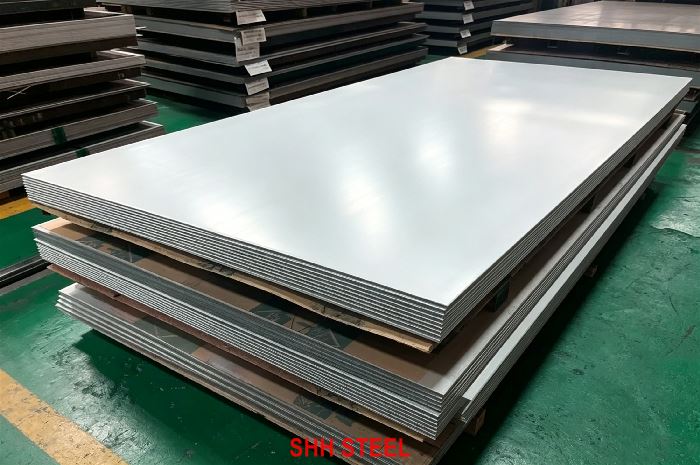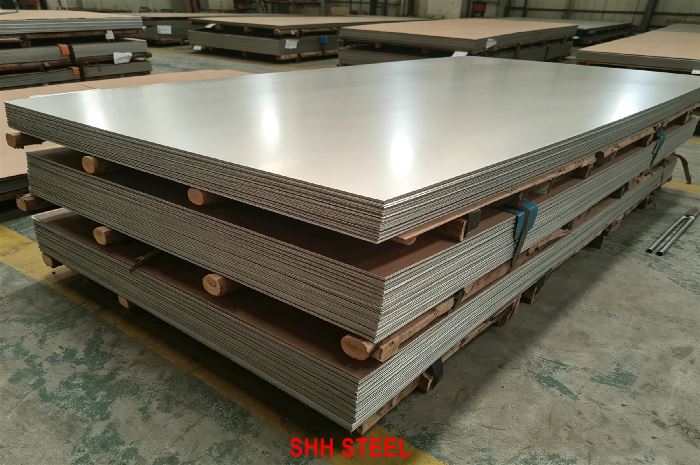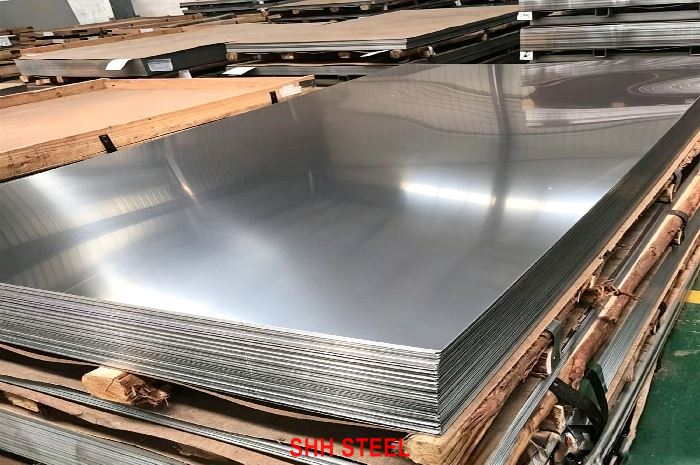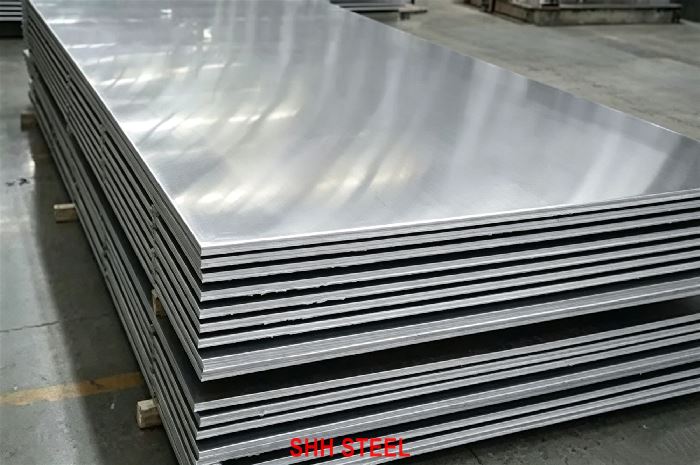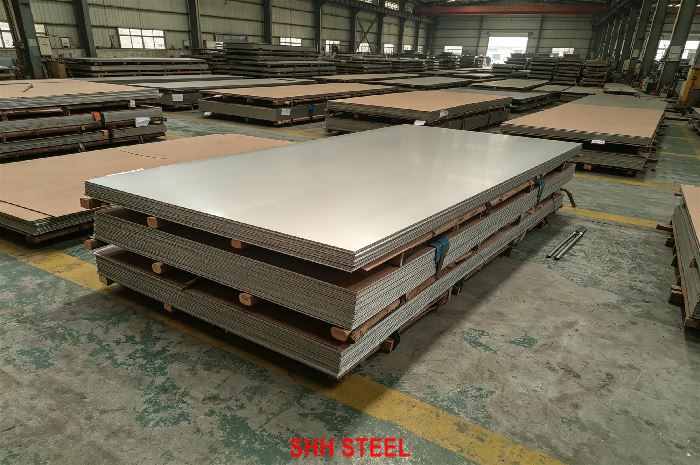

JIS G4305 SUS329J1 Steel Plate | 329J1 Stainless Steel
What is JIS G4305 SUS329J1 Steel Plate?
As a stainless steel supplier and China mill-direct exporter, SHH STEEL supplies JIS G4305 SUS329J1 Steel Plate, also known as 329J1 stainless steel. SUS329J1 is a duplex (austenitic-ferritic) grade of JIS G4305:2021, the Japanese Industrial Standard for cold-rolled stainless steel plate, sheet and strip. It is the oldest duplex grade in the standard: a 23 – 28 % chromium, 3 – 6 % nickel, 1 – 3 % molybdenum steel without a nitrogen requirement, solution treated so that the structure contains both austenite and ferrite.
Compared with the nitrogen-alloyed duplex grades that followed it, such as JIS G4305 SUS329J3L steel plate, SUS329J1 allows more carbon (0.08 % maximum) and has lower minimum strength, but SUS329J1 duplex plate remains in JIS G4305:2021 and is still specified for replacement parts and for drawings written to the original grade. In American terms its nearest listing is Type 329 (UNS S32900) in ASTM A240, and GB/T 20878 cross-references it to the Chinese grade 06Cr26Ni4Mo2.
This page summarises the requirements of JIS G4305:2021 for SUS329J1: chemical composition, mechanical properties, surface finishes, standard sizes and the informative heat-treatment conditions of Annex JA. Hot-rolled plate of the same grade is ordered to JIS G 4304:2021, which also lists SUS329J1. SHH STEEL quotes either standard and confirms the edition named on the drawing before an order is placed.
SUS329J1 material specification and SHH STEEL supply scope
| Item | JIS G4305:2021 requirement | SHH STEEL supply |
|---|---|---|
| Standard | JIS G 4305:2021, cold-rolled stainless steel plate, sheet and strip | Full compliance; JIS G 4304:2021 for hot-rolled plate |
| Grade | SUS329J1 (austenitic-ferritic (duplex)) | Confirmed by heat analysis on the certificate |
| Standard plate sizes (Table 16) | Thickness 0.30 – 20.0 mm; 1 000 × 2 000, 1 219 × 2 438, 1 219 × 3 048 and 1 524 × 3 048 mm | Other sizes by agreement, as Table 16 allows |
| Standard strip thickness (Table 17) | 0.30 – 6.0 mm | Coil and slit strip |
| Surface finish (Table 15) | No.2D, No.2B, BA, HL; polished finishes by the manufacturer’s method | Finish written into the mill order |
| Inspection document | JIS G 0415, inspection certificate 3.1, unless otherwise specified | 3.1 standard; 3.2 with third-party witness on request |
Mechanical properties in JIS G4305 apply to thickness 0.30 mm and above, and the standard notes that properties after heat treatment carried out by the user are not specified. Clause 7 of the standard makes intergranular corrosion testing a matter for agreement: if the purchaser asks for it, the test method and acceptance are agreed at the order.
Chemical composition of JIS G4305 SUS329J1 (heat analysis, %)
| Element | Content (%) |
|---|---|
| Carbon (C) | ≤ 0.08 |
| Silicon (Si) | ≤ 1.00 |
| Manganese (Mn) | ≤ 1.50 |
| Phosphorus (P) | ≤ 0.040 |
| Sulphur (S) | ≤ 0.030 |
| Nickel (Ni) | 3.00 – 6.00 |
| Chromium (Cr) | 23.00 – 28.00 |
| Molybdenum (Mo) | 1.00 – 3.00 |
Note a) to Table 4 of JIS G4305 states that if copper, tungsten or nitrogen, which are not specified for SUS329J1, are added as needed, their content shall be reported. Unlike SUS329J3L and JIS G4305 SUS329J4L, SUS329J1 has no nitrogen range, so its pitting resistance equivalent (PREN = %Cr + 3.3 × %Mo + 16 × %N) at the minimum limits is about 26 without nitrogen; any nitrogen added raises it and is shown on the certificate.
Mechanical properties of SUS329J1 in the solution-treated condition (JIS G4305 Table 10)
| Property | Requirement |
|---|---|
| 0.2 % proof stress | ≥ 390 N/mm² |
| Tensile strength | ≥ 590 N/mm² |
| Elongation | ≥ 18 % |
| Hardness | ≤ 277 HBW, or ≤ 29 HRC, or ≤ 292 HV |
Proof stress, tensile strength and elongation apply to thickness 0.30 mm and above; proof stress is applied when the purchaser specifies it. Only one hardness value is required, chosen by the manufacturer unless the order says otherwise. For comparison, the same table sets 450 N/mm² minimum proof stress and 620 N/mm² minimum tensile strength for SUS329J3L and SUS329J4L.
Surface finishes for SUS329J1 sheet and plate
| Finish (Table 15) | Description |
|---|---|
| No.2D | Cold rolled, heat treated and pickled (or equivalent); may include a final light pass on dull rolls |
| No.2B | Cold rolled, heat treated, pickled, then lightly cold rolled for a suitable lustre |
| BA | Bright annealed after cold rolling |
| HL | Polished with abrasive of suitable grit to give continuous polishing lines |
JIS G4305 leaves polished finishes such as No.3, No.4, #240, #320 and #400 to the manufacturer’s method, so SHH STEEL writes the finish, the grit and any protective film into the purchase order. For duplex grades, No.2B and No.2D are the usual finishes for sheet and strip; HL and polished finishes are used where appearance matters.
Heat treatment and delivery condition of SUS329J1
| Treatment | Condition (JIS G4305 Annex JA, Table JA.2) |
|---|---|
| Solution treatment | 950 – 1 100 °C, rapid cooling |
Annex JA is informative: it gives examples of heat-treatment conditions, not mandatory limits. Rapid cooling after solution treatment is what keeps the two-phase structure free of the brittle phases that can form in duplex steels held at intermediate temperatures, so SHH STEEL asks the mill to record the solution-treatment temperature on the certificate.
Table 19 of JIS G4305 gives a basic mass of 7.80 kg/(mm·m²) for SUS329J1, which is used to calculate plate weight (equivalent to a density of 7.80 g/cm³). Lead time from the mill is normally 30 – 40 days after order confirmation, depending on size, finish and rolling schedule.
Key characteristics of 329J1 stainless steel
- Duplex structure: 23.00 – 28.00 % chromium with 3.00 – 6.00 % nickel gives a mixed austenite-ferrite structure after solution treatment.
- Higher strength than the 300-series austenitic grades: 390 N/mm² minimum proof stress against 175 N/mm² for SUS316L in JIS G4305 Table 8.
- Molybdenum 1.00 – 3.00 % for resistance to pitting in chloride-bearing media; no nitrogen requirement.
- Carbon up to 0.08 %, higher than the low-carbon duplex grades SUS329J3L and SUS329J4L (0.030 % maximum).
- Magnetic, like other duplex grades, because of its ferrite content.
- Density 7.80 g/cm³ (JIS G4305 Table 19), lower than the 7.98 g/cm³ of SUS316L.
SUS329J1 equivalent grades
| System | Grade | Comment |
|---|---|---|
| ASTM / UNS | Type 329, UNS S32900 (ASTM A240) | Nearest; A240 limits Ni 2.00 – 5.00 % and Mo 1.00 – 2.00 %, C ≤ 0.08 % |
| China (GB/T 20878) | 06Cr26Ni4Mo2, ISC S29008 | Cross-referenced to SUS329J1 and S32900 in GB/T 20878 Table C.1 |
| ISO | X6CrNiMo26-4-2 (4480-329-00-U) | Listed in GB/T 20878 Table C.1; EN number 1.4480 shown in brackets |
| EN 10088-2 | No listed equivalent | The modern EN duplex grades are nitrogen-alloyed, for example EN 10088-2 1.4462 plate and EN 10088-2 1.4362 plate |
The ASTM A240 Type 329 nickel and molybdenum ranges overlap the JIS ranges but are not the same, so a heat can be dual-certified only when it meets both: in practice nickel 3.00 – 5.00 % and molybdenum 1.00 – 2.00 %. A240 sets 620 MPa tensile strength, 485 MPa yield strength and 15 % elongation for S32900. Where a drawing allows a nitrogen-alloyed replacement, JIS G4305 SUS329J3L steel plate and ASTM A240 Type 2205 sheet and plate are the usual choices; SHH STEEL compares the limits for the customer before quoting.
Applications of JIS G4305 SUS329J1 Steel Plate
The Japan Stainless Steel Association (JSSA) lists the main uses of SUS329J1 as sluice gates, flue gas desulphurisation equipment and seawater pump shafts, and JFE Steel names seawater condensers, heat exchangers and chemical plant equipment for this duplex type. Typical plate and sheet applications therefore include:
- Sluice gates and other water-control structures
- Flue gas desulphurisation (FGD) equipment
- Seawater pump shafts and pump parts machined from plate
- Seawater condensers and heat exchangers
- Chemical plant equipment
- Replacement parts for equipment originally built in SUS329J1
JSSA ranks the nitrogen-alloyed SUS329J3L and SUS329J4L above SUS329J1 for pitting resistance, so for new designs engineers often compare JIS G4305 SUS329J3L steel plate and JIS G4305 SUS316L steel plate before choosing. SHH STEEL can supply all three.
SUS329J1 compared with related JIS G4305 grades
The table compares SUS329J1 with the JIS G4305:2021 grades that buyers most often consider alongside it. Chemistry is taken from Tables 3 – 7 and the minimum mechanical properties from Tables 8 – 14 of the standard, all in the condition in which the grade is normally supplied.
| JIS G4305 grade | Cr % | Ni % | Mo % | Other | 0.2 % proof stress, N/mm² | Tensile, N/mm² | Elongation, % |
|---|---|---|---|---|---|---|---|
| SUS329J1 | 23.00 – 28.00 | 3.00 – 6.00 | 1.00 – 3.00 | no N range | 390 | 590 | 18 |
| JIS G4305 SUS329J3L | 21.00 – 24.00 | 4.50 – 6.50 | 2.50 – 3.50 | N 0.08 – 0.20 | 450 | 620 | 18 |
| JIS G4305 SUS329J4L | 24.00 – 26.00 | 5.50 – 7.50 | 2.50 – 3.50 | N 0.08 – 0.30 | 450 | 620 | 18 |
| JIS G4305 SUS327L1 | 24.00 – 26.00 | 6.00 – 8.00 | 3.00 – 5.00 | N 0.24 – 0.32 | 550 | 795 | 15 |
| JIS G4305 SUS316L | 16.00 – 18.00 | 12.00 – 15.00 | 2.00 – 3.00 | C ≤ 0.030 | 175 | 480 | 40 |
SUS329J1 has the widest chromium range of the duplex grades but no nitrogen requirement and lower minimum strength than the nitrogen-alloyed grades. The IMOA cross-reference table lists Type 329 (S32900) against SUS 329J1 and EN 1.4460 (X3CrNiMoN27-5-2); 1.4460 is nitrogen-alloyed, so it should be checked against the drawing before substitution. SHH STEEL can quote the grades in this table side by side when a buyer is still choosing between them.
SUS329J1 to JIS G4305 (cold rolled) or JIS G4304 (hot rolled)?
SUS329J1 is listed in both JIS G4305:2021 (cold-rolled plate, sheet and strip) and JIS G4304:2021 (hot-rolled plate, sheet and strip). The chemistry and the mechanical property tables are the same in both standards, but the product range, finish and tolerances differ:
| Item | JIS G4305 (cold rolled) | JIS G4304 (hot rolled) |
|---|---|---|
| Standard plate thicknesses (Table 16) | 0.30 – 20.0 mm | 2.0 – 35.0 mm |
| Standard plate sizes | 1 000 × 2 000, 1 219 × 2 438, 1 219 × 3 048, 1 524 × 3 048 mm | Same four sizes |
| Standard strip thicknesses (Table 17) | 0.30 – 6.0 mm | 2.0 – 9.0 mm |
| Surface finish (Table 15) | No.2D, No.2B, BA, HL | No.1 (hot rolled, heat treated and pickled) |
| Plate thickness tolerance | Table 20, or ET / ST on request | Classes A, B or C (Tables 20 – 22); B and C use an addition to thickness for calculated mass |
As a rule, thin sheet and anything that needs a bright or brushed surface is ordered to JIS G4305, while heavier plate for fabrication is ordered to JIS G4304. Sizes outside the tables are possible by agreement in both standards. SHH STEEL confirms which standard and finish suit the part before quoting.
Corrosion resistance of SUS329J1
A common way to rank resistance to pitting is the pitting resistance equivalent number, PREN = %Cr + 3.3 × %Mo + 16 × %N. Calculated from the JIS G4305 limits, SUS329J1 has a PREN of about 26.3 at the minimum of every range and about 37.9 at the maximum. PREN is a ranking tool, not a guarantee of performance in a given environment, and actual heats normally sit between these values; the certificate analysis gives the real figure for each heat. SHH STEEL can calculate the PREN of the heat offered from its certificate before the order is confirmed.
Duplex steels such as SUS329J1 combine chromium, molybdenum and nitrogen with a two-phase structure. The IMOA duplex guide reports that duplex grades resist chloride stress corrosion cracking much better than Type 304L and 316L in accelerated laboratory tests, which is one of the main reasons they are chosen for warm chloride service. The same guide warns that sigma phase can form between about 700 and 1 000 °C and that nitrides and carbides can form between 450 and 800 °C, so correct annealing and rapid cooling are essential to keep the corrosion resistance shown by PREN. Without a nitrogen range, SUS329J1 depends on chromium and molybdenum for its pitting resistance, which is why JSSA rates the nitrogen-alloyed SUS329J3L and SUS329J4L higher.
Where resistance to intergranular corrosion must be demonstrated, clause 7 of JIS G4305 lets the purchaser specify one of four test methods: JIS G 0571 (oxalic acid etch test), JIS G 0572 (ferric sulphate – sulphuric acid test), JIS G 0573 (65 % nitric acid test) or JIS G 0575 (copper sulphate – sulphuric acid test). One test piece is taken per heat and heat-treatment lot. SHH STEEL writes the chosen method and acceptance criterion into the mill order when a project requires it.
Physical properties of SUS329J1
| Property | Typical value (IMOA duplex guide, Type 329 (S32900)) |
|---|---|
| Density | 7.75 g/cm³ |
| Modulus of elasticity at 20 °C | 200 GPa |
| Specific heat at 20 °C | 460 J/(kg·K) |
| Electrical resistivity at 20 °C | 0.80 Ω·mm²/m |
| Mean thermal expansion 20 – 100 °C | 10.9 × 10⁻⁶ /K |
JIS G4305 Table 19 gives a basic mass of 7.80 kg/(mm·m²) for SUS329J1. The other values are typical producer data for Type 329 quoted by the IMOA duplex guide and are for design guidance only. On request, SHH STEEL can pass on the producing mill’s own data sheet for the heat supplied.
Welding, forming and machining SUS329J1
SUS329J1 is welded with the usual arc processes. The IMOA duplex guide notes that duplex weld metal resists hot cracking much better than austenitic weld metal, but that the procedure must let the heat-affected zone cool quickly to avoid intermetallic phases. As a general guideline it limits the interpass temperature to 150 °C for lean and standard duplex grades, and recommends that this limit be fixed when the procedure is qualified and monitored in production. Modern duplex grades are balanced to about 40 – 50 % ferrite, and the procedure should keep the weld and heat-affected zone close to this balance.
For joining duplex to duplex, the IMOA guide lists E2209 filler metals. Because of 475 °C embrittlement of the ferrite, duplex steels should not be used for long periods above the temperatures allowed by the pressure-vessel design code; IMOA quotes 315 °C as the ASME limit for common duplex grades. In cold forming, duplex plate needs more force than 316L and shows more springback because of its higher proof stress, and its relative machinability is lower than that of austenitic grades, so tool settings should be adjusted.
SHH STEEL can deliver SUS329J1 cut to size, bevelled or pre-formed through its processing partners, so that the fabricator receives parts ready for welding.
- Keep interpass temperature at or below 150 °C.
- Use duplex filler metal (E2209 / ER2209 type) unless the design calls for otherwise.
- Clean and pickle welds to restore corrosion resistance.
Dimensional tolerances for SUS329J1 plate and sheet (JIS G4305)
JIS G4305:2021 clause 9 sets the tolerances for cold-rolled plate, sheet and strip, and SHH STEEL checks thickness at the positions the standard defines before shipment. Thickness tolerances for plate are given in Table 20 and depend on thickness and width:
| Thickness (mm) | Width < 1 250 mm | Width 1 250 – 1 600 mm |
|---|---|---|
| 0.30 – < 0.60 | ± 0.05 | ± 0.08 |
| 0.60 – < 0.80 | ± 0.07 | ± 0.09 |
| 0.80 – < 1.00 | ± 0.09 | ± 0.10 |
| 1.00 – < 1.25 | ± 0.10 | ± 0.12 |
| 1.25 – < 1.60 | ± 0.12 | ± 0.15 |
| 1.60 – < 2.00 | ± 0.15 | ± 0.17 |
| 2.00 – < 2.50 | ± 0.17 | ± 0.20 |
| 2.50 – < 3.15 | ± 0.22 | ± 0.25 |
| 3.15 – < 4.00 | ± 0.25 | ± 0.30 |
| 4.00 – < 5.00 | ± 0.35 | ± 0.40 |
| 5.00 – < 6.00 | ± 0.40 | ± 0.45 |
| 6.00 – < 8.00 | ± 0.50 | ± 0.50 |
| 8.00 – < 10.0 | ± 0.60 | ± 0.60 |
| 10.0 – < 16.0 | ± 0.70 | ± 0.70 |
| 16.0 – 25.0 | ± 0.80 | ± 0.80 |
Tighter thickness tolerances can be ordered with the symbols ET (Table 22) or ST (Table 23), and narrower width tolerances with EW (Table 26). Plate width tolerance (Table 24) is +10 / 0 mm for lengths up to 3 500 mm, and plate length tolerance (Table 27) is +10 / 0 mm for thickness under 10 mm and lengths up to 3 500 mm. Flatness is measured on request: Table 28 allows 15 – 20 mm per 3 500 mm length, or 3 – 6 mm when the special flatness symbol EF is ordered.
For hot-rolled SUS329J1 plate ordered to JIS G 4304, the tolerances of that standard apply. SHH STEEL states the tolerance symbols on the quotation so that the buyer knows exactly which table the plate will be measured against.
Testing, inspection and marking of SUS329J1
Clause 11 of JIS G4305 sets the test rules. Chemical analysis follows JIS G 0404 and JIS G 0320, and a product (check) analysis to JIS G 0321 can be requested by the purchaser. For mechanical tests, one sample is taken from plate or strip of the same heat and the same heat-treatment condition, and one test piece is used for each test.
- Tensile test to JIS Z 2241 at 23 ± 5 °C, using test piece No. 4, No. 10 or No. 13B (No. 14A, 14B or 5 also allowed).
- Hardness test to JIS Z 2243-1 (Brinell), JIS Z 2244-1 (Vickers) or JIS Z 2245 (Rockwell), at 23 ± 5 °C.
- Bend test to JIS Z 2248 where the grade has a bend requirement; the manufacturer may omit it, but the material must still meet it, and it must be done if the purchaser asks.
- Inspection of chemistry, mechanical properties, surface finish, dimensions and appearance under clause 12; corrosion resistance only when specified.
Under clause 13 each plate or bundle is marked with the grade symbol, dimensions, any special tolerance or flatness symbols (ET, ST, EW, EF), the surface finish, the heat-treatment symbol where applicable, the manufacturer’s name or mark, and the heat or inspection number. Clause 14 makes the inspection document JIS G 0415 type 3.1 unless another type is ordered; SHH STEEL checks the marking against the certificate before shipment, and a third-party inspector arranged by SHH STEEL can witness the tests when a 3.2 document is required.
How to order SUS329J1 plate and sheet
A complete enquiry avoids delays and wrong deliveries. For SUS329J1 we recommend stating:
- Standard and edition: JIS G 4305:2021 (cold rolled) or JIS G 4304:2021 (hot rolled), grade SUS329J1.
- Product form: plate, sheet, coil or strip; thickness, width and length, or coil inner diameter and weight.
- Tolerance and flatness symbols if tighter than standard (ET, ST, EW, EF).
- Surface finish from Table 15 (No.2D, No.2B, BA, HL) or a polished finish with grit and protective film.
- Heat-treatment condition, and any intergranular corrosion test method (JIS G 0571 – 0575).
- Inspection document type (JIS G 0415 3.1 by default, 3.2 if third-party witness is needed).
- Any dual certification required, for example to ASTM A240 or EN 10088-2, and any product analysis or PMI.
- Packing, marking and destination port; SHH STEEL can add customer marking or bar codes on request.
SHH STEEL reviews every enquiry against these points and confirms in writing anything that the mill cannot meet before the order is placed.
How to calculate the weight of SUS329J1 plate
Table 18 of JIS G4305 calculates plate mass from the basic mass in Table 19, which for SUS329J1 is 7.80 kg per mm of thickness per m² of area. The basic mass is multiplied by the thickness in millimetres to give the unit mass in kg/m², then by the plate area in m², and the result is rounded as the table specifies.
| Example | Calculation | Mass |
|---|---|---|
| SUS329J1, 3.0 × 1 219 × 2 438 mm | 7.80 × 3.0 × (1.219 × 2.438) | about 69.5 kg per sheet |
Invoiced weight may be calculated (theoretical) or actual (weighed), and this should be agreed at the order. SHH STEEL states which method is used on the quotation, and the SHH STEEL packing list shows both the calculated and the actual weight of each bundle.
Why choose SHH STEEL for SUS329J1
As a SUS329J1 supplier, we find that buyers usually worry less about price than about getting the right material on time. The table below lists the concerns we hear most often and how SHH STEEL deals with each one.
| Buyer concern | Risk | How SHH STEEL handles it |
|---|---|---|
| Wrong duplex grade | SUS329J3L or a non-duplex grade is supplied against a SUS329J1 order. | Chromium, nickel and molybdenum are checked against Table 4 on the certificate and by PMI before shipment. |
| Phase balance | Slow cooling after annealing harms toughness and corrosion resistance. | Solution-treatment temperature and rapid cooling are written into the mill order and recorded on the certificate. |
| Certificate gaps | Optional copper, tungsten or nitrogen additions are not reported. | Reporting of these elements, as Table 4 note a) requires, is checked on every certificate. |
| Minimum order | Mills set high minimums for less common grades. | Orders are consolidated so smaller lots can join a mill rolling where the mill makes the grade. |
| Delivery tracking | Delays at rolling, annealing or testing are found too late. | A dedicated person follows the schedule and reports progress at each stage. |
SHH STEEL also offers steel cutting services, bending and forming services, a third-party testing service with partner laboratories, and a worldwide shipping service. See our full range of stainless steel sheets and plates.
FAQ
- What is SUS329J1 equivalent to?
- The nearest American grade is Type 329, UNS S32900, in ASTM A240. Its chromium (23.0 – 28.0 %) and carbon (0.08 %) limits match SUS329J1, but A240 sets nickel at 2.00 – 5.00 % and molybdenum at 1.00 – 2.00 %, against 3.00 – 6.00 % and 1.00 – 3.00 % in JIS G4305, so the two are close rather than identical. GB/T 20878 cross-references SUS329J1 to the Chinese grade 06Cr26Ni4Mo2 (ISC S29008) and to ISO X6CrNiMo26-4-2. EN 10088-2 has no listed equivalent. If a drawing allows substitution, SHH STEEL compares the limits and can offer a heat that meets both JIS and ASTM. Purchase orders should name JIS G4305, its edition, the grade, the thickness and the inspection document required, so the certificate can be checked against the same tables.
- What is the chemical composition of JIS G4305 SUS329J1?
- JIS G4305:2021 sets the following heat-analysis limits for SUS329J1: Carbon (C) ≤ 0.08; Silicon (Si) ≤ 1.00; Manganese (Mn) ≤ 1.50; Phosphorus (P) ≤ 0.040; Sulphur (S) ≤ 0.030; Nickel (Ni) 3.00 – 6.00; Chromium (Cr) 23.00 – 28.00; Molybdenum (Mo) 1.00 – 3.00. There is no nitrogen range, which separates SUS329J1 from the low-carbon, nitrogen-alloyed SUS329J3L and SUS329J4L. Elements not listed are not added intentionally; where the standard asks for the content of optional elements to be reported, it appears on the inspection certificate. SHH STEEL checks every certificate against these limits before shipment and can arrange an independent check analysis by a partner laboratory. Where a project specification adds requirements beyond JIS G4305, they should be written into the enquiry so the mill can confirm them before rolling.
- What are the mechanical properties of SUS329J1 plate?
- In the solution-treated condition, JIS G4305 Table 10 requires SUS329J1 to have a 0.2 % proof stress of at least 390 N/mm², a tensile strength of at least 590 N/mm² and an elongation of at least 18 %. Hardness must not exceed 277 HBW, 29 HRC or 292 HV; only one hardness method is needed. These values apply to thickness 0.30 mm and above, and the proof stress applies when the purchaser specifies it. The strength is well above that of austenitic SUS316L (175 N/mm² proof stress) but below the 450 N/mm² of SUS329J3L. SHH STEEL checks tensile results on the 3.1 certificate for every heat. Any supplementary test, such as a product analysis or a corrosion test, has to be agreed at the enquiry stage because it cannot be added after delivery.
- How is SUS329J1 heat treated?
- Annex JA of JIS G4305 gives 950 – 1 100 °C with rapid cooling as an example solution treatment for SUS329J1. The annex is informative, so the mill sets its own practice within the requirements of the standard, but rapid cooling matters: duplex steels held at intermediate temperatures can form brittle intermetallic phases that reduce toughness and corrosion resistance. For welded fabrication, the welding procedure should be qualified for duplex steel; SHH STEEL supplies the plate in the solution-treated condition and records the treatment temperature on the inspection certificate. Post-weld solution treatment, if required, is agreed with the fabricator. If a drawing names more than one standard, the material must meet each of them, and the certificate should state every standard it claims.
- What sizes and finishes of SUS329J1 can SHH STEEL supply?
- JIS G4305 lists standard plate thicknesses from 0.30 mm to 20.0 mm and sheet sizes from 1 000 × 2 000 mm to 1 524 × 3 048 mm; strip is listed from 0.30 mm to 6.0 mm. The standard finishes are No.2D, No.2B, BA and HL, with polished finishes made by the manufacturer's method. Other sizes are possible by agreement, and hot-rolled plate is ordered to JIS G 4304. SHH STEEL confirms with the mill which sizes it can roll in SUS329J1, then offers cut-to-size blanks, slit coil or full plates. Lead time is normally 30 – 40 days. The figures quoted are the limits of JIS G4305; the actual values for a given heat are those reported on the mill test certificate.
- Is SUS329J1 the same as SUS329J3L?
- No. Both are duplex grades in JIS G4305, but they are different steels. SUS329J1 allows up to 0.08 % carbon, has 3.00 – 6.00 % nickel and 1.00 – 3.00 % molybdenum, and has no nitrogen range. SUS329J3L limits carbon to 0.030 %, has 4.50 – 6.50 % nickel, 2.50 – 3.50 % molybdenum and 0.08 – 0.20 % nitrogen, and is the JIS counterpart of 2205-type duplex. SUS329J3L also has higher minimum strength: 450 against 390 N/mm² proof stress and 620 against 590 N/mm² tensile strength. SHH STEEL supplies both and can help confirm which grade a drawing really requires. Purchase orders should name JIS G4305, its edition, the grade, the thickness and the inspection document required, so the certificate can be checked against the same tables.
Conclusion
JIS G4305 SUS329J1 Steel Plate (329J1 stainless steel) is the original duplex grade of JIS G4305, with 390 N/mm² minimum proof stress and a 23 – 28 % chromium, molybdenum-bearing two-phase structure. SHH STEEL supplies it with full JIS G4305 compliance, 3.1 inspection certificates and optional third-party testing, with a normal lead time of 30 – 40 days. Contact SHH STEEL for availability, sizes and a quotation for your SUS329J1 requirement.
Quality Steel Needed? Inquire for Offers
Related Products