

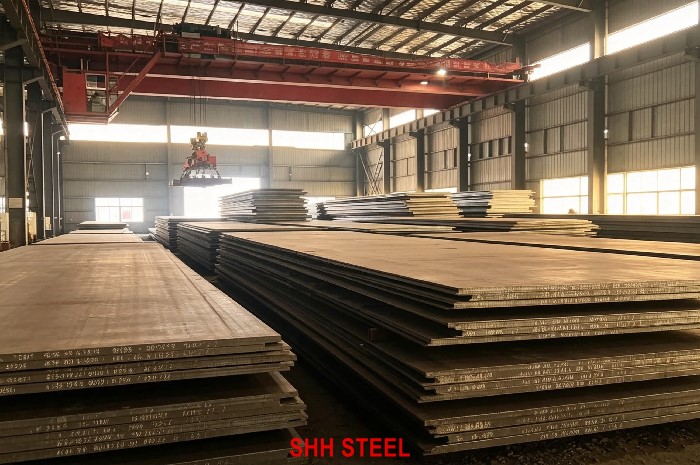
ISO 630-2 S275B Steel Plate | S275B Structural Plate, 20°C Impact
General Description of ISO 630-2 S275B Steel Plate
ISO 630-2 S275B steel plate is grade S275, quality B, of ISO 630-2:2021 (Edition 3), the international standard for technical delivery conditions for structural steels for general purposes. Quality B is impact-tested at 20 °C (clause 4.2). The document applies to reversing-mill plates, wide flats, hot-rolled sections and bars, used in the as-delivered condition and normally intended for welded or bolted structures. Part 2 is not the ISO 630 part that specifies weldable fine-grain structural steels. This page is written to ISO 630-2:2021; confirm that this is the edition on the order. Mechanical-property tables were not inspected for this page; confirm Tables A.4, A.5 and A.6 against the official text.
Annex A covers grades S235, S275, S355 and S460; Annex B covers grades SG205, SG250, SG285 and SG345. Clause 4.3 requires the two annexes to be regarded separately and not combined. S460 is listed for long products only (Table A.1 note k) and is not written as a plate grade on this page. The quality letter is part of the designation. S275B is not interchangeable with the other S275 qualities, or with S235 or S355 of any quality.
General technical delivery conditions are given in ISO 630-1, the normative reference of ISO 630-2:2021. Confirm the official texts of both documents for the edition stated on the order.
ISO 630-2 S275B Steel Plate Material Specification
As of 12 November 2026, ISO 630-2:2021 (Edition 3, April 2021) remains published. It cancels and replaces the second edition (ISO 630-2:2011) and was technically revised. This page is written to ISO 630-2:2021. A systematic review closed on 3 September 2026; this page does not treat that close as a withdrawal, as a confirmation step that changes the text, or as the publication of a replacement edition. Buyers should confirm that ISO 630-2:2021 is the edition stated on the order. This page does not tabulate any later edition.
ISO 630-2 S275B Steel Plate is specified in ISO 630-2:2021, whose title is “Technical delivery conditions for structural steels for general purposes.” The document applies to steel plates rolled on a reversing mill, wide flats, hot-rolled sections and bars, used in the as-delivered condition and normally intended for welded or bolted structures. Continuous-mill sheet and strip, and tubular products, are outside the Scope. In every part of ISO 630, “thickness” means nominal thickness unless otherwise stated.
For grade S275, the Scope limits flat products to nominal thicknesses of not less than 3 mm and not more than 400 mm, and long products to not less than 3 mm and not more than 250 mm. This page is a reversing-mill plate page. The tighter S460 long-product limit of 150 mm does not apply to S275. There is no Quality A row for S275 in Table A.1 as inspected; this page does not treat S275A as a listed Annex A designation.
General technical delivery conditions, including the information the purchaser shall supply, the available options, the carbon-equivalent formula, surface condition, internal soundness, dimensions and tolerances, test methods, inspection documents and marking, are given in ISO 630-1, which is the sole normative reference of ISO 630-2:2021. If the purchaser does not specify any ISO 630-1 option at enquiry and order, the products are supplied to the basic specification (clause 5.2). Clause 4.1 requires the grades to be classified as unalloyed or alloy steels; this page does not assign that classification from the grade name alone. Confirm classification, options and any special steelmaking process against the official texts of ISO 630-2:2021 and ISO 630-1.
ISO 630-2 S275B Steel Plate Chemical Composition
Clause 6.3.1 requires the heat analysis of Annex A grades to comply with Table A.1. Clause 6.3.2 requires the product analysis of grades S235, S275, S355 and S460 to comply with Table A.2. The tables below give the S275 rows as read from Tables A.1 and A.2 of ISO 630-2:2021. This page is quality B (S275B); the other S275 qualities are shown so that the differences can be read together. They are not substitutes for the ordered quality. Silicon is not specified as a Table A.1 or Table A.2 maximum for S275. All listed figures are maxima. Table A.1 note i is marked on quality C, and Table A.2 note i is marked on qualities C and D; those notes tighten carbon above 150 mm (see the notes below). Confirm against the official Table A.1 whether quality D carries the same note.
Table A.1 — chemical composition, % by mass, heat analysis, grade S275
| Quality | Deoxidation | C max., ≤ 16 mm, % | C max., > 16 mm to ≤ 40 mm, % | C max., > 40 mm, % | Si max., % | Mn max., % | P max., % | S max., % | N max., % | Cu max., % | Other max., % |
|---|---|---|---|---|---|---|---|---|---|---|---|
| B | FN | 0.21 | 0.21 | 0.22 | — | 1.50 | 0.035 | 0.035 | 0.012 | 0.55 | — |
| C | FN | 0.18 | 0.18 | 0.18 (note i) | — | 1.50 | 0.030 | 0.030 | 0.012 | 0.55 | — |
| D | see Table A.3; confirm Table A.1 | confirm official | confirm official | confirm official | confirm official | confirm official | confirm official | confirm official | confirm official | confirm official | confirm official |
Table A.2 — chemical composition, % by mass, product analysis, grade S275
| Quality | Deoxidation | C max., ≤ 16 mm, % | C max., > 16 mm to ≤ 40 mm, % | C max., > 40 mm, % | Si max., % | Mn max., % | P max., % | S max., % | N max., % | Cu max., % | Other max., % |
|---|---|---|---|---|---|---|---|---|---|---|---|
| B | FN | 0.24 | 0.24 | 0.25 | — | 1.60 | 0.045 | 0.045 | 0.014 | 0.60 | — |
| C | FN | 0.21 | 0.21 | 0.21 (note i) | — | 1.60 | 0.040 | 0.040 | 0.014 | 0.60 | — |
| D | FF | 0.21 | 0.21 | 0.21 (note i) | — | 1.60 | 0.035 | 0.035 | — | 0.60 | — |
Clause 6.3.3 and Table A.3 give the maximum carbon equivalent (CEV) on heat analysis. For S275, qualities B, C and D share the same CEV maxima:
| Grade / qualities | ≤ 30 mm, % | > 30 mm to ≤ 40 mm, % | > 40 mm to ≤ 150 mm, % | > 150 mm to ≤ 250 mm, % | > 250 mm to ≤ 400 mm, % |
|---|---|---|---|---|---|
| S275 (B, C and D) | 0.40 | 0.40 | 0.42 | 0.44 | 0.44 |
Table A.1 note b: FN means rimming steels are not permitted; FF means fully killed steel. Clause 6.1 requires the steels to be killed (non-rimming). Quality D is listed as FF (fully killed). Qualities B and C are listed as FN, which is not the same as a fully killed requirement.
Table A.1 note c is written for sections thicker than 100 mm (carbon by agreement) and is not applied on this plate page. Table A.1 notes d and e (a 0.005 % higher phosphorus and sulphur allowance, and an agreed 0.015 % higher sulphur maximum for improved machinability when the steel is treated to modify the sulphide morphology and shows a minimum of 0.0020 % Ca) are written for long products. Table A.2 notes d and e are written for sections and bars. Do not apply those allowances to plate unless the official text and the order say so.
Table A.1 note f (heat analysis): the nitrogen maximum does not apply if the composition shows a minimum total aluminium of 0.020 %, or a minimum of 0.015 % acid-soluble aluminium, or sufficient other nitrogen-binding elements; those elements shall be mentioned in the inspection document. This exception is relevant where nitrogen is specified (qualities B and C). Table A.2 note f gives a nitrogen exception for product analysis with different aluminium figures (read as 0.015 % total aluminium or 0.013 % acid-soluble aluminium); confirm the official wording and figures of Table A.2 notes d to g, which are not the same as Table A.1 note f.
Table A.1 note g: copper above 0.40 % on heat analysis can cause hot shortness during hot forming. Table A.2 note g (confirm official wording) gives 0.45 % on product analysis for the same warning. Note h: if other elements are added, they shall be mentioned on the inspection document.
Table A.1 note i is clearly marked on quality C: for nominal thickness greater than 150 mm, the heat-analysis carbon maximum is 0.20 %. Confirm against the official Table A.1 whether quality D carries the same note. Table A.2 note i is clearly marked on qualities C and D and gives a product-analysis carbon maximum of 0.22 % for nominal thickness greater than 150 mm. Quality B has no note-i superscript; its Table A.1 carbon maximum above 40 mm is 0.22 %, and its Table A.2 carbon maximum above 40 mm is 0.25 %. Notes j, k and l are written for S355 or S460 and are not applied to S275.
The Table A.1 quality D cells were not clearly legible in the inspected text, and their numeric values are omitted from this page. Confirm every Table A.1 quality D cell against the official text. Table A.3, which was clear, lists quality D as FF (fully killed). The Table A.2 quality D row (product analysis) was clear and is tabulated above.
Table A.3 note 1, which applies to all S235, S275 and S355 qualities, allows an agreed copper content of 0.25 % to 0.40 % on heat analysis and 0.20 % to 0.45 % on product analysis; in that case the maximum CEV of Table A.3 is increased by 0.02 %. State that option on the order if it is required. Table A.3 note 2 applies to S275 (and to S355): when products are supplied with a control on silicon (for example for hot-dip zinc coating) so that other elements such as carbon and manganese may need to be increased to achieve the required tensile properties, the maximum CEV of this table is increased by 0.02 % where silicon is not more than 0.030 %. A further CEV increase is specified where silicon is not more than 0.25 %; the increment itself was not clearly legible in the inspected text and is omitted here. Confirm that increment against the official text of note 2. State a silicon-controlled delivery on the order if it is required. The CEV formula is given in ISO 630-1 and is not restated here.
The figures in the tables above were read from Tables A.1, A.2 and A.3 of ISO 630-2:2021. A maximum is an upper limit, not a target addition. An em dash means the element is not specified in that cell. Confirm every cell and every footnote against the official text of ISO 630-2:2021 before use on an order. Product-analysis maxima in Table A.2 must not be used to widen the heat-analysis order limits of Table A.1.
ISO 630-2 S275B Steel Plate Mechanical Properties
The designation S275B identifies grade S275, quality B, of Annex A. Quality B is impact-tested at 20 °C (clause 4.2). That is the specified test temperature, not a design temperature and not an impact-energy value.
Clause 6.4.1 requires the tensile properties at room temperature to comply with Tables A.4 and A.5. Clause 6.4.2 requires Charpy V-notch impact properties to comply with Table A.6. Those three tables were not in the portion of ISO 630-2:2021 inspected for this page (the inspected text ends at Table A.3). This page therefore does not tabulate yield strength, tensile strength, elongation or impact energy, and it does not borrow those figures from EN 10025-2 S275JR or from another ISO 630 part. Confirm Tables A.4, A.5 and A.6, including any thickness bands, specimen size and validity rules, against the official text of ISO 630-2:2021.
Clause 6.4.2 requires the orientation of the impact specimens to be longitudinal unless a transverse orientation is agreed between the purchaser and the manufacturer (see clause 5.2 and ISO 630-1). If a transverse test is required, state it on the order. Clause 8.1 requires verification of mechanical properties to be by heat. Clause 8.2.1 defines the Annex A test unit as products of the same form, grade, quality, delivery condition and thickness range as specified in Table A.4 for the yield strength, taken by heat and 60 tonnes or part thereof, or 80 tonnes or part thereof for heavy sections with a mass greater than 200 kg/m, or for all sections if the mass of the heat exceeds 200 tonnes. By agreement at the time of ordering, two tests by heat may be used. The Table A.4 thickness bands themselves were not inspected and are not restated here.
ISO 630-2 S275B Steel Plate Delivery Conditions
At the manufacturer’s discretion, clause 6.2 requires products to be delivered in the as-rolled condition, the normalized-rolled condition, the normalized condition, or the thermomechanical processed condition. The delivery condition shall be indicated in the inspection document. Do not assume a normalized or thermomechanically processed delivery from the grade name alone. If a particular condition is required, state it on the order; the options of ISO 630-1 may apply (clause 5.2).
The mandatory information to be supplied by the purchaser is specified in ISO 630-1 (clause 5.1). On the order, state the edition (ISO 630-2:2021), the grade and quality (S275B), the product form and dimensions, the quantity, the type of inspection document (specific or non-specific — clause 7), and any required option: a stated delivery condition, the agreed copper range of Table A.3 note 1, a transverse impact-specimen orientation, a special steelmaking process, or other ISO 630-1 options. If a special steelmaking process is specified, it shall be reported in the inspection document (clause 6.1). The steels shall be killed (non-rimming).
ISO 630-2 S275B Steel Plate Weldability
Weldability is supported by the killed (non-rimming) requirement of clause 6.1, the Table A.1 and Table A.2 chemistry, and the Table A.3 maximum CEV on heat analysis. For S275, that CEV is 0.40 % up to 40 mm, 0.42 % above 40 mm up to 150 mm, and 0.44 % above 150 mm up to 400 mm. If the agreed copper option of Table A.3 note 1 is used, those maxima increase by 0.02 %. If a silicon-controlled delivery under Table A.3 note 2 is agreed, the same maxima increase by 0.02 % where silicon is not more than 0.030 %. A further CEV increase is specified where silicon is not more than 0.25 %; that increment was not clearly legible in the inspected text and is omitted here — confirm it against the official note. The CEV formula is in ISO 630-1 and is not restated on this page. Table A.3 note 2 is written for S275 and S355 and is applied here as an order option, not as a default.
A listed CEV maximum is not a welding procedure, a preheat schedule or a qualified joint. The fabricator shall qualify welding to the project specification and to the official edition on the order. This page does not tabulate preheat, heat-input or hydrogen controls. Copper above the Table A.1 note g threshold can cause hot shortness during hot forming; take that warning into account if copper is at the upper end of the permitted range or if the agreed copper option is used. S275B is not a weathering grade; atmospheric-corrosion-resistant structural steels are specified in ISO 630-5, not in Part 2.
ISO 630-2 S275B Steel Plate Tolerances
Clauses 6.5 (surface condition), 6.6 (internal soundness) and 6.7 (dimensions, tolerances on dimensions and shape, and mass) of ISO 630-2:2021 all refer to ISO 630-1. Test methods (clause 9) and marking (clause 10) also refer to ISO 630-1. This page does not tabulate the ISO 630-1 tolerance, surface or soundness tables, and it does not assign a dimensional standard on this page. Confirm those requirements against the official text of ISO 630-1 and any dimensional standard it cites.
Clause 7 requires the type of inspection document (specific or non-specific) to be specified, by reference to ISO 630-1. State the document type on the order. Do not assume a specific inspection document, an ultrasonic class or a surface class from the grade name alone.
ISO 630-2 S275B Steel Plate Applications and service limits
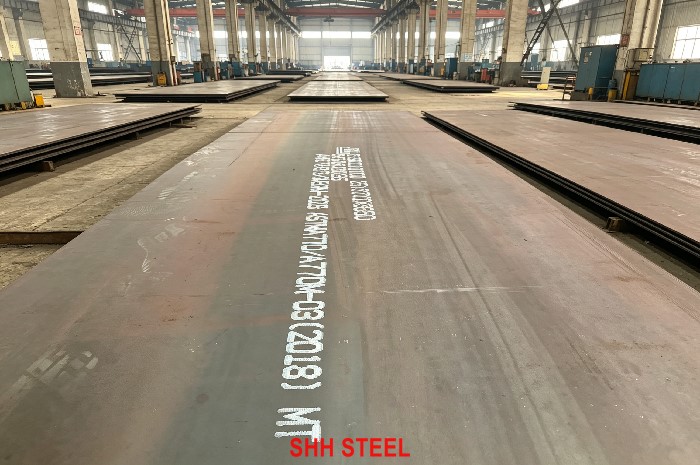
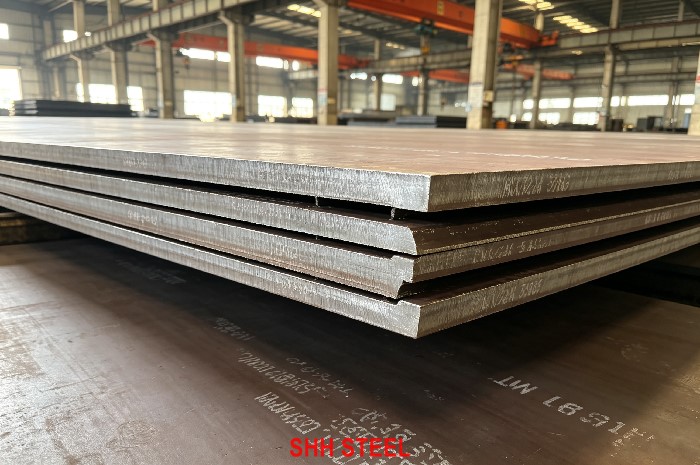
S275B plate under ISO 630-2:2021 is a general-purpose structural steel for use in the as-delivered condition, normally in welded or bolted structures, as reversing-mill plate within the Scope thickness limits. The Scope also covers wide flats, hot-rolled sections and bars; those forms are not the subject of this plate page. Continuous-mill sheet and strip, and tubular products, are outside the document.
Quality B is impact-tested at 20 °C. That test temperature is not, by itself, a permitted service temperature. Selection of the quality, the thickness, the delivery condition and any agreed option is a design decision for the project engineer. This page does not assign a minimum design temperature, a pressure-equipment duty, a fire rating or a fatigue class. Part 2 is not a fine-grain structural-steel specification. Confirm fitness for the intended service against the official standard, the project specification and the quality document.
Compare S275B with related ISO 630-2 grades
The three listed S275 qualities differ in impact-test temperature, in deoxidation and in some chemistry maxima. They are not interchangeable. Quality B is FN, with heat-analysis carbon 0.21 % maximum up to 40 mm and 0.22 % above 40 mm, and phosphorus and sulphur 0.035 % maximum; quality C is FN, with carbon 0.18 % maximum in every Table A.1 thickness band, 0.20 % maximum above 150 mm (note i), and phosphorus and sulphur 0.030 % maximum. Quality D is listed as FF (fully killed) in Table A.3, which was clear. Table A.1 quality D chemistry is omitted because those cells were not clearly legible; confirm the official Table A.1. Table A.2 quality D, which was clear, has product-analysis carbon 0.21 % maximum in each thickness band, with note i (0.22 % above 150 mm), phosphorus and sulphur 0.035 % maximum, and nitrogen not specified. Impact-test temperatures are 20 °C, 0 °C and −20 °C respectively (clause 4.2). CEV maxima in Table A.3 are the same for all three qualities.
- ISO 630-2 S275C is quality C, impact-tested at 0 °C. It is a different quality of the same grade, not a substitute for S275B.
- ISO 630-2 S275D is quality D, impact-tested at −20 °C. It is a different quality of the same grade, not a substitute for S275B.
S235 and S355 of Annex A are other grades in the same document, with their own Table A.1, A.2 and A.3 rows. This page does not tabulate those rows and does not treat them as interchangeable with S275. S460 is listed for long products only (Table A.1 note k) and is not written as a plate grade here. Annex B grades SG205, SG250, SG285 and SG345 belong to an annex that clause 4.3 requires to be regarded separately, without combining with Annex A in any way; they are not substitutes for S275B.
Related products under EN 10025-2 are compared in the Equivalent Material Grade section. They are not ISO 630-2 designations and are not automatic equivalents. Weathering-resistant structural steels are specified in ISO 630-5, a sibling part, not in Part 2.
ISO 630-2 S275B Steel Plate Equivalent Material Grade
The heading identifies a comparison topic, not a declaration of interchangeable material. No automatic foreign equivalent or dual certification is offered for S275B. A similar impact-test temperature, or a similar grade number, is not interchangeability.
| Standard | Country-Region | Equivalent Grade | Note |
|---|---|---|---|
| ISO 630-2:2021 | International (ISO) | S275B | This page. Annex A general-purpose structural steel, quality as designated. Not interchangeable with other S275 qualities, with other Annex A grades, or with Annex B grades. |
| EN 10025-2 | Europe | S275JR | Related structural plate at the same impact-test temperature class (20 °C). Not equivalent. Official correspondence tables were not inspected. Verify chemistry, tensile and impact requirements, thickness, delivery condition and the project specification. Engineer approval is required. Not a verified formal equivalent. |
None of those relationships is interchangeability. Confirm every requirement against the official text of each standard named on the order, and obtain engineer approval before any substitution.
Why choose Us
SHH STEEL produces and exports ISO 630-2 general-purpose structural plate, including ISO 630-2 S275B Steel Plate. We review the ordered edition, grade and quality, thickness, delivery condition, inspection-document type and agreed options before production, and we state the actual results on the inspection document. We do not treat a related EN 10025-2 designation, or another ISO 630-2 quality or grade, as a substitute for the ordered designation.
Orders are accepted against ISO 630-2:2021 unless the order states a different edition. Enquiry details should include the edition, the grade and quality, dimensions, quantity, the delivery condition if a particular condition is required, the inspection document type, and any agreed options (copper range, impact-specimen orientation, special steelmaking). See the ISO 630-2 hub for the product family.
Our Service
Supply covers production to the ordered ISO 630-2:2021 requirements, together with mill documentation and export packing and shipment. Inspection documents record the actual heat analysis, the delivery condition, and the mechanical results required by the official tables of the edition on the order. Agreed options (the Table A.3 note 1 copper range, a stated delivery condition, a transverse impact test, a special steelmaking process) are supplied when they are stated on the order, not by default.
To enquire, state ISO 630-2:2021, grade and quality S275B, dimensions, quantity, the inspection-document type and any required options. SHH STEEL will confirm manufacturability and the inspection plan against that order. This page is a product description written to ISO 630-2:2021; the official standard of the edition on the order, and the inspection document, govern acceptance.
FAQ
-
What is S275B steel plate?
-
ISO 630-2 S275B Steel Plate is grade S275, quality B, under ISO 630-2:2021, for general-purpose structural use as reversing-mill plate. Quality B is impact-tested at 20 °C. It is not a fine-grain steel by Part 2 designation alone, and it is not interchangeable with the other S275 qualities or with other Annex A or Annex B grades.
-
Is ISO 630-2:2021 the current edition?
-
Yes, as of 12 November 2026. ISO 630-2:2021 (Edition 3, April 2021) remains published and is the edition used on this page. It cancels and replaces ISO 630-2:2011. A systematic review closed on 3 September 2026; this page does not treat that close as a withdrawal or as the publication of a replacement edition. State ISO 630-2:2021, together with the grade and the quality, on the order, and confirm that this is the edition that applies. This page does not tabulate any later edition.
-
What impact test applies to S275B?
-
Clause 4.2 requires quality B to be impact-tested at 20 °C. The impact energy, specimen size and validity rules are in Table A.6, which was not inspected for this page and is not tabulated here. Do not assume an energy value from a related EN 10025-2 designation. Specimens are longitudinal unless a transverse orientation is agreed (clause 6.4.2). Confirm Table A.6 against the official text, and state any required orientation on the order.
-
Is S275B equivalent to EN 10025-2 S275JR?
-
No. EN 10025-2 S275JR is a related structural plate at the same impact-test temperature class. It is not a verified formal equivalent and is not a substitute for S275B. Official correspondence tables were not inspected. Verify chemistry, tensile and impact requirements, thickness, delivery condition and the project specification. Engineer approval is required before any substitution.
-
How should S275B steel plate be ordered?
-
State ISO 630-2:2021, the grade and quality S275B, the product form and dimensions, the quantity, and the type of inspection document. If a particular delivery condition is required (as-rolled, normalized rolled, normalized or thermomechanical processed), state it; otherwise clause 6.2 leaves the condition to the manufacturer’s discretion, and it shall be recorded on the inspection document. State any agreed option (copper range, transverse impact test, special steelmaking). The mandatory purchaser information is specified in ISO 630-1.
Enquire about ISO 630-2 S275B Steel Plate
Enquire for ISO 630-2 S275B Steel Plate to ISO 630-2:2021. State the grade and quality S275B, the dimensions, the quantity, the delivery condition if a particular condition is required, the inspection-document type and any agreed options. SHH STEEL will confirm the inspection plan against the official tables of the edition on the order. The official standard and the inspection document govern acceptance.
Quality Steel Needed? Inquire for Offers
Related Products
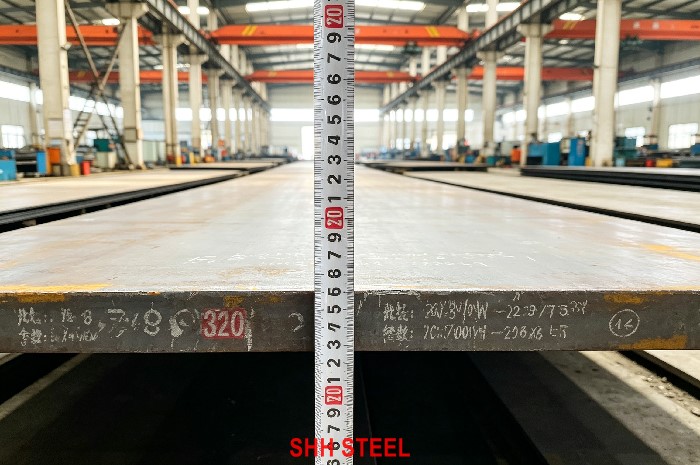
ISO 630-2 S355C Steel Plate | S355C Structural Plate, 0°C Impact
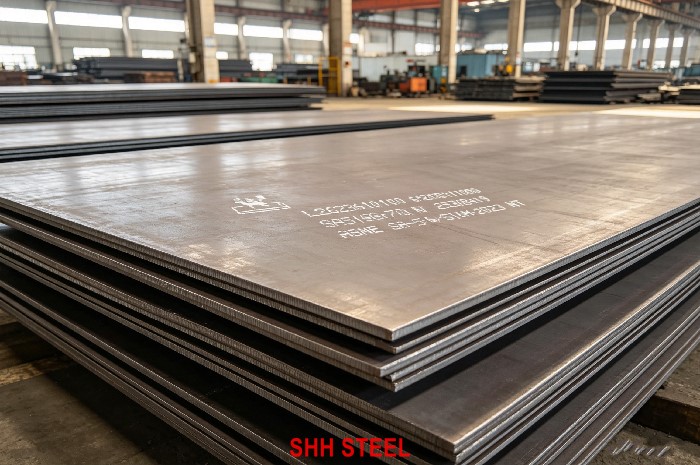
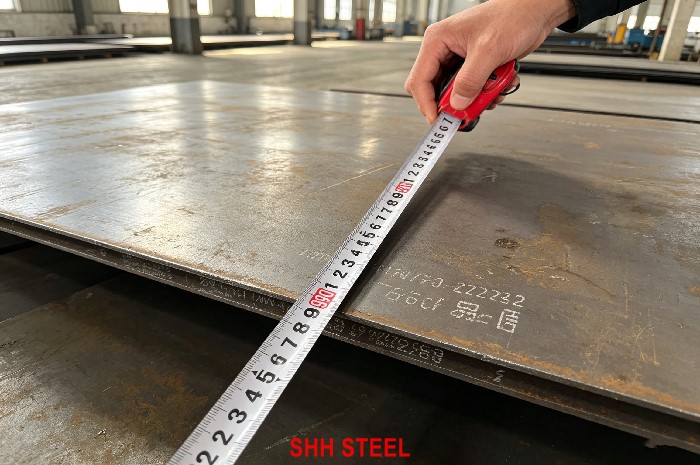
ISO 630-2 S275D Steel Plate | S275D Structural Plate, -20°C Impact
ISO 630-2 S355D Steel Plate | S355D Structural Plate, -20°C Impact

