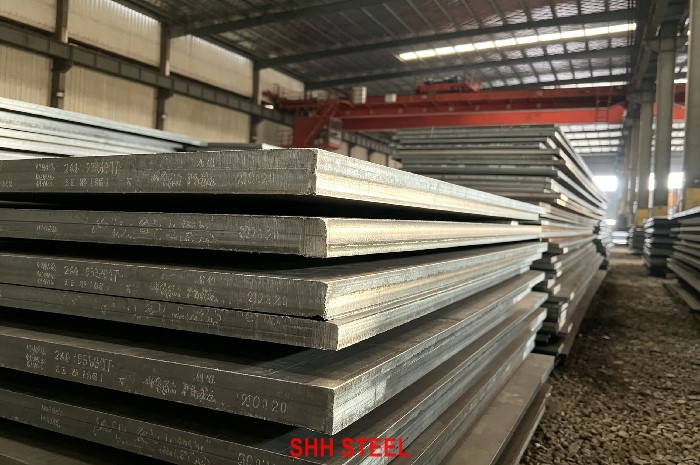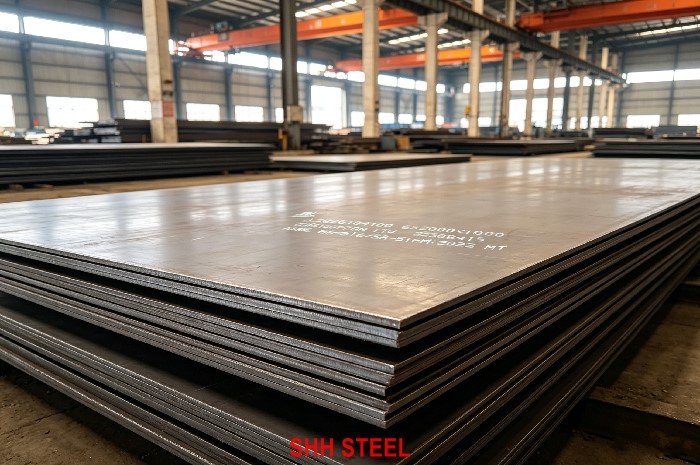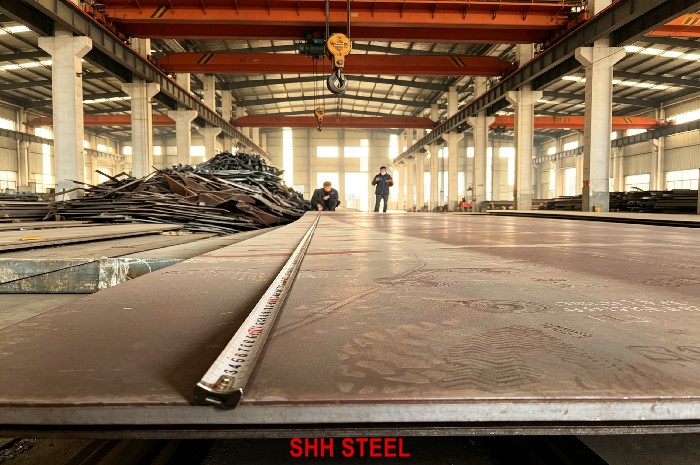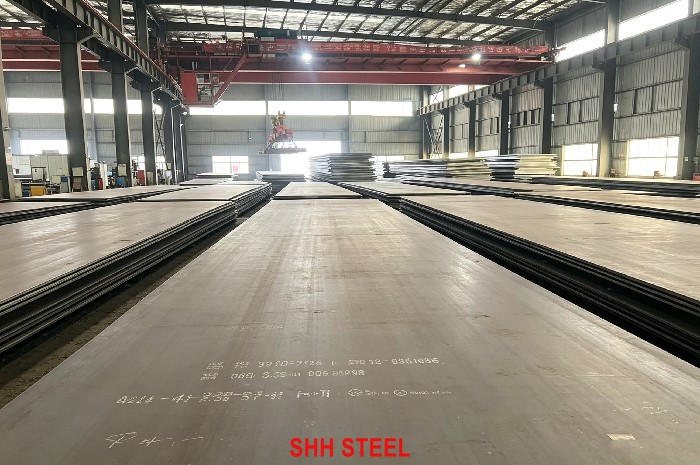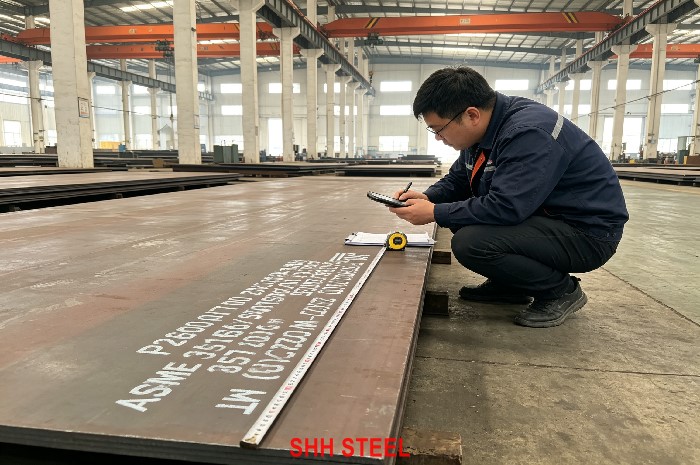
GOST 19281 14G2 Steel Plate | 14G2 HSLA Rolled Steel Plate
General Description of GOST 19281 14G2 Steel Plate
GOST 19281 14G2 Steel Plate is listed in Table 7 under unalloyed quality steels, with ladle carbon 0.12–0.18 %, silicon 0.17–0.37 % and manganese 1.20–1.60 %. Chromium, nickel and copper are residual limits of not more than 0.30 %, and vanadium is a residual limit of not more than 0.12 %. There is no specified nitrogen-alloying range. Those cells distinguish 14G2 from 14G2AF, which is listed under alloyed steels with the same carbon and manganese ranges but silicon 0.30–0.60 %, vanadium 0.07–0.12 %, nitrogen 0.015–0.025 % and chromium not more than 0.40 %, and which Table A.2 places at classes 375 and 390 rather than 325. A shared class 390 Table 10 cell is not interchangeability.
Composition-1 is written 14G2-1 and is specified on this page, not as a separate article. Silicon on 14G2-1 remains the 0.17–0.37 % range; only manganese is an upper limit (not more than 1.60 %). Table 7 note 7 does not recommend composition-1 steel for articles the customer will heat-treat. Table 7 has no 14G2D row; this page does not invent one. The copper-bearing 14G2AFD family is a different alloyed designation.
GOST 19281 14G2 Steel Plate Material Specification
As of 12 November 2026, GOST 19281-2014 remains in force. It was introduced on 1 January 2015, replaces GOST 19281-89, and has restricted validity until 1 December 2026. It is applied with Amendment 1, which has been in force from 1 June 2020. This page is written to the 2014 edition, with Amendment 1 where that amendment is known. GOST 19281-2025 has been adopted and takes effect on 1 December 2026, so buyers should confirm which edition applies to their order. The 2025 edition has a right of early application; this page does not tabulate 2025 requirements. Two one-page corrections issued after Amendment 1 were not inspected for this page; confirm any later correction against the official text of the edition stated on the order.
The official English title of GOST 19281-2014 is “High strength rolled steel. General specification.” The standard covers hot-rolled plate, universal wide strip, bars, sections and bent profiles of high strength for general-purpose structures with welded, riveted or bolted connections. This page is the plate product. Table A.2 recommends 14G2 and 14G2-1 at class 325 up to 32 mm, in a dedicated row, and at class 390 up to 32 mm with footnote **. It does not list 14G2 at classes 265, 295, 315, 345, 355, 375 or 440.
Order the plate by strength class and by grade. The classes used in the standard are 265, 295, 315, 325, 345, 355, 375, 390 and 440. Each class is a specified minimum yield strength in N/mm², subject to any higher Table 10 cell for a named grade and thickness. Inspection categories, delivery condition, guaranteed weldability (GS) and any listed variant must be stated on the order; they are not implied by the grade name.
GOST 19281 14G2 Steel Plate Chemical Composition
The ladle analysis below was read from Table 7 of the 2016 reprint (unalloyed-quality heading, PDF page 17). Amendment 1 does not change these numeric cells. Values are mass fraction, in %.
| Grade | C | Si | Mn | P max | S max | Cr | Ni | Cu | V | Other |
|---|---|---|---|---|---|---|---|---|---|---|
| 14G2 | 0.12–0.18 | 0.17–0.37 | 1.20–1.60 | 0.030 | 0.035 | ≤0.30 | ≤0.30 | ≤0.30 | ≤0.12 | — |
| 14G2-1 | 0.12–0.18 | 0.17–0.37 | ≤1.60 | 0.030 | 0.035 | ≤0.30 | ≤0.30 | ≤0.30 | ≤0.12 | — |
Table 7 is ladle analysis, read from the 2016 reprint. Amendment 1 does not change the numeric chemistry cells for 14G2, 14G2AF or 16G2AF, or for the composition-1 and copper-bearing rows listed with them. Table 8 gives product-analysis deviations, also read from the 2016 reprint. For elements whose Table 7 cell is an upper limit only, Table 8 note 2 applies only the plus deviations. Carbon on these base grades is a range with both a lower and an upper limit, so both the plus and the minus carbon deviations apply in the product analysis of the base grades.
| Element | Product-analysis deviation, % |
|---|---|
| C | ±0.02 |
| Mn | ±0.10 |
| Si | ±0.05 |
| Cr | ±0.05 |
| Ni | ±0.05 |
| Cu | ±0.05 |
| S | ±0.005 |
| P | +0.005 (plus only) |
| N | ±0.005 |
| V | +0.02 / −0.01 |
| Ti | +0.010 / −0.005 |
| Nb | +0.010 / −0.005 |
| Al | +0.010 / −0.005 |
14G2 is not alloyed with nitrogen in Table 7, so the note-2 nitrogen limits above apply unless a different agreement is stated. Silicon on 14G2-1 remains a range (0.17–0.37 %), not an upper limit only; only manganese is an upper limit (not more than 1.60 %) on that composition-1 row, so Table 8 note 2 (plus deviations only) applies to manganese on 14G2-1, not to silicon.
Arsenic shall not exceed 0.08 % in steel of all grades (Table 7 note 1). Nitrogen in steel that is not alloyed with nitrogen shall not exceed 0.008 % without secondary metallurgy, or 0.010 % with secondary metallurgy. Amendment 1 allows nitrogen up to 0.012 % inclusive provided the product meets the official Tables 11 and 12 for impact after mechanical ageing, regardless of the ordered category, including an order without a category. A further nitrogen-equivalent provision is stated in note 3; confirm that provision against the official text.
Amendment 1, Table 7 note 4, requires aluminium deoxidation of 0.02–0.06 % for grades 09G2, 09G2-1, 09G2S, 09G2S-1 and 10KhSND. That list does not include 14G2, 14G2AF or 16G2AF. Do not treat that aluminium range as a mandatory ladle requirement for this grade from note 4. Amendment 1 note 5 still permits microalloying with aluminium, titanium and niobium, calculated to give aluminium not more than 0.05 %, titanium not more than 0.04 % and niobium not more than 0.05 %, unless other mass fractions are stated in Table 7; those elements are controlled and stated in the quality document when that option is used.
Table 7 note 7: composition-1 grades (the digit 1 after a hyphen in the designation) are not recommended for articles the customer will heat-treat. If the purchaser will heat-treat the plate, do not select a composition-1 variant on that recommendation alone; agree the grade and the treatment with the manufacturer.
Table 7 note 8: when the product is made on a rolling-casting module, the lower carbon limit may be removed for 14G2 (and for other named grades that are not this page’s subject, including 14G2AF and 14G2AFD), provided all requirements of the standard are met. That option is not implied by the grade name; confirm it against the official text and state it on the order if it is used. Note 8 does not name 14G2-1.
Amendment 1 note 11 (niobium microalloying and non-rejectable lower silicon or carbon limits) names only 09G2S and 17G1S. It does not name 14G2, 14G2AF or 16G2AF.
GOST 19281 14G2 Steel Plate Mechanical Properties
Annex A is a recommended annex. Table A.2 lists grades that provide the stated strength class at the stated thickness for plate, universal wide strip and bent profiles. A listing in Table A.2 is not a certificate that every thickness in the band is interchangeable with every other grade in the same cell, and it is not a substitute for the Table 10 tensile minima of the ordered class. Footnote * permits controlled rolling (KP) or controlled rolling followed by accelerated cooling. Footnote ** permits controlled rolling, thermomechanical treatment (TMO) or thermal strengthening (TY). Amendment 1 replaced only the class 375 row of Table A.2; the other rows below were visually read from the 2016 reprint, which Amendment 1 does not rewrite.
For 14G2, Table A.2 (2016 visual; Amendment 1 does not rewrite these classes) lists the following recommended plate combinations:
| Strength class | Thickness in Table A.2 (2016 visual; not rewritten by Amendment 1 for these classes) | 14G2 family listed | Table A.2 footnote |
|---|---|---|---|
| 325 | Up to 32.0 mm inclusive (dedicated row) | 14G2, 14G2-1 only | — |
| 390 | Up to 32.0 mm inclusive | 14G2, 14G2-1, with 10G2S1 and other named grades | ** (controlled rolling, TMO or thermal strengthening) |
Table 10 gives minimum yield strength (ReH, σ_T), tensile strength (Rm, σ_B) and percentage elongation after fracture (δ5) for plate, universal wide strip and bent profiles. The yield minimum equals the strength class, except where Table 10 states a higher figure for a named grade group. Amendment 1 rewrote the thickness column of Table 10 for strength classes 295, 345, 355 and 440. The yield, tensile-strength and elongation minima below were read from the 2016 reprint of Table 10, whose mechanical columns Amendment 1 did not describe as replaced. Use the official Amendment 1 (2021 consolidated) table for the current thickness bands of those four classes, including any footnote that applies to thicker product. A 2016 footnote that treated some thicker bands as non-rejectable until 1 January 2016 has elapsed.
Table 10 lists 14G2 and 14G2-1 at class 325 in three thickness bands, all with ReH 325 N/mm², Rm 450 N/mm² and elongation 21 %, and at class 390 up to 50 mm with ReH 390 N/mm², Rm 510 N/mm² and elongation 19 %. 14G2 is not in the Table 10 groups for classes 265, 295, 315, 345, 355, 375 or 440.
| Strength class | Thickness label in the 2016 Table 10 (see the Amendment 1 note) | ReH min, N/mm² | Rm min, N/mm² | Elongation δ5 min, % | Grade group and A.2 relationship |
|---|---|---|---|---|---|
| 325 | Up to 10.0 mm inclusive (thickness column not amended) | 325 | 450 | 21 | 14G2, 14G2-1 with 16GS, 09G2S, 10G2S1, 17GS, 15GF and 17G1S. Within the Table A.2 14G2 band (up to 32 mm). |
| 325 | Over 10.0 mm up to 20.0 mm inclusive (not amended) | 325 | 450 | 21 | 14G2, 14G2-1 in this group. The parallel 09G2S / 09G2S-1 cell in this band has Rm 470 N/mm². A shared class is not a shared tensile cell. |
| 325 | Over 20.0 mm up to 60.0 mm inclusive (not amended) | 325 | 450 | 21 | 14G2, 14G2-1 with 16GS, 09G2S, 10G2S1, 17GS, 15GF and 17G1S. Table A.2 recommends 14G2 at class 325 only up to 32 mm; above 32 mm this is a Table 10 listing, not an A.2 recommendation. |
| 390 | Up to 50.0 mm inclusive (not amended) | 390 | 510 | 19 | 14G2, 14G2-1 with the 14G2AF and 16G2AF families and other named grades. Table A.2 recommends 14G2 at class 390 only up to 32 mm with footnote **. A shared Table 10 cell is not interchangeability. |
Impact toughness for plate is specified in Table 12, which Amendment 1 replaced in full, and is selected by the inspection category ordered from Table 4, which Amendment 1 also replaced. Values are minima in J/cm² for KCU or KCV at the temperatures listed for that category, class, grade and thickness. A plus sign in Table 12 means the test is made to collect statistical data; the result is recorded in the quality document and is not a specified minimum. A minus sign means the property is not specified and is not tested. This page does not tabulate Table 12 cells, because an official-format 2021 (Amendment 1) Table 12 was not visually inspected and a third-party extract is not a substitute for that inspection. If impact is required, state the category, the temperature and the test type on the order, and confirm the current figures against the official table of GOST 19281-2014 with Amendment 1.
Amendment 1 marked some Table 12 cells as optional for two years from 1 June 2020. That two-year period has elapsed. Confirm the current application of those footnote cells, and of any later one-page correction, against the official text. Do not take impact figures from the 2016 reprint, from another standard, or from a handbook and apply them as the current official minima.
Amendment 1 deletes clause 5.2.1.6, which in the 2016 reprint required a 180° bend on a mandrel of diameter equal to two specimen thicknesses and allowed the manufacturer to omit the test if it guaranteed satisfactory results at the purchaser. That deleted clause is not restated on this page as a current requirement. The amended acceptance rules still provide for recording a 180° bend result, or a manufacturer’s guarantee of that bend, on the quality document. Confirm the current bend requirement against the official 2014 text with Amendment 1.
Table 10 may list a grade in a thickness band that Table A.2 does not recommend. A Table 10 listing is the tensile requirement if that class and thickness are ordered; it is not, by itself, a Table A.2 recommendation. State the class on the order.
GOST 19281 14G2 Steel Plate Delivery Conditions
The strength class is the ordering property. State the edition that applies to the order (see the Material Specification), the grade (including any composition-1 or copper-bearing D variant listed on this page), the strength class, the inspection category, the dimensions, the quantity and the delivery condition. Table A.2 recommends 14G2 plate at class 325 up to 32 mm and at class 390 up to 32 mm with footnote **. A Table A.2 listing is a recommended combination of grade, class and thickness; it is not a substitute for stating the class on the order, and it is not interchangeability with other grades listed in the same cell.
Delivery may be agreed as hot-rolled, heat-treated, or with controlled rolling (KP), controlled rolling followed by accelerated cooling, thermomechanical treatment (TMO) or thermal strengthening (TY), where Table A.2 or the order permits those routes (footnotes * and ** in Table A.2). Do not assume a heat-treated or thermomechanically treated delivery from the grade name alone. Record the actual condition on the quality document. If the purchaser will heat-treat the article after delivery, see Table 7 note 7 before selecting a composition-1 variant.
Table 7 has no 14G2D row. This page does not invent a copper-bearing D variant for 14G2. The copper-bearing 14G2AFD family is a different alloyed designation, not specified as 14G2.
GOST 19281 14G2 Steel Plate Weldability
When guaranteed weldability (designated GS) is ordered, Amendment 1 to clause 5.2.1.2 limits the carbon equivalent CEV to not more than 0.43 % for strength classes 265, 295, 315 and 325; 0.46 % for classes 345, 355 and 375; 0.48 % for class 390; and 0.51 % for class 440. The same clause also requires the manufacturing technology and the chemical composition, including the Table 8 product-analysis deviations, to support weldability. GS is not implied by the grade name; state it on the order if it is required.
This page does not give preheat, interpass, heat-input or post-weld heat-treatment figures. The fabricator is responsible for welding-procedure qualification, consumable selection, preheat and any post-weld heat treatment required by the project specification. Do not take those figures from another standard or from a handbook and apply them as GOST 19281 rules. A shared strength class, a Table A.2 listing alongside another grade, or a commonly compared foreign designation does not make those grades automatic welding substitutes.
GOST 19281 14G2 Steel Plate Tolerances
Dimensions, shape and permissible deviations for plate follow the plate-dimension standard cited by GOST 19281-2014 as updated by Amendment 1. State the required thickness, width, length, thickness-accuracy class, edge condition and, for plate supplied as sheets, the flatness class on the order. This page does not tabulate numerical deviation limits from that dimension standard.
Surface quality and dressing limits are those of GOST 19281-2014 with Amendment 1. Confirm the permitted defect types, dressing depth and area, and the prohibition on delamination against the official text. Ultrasonic testing is not a default requirement. If continuity testing is required, state the method, the class and the test volume on the order; they are not implied by the grade or the strength class.
GOST 19281 14G2 Steel Plate Applications and service limits
14G2 under GOST 19281-2014 is general-purpose high-strength rolled steel for welded, riveted or bolted structures. Typical uses are structural members, frames and fabricated platework where the ordered strength class, thickness and inspection category match the design. This page does not assign a design stress, a temperature limit or a code approval. Those come from the project specification and the design standard, not from the grade name.
Table A.2 does not recommend 14G2 plate above 32 mm at class 325 or class 390, and does not list it at class 440. Table 10 lists a wider 325 band (up to 60 mm) and a wider 390 band (up to 50 mm); those wider listings are tensile requirements if so ordered, not Table A.2 recommendations. Footnote ** at class 390 is a permitted processing route, not a default delivery. Do not use this plate as a boiler or pressure-vessel product solely because the same designation appears under GOST 5520; that is a different product standard with its own thickness, category and test regime. Do not treat a commonly compared foreign structural grade as approved for the same duty without engineer review of both complete specifications.
Compare 14G2 with related GOST 19281 grades
These three GOST 19281 grades sit next to one another in the locked title plan. 14G2 is an unalloyed-quality manganese steel. 14G2AF and 16G2AF are alloyed nitrogen-vanadium (AF) steels, with a higher chromium residual (not more than 0.40 %) and specified vanadium and nitrogen ranges. They are related, not equivalent. A shared strength class or a shared Table 10 cell is not interchangeability. Sister GOST 19281 product pages are not linked here because those URLs are not live; the designations are named for comparison only.
| Grade | Table 7 heading / C, Si, Mn, V, N, Cr | Table A.2 plate classes (summary) | Distinctive Table 10 cell |
|---|---|---|---|
| 14G2 (this plate) | Unalloyed quality. C 0.12–0.18; Si 0.17–0.37; Mn 1.20–1.60; V residual ≤0.12; not N-alloyed; Cr ≤0.30. No D row. | 325 (≤32 mm); 390 (≤32 mm, **) | Class 325: 325 / 450 / 21 %. Class 390: 390 / 510 / 19 %. |
| 14G2AF | Alloyed. C 0.12–0.18; Si 0.30–0.60; Mn 1.20–1.60; V 0.07–0.12; N 0.015–0.025; Cr ≤0.40. D and -1 listed. | 375 (10–50 mm, Amd 1 — confirm companions); 390 (≤50 mm) | Class 375: 375 / 510 / 20 %. Class 390: 390 / 510 / 19 % (shared with 14G2 and 16G2AF, not interchangeability). |
| 16G2AF | Alloyed. C 0.14–0.20; Si 0.30–0.60; Mn 1.30–1.70; V 0.08–0.14; N 0.015–0.025; Cr ≤0.40. D and -1 listed. | 390 (32–50 mm); 440 (≤32 mm, with 18G2AF) | Class 390: 390 / 510 / 19 %. Class 440: ReH 440 / Rm 590; elongation confirm official (2016 cell blank). |
GOST 19281 14G2 Steel Plate Equivalent Material Grade
No formal equivalence has been verified for the designations below. They are related designations only and are not equivalent to this GOST 19281-2014 plate. Official correspondence or equivalent-grade tables were not inspected for this page; confirm any claimed equivalent against the official texts of both standards and the project specification. Engineer approval is required before any substitution. This page does not link any external catalogue. None of those relationships is interchangeability.
| Standard | Country-Region | Equivalent Grade | Note |
|---|---|---|---|
| GOST 19281-2014 | Interstate (GOST) | 14G2 | This page’s designation. Not an equivalent of another grade. |
| GB/T 1591 | China | GB/T 1591 Q355B | Commonly compared at a mid-range yield class; not equivalent. Verify chemistry, strength class, thickness, delivery, impact category and the project specification. A similar yield class does not authorise substitution. Engineer approval is required. Not a verified formal equivalent. |
| EN 10025-2 | Europe | EN 10025-2 S355J2 | Commonly compared structural plate; not equivalent. Verify chemistry, impact temperature, delivery condition, thickness limits and the project specification. Engineer approval is required. Not a verified formal equivalent. |
Related high-strength structural plate systems, including GB/T 1591, EN 10025-2 and ASTM A572, are sometimes listed on comparison charts. No grade in those systems is listed as a verified equivalent on this page beyond the commonly compared products in the table. A chart cannot replace a review of chemistry, strength class, product form, delivery condition, mechanical tests and the project specification.
Why choose Us
SHH STEEL produces and exports GOST 19281 plate, including GOST 19281 14G2 Steel Plate. We review the ordered strength class (325 or 390 as agreed), the ladle analysis against Table 7, including the 14G2-1 silicon range and manganese upper limit where that variant is ordered, and the Table 10 tensile minima before production, and we state the actual results on the quality document. We do not treat a shared strength class, a Table A.2 cell shared with another grade, or a commonly compared foreign designation as a substitute for the ordered grade and class.
Orders are accepted against GOST 19281-2014, including Amendment 1, unless the order states the 2025 edition. Enquiry details should include the edition, grade (and any listed variant), strength class, inspection category, thickness, width, length, quantity, delivery condition and any agreed options (guaranteed weldability GS, ultrasonic class, microalloying agreement). See the GOST 19281 hub for the product family.
Our Service
Supply covers production to the ordered 2014 requirements, including Amendment 1, or to the 2025 edition if that is the edition stated on the order, together with mill documentation and export packing and shipment. Quality documents record the actual ladle analysis, tensile results for the ordered class, and, where the category requires them, impact results, including any characteristic that Table 12 marks as determined for statistical data. Guaranteed weldability and ultrasonic testing are supplied when they are agreed on the order, not by default.
To enquire, state the edition (GOST 19281-2014 with Amendment 1, or GOST 19281-2025 if that edition applies), grade 14G2, the strength class, the inspection category, dimensions, quantity and the required options. SHH STEEL will confirm manufacturability and the inspection plan against that order. This page is a product description written to the 2014 edition with Amendment 1; the official standard of the edition on the order, and the quality document, govern acceptance.
FAQ
-
What is 14G2 steel plate?
-
14G2 steel plate is a manganese high-strength rolled steel under GOST 19281-2014. Table 7 lists it under unalloyed quality steels, with carbon 0.12–0.18 %, silicon 0.17–0.37 % and manganese 1.20–1.60 %. The ordering property is the strength class. Table A.2 recommends it for plate at class 325 up to 32 mm and at class 390 up to 32 mm with footnote **. Composition-1 (14G2-1) is specified on this page.
-
Is GOST 19281-2014 still current for 14G2?
-
Yes, as of 12 November 2026. GOST 19281-2014 remains in force, applied with Amendment 1 from 1 June 2020, and has restricted validity until 1 December 2026. This page is written to the 2014 edition, with Amendment 1 where that amendment is known. GOST 19281-2025 has been adopted and takes effect on 1 December 2026, so buyers should confirm which edition applies to their order. The 2025 edition has a right of early application. State the edition, and Amendment 1 if the 2014 edition is ordered, together with the grade and the strength class, on the order. This page does not tabulate 2025 tables. Two one-page corrections issued after Amendment 1 were not inspected for this page.
-
Which strength classes can 14G2 plate be ordered in?
-
Table A.2 recommends 14G2 and 14G2-1 at class 325 up to 32 mm, in a dedicated row, and at class 390 up to 32 mm with footnote ** (controlled rolling, thermomechanical treatment or thermal strengthening). It does not list 14G2 at 265, 295, 315, 345, 355, 375 or 440. Table 10 gives tensile minima at class 325 (325 / 450 / 21 %) in bands up to 60 mm, and at class 390 (390 / 510 / 19 %) up to 50 mm. Above the Table A.2 thickness, a Table 10 listing is not an A.2 recommendation. State the class on the order.
-
How does 14G2 differ from 14G2AF?
-
14G2 is unalloyed quality, with silicon 0.17–0.37 %, residual vanadium not more than 0.12 %, no specified nitrogen range, and chromium not more than 0.30 %. 14G2AF is an alloyed nitrogen-vanadium steel with the same carbon and manganese ranges, silicon 0.30–0.60 %, vanadium 0.07–0.12 %, nitrogen 0.015–0.025 %, and chromium not more than 0.40 %. Table A.2 places 14G2 at classes 325 and 390 (up to 32 mm) and 14G2AF at classes 375 and 390 (up to 50 mm). They share a Table 10 class 390 cell (390 / 510 / 19 %); that shared cell is not interchangeability. Table 7 has no 14G2D row; 14G2AFD is a 14G2AF-family grade.
-
Is 14G2-1 a separate product, and is there a 14G2D?
-
14G2-1 is specified on this page, not as a separate article. It is composition-1: silicon remains 0.17–0.37 %, and manganese is not more than 1.60 %. Table 7 note 7 does not recommend composition-1 steel for articles the customer will heat-treat. Table 7 has no 14G2D row; this page does not invent one.
Enquire about GOST 19281 14G2 Steel Plate
Enquire for GOST 19281 14G2 Steel Plate to GOST 19281-2014, including Amendment 1, or to GOST 19281-2025 if that is the edition that applies to the order. State the grade 14G2, the strength class, the inspection category, dimensions, quantity, the delivery condition and any agreed options. SHH STEEL will confirm the inspection plan against the official tables of the edition on the order. The official standard and the quality document govern acceptance.
Quality Steel Needed? Inquire for Offers
Related Products