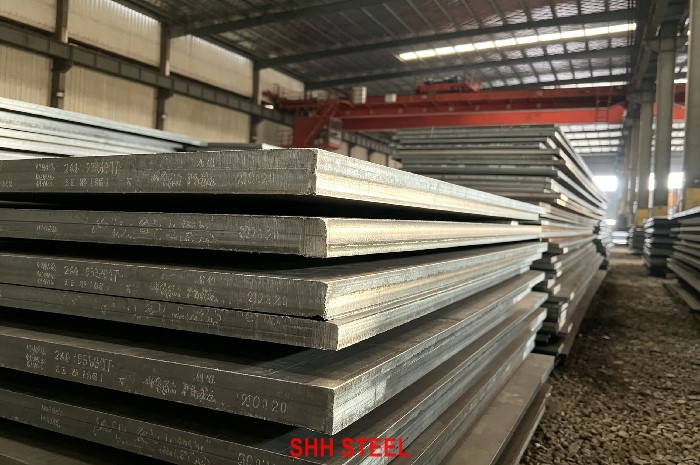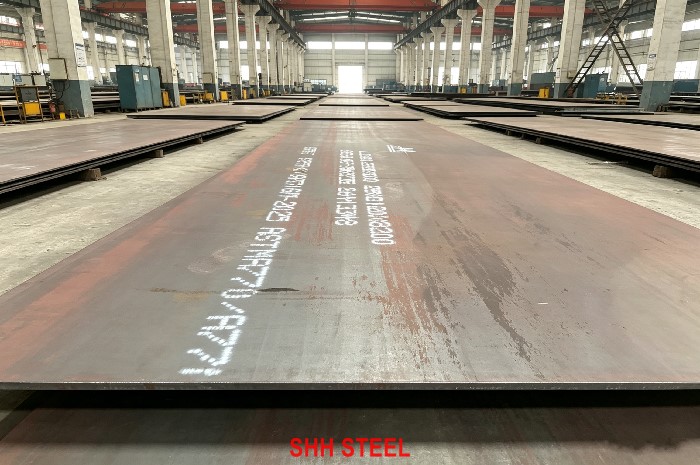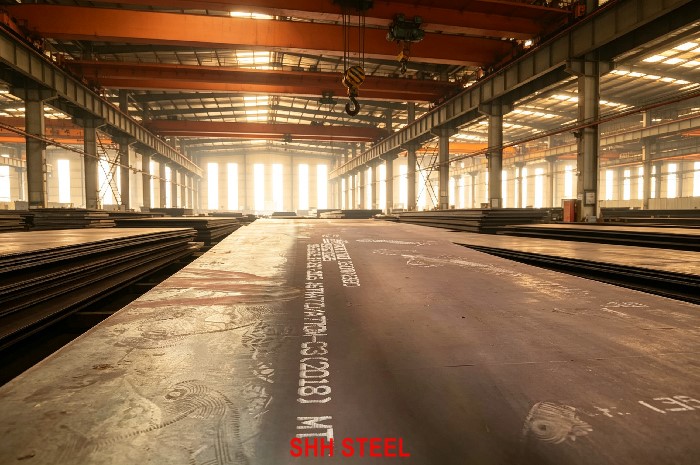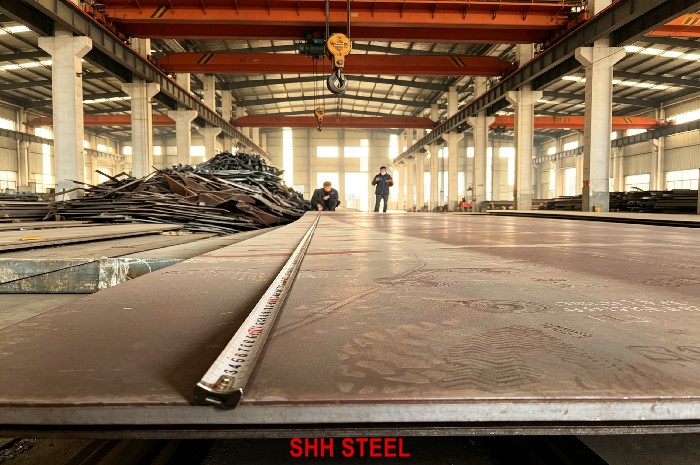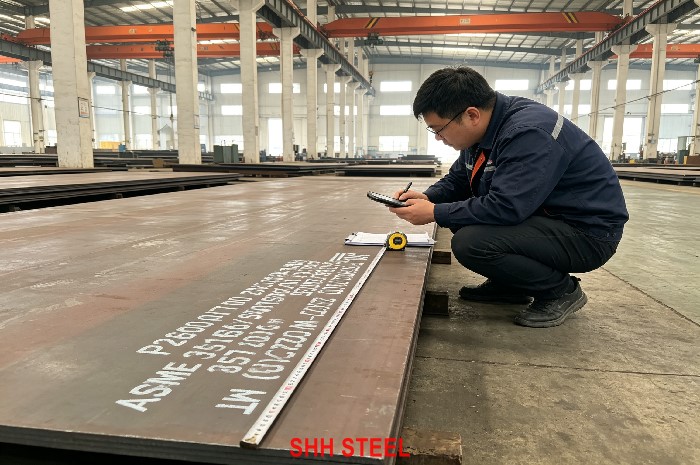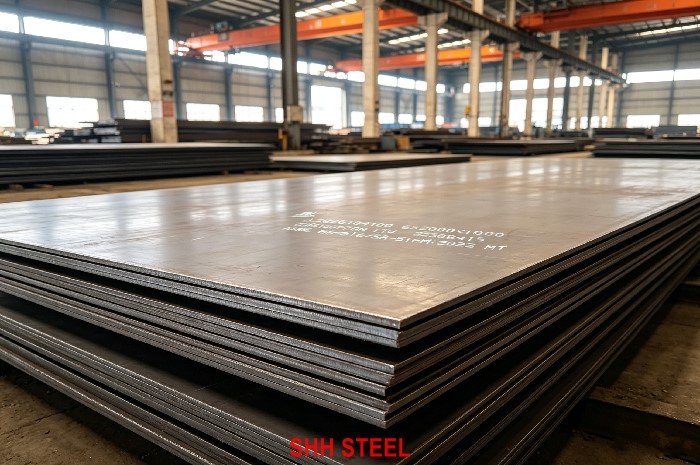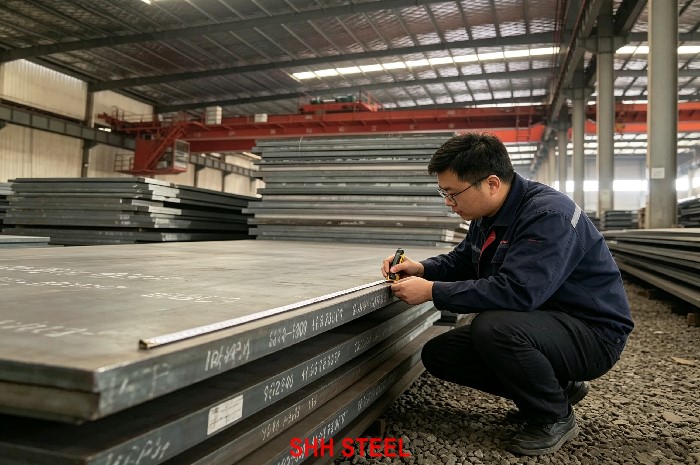
GOST 19281 10KhNDP Steel Plate | 10KhNDP HSLA Rolled Steel Plate
General Description of GOST 19281 10KhNDP Steel Plate
GOST 19281 10KhNDP Steel Plate is listed in Table 7 under alloyed steels. It is the phosphorus-bearing grade of this group: phosphorus is a specified range of 0.070–0.120 %, not a 0.030 % residual maximum. Silicon is 0.17–0.37 %, the lowest of the three, and Table 7 specifies aluminium 0.08–0.15 % — a different cell from the 0.02–0.06 % note 4 deoxidation range that applies to 10KhSND and does not apply to 10KhNDP. Chromium 0.50–0.80 % is lower than the 0.60–0.90 % range on 10KhSND and 15KhSND. Carbon is not more than 0.12 %. Table A.2 places 10KhNDP at class 345, in the first sub-row, whereas 15KhSND is in the second sub-row of the same class, and 10KhSND is recommended at 375 and 390. Table 10 gives 10KhNDP a dedicated class 345 cell of 345 / 470 / 20 %, lower in tensile strength and elongation than the 15KhSND group’s 345 / 490 / 21 %. A shared class is not interchangeability.
Table 7 has no 10KhNDP-1 composition-1 row; this page does not invent one. The letters D and P are already in the base designation. Table 8 note 1 gives special product-analysis deviations for phosphorus and aluminium on this grade.
GOST 19281 10KhNDP Steel Plate Material Specification
As of 12 November 2026, GOST 19281-2014 remains in force. It was introduced on 1 January 2015, replaces GOST 19281-89, and has restricted validity until 1 December 2026. It is applied with Amendment 1, which has been in force from 1 June 2020. This page is written to the 2014 edition, with Amendment 1 where that amendment is known. GOST 19281-2025 has been adopted and takes effect on 1 December 2026, so buyers should confirm which edition applies to their order. The 2025 edition has a right of early application; this page does not tabulate 2025 requirements. Two one-page corrections issued after Amendment 1 were not inspected for this page; confirm any later correction against the official text of the edition stated on the order.
The official English title of GOST 19281-2014 is “High strength rolled steel. General specification.” The standard covers hot-rolled plate, universal wide strip, bars, sections and bent profiles of high strength for general-purpose structures with welded, riveted or bolted connections. This page is the plate product. Table A.2 recommends 10KhNDP at class 345 up to 50 mm, in the first grade sub-row. It does not list 10KhNDP at classes 325, 355, 375 or 390.
Order the plate by strength class and by grade. The classes used in the standard are 265, 295, 315, 325, 345, 355, 375, 390 and 440. Each class is a specified minimum yield strength in N/mm², subject to any higher Table 10 cell for a named grade and thickness. Inspection categories, delivery condition, guaranteed weldability (GS) and any listed variant must be stated on the order; they are not implied by the grade name.
GOST 19281 10KhNDP Steel Plate Chemical Composition
The ladle analysis below was read from Table 7 of the 2016 reprint (alloyed-steels heading, PDF page 19). Amendment 1 does not change these numeric cells. Values are mass fraction, in %. The phosphorus range and the aluminium range are distinctive Table 7 cells of this grade.
| Grade | C | Si | Mn | P | S max | Cr | Ni | Cu | V | Other |
|---|---|---|---|---|---|---|---|---|---|---|
| 10KhNDP | ≤0.12 | 0.17–0.37 | 0.30–0.60 | 0.070–0.120 | 0.035 | 0.50–0.80 | 0.30–0.60 | 0.30–0.50 | ≤0.12 | 0.08–0.15 Al |
Table 7 is ladle analysis, read from the 2016 reprint under the alloyed-steels heading. Amendment 1 does not change the numeric chemistry cells for 10KhSND, 15KhSND or 10KhNDP. Table 8 gives product-analysis deviations, also read from the 2016 reprint, with the Amendment 1 boron row noted below where it applies. For elements whose Table 7 cell is an upper limit only, Table 8 note 2 applies only the plus deviations. Carbon on 10KhSND and 10KhNDP is an upper limit only (not more than 0.12 %), so only the plus carbon deviation applies in the product analysis of those grades. Carbon on 15KhSND is a range, so both the plus and the minus carbon deviations apply.
| Element | Product-analysis deviation, % |
|---|---|
| C | ±0.02 |
| Mn | ±0.10 |
| Si | ±0.05 |
| Cr | ±0.05 |
| Ni | ±0.05 |
| Cu | ±0.05 |
| S | ±0.005 |
| P | +0.005 (plus only) |
| N | ±0.005 |
| V | +0.02 / −0.01 |
| Ti | +0.010 / −0.005 |
| Nb | +0.010 / −0.005 |
| Al | +0.010 / −0.005 |
Arsenic shall not exceed 0.08 % in steel of all grades (Table 7 note 1). Nitrogen in steel that is not alloyed with nitrogen shall not exceed 0.008 % without secondary metallurgy, or 0.010 % with secondary metallurgy. Amendment 1 allows nitrogen up to 0.012 % inclusive provided the product meets the official Tables 11 and 12 for impact after mechanical ageing, regardless of the ordered category, including an order without a category. A further nitrogen-equivalent provision is stated in note 3; confirm that provision against the official text. These three grades have no specified nitrogen-alloying range in Table 7.
Amendment 1, Table 7 note 4, requires aluminium deoxidation of 0.02–0.06 % for grades 09G2, 09G2-1, 09G2S, 09G2S-1 and 10KhSND. That list does not include 15KhSND or 10KhNDP. Do not treat that 0.02–0.06 % aluminium range as a mandatory ladle requirement for this grade from note 4. 10KhNDP already has a specified aluminium range of 0.08–0.15 % in the “other elements” column of Table 7; that is a Table 7 composition cell, not the note 4 range. Amendment 1 note 5 still permits microalloying with aluminium, titanium and niobium, calculated to give aluminium not more than 0.05 %, titanium not more than 0.04 % and niobium not more than 0.05 %, unless other mass fractions are stated in Table 7.
Table 8 note 1 states product-analysis deviations specifically for 10KhNDP: phosphorus +0.030 / −0.010 %, and aluminium +0.020 / −0.010 %. Those figures were read from the 2016 reprint of Table 8 and are the deviations this page uses for phosphorus and aluminium on 10KhNDP, in place of the general Table 8 phosphorus and aluminium rows. Phosphorus on 10KhNDP is a range (0.070–0.120 %), not an upper limit only. Confirm the official Table 8 note 1. The Amendment 1 boron row is for 10KhSND with (Ti+B) only and is not used on this grade. Table 7 note 8 and Amendment 1 note 11 do not name 10KhNDP. Table 7 has no 10KhNDP-1 row; this page does not invent one, and Table 7 note 7 (composition-1) therefore has no 10KhNDP application on this page.
Clause 5.2.1.3 provides that, when the steel designation includes the letter D, the product is supplied with increased resistance to atmospheric corrosion, guaranteed by the chemical composition and the manufacturing technology. That letter is part of the base designations 10KhSND, 15KhSND and 10KhNDP; it is not a separate suffix variant on these pages. This is not a tabulated corrosion rate, not a coating specification, and not a formal weathering-grade equivalence. Confirm the official clause. Related weathering-resistant structural steel is published under ISO 630-5; that system is not equivalent to GOST 19281 and is not a substitute without engineer review of both complete specifications.
GOST 19281 10KhNDP Steel Plate Mechanical Properties
Annex A is a recommended annex. Table A.2 lists grades that provide the stated strength class at the stated thickness for plate, universal wide strip and bent profiles. A listing in Table A.2 is not a certificate that every thickness in the band is interchangeable with every other grade in the same cell, and it is not a substitute for the Table 10 tensile minima of the ordered class. Footnote * permits controlled rolling (KP) or controlled rolling followed by accelerated cooling. Footnote ** permits controlled rolling, thermomechanical treatment (TMO) or thermal strengthening (TY). Amendment 1 replaced only the class 375 row of Table A.2; the other rows below were visually read from the 2016 reprint, which Amendment 1 does not rewrite.
For 10KhNDP, Table A.2 (2016 visual; Amendment 1 does not rewrite this class) lists the following recommended plate combination:
| Strength class | Thickness in Table A.2 (2016 visual; not rewritten by Amendment 1 for this class) | 10KhNDP listed | Table A.2 footnote |
|---|---|---|---|
| 345 | Up to 50.0 mm inclusive (first grade sub-row) | 10KhNDP, with 09G2D, 09G2S, 10G2S1, 14KhGS, 17GS, 15GF and 17G1S. 15KhSND is in the second sub-row of the same class. | — |
Table 10 gives minimum yield strength (ReH, σ_T), tensile strength (Rm, σ_B) and percentage elongation after fracture (δ5) for plate, universal wide strip and bent profiles. The yield minimum equals the strength class, except where Table 10 states a higher figure for a named grade group. Amendment 1 rewrote the thickness column of Table 10 for strength classes 295, 345, 355 and 440. The yield, tensile-strength and elongation minima below were read from the 2016 reprint of Table 10, whose mechanical columns Amendment 1 did not describe as replaced. Use the official Amendment 1 (2021 consolidated) table for the current thickness bands of those four classes, including any footnote that applies to thicker product. A 2016 footnote that treated some thicker bands as non-rejectable until 1 January 2016 has elapsed.
Table 10 lists 10KhNDP at class 345 in a dedicated cell: ReH 345 N/mm², Rm 470 N/mm² and elongation 20 %. The parallel 15KhSND group at the same class is 345 / 490 / 21 %. Amendment 1 rewrote the Table 10 thickness column for class 345; the 2016 thickness labels are not presented as current. Confirm the official Amendment 1 bands. 10KhNDP is not in the Table 10 groups for classes 375 or 390 as read from the 2016 reprint.
| Strength class | Thickness label in the 2016 Table 10 (see the Amendment 1 note) | ReH min, N/mm² | Rm min, N/mm² | Elongation δ5 min, % | Grade group and A.2 relationship |
|---|---|---|---|---|---|
| 345 | 2016 labels: up to 32.0 mm inclusive, and over 32.0 up to 50.0 mm inclusive with a 2016 footnote — thickness column amended, confirm official bands | 345 | 470 | 20 | Dedicated 10KhNDP cell. The parallel 15KhSND group at the same class is 345 / 490 / 21 %. A shared class is not a shared tensile cell, and is not interchangeability. Table A.2 also recommends 10KhNDP at class 345 up to 50 mm. |
Impact toughness for plate is specified in Table 12, which Amendment 1 replaced in full, and is selected by the inspection category ordered from Table 4, which Amendment 1 also replaced. Values are minima in J/cm² for KCU or KCV at the temperatures listed for that category, class, grade and thickness. A plus sign in Table 12 means the test is made to collect statistical data; the result is recorded in the quality document and is not a specified minimum. A minus sign means the property is not specified and is not tested. This page does not tabulate Table 12 cells, because an official-format 2021 (Amendment 1) Table 12 was not visually inspected and a third-party extract is not a substitute for that inspection. If impact is required, state the category, the temperature and the test type on the order, and confirm the current figures against the official table of GOST 19281-2014 with Amendment 1.
Amendment 1 marked some Table 12 cells as optional for two years from 1 June 2020. That two-year period has elapsed. Confirm the current application of those footnote cells, and of any later one-page correction, against the official text. Do not take impact figures from the 2016 reprint, from another standard, or from a handbook and apply them as the current official minima.
Amendment 1 deletes clause 5.2.1.6, which in the 2016 reprint required a 180° bend on a mandrel of diameter equal to two specimen thicknesses and allowed the manufacturer to omit the test if it guaranteed satisfactory results at the purchaser. That deleted clause is not restated on this page as a current requirement. The amended acceptance rules still provide for recording a 180° bend result, or a manufacturer’s guarantee of that bend, on the quality document. Confirm the current bend requirement against the official 2014 text with Amendment 1.
Table 10 may list a grade in a thickness band that Table A.2 does not recommend. A Table 10 listing is the tensile requirement if that class and thickness are ordered; it is not, by itself, a Table A.2 recommendation. State the class on the order.
GOST 19281 10KhNDP Steel Plate Delivery Conditions
The strength class is the ordering property. State the edition that applies to the order (see the Material Specification), the grade (including any composition-1 or copper-bearing D variant listed on this page), the strength class, the inspection category, the dimensions, the quantity and the delivery condition. Table A.2 recommends 10KhNDP plate at class 345 up to 50 mm. A Table A.2 listing is a recommended combination of grade, class and thickness; it is not a substitute for stating the class on the order, and it is not interchangeability with other grades listed in the same cell.
Delivery may be agreed as hot-rolled, heat-treated, or with controlled rolling (KP), controlled rolling followed by accelerated cooling, thermomechanical treatment (TMO) or thermal strengthening (TY), where Table A.2 or the order permits those routes (footnotes * and ** in Table A.2). Do not assume a heat-treated or thermomechanically treated delivery from the grade name alone. Record the actual condition on the quality document. If the purchaser will heat-treat the article after delivery, see Table 7 note 7 before selecting a composition-1 variant.
Table 7 has no 10KhNDP-1 row. This page does not invent a composition-1 variant. The letters D and P are part of the base designation, not a separate article.
Clause 5.2.1.3 provides that, when the steel designation includes the letter D, the product is supplied with increased resistance to atmospheric corrosion, guaranteed by the chemical composition and the manufacturing technology. That letter is part of the base designations 10KhSND, 15KhSND and 10KhNDP; it is not a separate suffix variant on these pages. This is not a tabulated corrosion rate, not a coating specification, and not a formal weathering-grade equivalence. Confirm the official clause. Related weathering-resistant structural steel is published under ISO 630-5; that system is not equivalent to GOST 19281 and is not a substitute without engineer review of both complete specifications.
GOST 19281 10KhNDP Steel Plate Weldability
When guaranteed weldability (designated GS) is ordered, Amendment 1 to clause 5.2.1.2 limits the carbon equivalent CEV to not more than 0.43 % for strength classes 265, 295, 315 and 325; 0.46 % for classes 345, 355 and 375; 0.48 % for class 390; and 0.51 % for class 440. The same clause also requires the manufacturing technology and the chemical composition, including the Table 8 product-analysis deviations, to support weldability. GS is not implied by the grade name; state it on the order if it is required.
This page does not give preheat, interpass, heat-input or post-weld heat-treatment figures. The fabricator is responsible for welding-procedure qualification, consumable selection, preheat and any post-weld heat treatment required by the project specification. Do not take those figures from another standard or from a handbook and apply them as GOST 19281 rules. A shared strength class, a Table A.2 listing alongside another grade, or a commonly compared foreign designation does not make those grades automatic welding substitutes. A related weathering-resistant designation is not a welding substitute either.
GOST 19281 10KhNDP Steel Plate Tolerances
Dimensions, shape and permissible deviations for plate follow the plate-dimension standard cited by GOST 19281-2014 as updated by Amendment 1. State the required thickness, width, length, thickness-accuracy class, edge condition and, for plate supplied as sheets, the flatness class on the order. This page does not tabulate numerical deviation limits from that dimension standard.
Surface quality and dressing limits are those of GOST 19281-2014 with Amendment 1. Confirm the permitted defect types, dressing depth and area, and the prohibition on delamination against the official text. Ultrasonic testing is not a default requirement. If continuity testing is required, state the method, the class and the test volume on the order; they are not implied by the grade or the strength class.
GOST 19281 10KhNDP Steel Plate Applications and service limits
10KhNDP under GOST 19281-2014 is general-purpose high-strength rolled steel for welded, riveted or bolted structures. Typical uses are structural members, frames and fabricated platework where the ordered strength class, thickness and inspection category match the design. This page does not assign a design stress, a temperature limit or a code approval. Those come from the project specification and the design standard, not from the grade name.
Table A.2 does not recommend 10KhNDP at class 325, 355, 375 or 390. Confirm official Table 10 thickness bands for class 345 after Amendment 1. The atmospheric-corrosion provision, including the specified phosphorus range, is not a tabulated corrosion rate and is not a substitute for a project coating or a formal weathering specification. Related ISO 630-5, EN 10025-5 or GB/T 4171 designations are not approved substitutes without engineer review. Do not use this plate as a boiler or pressure-vessel product solely because the same designation appears under GOST 5520; that is a different product standard with its own thickness, category and test regime. Do not treat a commonly compared foreign structural grade as approved for the same duty without engineer review of both complete specifications.
Compare 10KhNDP with related GOST 19281 grades
These three GOST 19281 grades are chromium-nickel-copper alloyed steels. The letter D in each base designation marks the copper-bearing, atmospheric-corrosion provision of clause 5.2.1.3. They differ in carbon, silicon, phosphorus, the chromium-nickel-copper ranges, the Table A.2 class listings, and selected Table 10 cells. 10KhNDP is the phosphorus-bearing grade (the letter P). They are related, not equivalent. A shared strength class or a shared reputation as atmospheric-corrosion-resistant steel is not interchangeability. Sister GOST 19281 product pages are not linked here because those URLs are not live; the designations are named for comparison only.
| Grade | Table 7 distinctive chemistry | Table A.2 plate classes (summary) | Distinctive Table 10 cell |
|---|---|---|---|
| 10KhSND | C ≤0.12; Si 0.80–1.10; Mn 0.50–0.80; Cr 0.60–0.90; Ni 0.50–0.80; Cu 0.40–0.60; P 0.030 max. Note 4 Al 0.02–0.06 % mandatory. Optional (Ti+B). | 375 (≤10 mm, Amd 1 — confirm companions); 390 (≤40 mm dedicated; also ≤50 mm with 14G2AF) | Class 375: 375 / 510 / 20 % (T10 up to 50 mm; A.2 only ≤10 mm). Class 390: 390 / 510 / 19 %. |
| 15KhSND | C 0.12–0.18; Si 0.40–0.70; Mn 0.40–0.70; Cr 0.60–0.90; Ni 0.30–0.60; Cu 0.20–0.40; P 0.030 max. Note 4 Al does not apply. | 345 (≤50 mm, second sub-row) | Class 345: 345 / 490 / 21 % (confirm official Amd 1 thickness). Not the 10KhNDP 470 / 20 % cell. |
| 10KhNDP (this plate) | C ≤0.12; Si 0.17–0.37; Mn 0.30–0.60; P 0.070–0.120; Cr 0.50–0.80; Ni 0.30–0.60; Cu 0.30–0.50; Al 0.08–0.15. Table 8 note 1 for P and Al. | 345 (≤50 mm, first sub-row) | Class 345: 345 / 470 / 20 % — dedicated cell, lower Rm and elongation than 15KhSND at the same class. |
GOST 19281 10KhNDP Steel Plate Equivalent Material Grade
No formal equivalence has been verified for the designations below. They are related designations only and are not equivalent to this GOST 19281-2014 plate. Official correspondence or equivalent-grade tables were not inspected for this page; confirm any claimed equivalent against the official texts of both standards and the project specification. Engineer approval is required before any substitution. This page does not link any external catalogue. None of those relationships is interchangeability.
| Standard | Country-Region | Equivalent Grade | Note |
|---|---|---|---|
| GOST 19281-2014 | Interstate (GOST) | 10KhNDP | This page’s designation. Not an equivalent of another grade. |
| ISO 630-5 | International (ISO) | — (family; no grade assigned on this page) | Related weathering-resistant structural steel family. Not equivalent. Official correspondence tables were not inspected. Verify chemistry, strength class, thickness, delivery, toughness and the project specification. Engineer approval is required. Not a verified formal equivalent. |
| EN 10025-5 | Europe | — (family; no grade assigned on this page) | Related weathering-resistant structural plate family. Not equivalent. This page does not assign a lettered EN grade as a formal equivalent. Engineer approval is required. Not a verified formal equivalent. |
| GB/T 4171 | China | — (family; no grade assigned on this page) | Related atmospheric-corrosion-resistant structural plate family. Not equivalent. This page does not assign a Q355NH-class designation as a formal equivalent. Engineer approval is required. Not a verified formal equivalent. |
Related weathering-resistant structural plate systems include ISO 630-5, EN 10025-5 and GB/T 4171. Related high-strength structural plate systems, including GB/T 1591, EN 10025-2 and ASTM A572, are sometimes listed on comparison charts as well. No grade in those systems is listed as a verified equivalent on this page. A chart cannot replace a review of chemistry, including chromium, nickel, copper and (for 10KhNDP) phosphorus, strength class, product form, delivery condition, mechanical tests and the project specification. A similar yield class, or a shared reputation as atmospheric-corrosion-resistant steel, does not authorise substitution.
Why choose Us
SHH STEEL produces and exports GOST 19281 plate, including GOST 19281 10KhNDP Steel Plate. We review the ordered strength class (345 as agreed), the ladle analysis against Table 7, including the 0.070–0.120 % phosphorus range and the 0.08–0.15 % aluminium range, and the dedicated Table 10 cell of 345 / 470 / 20 %, with official confirmation of class 345 thickness before production, and we state the actual results on the quality document. We do not treat a shared strength class, a Table A.2 cell shared with another grade, or a commonly compared foreign designation as a substitute for the ordered grade and class.
Orders are accepted against GOST 19281-2014, including Amendment 1, unless the order states the 2025 edition. Enquiry details should include the edition, grade (and any listed variant), strength class, inspection category, thickness, width, length, quantity, delivery condition and any agreed options (guaranteed weldability GS, ultrasonic class, microalloying agreement). See the GOST 19281 hub for the product family.
Our Service
Supply covers production to the ordered 2014 requirements, including Amendment 1, or to the 2025 edition if that is the edition stated on the order, together with mill documentation and export packing and shipment. Quality documents record the actual ladle analysis, tensile results for the ordered class, and, where the category requires them, impact results, including any characteristic that Table 12 marks as determined for statistical data. Guaranteed weldability and ultrasonic testing are supplied when they are agreed on the order, not by default.
To enquire, state the edition (GOST 19281-2014 with Amendment 1, or GOST 19281-2025 if that edition applies), grade 10KhNDP, the strength class, the inspection category, dimensions, quantity and the required options. SHH STEEL will confirm manufacturability and the inspection plan against that order. This page is a product description written to the 2014 edition with Amendment 1; the official standard of the edition on the order, and the quality document, govern acceptance.
FAQ
-
What is 10KhNDP steel plate?
-
10KhNDP steel plate is a chromium-nickel-copper-phosphorus high-strength rolled steel under GOST 19281-2014. Table 7 lists it under alloyed steels, with carbon not more than 0.12 %, silicon 0.17–0.37 %, manganese 0.30–0.60 %, phosphorus 0.070–0.120 %, chromium 0.50–0.80 %, nickel 0.30–0.60 %, copper 0.30–0.50 % and aluminium 0.08–0.15 %. The letters D and P mark copper and phosphorus. Clause 5.2.1.3 provides for increased resistance to atmospheric corrosion, guaranteed by chemistry and manufacturing technology. The ordering property is the strength class. Table A.2 recommends it at class 345 up to 50 mm.
-
Is GOST 19281-2014 still current for 10KhNDP?
-
Yes, as of 12 November 2026. GOST 19281-2014 remains in force, applied with Amendment 1 from 1 June 2020, and has restricted validity until 1 December 2026. This page is written to the 2014 edition, with Amendment 1 where that amendment is known. GOST 19281-2025 has been adopted and takes effect on 1 December 2026, so buyers should confirm which edition applies to their order. The 2025 edition has a right of early application. State the edition, and Amendment 1 if the 2014 edition is ordered, together with the grade and the strength class, on the order. This page does not tabulate 2025 tables. Two one-page corrections issued after Amendment 1 were not inspected for this page.
-
Which strength classes can 10KhNDP plate be ordered in?
-
Table A.2 recommends 10KhNDP at class 345 up to 50 mm, in the first grade sub-row (15KhSND is in the second sub-row of the same class). It does not list 10KhNDP at 325, 355, 375 or 390. Table 10 gives a dedicated cell of 345 / 470 / 20 % at class 345, not the 345 / 490 / 21 % cell used for 15KhSND. Amendment 1 rewrote the Table 10 thickness column for class 345; confirm the official bands. State the class on the order.
-
How does 10KhNDP differ from 10KhSND and from 15KhSND?
-
The distinctive Table 7 cells are the phosphorus range of 0.070–0.120 % and aluminium 0.08–0.15 %. Silicon is 0.17–0.37 %, lower than both 10KhSND and 15KhSND, and chromium is 0.50–0.80 %, lower than their 0.60–0.90 %. Against 15KhSND, both are Table A.2 class 345 grades, but Table 10 gives 10KhNDP a dedicated 345 / 470 / 20 % cell against 15KhSND’s 345 / 490 / 21 %. Against 10KhSND, Table A.2 places 10KhNDP at 345 only, not at 375 or 390, and note 4 aluminium deoxidation and the (Ti+B) option apply to 10KhSND, not to 10KhNDP. Table 8 note 1 gives special phosphorus and aluminium product-analysis deviations for 10KhNDP only. A shared letter D is not interchangeability.
-
What are the Table 8 note 1 deviations, and is there a 10KhNDP-1?
-
Table 8 note 1, read from the 2016 reprint, permits product-analysis deviations for 10KhNDP of phosphorus +0.030 / −0.010 % and aluminium +0.020 / −0.010 %. This page uses those figures in place of the general Table 8 phosphorus and aluminium rows for this grade. Confirm the official note. Table 7 has no 10KhNDP-1 row; this page does not invent one. The letters D and P are part of the base designation.
Enquire about GOST 19281 10KhNDP Steel Plate
Enquire for GOST 19281 10KhNDP Steel Plate to GOST 19281-2014, including Amendment 1, or to GOST 19281-2025 if that is the edition that applies to the order. State the grade 10KhNDP, the strength class, the inspection category, dimensions, quantity, the delivery condition and any agreed options. SHH STEEL will confirm the inspection plan against the official tables of the edition on the order. The official standard and the quality document govern acceptance.
Quality Steel Needed? Inquire for Offers
Related Products