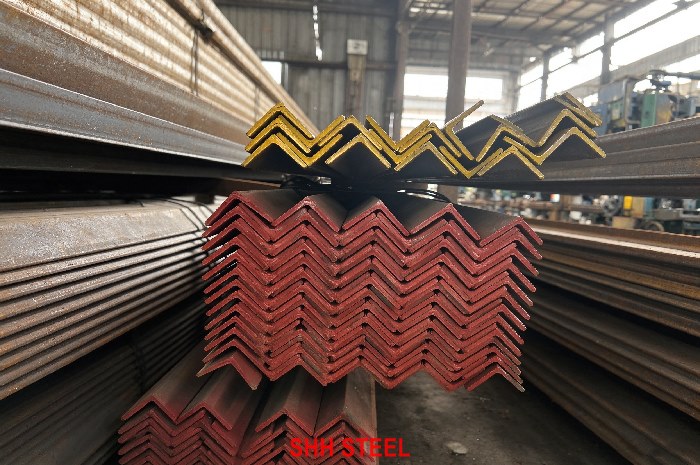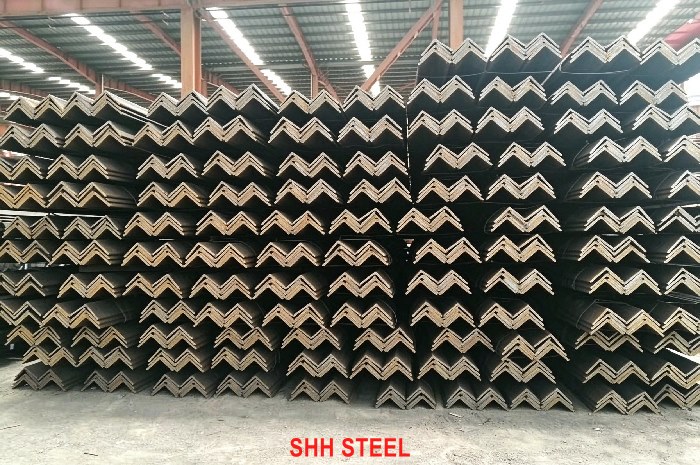
DIN 17100 St52-3 Steel Angles
What are DIN 17100 St52-3 Steel Angles?
DIN 17100 St52-3, also written St 52-3, is a higher-strength general structural steel in the withdrawn German standard DIN 17100, last issued in 1980. The steel number for St52-3 is 1.0570. This page is for hot-rolled equal-leg and unequal-leg angles, not for a plate, a merchant bar only, a U-section, or an I or H section.
DIN 17100 covered steel sections, including angles, delivered in the hot-formed or normalized condition. The standard is not current. New structural work should be specified to a living standard, ordinarily EN 10025-2 for this strength class. The live successor angle page on this site is EN 10025-2 S355J2 Equal and Unequal Steel Angles.
DIN 17100 is Withdrawn and is Superseded by EN 10025-2 S355J2 (S355J2G3)
DIN 17100 was withdrawn in the mid-1990s when DIN EN 10025 was adopted. The current European material standard for this class of non-alloy structural steel is EN 10025-2. The usual successor grade named for St52-3 is S355J2. In the earlier EN 10025 edition that grade was named S355J2G3. The present EN 10025-2 steel number for S355J2 is 1.0577; 1.0570 is the DIN 17100 St52-3 number, also used historically for S355J2G3. Those numbers are related, not a reason to treat the certificates as identical.
EN 10025-2 S355J2 Equal and Unequal Steel Angles has its own EN 10025-2 chemistry, including tighter phosphorus and sulfur limits, a 470–630 MPa tensile window, and a 27 J impact requirement at −20 °C. A St52-3 inspection document is not an S355J2 document.
DIN 17100 itself distinguished delivery conditions for this grade. Recitations of Table 3 map St 52-3 U to ISO Fe 510-C and St 52-3 N to Fe 510-D. Impact requirements in Table 2 depend on that U or N condition: the recitations compared here give 27 J at 0 °C for the U condition and 27 J at −20 °C for the N condition, with a lower 23 J figure in the thickest tabulated band. An enquiry that only says St52-3 must name the required impact temperature. Do not assume −20 °C, and do not treat EN 10025-2 S355JR Equal and Unequal Steel Angles as the St52-3 successor.
DIN 17100 St52-3 Chemical Composition for Angles (Ladle Analysis)
The table recites the DIN 17100:1980 Table 1 ladle-analysis limits for St52-3, including footnote 3 for silicon and manganese, from two independent public recitations of that edition. Product (sample) analysis variations are wider and are not rewritten here as shop maxima. Special Table 3 variants such as KSt 52-3 and RoSt 52-3 had their own carbon footnotes and are not this page.
Swipe horizontally to view all dimensions.
DIN 17100 St52-3 Mechanical Properties: Yield and Tensile Strength
Table 2 of DIN 17100:1980 gives St52-3 a tensile range of 490–630 N/mm² for product thicknesses from 3 mm to 100 mm, and 510–680 N/mm² below 3 mm. Minimum upper yield point is 355 N/mm² at t ≤ 16 mm, then 345, 335, 325 and 315 N/mm² in the 16–40, 40–63, 63–80 and 80–100 mm bands.
DIN 17100 Table 2 also specifies minimum elongation at rupture, which depends on specimen position, thickness and gauge length. Two public recitations of that elongation column do not agree closely enough, after layout reconstruction, for this page to reprint a single elongation table. Confirm elongation against the named edition, or specify the successor EN 10025-2 grade if a current elongation table is required.
Impact values depend on the U or N condition, as noted in the supersession section. The test result is an average of three ISO-V specimens; only one individual value may fall below the 23 J or 27 J minimum, and then only by a maximum of 30 %, in the Table 2 footnote recitations used here.
Swipe horizontally to view all dimensions.
DIN 17100 St52-3 Angle Sizes: EN 10056 Cross-Reference (DIN 1028 / 1029 Historical)
Historical German equal-leg and unequal-leg angle dimensions were tabulated in DIN 1028 and DIN 1029. Those dimensional standards have been replaced in current European practice by EN 10056-1, with tolerances in EN 10056-2. This page does not transcribe an unverified DIN 1028 or DIN 1029 annex.
The tables below are therefore a typographical cross-reference: the same verified EN 10056-1:2017 subset already published on EN 10025-2 S355J2 Equal and Unequal Steel Angles (71 equal-leg sizes, from L 80×80×8 to L 300×300×35, and five unequal-leg sizes in the L 200×100 family). They are for identification and estimating on a withdrawn-grade enquiry, not a rolling programme, not a warehouse list, and not a claim that every EN 10056-1 or every historical DIN 1028/1029 size is shown.
L 200×200×16 is a 200 mm equal angle, 16 mm thick, at the boundary of the first DIN 17100 St52-3 yield band (355 MPa). L 200×200×20 is 20 mm thick, so the St52-3 minimum yield in Table 2 is 345 MPa, not 355 MPa. L 200×100×12 is an unequal 200 mm by 100 mm angle and is not L 200×200×12. American L-shapes, and Chinese or Japanese angle designations, belong to their own dimensional standards, not to these EN 10056 rows.
Equal-leg angles (71 verified sizes, L 80×80×8 to L 300×300×35)
L 80 to L 150 equal (15 sizes)
Swipe horizontally to view all dimensions.
L 160 to L 200 equal (28 sizes)
Swipe horizontally to view all dimensions.
L 250 to L 300 equal (28 sizes)
Swipe horizontally to view all dimensions.
Unequal-leg angles (5 verified sizes, L 200×100×10 to L 200×100×16)
Swipe horizontally to view all dimensions.
Applications and Service Limits for DIN 17100 St52-3 Angles
St52-3 angles still appear on older drawings, bills of materials and maintenance enquiries. For new design, specify a current standard and grade, ordinarily EN 10025-2 S355J2 with an EN 10056 designation and a stated impact temperature, unless the contract truly requires a legacy DIN 17100 document. Weldability, coating and inspection must be stated on the order.
DIN 17100 St52-3 Angles Compared with EN 10025-2 S355J2 and S355JR
EN 10025-2 S355J2 Equal and Unequal Steel Angles is the live successor page usually named for this grade, including the earlier S355J2G3 designation. EN 10025-2 S355JR Equal and Unequal Steel Angles is the +20 °C sister in the same EN yield class and is not the St52-3 successor. Read the successor page together with this one when a legacy enquiry uses the St52-3 name. The tensile window, phosphorus and sulfur maxima, and the impact condition are not the same.
Near-Equivalents for DIN 17100 St52-3 Steel Angles: Not Automatic Substitutes
Near-equivalents only, not automatic substitutes. EN 10025-2 S355J2, and the earlier name S355J2G3, is the usual successor grade, not a drop-in certificate. S355J0 corresponds more closely to a 0 °C impact discussion and is not implied by an unmarked St52-3 name. GB/T 706 Q355B and ASTM A572 Grade 50 angles use different chemistry and different shape standards. Do not treat any of those certificates as DIN 17100 St52-3, or the reverse.
Sourcing DIN 17100 St52-3 Steel Angles from SHH STEEL
SHH STEEL reviews whether the enquiry truly requires a withdrawn DIN 17100 document or can be fulfilled as EN 10025-2 S355J2 Equal and Unequal Steel Angles under EN 10025-2, and what impact temperature is required. State the designation, the length, the U or N condition if a DIN document is still wanted, and the certificate required. These angles are filed under Steel Angles. The typographical size tables on this page are not a warehouse list.
FAQ: DIN 17100 St52-3 Steel Angles
-
Is DIN 17100 still a current standard?
- No. DIN 17100 was withdrawn after DIN EN 10025 was adopted. The last edition used on this page is DIN 17100:1980. The usual successor grade for St52-3 angles is EN 10025-2 S355J2, historically also named S355J2G3.
-
Is every St52-3 enquiry a −20 °C S355J2 enquiry?
- No. Recitations of DIN 17100 map St 52-3 U to a 0 °C impact discussion and St 52-3 N to −20 °C. Name the required temperature on the order. A St52-3 certificate is not automatically S355J2.
-
Which size standard is used on this page?
- Historical German angle sizes were in DIN 1028 (equal) and DIN 1029 (unequal). This page does not transcribe an unverified annex of those standards. The tables are the verified EN 10056-1 subset already used on the live S355J2 angle page, as a typographical cross-reference, not a warehouse list.
Conclusion
Treat DIN 17100 St52-3 as a withdrawn grade for equal and unequal angles, with the 1.0570 chemistry and the Table 2 yield and tensile bands recited here. For current supply, prefer EN 10025-2 S355J2, with the impact temperature stated, unless the contract truly requires a legacy DIN 17100 document. The two certificates are not interchangeable.
Quality Steel Needed? Inquire for Offers