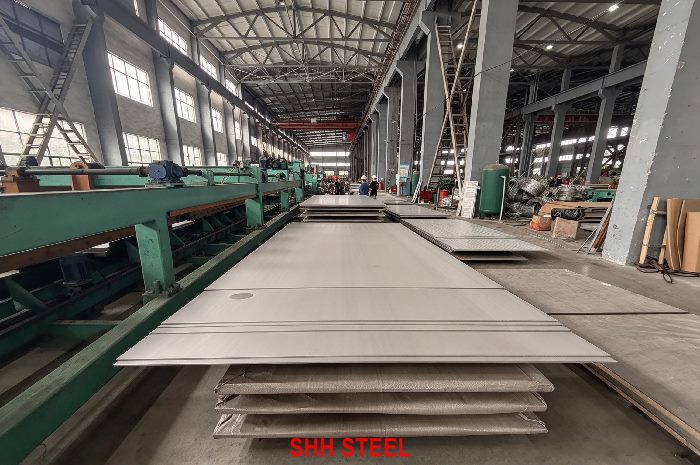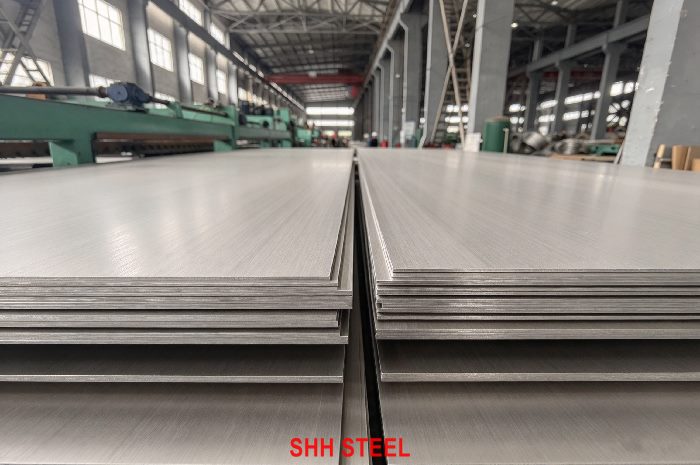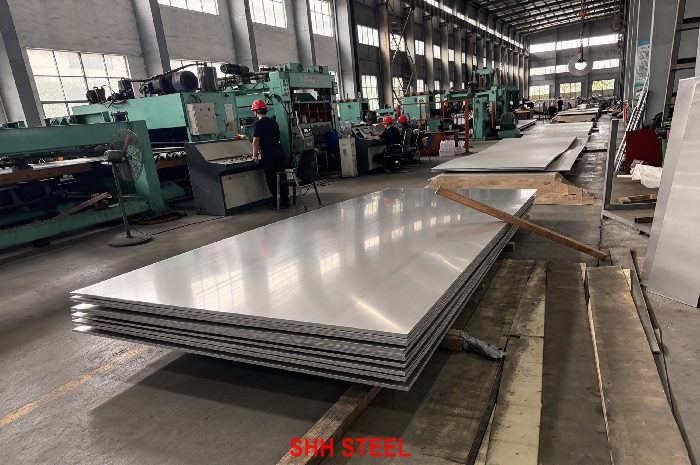
ASTM A240 UNS S31803 Duplex Stainless Steel Sheet
What is ASTM A240 UNS S31803 duplex stainless steel sheet?
Equivalent grades: UNS S31803 ≈ UNS S32205 (2205) ≈ EN 1.4462 X2CrNiMoN22-5-3 ≈ JIS SUS329J3L ≈ GB/T 022Cr22Ni5Mo3N (S22253) ≈ GB/T 022Cr23Ni5Mo3N (S22053).
UNS S31803 is the original 22Cr-5Ni-3Mo-N duplex stainless steel listed in ASTM A240/A240M. Its microstructure is roughly half ferrite and half austenite, which gives about twice the yield strength of 316L, much better resistance to chloride stress-corrosion cracking, and pitting resistance well above the standard austenitic grades. S31803 has wider chromium, molybdenum and nitrogen ranges than the later UNS S32205, so a heat that only just meets S31803 can have a pitting resistance equivalent (PREN) of about 30.5, against about 34 for the S32205 minimum.
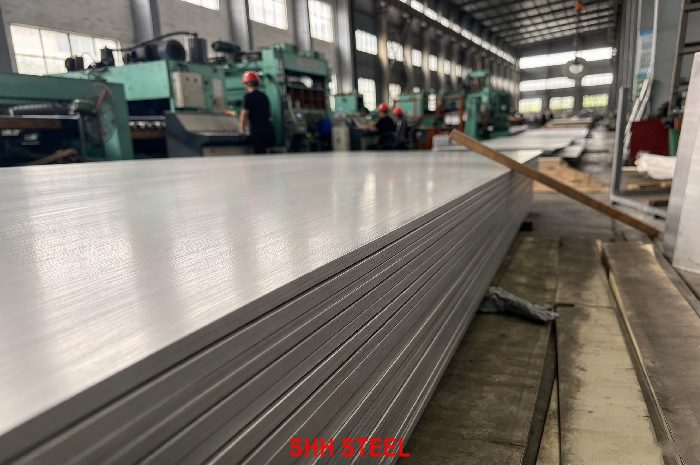
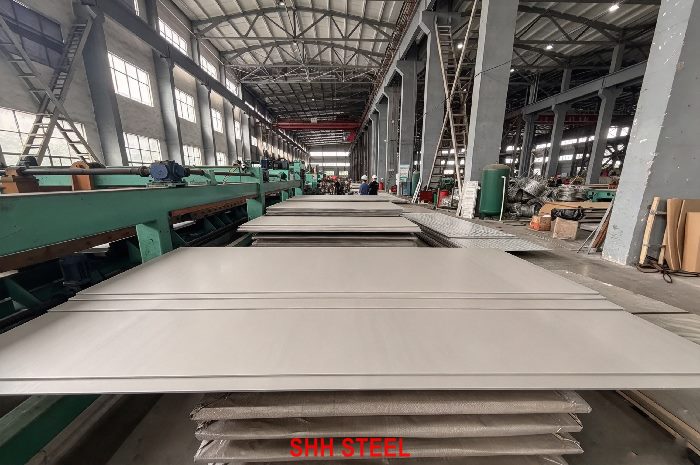
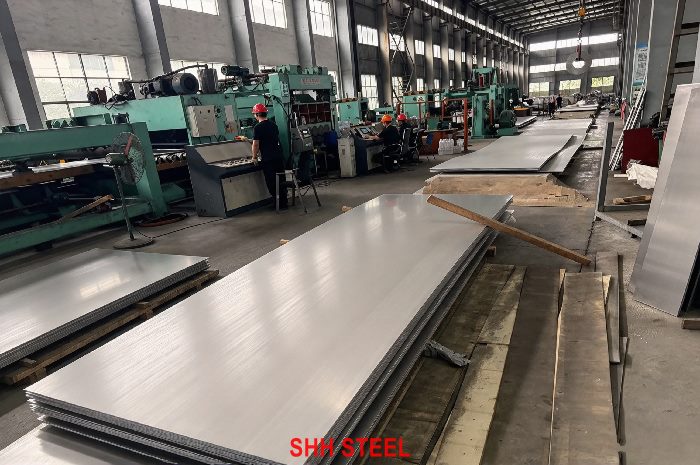
Under ASTM A480, sheet is flat material under 5.00 mm thick and 600 mm or more wide. S31803 sheet is therefore a cold-rolled 2B product in the thin gauges and a hot-rolled, annealed and pickled No.1 product toward the 3–4.75 mm end. Most material sold today is dual-certified S31803/S32205 on one mill test report. This page covers the A240 requirements, the difference between the two UNS numbers, the supplementary tests that oil, gas and chemical projects add, forming and welding of thin duplex sheet, and how SHH STEEL supplies it.
UNS S31803 sheet: specification summary
| Item | S31803 sheet data |
|---|---|
| Standard | ASTM A240/A240M; general requirements ASTM A480/A480M |
| ASME counterpart | SA-240, ordered only for ASME Code construction |
| UNS / common name | S31803 (A240 assigns the name 2205 to S32205) |
| Structure | austenitic-ferritic (duplex), about 50/50 after solution annealing |
| Sheet (A480) | under 5.00 mm thick, 600 mm and over wide |
| Typical gauges | 0.5–3.0 mm cold-rolled 2B; 3.0–4.75 mm hot-rolled No.1 |
| Widths | 1000, 1219, 1250, 1500 mm; slit coil to order |
| Lengths | 2000, 2438, 2500, 3000, 6000 mm or cut to size |
| Heat treatment | solution anneal 1020–1100 °C (1870–2010 °F), then rapid cooling (A480) |
| Finishes | No.1, 2D, 2B; No.4 and hairline polishing by agreement |
| Required tests | heat analysis, tension test, hardness |
| Supplementary tests | ASTM A923 Methods A/B/C, ferrite count (ASTM E562), Charpy, G48, PMI, by order |
| Certificates | EN 10204 3.1; 3.2 with third-party witness on request |
S31803 vs S32205: chemistry and why the difference matters
| Element, wt % (ASTM A240) | S31803 | S32205 |
|---|---|---|
| C max | 0.030 | 0.030 |
| Mn max | 2.00 | 2.00 |
| P max | 0.030 | 0.030 |
| S max | 0.020 | 0.020 |
| Si max | 1.00 | 1.00 |
| Cr | 21.0–23.0 | 22.0–23.0 |
| Ni | 4.5–6.5 | 4.5–6.5 |
| Mo | 2.5–3.5 | 3.0–3.5 |
| N | 0.08–0.20 | 0.14–0.20 |
S32205 was added to A240 as a tighter window inside the S31803 limits. Every S32205 heat therefore also meets S31803, but a heat at the bottom of the S31803 ranges will fail S32205. Mills now melt to the S32205 window by default, which is why dual certification is normal.
Nitrogen is the element that matters most. It raises strength and pitting resistance, and it speeds up the re-formation of austenite in the weld heat-affected zone. A heat at 0.08 % N welds with a noticeably more ferritic HAZ than one at 0.16 % N, with lower toughness and corrosion resistance. If a drawing says only “S31803”, add N 0.14–0.20 % to the purchase order; NORSOK M-630 data sheet D45 asks for exactly this range on S31803/S32205 plate.
PREN check (Cr + 3.3 Mo + 16 N) at the A240 minimums: S31803 = 21.0 + 8.25 + 1.28 ≈ 30.5; S32205 = 22.0 + 9.9 + 2.24 ≈ 34.1. A gap of more than three points is significant in seawater spray, chloride process water and bleach plants. Buyers who chose duplex from 2205 data sheets often add PREN ≥ 34 to the order, and we report the calculated value from the heat analysis.
Mechanical properties of S31803 sheet to ASTM A240
| Property | S31803 | S32205 |
|---|---|---|
| Tensile strength, min | 620 MPa (90 ksi) | 655 MPa (95 ksi) |
| Yield strength 0.2 %, min | 450 MPa (65 ksi) | 450 MPa (65 ksi) |
| Elongation in 50 mm, min | 25 % | 25 % |
| Hardness, max | 293 HBW / 31 HRC | 293 HBW / 31 HRC |
The yield minimum is more than twice the 170 MPa of A240 316L sheet. Designers use this to reduce gauge on tanks, panels and ducts, often by 20–30 %, but the same strength means higher press-brake loads and more springback. Real mill values for cold-rolled 2B sheet usually sit well above the minimums, typically 500–600 MPa yield and 700–800 MPa tensile, so check the certificate values when calculating bending force. Duplex is not recommended for long-term service above about 300 °C, where 475 °C embrittlement of the ferrite starts.
Ferrite content, A923 and −46 °C impact: what projects add to A240
ASTM A240 sets no ferrite range and no impact test for S31803. These figures come from project specifications or from the purchase order, so they must be named there. The table separates the common sources so they are not confused.
| Requirement | Source | Value | Notes for sheet |
|---|---|---|---|
| Intermetallic phase screen | ASTM A923 Method A | etch structure classification, no affected structure | screening only; applies to any thickness |
| Charpy impact | ASTM A923 Method B | 54 J (40 ft-lb) min at −40 °C, base metal and HAZ; 34 J weld metal | full-size basis; sub-size reduced in proportion to area |
| Ferric chloride corrosion | ASTM A923 Method C | max 10 mdd at 25 °C base metal (22 °C weld metal), 24 h | detects Cr/Mo depletion |
| Charpy impact | NORSOK M-630 MDS D45 | 45 J average / 35 J single at −46 °C | required for thickness ≥ 6 mm only; sub-size factors 5/6 (7.5 mm) and 2/3 (5 mm) |
| Ferrite content | NORSOK M-630 MDS D45 | 35–55 %, ASTM E562 point count, surface and mid-thickness | free of intermetallics and precipitates at 400× |
| Hardness | NORSOK M-630 MDS D45 | max 28 HRC (271 HB / 290 HV10) | stricter than A240’s 31 HRC |
Two practical points follow. First, the well-known “45 J / 35 J at −46 °C” is a NORSOK value and is only mandatory there for 6 mm and thicker, so it does not normally apply to sheet below 5 mm. If a project still asks for impact testing on sheet, agree the specimen size, or accept an A923 Method B test on thicker material from the same heat, before the order is placed. Second, the often-quoted “35–65 % ferrite” is a wider range used in some refinery and fabrication specifications; NORSOK base material is 35–55 %. Quote the range from your own specification, not a generic one. Correct annealing and fast water or air quenching keep production sheet comfortably near 45–50 % ferrite.
Finishes for S31803 sheet: No.1, 2B and polished
No.1 is hot-rolled, annealed and pickled, with a dull matt surface, used for 3–4.75 mm sheet in tanks, ducts and structural parts. 2B is cold-rolled, annealed, pickled and skin-passed, the standard finish for 0.5–3.0 mm and the best base for further polishing. 2D is a dull cold-rolled finish for deep drawing. No.4 and hairline are applied after rolling for visible architectural and equipment panels. Because duplex is harder than 316L, polishing takes longer and belts wear faster; ask for PVC film on the polished face to protect it during cutting and transport.
Thickness, flatness and edge condition
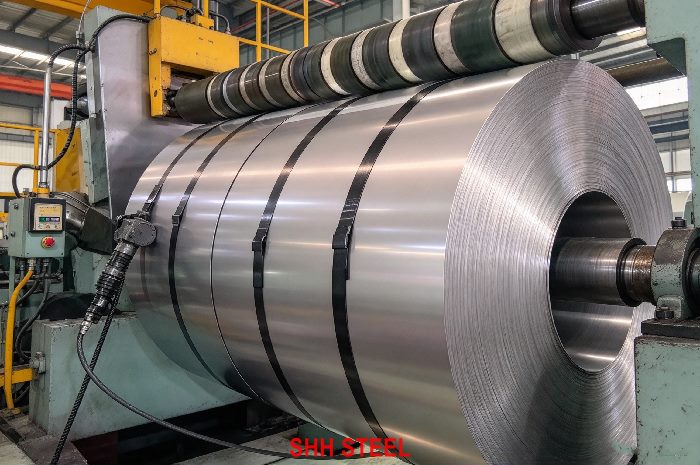
Thickness, width, length and flatness tolerances follow ASTM A480 (Annex A2 inch-pound, Annex A3 for A480M). Cold-rolled 2B sheet has tighter thickness tolerance than hot-rolled No.1, and duplex sheet tends to show slightly more residual stress after slitting or laser cutting than austenitic sheet. For laser-cut blanks and long panels, specify flatness in the order and, if needed, stretcher-levelled or tension-levelled material. Mill edge and slit edge are both available on coil; cut sheet is supplied with sheared edges unless otherwise agreed.
S31803 / S32205 sheet stock in China
| Thickness (mm) | Width (mm) | Length (mm) | Finish | Approx. quantity | Location |
|---|---|---|---|---|---|
| 0.8 | 1219 | 2438 | 2B | 100+ t | China |
| 1.0 | 1219 | 2438 | 2B | 200+ t | China |
| 1.5 | 1219 | 2438 | 2B | 300+ t | China |
| 2.0 | 1219 / 1500 | 2438 / 3000 | 2B | 300+ t | China |
| 3.0 | 1500 | 3000 | 2B / No.1 | 200+ t | China |
| 4.0 | 1500 | 3000 / 6000 | No.1 | 200+ t | China |
| 4.75 | 1500 | 6000 | No.1 | 100+ t | China |
Quantities are approximate and stock changes daily. All sheet is dual-certified S31803/S32205 with EN 10204 3.1 certificates. Send your size list for current availability; other gauges, widths and coil can be cut or rolled to order.
S31803 equivalents in ASTM, EN, JIS and GB/T
| Standard | Designation | Comment |
|---|---|---|
| ASTM A240 | UNS S32205 (2205) | narrower Cr, Mo, N; always meets S31803 |
| ASME SA-240 | SA-240 S32205 plate | for ASME Code pressure equipment |
| EN 10088-2 | 1.4462 X2CrNiMoN22-5-3 | N 0.10–0.22 %; general use |
| EN 10028-7 | 1.4462 pressure-vessel plate | adds elevated-temperature properties |
| JIS G4304 | SUS329J3L hot-rolled | close match; check N and Mo |
| JIS G4305 | SUS329J3L cold-rolled | cold-rolled sheet counterpart |
| GB/T 4237 | 022Cr23Ni5Mo3N (S22053) | Cr 22.0–23.0 %; nearest to S32205 |
| GB/T 713.7 | 022Cr22Ni5Mo3N (S22253) · S22053 | S22253 is the closest match to S31803 |
Equivalents are close, not identical. When a project names one standard, order to that standard or ask for multiple certification and check every limit on the certificate.
Related grades by alloy family
Duplex and super duplex
A240 S32205 (2205) is the tighter version of this grade. A240 S32750 (2507) has PREN of about 41 and above for seawater and severe chloride service. A240 S32304 (2304) and A240 S32101 are lean duplex grades with lower molybdenum and lower cost, for structural and moderate-corrosion use.
Austenitic
A240 316L and A240 317L are softer and easier to form but much weaker and prone to chloride stress-corrosion cracking above about 60 °C.
Super austenitic
A240 904L is chosen for sulfuric acid and other reducing acids where duplex is less suitable.
Ferritic
A240 444 and A240 430 are nickel-free, low-cost options for mild indoor and architectural service.
Applications, forming and welding of S31803 sheet
Typical uses are chemical tanker and storage tank components, heat-exchanger baffles and tube sheets in thin gauge, desalination evaporator parts, flue-gas desulfurisation ducts, pulp and paper equipment, offshore module panels and food-processing equipment exposed to brines. In thin gauges S31803 often replaces 316L where chloride stress-corrosion cracking has occurred.
Forming: use a bending radius of at least 2 t for sheet, allow for greater springback and roughly double the press force needed for 316L. Cutting: laser, plasma and waterjet are all suitable; remove heat tint by pickling. Welding: use 2209-type filler, keep heat input around 0.5–2.5 kJ/mm and interpass temperature below 150 °C, and avoid autogenous welds without nitrogen in the shielding gas, which leave a highly ferritic weld. Post-weld pickling and passivation restore corrosion resistance.
Certificates, testing and receiving inspection
Every delivery carries a mill test report to A480 with heat analysis, tensile, hardness and the UNS numbers certified. On request we add calculated PREN, ferrite count to ASTM E562, A923 Method A/B/C, ASTM G48 pitting, PMI on each sheet, and EN 10204 3.2 certificates with TÜV, BV, SGS, ABS, DNV or CCS witness. On receipt, check marking against the certificate, confirm the N content and finish, and spot-check thickness at several points.
Sourcing S31803 sheet: buyer concerns and SHH STEEL solutions
| Concern | How SHH STEEL handles it |
|---|---|
| Low-N S31803 heat instead of S32205 chemistry | heat analysis and PREN confirmed before cutting; dual certification by default |
| Ferrite, A923 or impact tests | test scope agreed in writing before production; third-party witness with 3.2 certificates |
| Small quantities across many sizes | mixed thicknesses and grades combined in one shipment |
| Heat tint and surface damage | in-house shearing, laser cutting, PVC film and polishing |
| Delivery delays | weekly production and shipping updates with photos |
How to order UNS S31803 sheet
State the standard and edition (ASTM A240/A240M), UNS number and whether dual certification is acceptable, thickness, width, length or coil, finish, quantity, any added chemistry limits such as N 0.14 % min or PREN ≥ 34, the supplementary tests and acceptance values from your project specification, certificate type and inspection agency, and packing. Send the list to SHH STEEL and we will reply with price, available stock and lead time.
FAQ
-
Can you supply sheet certified to both S31803 and S32205?
- Yes. Most of our duplex sheet comes from heats that meet both UNS numbers, and the mill certificate lists both. Tell us if your project needs a single designation.
-
Is the −46 °C 45 J / 35 J impact value an ASTM A240 requirement?
- No. It comes from NORSOK M-630 data sheet D45 and similar project specifications, and NORSOK requires it only for 6 mm and thicker. ASTM A923 Method B uses 54 J at −40 °C as a screen for intermetallic phases.
-
What ferrite range should I specify?
- Use your project specification. NORSOK M-630 D45 requires 35–55 % ferrite by ASTM E562; some other specifications allow a wider range. A240 itself sets no ferrite limit.
-
My drawing says S31803 but the client wants PREN ≥ 34. What should I order?
- Order S31803 with N 0.14 % min and PREN ≥ 34, or simply S31803/S32205 dual-certified. We confirm the heat analysis before cutting.
-
Can I order small lots across several thicknesses?
- Yes. We combine mixed sizes into one container or LCL shipment and cut to size in our workshop.
Conclusion
S31803 sheet is ordered for strength and chloride resistance, so the order should fix what A240 leaves open: nitrogen and PREN minimums, the ferrite range and supplementary tests from the project specification, finish and flatness. With those defined, dual-certified S31803/S32205 sheet from stock is the quickest and safest route.
Quality Steel Needed? Inquire for Offers
Related Products