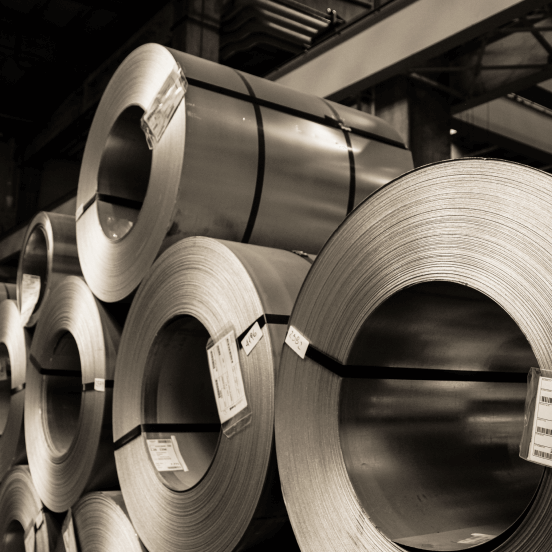

EN 10088-2 X2CrNi12 1.4003 Stainless Steel Plate Supplier | 1.4003 Ferritic Plate
1.4003 stainless steel plate: common buying pitfalls and a simpler supply route
X2CrNi12, steel number 1.4003, is a low-carbon ferritic stainless steel supplied as sheet, plate and strip to EN 10088-2, the European standard for corrosion resisting flat products for general purposes. The steel behind every 1.4003 stainless steel plate contains 10.5 – 12.5 % chromium and only 0.30 – 1.00 % nickel, so it is magnetic, it can be welded with ordinary shop procedures, and it costs noticeably less than 304. It is often grouped with the 3Cr12-type utility ferritics, a useful comparison as long as it is understood as a similarity rather than an exact match. Typical uses are structural frames, wear-and-corrosion parts, hoppers, chutes and transport equipment where carbon steel would rust quickly and an austenitic grade would be more than the job needs.
SHH STEEL works as a steel sourcing partner with long-term relationships with Chinese stainless mills. For large tonnages we help connect the buyer more directly with a mill that rolls the grade and size required, for a modest service fee. For small orders we consolidate demand, so that 1 – 5 t lots are placed against genuine mill production rather than unknown stock. Each shipment can be released after third-party inspection by TUV, ABS, BV, DNV, CCS or an agency the buyer nominates, and we accept payment by TT or LC. The rest of this page covers the technical side of EN 10088-2 1.4003, and the practical steps SHH STEEL takes so that the plate that arrives is the plate that was ordered.
The table below sets out the concerns buyers most often raise when sourcing EN 10088-2 X2CrNi12 plate from China, and how SHH STEEL handles each one.
| Buyer Concern | SHH STEEL Solution |
|---|---|
| Certificate mismatch or fake material | Plates come from long-term mill partners. Heat numbers are matched to the mill certificate, and PMI confirms the chemistry inside 1.4003 limits (Cr 10.5 – 12.5 %, Ni 0.30 – 1.00 %), which separates genuine X2CrNi12 from plain 410S or carbon-steel substitutes. Partner laboratories carry out chemical analysis, surface inspection and ultrasonic testing on request. EN 10204 3.1 is standard, and 3.2 certificates with third-party witness (TUV, ABS, BV, DNV, CCS or a buyer-nominated agency) are available. |
| Unsafe deposit | TT, LC or a TT + LC combination is accepted, so payment can be tied to shipping documents. For large projects the buyer can choose to contract directly with the mill, with SHH STEEL assisting for a small service fee. |
| Mill MOQ too high | 1.4003 is often needed in small lots for chutes, hoppers and frames. SHH STEEL consolidates 1 – 5 t orders against genuine mill production of the same grade. |
| Delivery delays | A dedicated person follows up the delivery schedule with the mill through rolling, annealing, testing and packing, and keeps the buyer updated. |
| Plate not ready for fabrication | Our own workshop provides cutting to size, bevelling for welding ferritic plate, drilling to drawing and surface pre-treatment as value-added services before shipment. |
EN 10088-2 vs EN 10028-7: standard selection for X2CrNi12 plate
The same steel, X2CrNi12 1.4003, appears in two European standards, and the difference between them matters more than the chemistry. EN 10088-2 is the technical delivery condition for sheet, plate and strip of corrosion resisting steels for general purposes. EN 10028-7 covers flat products of stainless steel for pressure purposes, and its plate is the one used for vessels and other equipment under the Pressure Equipment Directive and design codes such as EN 13445. When an enquiry does not say what the part does, SHH STEEL asks before quoting, so the plate is certified to the right standard from the start.
| Point | EN 10088-2 (this page) | EN 10028-7 |
|---|---|---|
| Intended use | General purposes: structures, frames, wear parts, transport and handling equipment | Pressure equipment: shells, heads, nozzles |
| Chemistry and room-temperature tensile values | Same limits for this grade | Same limits for this grade |
| Charpy impact requirement | No impact value set for this ferritic grade; may be agreed | Impact energy specified for the grade |
| Default inspection document | Test report 2.2 if the order says nothing; 3.1 / 3.2 by agreement | Normally 3.1 or 3.2 |
| Typical buyer | Fabricators, OEMs, mining and bulk-handling contractors | Pressure vessel manufacturers |
If your part does not hold pressure, EN 10088-2 is usually the correct and more economical standard to order against. If it does, use our EN 10028-7 X2CrNi12 1.4003 pressure vessel plate page instead, because a plate certified only to EN 10088-2 is not intended for pressure purposes. For a broader view of how European, American, Japanese and Chinese plate standards relate to each other, see our comparison of ASTM, EN, JIS and GB standards.
EN 10088-2 1.4003 specification overview
| Item | EN 10088-2:2014 requirement / SHH STEEL practice |
|---|---|
| Standard | EN 10088-2:2014, Stainless steels, Part 2: Technical delivery conditions for sheet/plate and strip of corrosion resisting steels for general purposes |
| Steel name / number | X2CrNi12 / 1.4003 |
| Structure | Ferritic, standard grade |
| Chemistry | Table 3 (cast analysis); product analysis tolerances in Table 5 |
| Room-temperature properties | Table 9, annealed condition, per product form |
| Elevated-temperature 0.2 % proof strength | Table 14 (for information and design reference) |
| Product forms | C cold-rolled strip up to 8 mm; H hot-rolled strip up to 13.5 mm; P hot-rolled plate up to 25 mm |
| Heat treatment | Annealed (+A); guideline temperatures in Table A.3 |
| Process route / finish | Table 6: 1D usual for hot-rolled plate; 2D or 2B for cold-rolled strip |
| Dimensions and tolerances | EN ISO 18286 for plate (P), EN ISO 9444-2 for hot-rolled strip (H), EN ISO 9445-2 for cold-rolled strip (C) |
| Surface quality of plate | EN 10163-2 class A2 unless otherwise agreed |
| Inspection document | EN 10204 2.2 by default; we normally issue 3.1, and 3.2 with a third-party inspector |
Edition note: the values on this page are taken from EN 10088-2:2014. A revised edition (EN 10088-2:2024) has since been published. If your contract names the newer edition, SHH STEEL checks the order against that text before production, and any difference is raised with you at the quotation stage rather than after rolling.
1.4003 chemical composition: heat analysis and product analysis tolerances
The 1.4003 chemical composition below is the cast (heat) analysis from EN 10088-2:2014 Table 3. Values are percentages by mass; a single figure is a maximum.
| Element | C | Si | Mn | P | S | Cr | Ni | N |
|---|---|---|---|---|---|---|---|---|
| Heat analysis, % | ≤ 0.030 | ≤ 1.00 | ≤ 1.50 | ≤ 0.040 | ≤ 0.015 | 10.5 – 12.5 | 0.30 – 1.00 | ≤ 0.030 |
The low carbon and nitrogen limits keep the weld zone tougher than in older 12 % chromium steels, and the small nickel addition helps to control the structure that forms in the heat-affected zone. Chromium near the 10.5 % threshold gives the steel its stainless character; it is enough for mild atmospheres and wet abrasion, but not for chloride service.
Product analysis tolerances (EN 10088-2 Table 5)
A product analysis is a check made on the delivered plate. It is not mandatory under EN 10088-2; it is carried out when agreed at the time of enquiry and order. On request, SHH STEEL arranges a product analysis on delivered plate through an independent laboratory and reports the result against these tolerances. The permissible tolerances on the cast limits are:
| Element | Cast limit, % | Permissible tolerance, % | Product analysis limit, % |
|---|---|---|---|
| C | ≤ 0.030 | +0.005 | ≤ 0.035 |
| Si | ≤ 1.00 | +0.05 | ≤ 1.05 |
| Mn | ≤ 1.50 | ±0.04 (range above 1.00 up to 2.00) | ≤ 1.54 |
| P | ≤ 0.040 | +0.005 | ≤ 0.045 |
| S | ≤ 0.015 | +0.003 | ≤ 0.018 |
| Cr | 10.5 – 12.5 | ±0.15 | 10.35 – 12.65 |
| Ni | 0.30 – 1.00 | +0.03 on the maximum | ≤ 1.03 (lower limit: see note) |
| N | ≤ 0.030 | +0.01 | ≤ 0.040 |
Note: the standard lists the nickel tolerance for limits up to 1.00 % against the maximum; how it applies to the 0.30 % minimum should be confirmed in the contract if a product analysis is ordered. EN 10088-2 also states that, where several product analyses are made on one cast, individual results may exceed the maximum or fall below the minimum, but not both for the same element.
1.4003 mechanical properties by product form (C, H, P)
The 1.4003 mechanical properties are set in EN 10088-2:2014 Table 9 for the annealed condition. The standard gives a separate row for each product form, and the proof strength depends on the test direction, so it is worth stating both the form and the thickness on the order.
| Product form | Max. thickness, mm | Rp0.2 min, MPa (long.) | Rp0.2 min, MPa (tr.) | Rm, MPa | A min, % (long. + tr.) |
|---|---|---|---|---|---|
| C – cold-rolled strip | 8 | 280 | 320 | 450 – 650 | 20 |
| H – hot-rolled strip | 13.5 | 280 | 320 | 450 – 650 | 20 |
| P – hot-rolled plate | 25 | 250 | 280 | 450 – 650 | 18 |
Elongation is measured on an 80 mm gauge length below 3 mm thickness and on a proportional gauge length (5.65√S0) from 3 mm upwards. For sizes beyond the tabulated thickness, EN 10088-2 says the mechanical values are to be agreed at the time of enquiry and order. Table 9 also records resistance to intergranular corrosion (tested to EN ISO 3651-2) as “no” both in the delivery condition and in the welded condition for this grade, which simply means that intergranular resistance is not a property the standard guarantees for 1.4003.
Impact toughness
EN 10088-2 does not set a Charpy impact value for X2CrNi12. If toughness matters for a structural or low-temperature application, a test temperature and acceptance value can be agreed with the mill before rolling; SHH STEEL writes that requirement into the mill order and checks it on the certificate. Where impact values must be guaranteed by the standard itself, plate to EN 10028-7 is the usual route.
Proof strength at elevated temperature (Table 14)
| Temperature, °C | 100 | 150 | 200 | 250 | 300 |
|---|---|---|---|---|---|
| Rp0.2 min, MPa (+A) | 240 | 235 | 230 | 220 | 215 |
These values are given in EN 10088-2 for information; they are useful when checking a structural part that runs warm, such as ducting or a dryer frame. They are verified by an elevated-temperature tensile test only if this is agreed in the order.
Heat treatment of X2CrNi12 plate: annealing and hot forming
X2CrNi12 plate is delivered in the annealed condition (+A). EN 10088-2 Table A.3 gives the guideline temperatures:
| Operation | Temperature, °C | Cooling |
|---|---|---|
| Hot forming | 1 100 – 800 | Air |
| Annealing (+A) | 700 – 760 | Air or water |
Annealing recrystallises the rolled structure and produces the soft ferritic condition on which the tensile values above are based. The annealing range is relatively low and narrow compared with austenitic grades, and over-heating should be avoided because ferritic steels coarsen their grain quickly at high temperature, with a loss of toughness.
Ferritic plate of this type is not hardened by heat treatment, and parts fabricated from it are normally not heat treated after welding. If a fabricated part has to be re-annealed, for instance after severe cold forming, the Table A.3 range is the reference, and the procedure should be agreed with the fabricator. The temperatures in Annex A are guidelines; the actual furnace settings are chosen by the mill. SHH STEEL checks that the annealed condition (+A) is stated on each mill certificate before plates are released.
Physical properties of 1.4003 ferritic plate
The values below are approximate reference figures for X2CrNi12 at room temperature, consistent with the data commonly quoted from EN 10088-1. They are suitable for design estimates and weight calculation; where a figure is critical, use the values in EN 10088-1 itself.
| Property | Approximate value |
|---|---|
| Density | about 7.7 g/cm³ |
| Modulus of elasticity at 20 °C | about 220 GPa |
| Mean thermal expansion, 20 – 100 °C | about 10.4 × 10⁻⁶ /K |
| Thermal conductivity at 20 °C | about 25 W/(m·K) |
| Specific heat at 20 °C | about 430 J/(kg·K) |
| Electrical resistivity at 20 °C | about 0.6 Ω·mm²/m |
| Magnetic behaviour | Ferromagnetic (magnetic) |
Two of these figures matter in practice. Thermal expansion is much lower than that of 304, so 1.4003 frames and liners move less with temperature and match carbon steel more closely, which helps where the two are joined. The density of about 7.7 g/cm³ means a 10 mm plate weighs roughly 77 kg per square metre, slightly less than an austenitic plate of the same size. SHH STEEL uses this figure for weight and freight estimates in every quotation.
Corrosion behaviour of X2CrNi12 1.4003
With chromium close to the stainless threshold and no molybdenum, X2CrNi12 1.4003 sits at the economy end of the stainless range. It is chosen to replace painted or galvanised carbon steel where coatings are worn away, not to compete with 304 or 316 in aggressive media.
| Environment | Typical behaviour |
|---|---|
| Rural and mild industrial atmospheres | Good; light surface staining is possible but structural loss is minimal |
| Wet abrasion and sliding wear (coal, ore, ash, sugar cane) | Good; often outperforms carbon steel because no protective coating is lost |
| Potable water and condensates | Generally suitable |
| Chloride-rich, marine or de-icing salt exposure | Not recommended; pitting and staining likely |
| Strong acids | Not suitable |
Like other ferritic grades, 1.4003 is practically insensitive to chloride stress-corrosion cracking, which is an advantage over austenitic steels in warm, mildly contaminated conditions. Surface appearance is not its strength: where a bright finish must be kept outdoors, a higher-chromium grade is the better choice. The table is general guidance only, and material selection for a specific medium should be based on experience or testing. If the medium is uncertain, SHH STEEL can suggest a higher-chromium or austenitic alternative from the same mill partners rather than supplying 1.4003 where it would not last.
Weldability of 1.4003 ferritic plate: SHH STEEL workshop practice
Weldability is one of the reasons the grade exists. The low carbon and nitrogen levels, together with the nickel addition, give a heat-affected zone that is far less brittle than that of older 12 % chromium steels. 1.4003 can be joined by MMA, MIG/MAG, TIG and submerged-arc welding.
- Filler metal: austenitic consumables of the 309L type are widely used, especially when joining 1.4003 to carbon steel; 308L-type fillers are also used for 1.4003 to 1.4003 joints. Final choice should follow the welding procedure specification.
- Heat input: keep it low to moderate and avoid wide weaving, because ferritic steels coarsen their grain in the heat-affected zone when heat input is high.
- Preheat: normally not required for the thicknesses covered here; interpass temperature is usually kept low (commonly around 100 – 150 °C, as industry practice).
- Post-weld heat treatment: normally not required.
- Cleaning: remove heat tint by pickling or brushing to restore corrosion resistance at the weld.
These points reflect common industry practice for this grade family rather than requirements of EN 10088-2, which does not specify welding procedures. For structural work, the procedure should be qualified to the code that applies to your project. In the SHH STEEL workshop, weld bevels are cut to the angle and root face shown on your drawing, so plates arrive ready for the qualified procedure.
Formability, machinability and cutting of X2CrNi12 plate in the SHH STEEL workshop
X2CrNi12 plate behaves in the workshop much like a mild carbon steel with a little more spring-back. It can be cut by plasma, laser or waterjet, sheared in thinner gauges, and bent on a press brake. Because it is a ferritic steel, bending is best done at room temperature or slightly warm in cold weather, with an inside radius of at least one to two times the thickness for heavier plate, and with the bend line at right angles to the rolling direction where possible. These are workshop guidelines, not standard requirements.
Machining is comparable to other ferritic stainless grades: sharp tools, steady feeds and good coolant give clean results without the work-hardening problems of austenitic steels. Drilling and tapping of mounting holes in frames is routine.
SHH STEEL runs its own workshop next to the warehouse, so plates can be delivered ready for assembly instead of as raw mill sizes. The workshop handles cutting, beveling for weld preparation, profiling to drawing and surface preparation such as brushing or protective film. Details of the equipment are on our steel cutting services page. Pre-cut parts reduce freight weight, cut scrap at your end and shorten the time from delivery to fabrication.
1.4003 plate sizes, thickness limits and tolerances supplied by SHH STEEL
EN 10088-2 limits each product form to a maximum thickness, and the tolerance standard depends on the form:
| Product form | Thickness range covered by EN 10088-2 | Typical width supplied (by mill) | Tolerance standard |
|---|---|---|---|
| C – cold-rolled strip and sheet | up to 8 mm | 1 000 / 1 219 / 1 250 / 1 500 mm | EN ISO 9445-2 |
| H – hot-rolled strip and plate cut from coil | up to 13.5 mm | 1 250 / 1 500 / 1 800 / 2 000 mm | EN ISO 9444-2 |
| P – hot-rolled quarto plate | up to 25 mm (above by agreement) | 1 500 – 2 500 mm, wider by mill | EN ISO 18286 |
Widths and lengths in the table are typical mill offerings, not values from the standard. Lengths are usually 2 000 – 6 000 mm for coil-cut plate and up to about 12 000 mm for quarto plate, depending on the mill. EN 10088-2 says EN ISO 18286 normally applies only to individually rolled quarto plate (form P), while continuously rolled material (form H) follows EN ISO 9444-2. Under EN ISO 18286, width and length tolerances are class A unless another class is agreed, so state the class on the order if you need tighter limits. Surface imperfections on quarto plate are judged to EN 10163-2 class A2 unless otherwise agreed.
Most structural users of 1.4003 work in the 3 – 20 mm range. Thicker requirements, odd widths or very short lengths are where consolidation and in-house cutting usually make the most sense. SHH STEEL confirms available widths and lengths with the mill at quotation and cuts plate to finished size in its own workshop when a mill size does not fit.
Surface finishes for EN 10088-2 X2CrNi12 plate
Surface finish is ordered by the process route symbols of EN 10088-2 Table 6. Not every route is available for every grade, and the mill confirms which ones it can supply.
| Symbol | Description | Use for 1.4003 |
|---|---|---|
| 1D | Hot rolled, heat treated, pickled | Standard finish for hot-rolled plate (forms H and P) |
| 1E | Hot rolled, heat treated, mechanically descaled | Alternative for plate that will be painted or machined |
| 1C | Hot rolled, heat treated, not descaled | Only where scale is removed later in fabrication |
| 2D | Cold rolled, heat treated, pickled | Cold-rolled strip and sheet where good ductility matters |
| 2B | Cold rolled, heat treated, pickled, skin passed | Most common cold-rolled finish: smoother and flatter than 2D |
| 1J / 2J | Brushed or dull polished | On request, one side, in the SHH STEEL workshop |
Unless otherwise agreed, only one surface is inspected to the ordered finish (the prime surface), and the mill marks it, normally as the top surface. For 1D plate the standard permits grinding marks, and the finish is not as smooth as 2D or 2B. For most structural and wear applications 1D is entirely adequate; 2B sheet is chosen for visible panels and enclosures.
1.4003 equivalent grades and 1.4003 vs 304 comparison
Buyers often search for 3Cr12 stainless steel when they really need 1.4003, or the other way round. When buyers ask for the 1.4003 equivalent in another standard, the honest answer is that there are close relatives rather than exact twins. The table lists the nearest grades; chemistry and property limits differ in detail, so substitution should be checked against the governing specification.
| System | Nearest grade | Comment |
|---|---|---|
| ASTM A240 / ASME SA-240 | UNS S41003 | Closest match; similar Cr range, but limits such as Ni, S and the tensile minimums are not identical |
| Trade designation | 3Cr12-type | Similar 12 % Cr utility ferritic concept; not an identical specification |
| GB/T 4237 / GB/T 3280 | 022Cr12Ni (S11213) | Nearest Chinese grade; GB/T 4237 for hot-rolled, GB/T 3280 for cold-rolled plate and strip |
| JIS G 4304 / G 4305 | No exact equivalent | SUS410L is the nearest grade, not an equivalent |
| AISI | 409 / 410L family | Related 11 – 13 % Cr ferritics, not direct equivalents |
On our site you can compare related plate grades such as ASTM A240 Type 409, ASME SA240 409L, JIS G4305 SUS410L, GB/T 4237 022Cr12Ni S11213 and GB/T 4237 022Cr12 S11203. Where a drawing calls for UNS S41003 but the project is European, ordering X2CrNi12 to EN 10088-2 is often acceptable, but the designer should confirm it. SHH STEEL can prepare a side-by-side comparison of the limits to support that decision.
1.4003 vs 304
The 1.4003 vs 304 question usually comes down to cost against corrosion margin. ASTM A240 Type 304 contains about 18 % chromium and 8 % nickel, so it resists a far wider range of environments, but its price follows the nickel market. 1.4003 carries at most 1 % nickel, is magnetic, has higher proof strength in the annealed state and lower thermal expansion, and is markedly cheaper per tonne. For hoppers, chutes, frames and wagon bodies in mild or abrasive service, 1.4003 is often the better-value choice; for food contact, chlorides or visible architectural surfaces, 304 remains the safer one. SHH STEEL can quote both grades on one enquiry so the cost difference is clear.
Applications of 1.4003 ferritic plate
The typical 1.4003 ferritic plate application is a structure or wear part that would rust through in carbon steel, does not hold pressure, and does not justify an austenitic grade. Common uses include:
- Coal, ore and ash handling: hoppers, chutes, bins, conveyor skirts and liners
- Rail freight wagons and truck bodies for bulk materials
- Bus and coach frames and underbody structures
- Sugar mill, mining and mineral processing equipment exposed to wet abrasion
- Walkways, platforms, gratings and support frames in the construction industry and in industrial plants
- Ducting, dryer frames and enclosures operating moderately warm
- Agricultural equipment and silos
In each case the reasoning is the same: a modest stainless content that removes the need for coatings and maintenance, without paying for nickel that the environment does not require. For these uses SHH STEEL can supply plate cut to part size, which reduces scrap and freight. When the part is part of a pressure system instead, the EN 10028-7 version of the steel is used, and for heat-affected-zone toughness in thicker welded sections some designers prefer the titanium-stabilised EN 10028-7 X6CrNiTi12 1.4516 grade family.
Common buyer concerns and our solutions
Most problems in buying 1.4003 plate from China are not technical. They come from how the order is placed and followed. The table summarises what buyers tell us they worry about, and the specific steps we take for each.
| Concern | What Usually Happens | How SHH STEEL Handles It |
|---|---|---|
| Fake or substituted material | Plates arrive with a certificate copied from another heat, or a cheaper grade is supplied under the 1.4003 name. | Material is sourced from mills we have worked with for years; heat numbers on plates are matched to the certificate, PMI is carried out in our warehouse, and third-party inspection can be added before shipment. |
| Deposit risk | The supplier is responsive before payment and hard to reach afterwards. | TT or LC is accepted, so payment can be tied to shipping documents; a named contact follows the order from contract to arrival. |
| Quantity too small for the mill | Mills usually set a minimum of around 20 – 80 t per size, so 1 – 5 t enquiries are declined or redirected to unknown stock. | Small lots are consolidated with other orders and placed against genuine mill production of the same grade. |
| Long or uncertain delivery | Rolling dates slip and nobody tells the buyer until the ship is missed. | Dedicated follow-up with the mill on rolling, annealing and testing dates, with regular progress updates to the buyer. |
| Plates need cutting or preparation | Raw mill sizes have to be cut and bevelled locally, adding cost and time. | Our own workshop provides cutting, beveling, profiling and surface preparation, so parts ship ready for fabrication. |
None of these steps is complicated, but they need to be agreed at the start. When you send an enquiry, tell SHH STEEL which of these points matters most to you and we will build the order around it.
Testing, certificates and lead time at SHH STEEL
EN 10088-2 Table 21 sets out the tests. The cast analysis is always reported by the manufacturer, and a tensile test at room temperature is mandatory when specific testing is ordered. For quarto plate (form P), plates processed under identical conditions may be grouped into a batch of up to 30 000 kg and no more than 40 plates, with one test sample per batch for plates up to 15 m long. Other tests are optional and are carried out only when agreed at the time of order:
- Product analysis (extent to be agreed)
- Tensile test at elevated temperature, verifying Table 14 values
- Charpy impact test, at a temperature and acceptance level to be agreed
- Intergranular corrosion test to EN ISO 3651-2, normally not carried out
- Additional checks through our third-party testing service: PMI, dimensional and surface inspection
If the order does not name an inspection document, EN 10088-2 requires only a test report 2.2. Because this is rarely enough for export work, SHH STEEL supplies an EN 10204 3.1 inspection certificate as standard and a 3.2 certificate when an independent inspector (TUV, ABS, BV, DNV, CCS or an agency you nominate) witnesses testing and countersigns the document.
Ordering example and lead time
Following the pattern of the example in EN 10088-2, a typical order line would read: 10 plates EN ISO 18286, 8 × 2000 × 5000 mm, tolerance class B; steel EN 10088-2 – X2CrNi12+1D (or 1.4003+1D); inspection certificate EN 10204 – 3.1. Mill production lead time is generally 30 – 40 days from order confirmation, depending on the rolling schedule, the size and the tests requested. Consolidated small lots follow the same mill schedule, and SHH STEEL sends progress updates at rolling, testing and packing.
Why Work with SHH STEEL
- Mill relationships: long-term cooperation with Chinese stainless mills helps SHH STEEL secure competitive pricing and steadier delivery for 1.4003 and related ferritic grades.
- Direct mill assistance: for larger tonnages we help you connect more directly with a suitable mill, for a modest service fee, while we handle follow-up and documents.
- Order consolidation: 1 – 5 t lots are combined so they can be placed against genuine mill production.
- Own workshop: cutting, beveling, profiling and surface preparation before shipment.
- Inspection and certificates: third-party inspection by TUV, ABS, BV, DNV, CCS or your nominated agency, with EN 10204 3.1 or 3.2 certificates.
- Flexible payment: TT or LC accepted.
- Port logistics: plates are packed on seaworthy pallets with heat-number labels and shipped through our worldwide shipping service, together with other grades if needed.
As a 1.4003 plate supplier SHH STEEL also stocks and sources the wider range of stainless steel sheets and plates, so mixed orders of ferritic and austenitic plate can travel in one container with one set of paperwork.
FAQ
- What is 1.4003 stainless steel equivalent to?
- The closest 1.4003 equivalent in American standards is UNS S41003, which is listed in ASTM A240 and ASME SA-240. The two have similar chromium ranges and low carbon, but they are not identical: limits for nickel and sulphur, and the tensile minimums, are written differently, so a plate certified to one does not automatically meet the other. The steel is also often compared with 3Cr12-type utility ferritics, which follow the same idea of a 12 % chromium, low-carbon, weldable ferritic, but again without an exact match in every limit. In China the nearest hot-rolled grade is 022Cr12Ni (S11213) under GB/T 4237 (hot-rolled) and GB/T 3280 (cold-rolled). If a drawing names one of these grades and you would like to use X2CrNi12 to EN 10088-2 instead, ask the designer to confirm the substitution. SHH STEEL can provide a side-by-side comparison of the limits for that purpose.
- Is 1.4003 stainless steel magnetic?
- Yes. 1.4003 is a ferritic stainless steel, so it is magnetic in every condition, including the annealed condition in which plate is delivered. This is a normal property of the grade and not a sign of poor quality or wrong material, which is a common misunderstanding when buyers are used to austenitic grades such as 304. The magnetic behaviour is actually useful in some applications, for example where magnetic lifting is used in the workshop or where magnetic separators are part of a handling line. For material identification, a magnet only tells you that the steel is ferritic or martensitic; it cannot confirm that it is 1.4003. That is why SHH STEEL relies on heat-number traceability, the mill certificate and PMI with an XRF analyser, and add laboratory analysis or third-party inspection when the buyer requires it.
- What is the difference between 1.4003 and 304 stainless steel?
- The main difference is alloy content, and that drives both price and corrosion resistance. 304 contains about 18 % chromium and 8 % nickel and is austenitic and essentially non-magnetic. 1.4003 has 10.5 – 12.5 % chromium and no more than 1 % nickel, so it is ferritic, magnetic and considerably cheaper. In the annealed condition 1.4003 plate has a higher minimum proof strength than 304 plate and much lower thermal expansion, which helps when it is joined to carbon steel. On the other hand, 304 resists a far wider range of environments, including many chloride and food-processing conditions, and keeps a better appearance outdoors. As a rule, choose 1.4003 for hoppers, chutes, frames and transport equipment in mild or abrasive service, and choose 304 where corrosion resistance or appearance is the priority.
- Can 1.4003 stainless steel be welded?
- Yes, and good weldability is one of the main reasons the grade was developed. Its low carbon and nitrogen limits and the small nickel addition give a heat-affected zone with much better toughness than older 12 % chromium steels. It can be welded by MMA, MIG/MAG, TIG and submerged-arc processes. In common industry practice, austenitic fillers of the 309L type are used, particularly when 1.4003 is joined to carbon steel, and 308L-type fillers are also used for similar-metal joints. Heat input should be kept low to moderate to limit grain growth, preheat is usually not needed for the thicknesses covered by EN 10088-2, and post-weld heat treatment is normally not required. After welding, heat tint should be removed by pickling or brushing. EN 10088-2 does not specify welding procedures, so follow a qualified procedure for your project.
- Should I order 1.4003 plate to EN 10088-2 or EN 10028-7?
- It depends on whether the part holds pressure. EN 10088-2 covers stainless sheet, plate and strip for general purposes, such as structural frames, wear parts, hoppers and transport equipment. EN 10028-7 covers stainless flat products for pressure purposes and is the standard used for vessels designed under codes such as EN 13445 and supplied under the Pressure Equipment Directive. For X2CrNi12 the chemistry and room-temperature tensile values are the same in both, but EN 10028-7 adds requirements, including impact energy, and normally comes with a 3.1 or 3.2 certificate. EN 10088-2 defaults to a 2.2 test report unless something else is agreed. If your part is not pressure equipment, EN 10088-2 is normally the right and more economical choice. If it is, order to EN 10028-7 and tell SHH STEEL so at the enquiry stage.
- Can I buy a small quantity of 1.4003 plate from China, and how is quality checked?
- Yes. Most mills set a minimum order of roughly 20 – 80 t per size, which is why small enquiries are often turned away or quietly filled from stock of unknown origin. SHH STEEL consolidates small orders with other demand for the same grade, so lots of about 1 – 5 t can be placed against genuine mill production. Quality is checked in several steps. The heat number on each plate is matched to the mill certificate, plates are checked by PMI in our warehouse, and dimensions and surface are inspected before packing. We issue an EN 10204 3.1 certificate as standard, and on request an independent inspector from TUV, ABS, BV, DNV, CCS or an agency you nominate can witness testing and sign a 3.2 certificate. Payment by TT or LC is accepted, and lead time is generally 30 – 40 days.
Ordering EN 10088-2 1.4003 Plate from SHH STEEL
EN 10088-2 X2CrNi12 1.4003 is a practical, economical ferritic stainless steel for structures and wear parts that do not hold pressure: magnetic, weldable, stronger than 304 in the annealed state and much less sensitive to nickel prices. Choosing it is the easy part. Getting plate that matches its certificate, in the quantity you need, on a predictable schedule and ready for fabrication is where a sourcing partner earns its place, and that is the work SHH STEEL does every day through long-term mill cooperation, consolidation and our own workshop.
The next step is simple. Send SHH STEEL your drawing, or an enquiry with the quantity, grade, thickness and delivery destination, and we will judge whether direct mill supply or consolidation with processing fits your order better, and quote accordingly. Send your sizes and quantities for a quotation.
Quality Steel Needed? Inquire for Offers
Related Products