
GB/T 4237 022Cr25Ni7Mo4N S25073 Stainless Steel Plate Supplier
022Cr25Ni7Mo4N S25073 plate at a glance
022Cr25Ni7Mo4N is super duplex 2507 (UNS S32750, EN 1.4410): Cr 24–26%, Mo 3–5%, N 0.24–0.32%. Minimum proof strength is 550 MPa and PREN is above 40 at typical chemistry, so it is used where 2205 starts to pit, mainly in warm seawater and high-chloride process streams.
Reading the designation: ‘022’ gives the carbon level (C ≤0.030% in GB/T 4237), followed by Cr25 = about 25% chromium; Ni7 = about 7% nickel; Mo4 = about 4% molybdenum; N = nitrogen added. S25073 is the unified numeric code (ISC) used in GB/T 4237-2015.
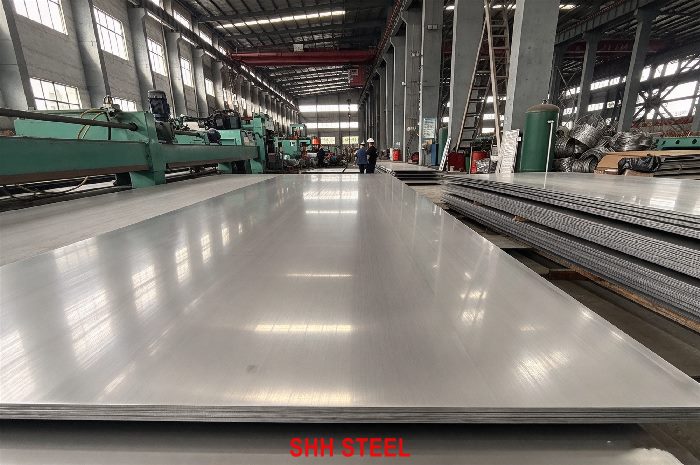
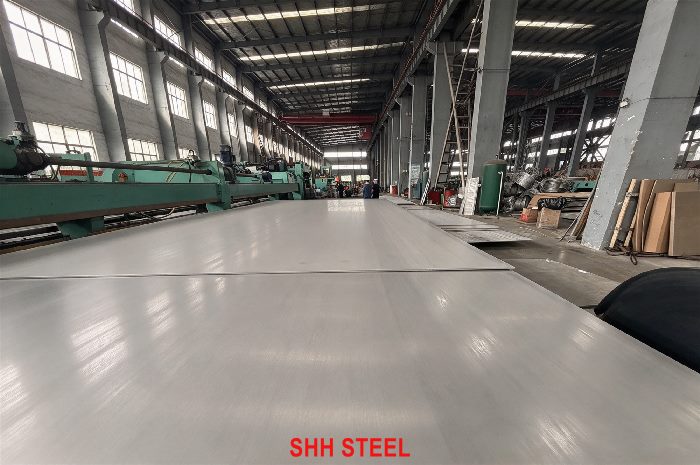
SHH STEEL produces and exports austenitic-ferritic (super duplex) stainless plate from China, works as a sales agent for leading stainless mills, and runs its own processing warehouse for cutting and surface finishing. 022Cr25Ni7Mo4N is part of our GB/T 4237 stainless plate range; for comparison, see our ASTM A240 Type 2507 page.
Corrosion behaviour and intergranular corrosion tests
Super duplex grades (PREN ≥40) are designed for seawater at ambient to moderate temperature, sour oil and gas service within NACE limits, and chloride process streams.
PREN of 022Cr25Ni7Mo4N from the GB/T 4237 limits: 37.7 – 42.7. PREN is a ranking tool for pitting in chlorides, not a guarantee; temperature, crevices, deposits and weld finish matter as much.
Intergranular corrosion testing is not compulsory for this grade in GB/T 4237-2015; when required, the method (GB/T 4334, ASTM A262 or A923 for duplex) and acceptance are agreed in the order.
For critical service, order ASTM G48 Method A (ferric chloride pitting) or Method C/E (critical pitting temperature) tests on the plate heat. We arrange them at the mill or an independent laboratory.
If service is harsher than 022Cr25Ni7Mo4N can handle, the next step up in this batch is GB/T 4237 015Cr20Ni18Mo6CuN S31252.
Chemical composition of 022Cr25Ni7Mo4N S25073
| Element | 022Cr25Ni7Mo4N heat analysis, % (Table 16) | Why it matters |
|---|---|---|
| C | ≤ 0.030 | Carbon. Low values protect welds from carbide precipitation; higher values add hot strength or hardenability. |
| Si | ≤ 0.80 | Silicon. Deoxidizer; in heat-resistant grades it builds a protective scale. |
| Mn | ≤ 1.20 | Manganese. Deoxidizer; in Mn-bearing grades it replaces nickel and keeps nitrogen in solution. |
| P | ≤ 0.035 | Phosphorus. Impurity, kept low for toughness and weld cracking resistance. |
| S | ≤ 0.020 | Sulfur. Impurity; low sulfur improves pitting resistance, hot workability and polishability. |
| Cr | 24.00 – 26.00 | Chromium. Forms the passive film; the main driver of corrosion and oxidation resistance. |
| Ni | 6.00 – 8.00 | Nickel. Stabilizes austenite, improves toughness and resistance to reducing acids. |
| Mo | 3.00 – 5.00 | Molybdenum. Raises pitting and crevice resistance in chlorides (×3.3 in PREN). |
| Cu | ≤ 0.50 | Copper. Improves resistance to sulfuric acid and, in ferritics, general corrosion and formability. |
| N | 0.24 – 0.32 | Nitrogen. Strengthens, stabilizes austenite and adds pitting resistance (×16 in PREN). |
| PREN (Cr + 3.3Mo + 16N) | 37.7 – 42.7 (minimum – mid-range) | Calculated from the limits above, not a requirement of GB/T 4237 |
Values are maximum unless a range is given. The mill reports the ladle (heat) analysis on the certificate; this is the figure to compare with Table 16.
Product analysis vs heat analysis
A check analysis drilled from the finished plate may differ slightly from the heat analysis. GB/T 4237 refers to GB/T 222 for the permitted deviations; the table applies them to the 022Cr25Ni7Mo4N limits. Deviations apply to one side of a range only, never to both sides in the same heat.
| Element | Heat analysis limit (%) | Permitted deviation | Product analysis limit (%) |
|---|---|---|---|
| C | ≤ 0.030 | +0.005 | ≤ 0.035 |
| Si | ≤ 0.80 | ±0.05 | ≤ 0.85 |
| Mn | ≤ 1.20 | ±0.04 | ≤ 1.24 |
| P | ≤ 0.035 | +0.005 | ≤ 0.040 |
| S | ≤ 0.020 | +0.005 | ≤ 0.025 |
| Cr | 24.00 – 26.00 | ±0.25 | 23.75 – 26.25 |
| Ni | 6.00 – 8.00 | ±0.10 | 5.90 – 8.10 |
| Mo | 3.00 – 5.00 | ±0.10 | 2.90 – 5.10 |
| Cu | ≤ 0.50 | ±0.03 | ≤ 0.53 |
| N | 0.24 – 0.32 | ±0.02 (min) / ±0.03 (max) | 0.22 – 0.35 |
Where the table says ‘by agreement’, the deviation is not tabulated for that content level and should be agreed in the contract, usually by reference to ASTM A480 Table A1.1.
Mechanical properties at room temperature
| Property | 022Cr25Ni7Mo4N (Table 21) |
|---|---|
| Proof strength Rp0.2, MPa | ≥ 550 |
| Tensile strength Rm, MPa | ≥ 795 |
| Elongation A, % | ≥ 15 |
| Hardness HBW | ≤ 310 |
| Hardness HRC | ≤ 32 |
Values apply to plate in the delivery heat-treated condition, tested transversely per GB/T 228.1. Hardness is checked by one method chosen by the mill.
Phase balance, strength and service limits
Duplex plate is about half ferrite and half austenite after solution annealing. Ferrite gives strength and resistance to stress corrosion cracking; austenite gives toughness and weldability. Mills measure the balance on each heat, and most project specifications ask for 35–65% ferrite in plate.
Two temperature limits apply to all duplex grades. Above about 250–300 °C long-term service causes 475 °C embrittlement, so ASME limits duplex to that range. At low temperature duplex has a ductile-brittle transition, so impact testing is normally specified at −40 °C or −46 °C for offshore plate.
Weight saving: with roughly double the proof strength of 316L, duplex shells and tanks can often be 30–40% thinner. That is the real cost case for 022Cr25Ni7Mo4N, not the price per tonne.
Welding and fabrication of 022Cr25Ni7Mo4N
Super duplex demands the tightest control: heat input about 0.2–1.5 kJ/mm, interpass ≤100 °C, ER2594 filler (25-9-4-N) and Ar + N2 root gas.
Most oil and gas buyers require the welding procedure to pass ASTM G48 Method A at 35–40 °C, ferrite 35–55% and Charpy ≥45 J at −46 °C. Plan these tests with the fabricator before cutting the plate.
Cutting: we cut 022Cr25Ni7Mo4N by plasma (up to about 150 mm), laser (thin plate) or waterjet, and remove the heat-affected edge by machining where the drawing requires it.
Heat treatment and delivery condition
Recommended heat treatment for 022Cr25Ni7Mo4N (GB/T 4237-2015 Annex C): 1 050 – 1 100 °C, water quench.
Super duplex is the most sensitive grade family to sigma phase. Quench time from the furnace to water must be short, and hot-formed parts must be re-solution annealed.
022Cr25Ni7Mo4N equivalent grades: ASTM, EN, JIS
| Standard system | Equivalent / closest grade |
|---|---|
| China GB/T 4237-2015 | 022Cr25Ni7Mo4N (S25073) |
| ASTM A240/A240M | 2507 / S32750 |
| EN 10088-2 | X2CrNiMoN25-7-4 / 1.4410 |
| JIS G4304 (hot rolled) | — |
| Common name | 2507 |
Equivalent grades are close in chemistry and properties but are never identical: limits on carbon, nitrogen and residual elements differ. For dual or multiple certification the heat must meet every standard named on the order, and we confirm that from the heat chemistry before quotation.
Related pages: ASTM A240 Type 2507, ASME SA240 2507. See also our ASTM A240/A240M and JIS G4305 plate lists.
Testing and certification
- Heat chemical analysis on every heat; product analysis by agreement
- Tensile test (Rp0.2, Rm, A) per batch
- Hardness test
- Ferrite content measurement
- ASTM A923 Method A/B/C for intermetallic phases when specified
- Charpy V-notch impact at −40 °C or −46 °C when specified
- ASTM G48 pitting test when specified
- Ultrasonic testing (NB/T 47013.3 or ASTM A578) when specified
- Positive material identification (PMI) on every plate leaving our warehouse
- Visual and dimensional inspection; third-party inspection (SGS, BV, TÜV, Intertek) at the buyer’s request
Certificates follow EN 10204 3.1 as standard. Where plate is also certified to ASME SA240 or ASTM A240, both standards are shown on one certificate.
Comparison with sister grades
The table compares 022Cr25Ni7Mo4N with the grades buyers most often weigh it against. Strength values are GB/T 4237-2015 minimums; PREN is calculated from the minimum chemistry.
| Grade (GB/T 4237) | Key chemistry, % | PREN min | Rp0.2 min, MPa | Rm min, MPa |
|---|---|---|---|---|
| 022Cr25Ni7Mo4N S25073 | C ≤ 0.030, Cr 24.00 – 26.00, Ni 6.00 – 8.00, Mo 3.00 – 5.00, N 0.24 – 0.32, Cu ≤ 0.50 | 37.7 | 550 | 795 |
| GB/T 4237 022Cr25Ni7Mo4WCuN S27603 | C ≤ 0.030, Cr 24.00 – 26.00, Ni 6.00 – 8.00, Mo 3.00 – 4.00, N 0.20 – 0.30, Cu 0.50 – 1.00 | 37.1 | 550 | 750 |
| GB/T 4237 03Cr25Ni6Mo3Cu2N S25554 | C ≤ 0.04, Cr 24.00 – 27.00, Ni 4.50 – 6.50, Mo 2.90 – 3.90, N 0.10 – 0.25, Cu 1.50 – 2.50 | 35.2 | 550 | 760 |
| GB/T 4237 022Cr23Ni5Mo3N S22053 | C ≤ 0.030, Cr 22.00 – 23.00, Ni 4.50 – 6.50, Mo 3.00 – 3.50, N 0.14 – 0.20 | 34.1 | 450 | 655 |
| GB/T 4237 015Cr20Ni18Mo6CuN S31252 | C ≤ 0.020, Cr 19.50 – 20.50, Ni 17.50 – 18.50, Mo 6.00 – 6.50, N 0.18 – 0.25, Cu 0.50 – 1.00 | 42.2 | 310 | 655 |
| GB/T 4237 015Cr24Ni22Mo8Mn3CuN S32652 | C ≤ 0.020, Cr 24.00 – 25.00, Ni 21.00 – 23.00, Mo 7.00 – 8.00, N 0.45 – 0.55, Mn 2.00 – 4.00 | 54.3 | 430 | 750 |
Welding windows are narrower than 2205: heat input about 0.2–1.5 kJ/mm, interpass ≤100–150 °C, ER2594 filler. Ask for ASTM A923 Method A/C or G48 testing when the plate goes to oil and gas; NORSOK M-630 MDS sheets are common.
Typical uses of GB/T 4237 022Cr25Ni7Mo4N
Where super duplex is specified:
- Offshore topside and subsea process equipment
- Seawater cooling, firewater and desalination (RO high-pressure) systems
- Chemical process vessels in chloride
- Pulp bleach plant equipment
- Flue gas scrubbers
Buyers specifying 022Cr25Ni7Mo4N for these jobs often compare it with GB/T 4237 022Cr25Ni7Mo4WCuN S27603 and GB/T 4237 015Cr24Ni22Mo8Mn3CuN S32652; the comparison table on this page shows the differences.
International grade pages for the alternatives mentioned above: ASTM A240 Type 2205, AISI 254 SMO, AISI 254 SMO.
Other GB/T 4237 grades buyers request alongside it: GB/T 4237 022Cr22Ni5Mo3N S22293, GB/T 4237 022Cr23Ni4MoCuN S23043.
GB/T 4237 022Cr25Ni7Mo4N specification details
| Item | GB/T 4237-2015 requirement / SHH STEEL supply |
|---|---|
| Standard | GB/T 4237-2015 Hot rolled stainless steel plate, sheet and strip (current edition, replaces GB/T 4237-2007) |
| Grade / unified code | 022Cr25Ni7Mo4N / S25073 |
| Steel class | Austenitic-ferritic (super duplex) |
| Chemical composition | Table 16 (heat analysis); product analysis per GB/T 222 |
| Mechanical properties | Table 21 |
| Product forms | Hot-rolled thick plate (3.0 – 200 mm in the standard), hot-rolled wide strip and cut plate (2.0 – 25.4 mm) |
| Our usual thickness range | 3 – 60 mm |
| Delivery condition | 1 050 – 1 100 °C, water quench |
| Surface | Hot rolled, heat treated, pickled (No.1 / 1D) as standard; ground or polished by agreement |
| Density | 7.8 g/cm³ |
| Certificate | EN 10204 3.1 mill certificate; 3.2 with third-party inspection on request |
Sister grades on the same standard are listed under GB/T 4237; cold-rolled sheet of the same chemistry is ordered to GB/T 3280, and all our plate lines sit in stainless steel sheets and plates.
Sizes, tolerances and weight
| Dimension | Typical supply |
|---|---|
| Thickness | 3 – 60 mm |
| Width | 1 000 / 1 219 / 1 250 / 1 500 / 1 800 / 2 000 mm; wider by mill order |
| Length | 2 000 / 2 438 / 3 000 / 6 000 mm or cut to size |
| Flatness | Per GB/T 4237; ≤15 mm per metre for plate up to 25 mm unless agreed tighter |
| Thickness tolerance | Per the GB/T 4237 dimensional tolerance tables (normal or higher accuracy as ordered) |
| Edge | Mill edge or cut edge |
Weight: plate mass in kg/m² = thickness (mm) × density (7.8 g/cm³). A 10 mm 022Cr25Ni7Mo4N plate weighs about 78.0 kg/m²; a 1 500 × 6 000 × 10 mm plate about 702 kg.
Finishes and warehouse services
| Finish | Description | Availability for this grade |
|---|---|---|
| No.1 / 1D | Hot rolled, heat treated, pickled; the GB/T 4237 standard surface | Standard |
| Shot-blasted + pickled | Uniform matte for welded structures | On request |
| Ground | Ground surface for defect removal or UT | On request |
| 2B / BA | Cold-rolled finishes (ordered as GB/T 3280 sheet, not hot-rolled plate) | Sheet only |
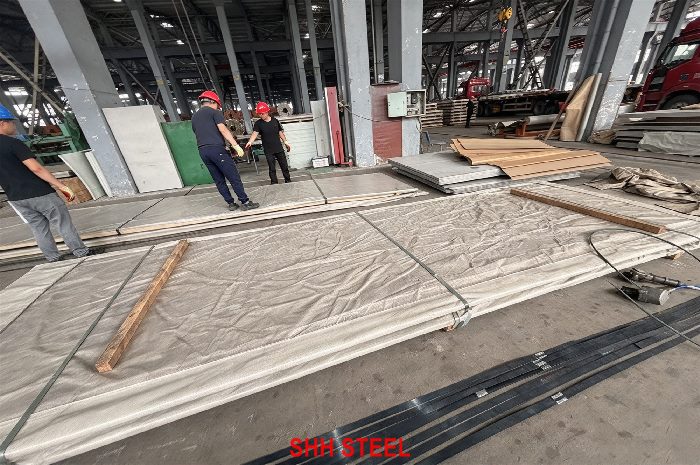
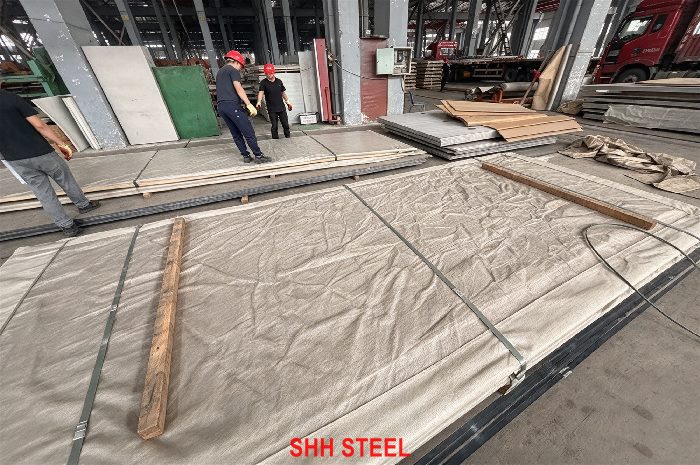
Our warehouse cuts plate to size (plasma, laser, waterjet, saw), bevels weld edges, polishes and applies PVC protective film. Processed plate ships with the original mill heat number marked. Ask for cut pieces of other stainless steel products at the same time to consolidate freight.
What to put on a 022Cr25Ni7Mo4N purchase order
- Standard and edition: GB/T 4237-2015
- Grade and code: 022Cr25Ni7Mo4N (S25073); add the equivalent if dual certification is needed
- Thickness × width × length, quantity in pieces or tonnes
- Thickness tolerance class and flatness if tighter than standard
- Surface finish and protective film
- Tests beyond the standard (IGC, UT, impact, ferrite, PMI, grain size)
- Certificate type (EN 10204 3.1 / 3.2) and inspection body
- Marking, packing (wooden cases, steel pallets) and delivery terms
Send the list to SHH STEEL and we return a quotation with mill, lead time and stock options. Other grades from the same standard can be combined in one shipment; browse GB/T 4237 plate grades.
Supply chain and lead time
022Cr25Ni7Mo4N is a mainstream grade at Chinese stainless mills. We supply it from our own stock and processing warehouse, and by mill order from major producers such as TISCO and Baosteel Stainless, for which we act as a sales agent. Stock plate ships in about 1–2 weeks after cutting; mill orders typically take 30–60 days depending on thickness and rolling schedule.
Every plate is traceable to its heat number, and copies of the mill certificates stay on file for repeat orders and audits. The same mills also supply our ASTM A240, ASME SA240, JIS G4305 and AISI plate ranges, so mixed-standard orders can ship together.
FAQ
- Is 022Cr25Ni7Mo4N the same as 2507?
- Yes. 022Cr25Ni7Mo4N (S25073) is GB/T 4237's 2507 super duplex, corresponding to UNS S32750 and EN 1.4410. GB/T 4237-2015 minimums: 550 MPa proof, 795 MPa tensile, 15% elongation, HBW ≤310.
- What is the chemical composition of 022Cr25Ni7Mo4N?
- Under GB/T 4237-2015 Table 16, 022Cr25Ni7Mo4N (S25073) has C ≤ 0.030, Cr 24.00 – 26.00, Ni 6.00 – 8.00, Mo 3.00 – 5.00, N 0.24 – 0.32, Cu ≤ 0.50. Phosphorus is limited to ≤0.035% and sulfur to ≤0.020%.
- What are the mechanical properties of 022Cr25Ni7Mo4N plate?
- GB/T 4237-2015 Table 21 requires for 022Cr25Ni7Mo4N: proof strength Rp0.2 ≥550 MPa, tensile strength ≥795 MPa and elongation ≥15%, hardness ≤310 HBW. Values apply to plate in the delivery heat-treated condition.
- Is 022Cr25Ni7Mo4N stainless steel magnetic?
- Yes, partly. Duplex plate contains about 50% ferrite, so it attracts a magnet, though less strongly than ferritic steel.
- What thickness of 022Cr25Ni7Mo4N plate can you supply?
- Under GB/T 4237 we supply 022Cr25Ni7Mo4N hot-rolled plate in 3 – 60 mm, widths up to 2 000 mm (wider by mill order), cut to size in our warehouse. Thinner material is cold-rolled sheet to GB/T 3280.
- What is the PREN of 022Cr25Ni7Mo4N?
- Using PREN = Cr + 3.3Mo + 16N and the GB/T 4237-2015 limits, 022Cr25Ni7Mo4N has a PREN of about 37.7 at minimum chemistry and 42.7 at mid-range.
Conclusion
GB/T 4237 022Cr25Ni7Mo4N (S25073) is a super duplex plate grade, known internationally as 2507. It is defined by Table 16 chemistry (C ≤ 0.030, Cr 24.00 – 26.00, Ni 6.00 – 8.00, Mo 3.00 – 5.00, N 0.24 – 0.32, Cu ≤ 0.50) and Table 21 properties of at least 550 MPa proof strength and 795 MPa tensile strength. Typical uses include offshore topside and subsea process equipment, seawater cooling, firewater and desalination and chemical process vessels in chloride. Welding windows are narrower than 2205: heat input about 0.2–1.5 kJ/mm, interpass ≤100–150 °C, ER2594 filler.
Before ordering, state the standard edition, the grade name with its code, and any extra tests, so that the mill certificate matches your design documents. SHH STEEL supplies 022Cr25Ni7Mo4N plate from stock and by mill order, cut to size and finished in our own warehouse, with EN 10204 3.1 certificates. For related grades see GB/T 4237 022Cr25Ni7Mo4WCuN S27603 and GB/T 4237 03Cr25Ni6Mo3Cu2N S25554, our GB/T 4237 category and the ASTM A240 Type 2507 page. Send your sizes and quantities for a quotation.
Quality Steel Needed? Inquire for Offers
Related Products