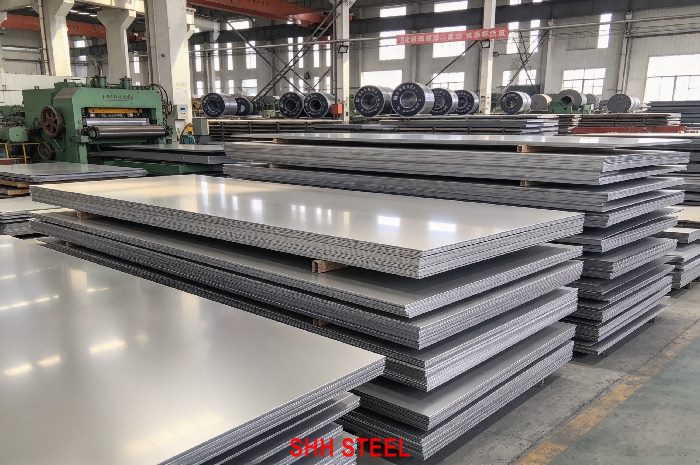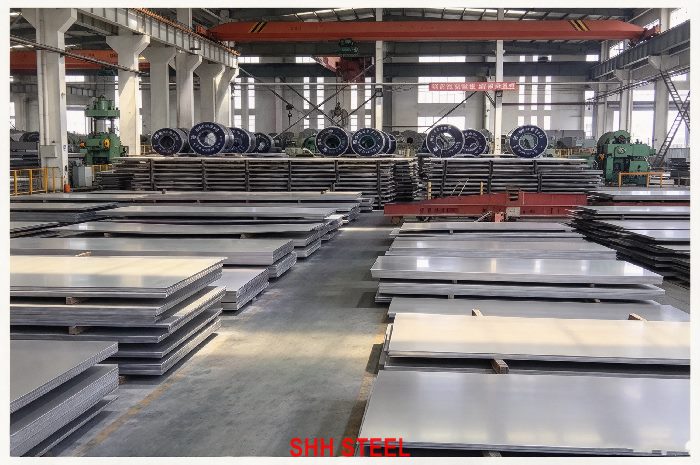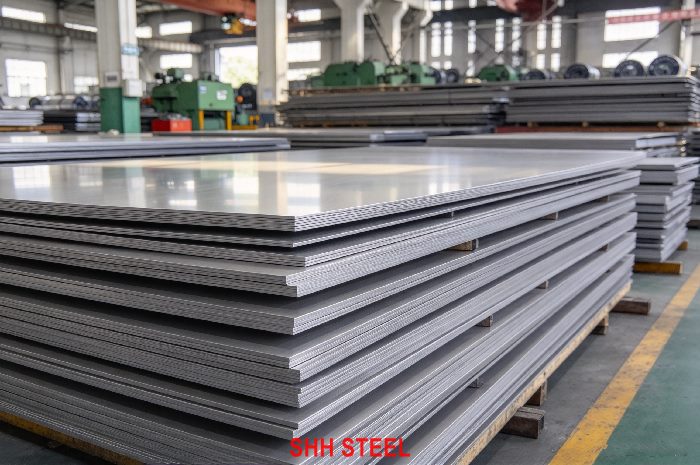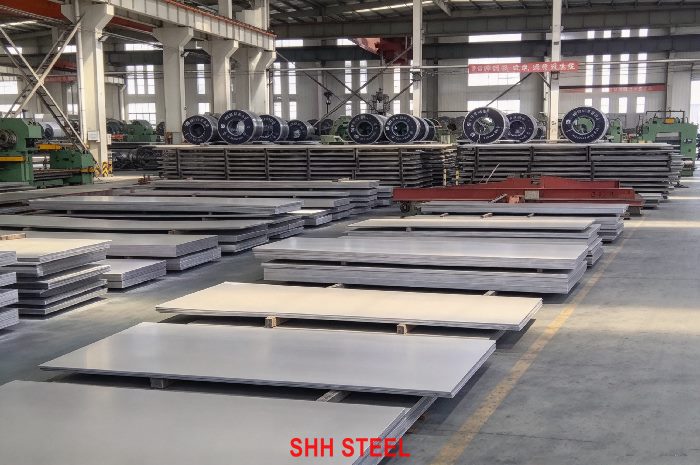
ASTM A666 UNS S30103 Cold Worked Stainless Steel Sheet
What is ASTM A666 UNS S30103 Cold Worked Stainless Steel Sheet?
Equivalent grades: UNS S30103 (Type 301L) ≈ EN 1.4318 X2CrNiN18-7 (nearest) ≈ GB/T 022Cr17Ni7 (S30103).
UNS S30103 (Type 301L) is a cold-worked austenitic grade. Type 301L is the low-carbon version of 301. Low carbon protects the weld zone from sensitisation, so 301L is used for welded high-strength structures such as railway car bodies.
ASTM A666 covers austenitic stainless steel sheet, strip, plate and flat bar in the annealed condition or cold worked to defined tempers: 1/16, 1/8, 1/4, 1/2, 3/4 and full hard, depending on the grade. It is the specification used when high-strength stainless sheet is bought for structural, transport and spring applications.
This page sets out the ASTM A666 requirements for UNS S30103 (Type 301L) sheet: specification summary, chemistry, mechanical properties, corrosion resistance, heat treatment, finishes and tolerances, current stock, equivalents, fabrication and testing. SHH STEEL supplies it mill-direct from China with EN 10204 3.1 certificates, optional third-party inspection and in-house cutting.
UNS S30103 (Type 301L) sheet: specification summary
| Item | UNS S30103 (Type 301L) data |
|---|---|
| Standard | ASTM A666, annealed or cold-worked austenitic stainless steel sheet, strip, plate and flat bar |
| General requirements | ASTM A480/A480M |
| Conditions | annealed, or cold worked to 1/16, 1/8, 1/4, 1/2, 3/4 or full hard (grade-dependent) |
| Ordering | temper may be ordered by tensile strength or by yield strength |
| Typical gauges | 0.3–3.0 mm cold rolled |
| Widths | up to 1250 mm; slit coil to order |
| Finishes | 2B and bright cold-rolled; tempered sheet is not annealed after rolling |
| Certificates | EN 10204 3.1; 3.2 on request |
| Grade family | austenitic |
Size range. Sheet is normally cold rolled from about 0.3–0.5 mm up to 3 mm and hot rolled from about 3 mm to just under 5 mm. Coil widths of 1000, 1219, 1250 and 1500 mm are standard; slitting and cut-to-length lines produce narrower strip and exact lengths. Sheets thinner than 0.5 mm or wider than 1500 mm should be confirmed before ordering. UNS S30103 (Type 301L) is produced regularly by several mills; common sizes are held in stock, and other sizes are rolled in the mill’s scheduled campaigns for the grade.
Chemical composition of UNS S30103 (Type 301L) (ASTM A666)
| Element | wt % |
|---|---|
| C | 0.03 max |
| Si | 1.00 max |
| Mn | 2.00 max |
| P | 0.045 max |
| S | 0.030 max |
| Cr | 16.0–18.0 |
| Ni | 6.0–8.0 |
| N | 0.20 max |
Single values are maximums unless marked min. Ranges are heat (cast) analysis limits.
PREN check (Cr + 3.3 Mo + 16 N): about 16.0 at the specification minimums and about 18.6 at mid-range. Where corrosion resistance is critical, write a minimum PREN on the order and ask for the calculated value from the heat analysis on the certificate.
Mechanical properties of UNS S30103 (Type 301L) sheet
| Condition | Yield strength 0.2 %, min | Tensile strength, min |
|---|---|---|
| annealed | 220 MPa | 550 MPa (El. 45 % min) |
| 1/16 hard | 345 MPa | 690 MPa |
| 1/8 hard | 415 MPa | 760 MPa |
| 1/4 hard | 515 MPa | 825 MPa |
| 1/2 hard | 690 MPa | 930 MPa |
A666 tempers can be ordered by tensile strength or by yield strength, and the purchaser should state which. The minimum annealed yield strength is 220 MPa; at 1/2 hard the minimum yield strength is about four times higher. Elongation, bend radius and the gauges for which each temper is available fall as the temper rises; check the A666 table for your thickness before you design a bend. Cold-worked sheet loses its temper if it is heated above about 425 °C, so welding reduces strength locally.
Corrosion resistance of UNS S30103 (Type 301L): PREN and limits
Austenitic stainless steels are non-hardenable by heat treatment, tough down to cryogenic temperatures and easy to form and weld. Corrosion resistance rises with chromium, molybdenum and nitrogen; the PREN of this grade at the specification minimum is about 16.0. Low-carbon (L) and stabilised versions protect welds against intergranular corrosion.
Austenitic grades are prone to chloride stress-corrosion cracking above about 60 °C in chloride environments. Where that risk exists, duplex or super-austenitic grades are the usual upgrade. Cold work raises strength but also makes some grades slightly magnetic.
How UNS S30103 (Type 301L) compares with related grades
| Grade | Cr | Ni | Mo | N | PREN (min) | YS / Rp0.2 min, MPa |
|---|---|---|---|---|---|---|
| UNS S30103 (Type 301L) | 16.0–18.0 | 6.0–8.0 | — | 0.20 max | 16.0 | 220 |
| UNS S30100 (Type 301) | 16.0–18.0 | 6.0–8.0 | — | 0.10 max | 16.0 | 205 |
| UNS S30153 (Type 301LN) | 16.0–18.0 | 6.0–8.0 | — | 0.07–0.20 | 17.1 | 240 |
| UNS S30400 (Type 304) | 17.5–19.5 | 8.0–10.5 | — | 0.10 max | 17.5 | 205 |
Choose UNS S30103 (Type 301L) for general corrosion resistance with easy forming and welding. In warm chloride environments consider a molybdenum-bearing or duplex grade instead.
The table uses specification limits, not typical mill values, so it shows the guaranteed position of each grade. Final selection should also consider product availability in the thickness you need, welding consumables, and the inspection requirements of your project.
Heat treatment and delivery condition of UNS S30103 (Type 301L)
Heat treatment: annealed condition: solution annealed, rapid cooling; tempers produced by cold rolling.
Austenitic grades are solution annealed and cooled rapidly to keep carbides in solution. They cannot be hardened by heat treatment, only by cold work.
Surface finishes for UNS S30103 (Type 301L) sheet
Cold-worked sheet is supplied with a bright cold-rolled or 2B-type surface; it is not annealed after the final rolling pass, so it keeps its temper. Annealed A666 sheet comes as 2B or 2D. Protective film is recommended for visible transport and architectural panels.
Dimensions, tolerances and flatness
Dimensional tolerances follow ASTM A480/A480M. Tempered sheet is harder to level, so flatness should be agreed, especially for 1/2 hard and harder tempers. Bend-test and elongation requirements in A666 depend on thickness and temper; check the table for your gauge.
Ordering tempers. An A666 order should state the grade, the condition (annealed or the temper), whether the temper is defined by tensile or yield strength, thickness and width, finish, edge and flatness. Because tempers are rolled to order, small quantities of unusual tempers have longer lead times; 1/4 and 1/2 hard are the most common for structural sheet. For railway and bus structures, the purchaser often adds weldability or crash-test requirements from the vehicle specification.
UNS S30103 (Type 301L) sheet stock in China
| Thickness (mm) | Width (mm) | Length (mm) | Finish | Approx. quantity | Location |
|---|---|---|---|---|---|
| 0.5 | 1000 / 1219 | 2000 / 2438 | 2B | 200+ t | China |
| 0.8 | 1219 | 2438 | 2B | 200+ t | China |
| 1.0 | 1219 / 1250 | 2438 / 2500 | 2B | 100+ t | China |
| 1.5 | 1219 / 1500 | 2438 / 3000 | 2B | 100+ t | China |
| 2.0 | 1219 / 1500 | 2438 / 3000 | 2B | 100+ t | China |
| 3.0 | 1500 | 3000 | 2B / No.1 | 100+ t | China |
| 4.0 | 1500 | 3000 / 6000 | No.1 | 100+ t | China |
Quantities are approximate and stock changes daily. Send your size list for current availability; other thicknesses, widths and cut sizes can be supplied from mill production.
Packing and logistics. Sheet is packed on wooden or steel pallets with interleaving paper or PVC film, edge protectors and waterproof wrapping, typically 2–3 t per pallet. Coil is packed eye-to-wall or eye-to-sky with steel bands. We consolidate mixed grades and sizes into one container and send loading photos with the shipping documents.
UNS S30103 (Type 301L) equivalents in other standards
| Standard | Designation | Comment |
|---|---|---|
| EN | 1.4318 X2CrNiN18-7 | nearest grade only; limits differ, check before substituting |
| GB/T | 022Cr17Ni7 (S30103) | same alloy family and limits closely matched; compare each limit on the certificate |
Equivalents are close, not identical. When a project names one standard, order to that standard or ask for multiple certification and check every limit on the certificate.
Related grades by alloy family
Same standard
Other grades in this standard: 1.4310 plate, SUS301 (G4304), A666 S30100, A666 S30153, A666 S20100.
Austenitic
General-purpose austenitic grades for comparison: A240 S30400, A240 S30403, A240 S31600, A240 S31603, A240 S30500, A240 S32100, A240 S30100, 1.4301 plate.
Applications, forming and welding of UNS S30103 (Type 301L)
Typical uses: railway car bodies, bus and truck frames, structural members, conveyor parts, springs, clips, fasteners, and architectural trim.
Austenitic sheet and plate form and weld easily. Cut by plasma, laser or waterjet and remove heat tint by pickling or grinding. For welding use an ER308L, ER316L or ER347 filler matching the grade (AWS A5.9). Keep the weld area clean and free of carbon-steel contamination, and pickle and passivate after welding where corrosion resistance matters.
Welding practice. Austenitic sheet is welded with GTAW, GMAW, SMAW or laser without preheat. Keep the interpass temperature below about 150 °C, use back-purging on corrosion-critical joints and pickle afterwards. Low-carbon or stabilised grades avoid sensitisation; standard-carbon grades used at temperature may need a solution anneal after heavy welding.
Certificates, testing and receiving inspection
Every delivery carries a mill certificate to ASTM A480/A480M with heat analysis, tensile results and hardness, and the grade and standard as ordered. Supplementary tests we can arrange: intergranular corrosion testing (ASTM A262 Practice E or EN ISO 3651-2 / GB/T 4334), PMI and surface inspection. Third-party witness by SGS, BV, TÜV, DNV, ABS or LR is available with EN 10204 3.2 certificates.
On receipt, check marking and heat number against the certificate, measure thickness at several points and confirm the finish and edge condition before cutting.
Common mistakes when specifying UNS S30103 (Type 301L)
- Mixing L and standard-carbon grades in welded equipment.
- Leaving out the finish and film side for visible parts.
- Using the grade in warm chlorides where stress-corrosion cracking is likely.
Each of these can be avoided by writing the requirement into the purchase order and checking it on the certificate before the material is cut.
Sourcing UNS S30103 (Type 301L): buyer concerns and SHH STEEL solutions
| Concern | How SHH STEEL handles it |
|---|---|
| Mixed-up 304/316 or L/non-L grades | PMI and heat-number tracking for every sheet |
| Surface scratches on finished sheet | PVC film, interleaving paper and wooden-case packing |
| Small quantities across many sizes | mixed thicknesses and grades combined in one shipment |
| Cutting and edge preparation | in-house shearing, plasma, laser and waterjet cutting, bevelling |
| Delivery delays | weekly production and shipping updates with photos |
How to order UNS S30103 (Type 301L) sheet
State the standard and edition (ASTM A666), the grade (UNS S30103 (Type 301L)), thickness, width and length or coil, finish, quantity, tolerance class, any added chemistry limits, the supplementary tests and acceptance values from your specification, the certificate type and inspection agency, and packing. Send the list to SHH STEEL and we will reply with price, available stock and lead time.
FAQ
-
Can I order A666 S30103 by yield strength instead of temper name?
- Yes. A666 allows tempers to be ordered by minimum tensile or minimum yield strength. State the value and the gauge, and we will confirm which temper the mill will roll to.
-
Is UNS S30103 (Type 301L) equivalent to EN 1.4318 X2CrNiN18-7?
- They are the nearest match, but limits differ; check each element and the property table before substituting.
-
Is UNS S30103 (Type 301L) magnetic?
- It is essentially non-magnetic when annealed; cold work can make it slightly magnetic.
-
Can I order small quantities or cut sizes?
- Yes. We combine mixed thicknesses and grades into one shipment and cut plate and sheet to size in our workshop.
-
Which certificates and tests can you provide?
- Every order ships with a mill certificate (EN 10204 3.1 type) showing heat analysis and mechanical tests. Supplementary tests and 3.2 certificates with SGS, BV, TÜV or another agency are available by agreement.
Conclusion
UNS S30103 (Type 301L) sheet should be ordered with the points the standard leaves open written into the contract: finish, tolerance class, any extra chemistry limits and the supplementary tests your application needs. With those fixed, stock material from China is a fast and reliable route.
Quality Steel Needed? Inquire for Offers
Related Products