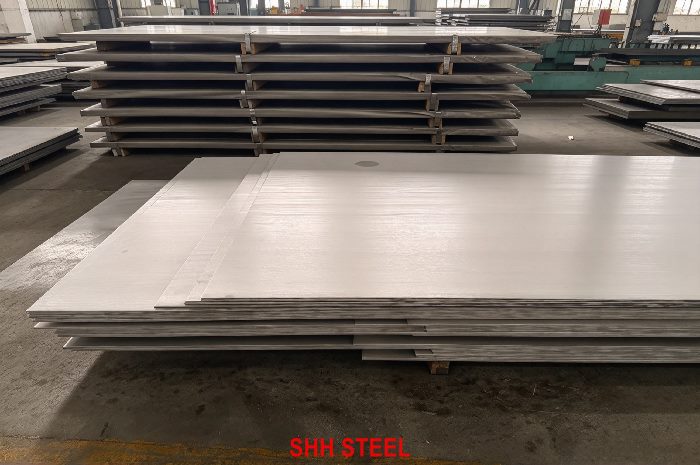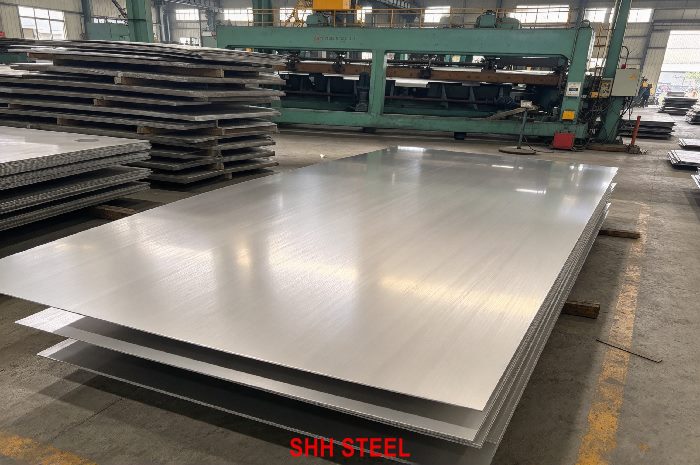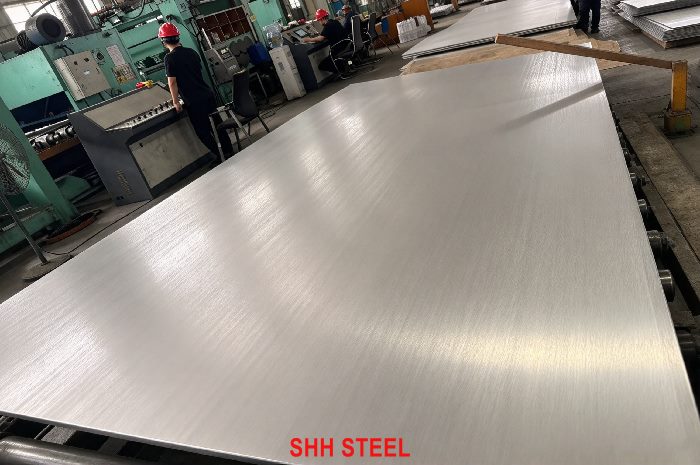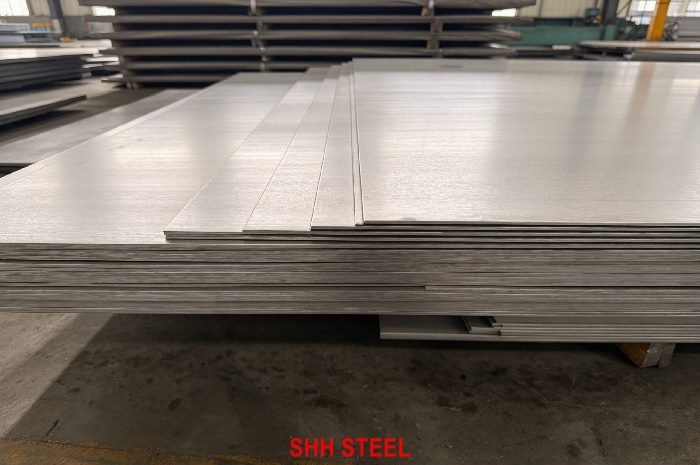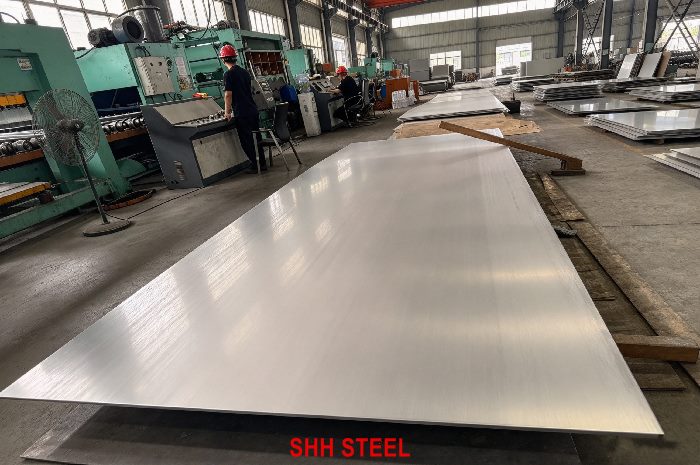

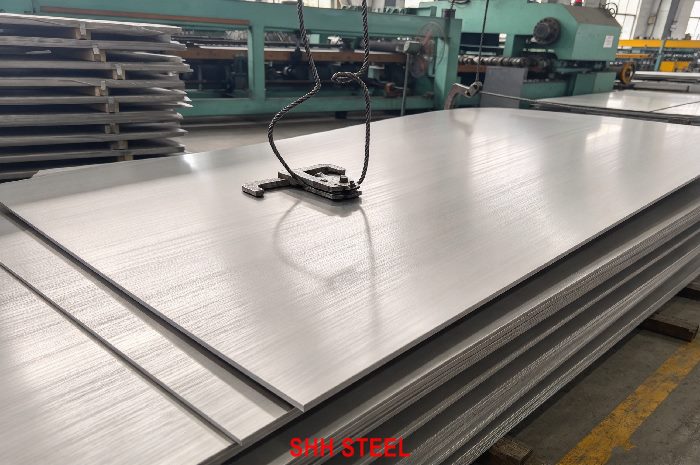
EN 10028-7 X3CrNiMo13-4 1.4313 Pressure Vessel Stainless Plate
What is EN 10028-7 X3CrNiMo13-4 1.4313?
EN 10028-7 X3CrNiMo13-4 (1.4313) is a soft martensitic stainless steel supplied quenched and tempered, listed in EN 10028-7:2016 for flat products used in pressure equipment. It is delivered quenched and tempered (+QT) as hot-rolled plate (P) up to 75 mm, and plate in that condition has a minimum 0.2% proof strength of 650 MPa with a tensile strength of 780 – 980 MPa (Table 8). Its nearest ASTM counterpart is S41500, but the two specifications are not identical.
X3CrNiMo13-4 1.4313 is described by two designations: the steel name X3CrNiMo13-4, which is built from the carbon content (in hundredths of a percent) and the main alloying elements with their approximate percentages, and the steel number 1.4313, which is the five-digit material number used throughout European standards. EN 10028-7 is Part 7 of the EN 10028 series, the harmonized European standard for flat steel products for pressure purposes, and the part that covers stainless steels. Plate certified to it can be used under the Pressure Equipment Directive 2014/68/EU and design codes such as EN 13445, which is why every X3CrNiMo13-4 pressure vessel plate we ship is tested to the 2016 edition.
X3CrNiMo13-4 is a soft martensitic steel: low carbon (≤ 0.05%) with 3.5 – 4.5% nickel gives a tough tempered martensite that can be welded far more easily than classic 13% Cr martensitic steel. Its proof strength of 650 MPa is roughly three times that of 1.4301.
SHH STEEL is a stainless steel producer and exporter based in Shanghai. We act as sales agent for well-known mills, run our own processing warehouse for cutting, bevelling and polishing, and ship every EN 10028-7 stainless plate with EN 10204 3.1 or 3.2 certificates. Buyers who already know the ASTM grade can compare this page with our ASTM A240 Type S41500 page, and related grades sit in our our stainless sheet and plate range.
Why designers specify 1.4313
Material selection for a pressure vessel starts from the design conditions: medium, design temperature, pressure and the minimum design metal temperature. Soft martensitic grades are chosen when the designer needs a proof strength of 650 MPa or more together with stainless corrosion resistance, for example in hydropower and pump equipment. Because X3CrNiMo13-4 is a harmonized EN 10028-7 grade, its proof strength values can be used directly for the nominal design stress in EN 13445-3, without a particular material appraisal, which shortens approvals on CE-marked equipment.
EN 10028-7:2016 specification summary
In short, EN 10028-7 1.4313 is the pressure-equipment certification of X3CrNiMo13-4; outside pressure equipment the same steel is sold to EN 10088-2. The specification of 1.4313 is the set of requirements in EN 10028-7:2016 that a plate must meet before it can be certified for pressure equipment. The summary below gives the clauses and tables that apply to this grade.
| Item | EN 10028-7:2016 requirement / SHH STEEL supply |
|---|---|
| Standard | EN 10028-7:2016, Flat products made of steels for pressure purposes, Part 7: Stainless steels |
| Steel name / number | X3CrNiMo13-4 / 1.4313 |
| Steel class | Martensitic |
| Chemical composition | Table 2 (cast analysis); product analysis deviations in Table 5 |
| Room-temperature properties | Table 8, per product form |
| Elevated-temperature properties | Table 12 (0.2% proof strength) |
| Product forms and maximum thickness | hot-rolled plate (P) up to 75 mm |
| Delivery condition | quenched and tempered (+QT); heat treatment guidance in Annex A |
| Process routes (Table 6) | hot-rolled plate (P): 1C, 1E or 1D |
| Dimensional tolerances | EN ISO 18286 (P) |
| Density | about 7.7 g/cm³ (approximate; EN 10088-1 gives reference values) |
| Inspection document | EN 10204 3.1 as standard; 3.2 with third-party witness on request |
EN 10028-7 does not repeat the general delivery rules: it refers to EN 10028-1 for general requirements, to EN 10088-1 for physical properties, and to the EN ISO tolerance standards listed above. The maximum thicknesses in the table are those for which Table 8 gives mechanical property values; thicker material can be produced by some mills, but it falls outside the standard and the properties must be agreed separately.
Scope in plain terms
The standard covers flat products in the form of plate, sheet and strip. Product form C is cold-rolled strip and the sheet cut from it, form H is hot-rolled strip and the sheet or plate cut from it, and form P is hot-rolled plate rolled individually on a plate mill. This grade is listed only in form P, so very thin gauges are not available as an EN 10028-7 product. The process route (1D, 2B and so on) must be named on the order, because the standard leaves the surface condition open.
1.4313 chemical composition: cast and product analysis
The 1.4313 chemical composition is the cast (heat) analysis reported by the steelmaker for each heat, and it must fall within EN 10028-7:2016 Table 2. Values are in percent by mass; a single value is a maximum unless marked otherwise.
| Element | X3CrNiMo13-4 cast analysis, % (Table 2) | Role in the steel |
|---|---|---|
| C | ≤ 0.05 | Strength; low values protect welds against sensitization |
| Si | ≤ 0.70 | Deoxidation; kept low in nitric-acid grades |
| Mn | ≤ 1.50 | Deoxidation and austenite stability; partly replaces nickel in Cr-Mn grades |
| P | ≤ 0.040 | Impurity, kept low for weld soundness |
| S | ≤ 0.015 | Impurity, kept low for toughness and hot ductility |
| N | ≥ 0.020 | Strength and pitting resistance; stabilizes austenite |
| Cr | 12.0 – 14.0 | Forms the passive film; main source of corrosion and oxidation resistance |
| Mo | 0.30 – 0.70 | Pitting and crevice corrosion resistance |
| Ni | 3.5 – 4.5 | Austenite stability, toughness and stress-corrosion resistance |
Product analysis tolerances (Table 5)
The product analysis is the composition measured on the finished plate. EN 10028-7 Table 5 sets how far it may deviate from the cast limits; the deviations below are applied to the X3CrNiMo13-4 limits of Table 2.
| Element | Cast analysis limit, % | Permissible deviation (Table 5) | Resulting product analysis limit, % |
|---|---|---|---|
| C | ≤ 0.05 | + 0.01 | ≤ 0.060 |
| Si | ≤ 0.70 | + 0.05 | ≤ 0.75 |
| Mn | ≤ 1.50 | + 0.04 | ≤ 1.54 |
| P | ≤ 0.040 | + 0.005 | ≤ 0.045 |
| S | ≤ 0.015 | + 0.003 | ≤ 0.018 |
| N | ≥ 0.020 | − 0.01 | ≥ 0.010 |
| Cr | 12.0 – 14.0 | ± 0.15 | 11.85 – 14.15 |
| Mo | 0.30 – 0.70 | − 0.03 / + 0.05 | 0.27 – 0.75 |
| Ni | 3.5 – 4.5 | ± 0.07 | 3.43 – 4.57 |
The footnote to Table 5 matters for acceptance: if several product analyses are made on one cast, an element may lie above the maximum or below the minimum of the range, but not both. Calculated from the minimum chemistry, PREN = Cr + 3.3Mo + 16N gives about 13.3 for 1.4313, a ranking value used for pitting resistance.
Product analysis, PMI and sampling
Product analysis is a check analysis made on a sample taken from the delivered plate, and under EN 10028-7 it is carried out only when the purchaser requests it at the time of ordering (Table 16). The cast analysis is always reported.
When a product analysis is agreed, the order should state the number of samples and the elements to be determined. Samples are taken through the thickness or from millings so the result represents the whole cross-section, and the analysis method follows the reference methods cited by EN 10028-1. Results are judged against the cast limits widened by the Table 5 deviations shown above; a result outside those limits normally leads to retests on further samples before a plate or a test unit is rejected.
PMI and laboratory checks at SHH STEEL
Every plate that leaves our Shanghai warehouse is checked by positive material identification (PMI) with a handheld XRF analyser, which confirms chromium, nickel, molybdenum and the other heavier elements. XRF cannot measure carbon, nitrogen or boron, so when those elements decide the grade, we arrange spark-OES or combustion analysis through our steel testing service. Product analysis results are added to the 3.1 certificate, or reported by the inspector on a 3.2 certificate.
Why the check matters
Mixed-up plates are a real risk in stock-holding: an 18-8 grade and a molybdenum or stabilized grade look identical, and a low-carbon grade cannot be told apart from its standard-carbon version without laboratory analysis. A product analysis or PMI record ties the physical plate to the certificate and protects the fabricator at the notified-body inspection.
1.4313 mechanical properties per product form
The 1.4313 mechanical properties are the room-temperature minimum values in EN 10028-7:2016 Table 8 for material in the quenched and tempered (+QT) condition. Unlike ASTM A240, EN 10028-7 gives a separate row for each product form, so the rolling route matters as much as the thickness.
| Product form | Max. thickness, mm | Rp0.2 min, MPa | Rm, MPa | A min, % |
|---|---|---|---|---|
| hot-rolled plate (P) | 75 | 650 | 780 – 980 | 14 |
With a proof strength of 650 MPa, 1.4313 high strength plate allows much thinner walls than austenitic plate of the same pressure rating, provided toughness and weldability are qualified.
Impact energy
Table 8 also sets minimum Charpy V-notch impact energy for the quenched and tempered plate at two test temperatures.
| Test | Requirement |
|---|---|
| Charpy V impact, KV2, 20 °C | ≥ 70 J |
| Charpy V impact, KV2, −20 °C | ≥ 40 J |
For comparison, the American plate specification ASME SA240 S41500 uses a single set of minimums for all thicknesses, so a plate that meets one standard does not automatically meet the other.
How designers use these values
Under EN 13445-3 the nominal design stress for martensitic steel follows from the lower of Rp0.2/1.5 and Rm/2.4 at the calculation temperature. The room-temperature values above are therefore only the starting point; for operation above 50 °C the elevated-temperature values in the next section are used.
Heat treatment of X3CrNiMo13-4 (quenching and tempering)
1.4313 quenched and tempered material is the standard delivery: Annex A gives quenching from 950 – 1 050 °C in oil, air or water, followed by tempering at 560 – 640 °C. Hot forming is carried out at about 1 150 – 900 °C. The tempering temperature controls the balance between strength and toughness; with this low-carbon 13 – 16% Cr composition with nickel, tempering also forms a fine reversed austenite that raises impact energy.
Heat treatment after fabrication
Annex B of EN 10028-7 covers post-weld and post-forming heat treatment. For martensitic grades a post-weld tempering treatment is normally applied to temper the fresh martensite in the weld and heat-affected zone; the temperature should be agreed with the filler-metal supplier and kept below the original tempering temperature. Cold-formed heads and shells are checked against the forming-strain limits of the design code (for example EN 13445-4), which decide whether a heat treatment is needed.
What can go wrong
An incorrectly heat-treated plate shows up as high hardness, low elongation or poor impact energy, and in corrosion tests as intergranular attack. Over-heating or slow cooling through the embrittlement range reduces toughness. When plate arrives in our warehouse we check the heat-treatment record on the certificate against Annex A and the tensile results before releasing it.
1.4313 properties at elevated temperature
The 1.4313 elevated temperature properties below are an essential input for hot equipment. Elevated-temperature properties are the minimum proof strengths that EN 10028-7 gives at temperatures above room temperature, and they are the values a designer uses to calculate the wall thickness of 1.4313 equipment operating hot.
| Temperature, °C | Rp0.2 min, MPa |
|---|---|
| 100 | 590 |
| 150 | 575 |
| 200 | 560 |
| 250 | 545 |
| 300 | 530 |
| 350 | 515 |
The values come from Table 12. Martensitic grades are not used in the creep range, and long exposure around 350 – 550 °C can cause temper embrittlement, so they are normally limited to moderate temperatures.
X3CrNiMo13-4 equivalent grades in ASTM, ASME, JIS and GB
A X3CrNiMo13-4 equivalent is a grade in another standard with similar chemistry and properties; it is a comparison, not an interchangeable certificate.
| Standard system | Equivalent or nearest grade |
|---|---|
| EN 10028-7 / EN 10088 | X3CrNiMo13-4, 1.4313 |
| ASTM A240 / ASME SA240 | UNS S41500 (F6NM / CA6NM family) |
| GB/T 4237 | 04Cr13Ni5Mo (S41595), related |
| Family | soft martensitic 13Cr-4Ni |
On 1.4313 vs S41500: the chemistry ranges overlap, but EN 10028-7 sets its own limits, its own strength values per product form and its own impact requirements. On steelspecs.com you can compare the related pages GB/T 4237 04Cr13Ni5Mo S41595 and AISI 410. For background reading, see our guide comparing ASTM, EN, JIS and GB steel standards.
Substitution rules
Replacing 1.4313 with a foreign grade in PED equipment needs the agreement of the designer and, where applicable, the notified body, usually through a particular material appraisal. The reverse also applies: an ASME vessel cannot simply use EN 10028-7 plate without the code’s material rules. Where both certificates are needed, we can often arrange dual certification at the mill, provided both sets of chemistry and property limits are met in one heat.
Welding and fabrication of 1.4313
Welding of X3CrNiMo13-4 is done by GTAW, SMAW, GMAW, FCAW or SAW with matching 13 4 or 16 5 1 type filler. Low-carbon soft martensitic steel needs only a low preheat, often around 100 °C for heavier sections, and post-weld tempering is normally specified. Pickling and passivation after welding restore the passive film in corrosive service.
Weld procedures for PED equipment are qualified to EN ISO 15614-1, and welders to EN ISO 9606-1. Where a fabricator lacks capacity, our welding team and partner workshops can prepare bevels and sub-assemblies. Our power and energy sector page shows the type of projects we supply.
Practical welding notes
- Clean the joint with stainless-only brushes and solvent; iron contamination leaves rust spots.
- Remove hydrogen sources: dry consumables and clean joints reduce the risk of cold cracking.
- Check the hardness of the heat-affected zone after tempering.
Forming and cutting
High proof strength limits cold forming, and bending radii should be generous; plasma, laser and waterjet cutting are all suitable, and heat-tinted edges should be ground before welding.
Corrosion resistance and PREN of 1.4313
Corrosion resistance is the ability of the plate to stay passive in the process medium, and 1.4313 has moderate corrosion resistance, better than 13% Cr martensitic steel thanks to its low carbon, nickel and molybdenum; it resists fresh water and mild environments but is not a chloride grade. Its minimum PREN is about 13.3.
The intergranular corrosion entries of Table 8 (not stated in the delivery condition, not stated in the sensitized or welded condition) tell the designer whether welds can be left without heat treatment. For comparison of pitting resistance across standards, see our AISI 414 page.
Media guide
| Medium | Typical suitability |
|---|---|
| Fresh water, hydropower | Good |
| Seawater | Limited; cathodic protection or coating often used |
| Sour service | Per project specification and hardness limits |
| Acids | Limited |
The table is general guidance. Final material selection should be based on the actual medium, temperature and concentration, and where possible on plant experience or corrosion testing.
Where X3CrNiMo13-4 plate is used
Applications of X3CrNiMo13-4 follow from its strength and corrosion behaviour. As a martensitic stainless steel plate certified to EN 10028-7, it is used for:
- Hydropower penstocks, spiral casings and turbine parts
- High-strength pressure parts in pumps and compressors
- Valve bodies and covers fabricated from plate
- Equipment needing strength, toughness and moderate corrosion resistance
Selection guidance by application
For storage tanks and low-pressure vessels the choice is usually driven by corrosion resistance and price, and plate thickness is moderate. For high-pressure or large-diameter vessels strength becomes important, and the high strength of this grade is the reason it is chosen. For heat exchangers, the shells, channels and tube sheets often use different grades, and we can supply all of them in one order with consistent certification.
Every 1.4313 stainless steel plate supplied for these duties is traceable to its heat, which is essential for CE marking under the PED.
Choosing between 1.4313 and similar grades
Comparing 1.4313 with its neighbours in EN 10028-7 shows where it fits: the differences come down to carbon, nitrogen, molybdenum and the stabilizing elements.
| EN 10028-7 grade | Key chemistry, % | Rp0.2 min, MPa (thickest form) | Rm, MPa |
|---|---|---|---|
| 1.4313 X3CrNiMo13-4 | C ≤ 0.05, Mn ≤ 1.50, N ≥ 0.020, Cr 12.0 – 14.0, Mo 0.30 – 0.70, Ni 3.5 – 4.5 | 650 | 780 – 980 |
| 1.4418 X4CrNiMo16-5-1 | C ≤ 0.06, Mn ≤ 1.50, N ≥ 0.020, Cr 15.0 – 17.0, Mo 0.80 – 1.50, Ni 4.0 – 6.0 | 680 | 840 – 980 |
How to choose
Start from the corrosion requirement and the design temperature, then compare strength, availability and cost. 1.4313 is the standard soft martensitic grade, while 1.4418 trades a little weldability for higher chromium and molybdenum and better corrosion resistance. Our engineers can review your design conditions and suggest the most economical grade. A related grade page on our site is JIS G4305 SUS410.
1.4313 plate dimensions and tolerances
The dimensions of 1.4313 plate are limited by the product forms that EN 10028-7 lists for the grade and by the rolling capacity of the mill.
| Product form | Thickness covered by EN 10028-7 | Typical width | Tolerance standard |
|---|---|---|---|
| hot-rolled plate (P) | up to 75 mm | 1 500 – 3 000 mm, wider by mill | EN ISO 18286 |
Weight per square metre is the thickness in millimetres multiplied by the density in g/cm³: with a density of about 7.7 g/cm³, a 10 mm plate weighs roughly 77 kg/m². Lengths are cut to order or supplied as mill lengths; for heads and dished ends we can supply circular blanks cut to the developed diameter.
Tolerance and flatness notes
For plate (form P), EN ISO 18286 gives thickness tolerance classes A to D and flatness classes; class B is a common choice for pressure vessels because it limits the negative tolerance. For strip and sheet cut from coil, EN ISO 9445-2 and EN ISO 9444-2 apply, and normal or special tolerances can be ordered. State the class on the order, since it decides the acceptance criteria.
Surface finish and processing of X3CrNiMo13-4
Surface finish is the process route defined by the EN 10088-2 codes that EN 10028-7 Table 6 uses, and it must be named on the order for 1.4313.
| Code | Description | Availability |
|---|---|---|
| 1C | Hot rolled, heat treated, not descaled | Forms H and P; only where the surface will be machined or descaled later |
| 1E | Hot rolled, heat treated, mechanically descaled | Forms H and P |
| 1D | Hot rolled, heat treated, pickled | Forms H and P; the usual finish for pressure vessel plate |
| Polished / brushed | Mechanically polished or brushed after delivery | On request in our warehouse |
We offer plasma and waterjet cutting service and surface finishing in our Shanghai warehouse, along with bevel preparation and protective PE film.
Choosing a finish
1D is the standard finish for hot-rolled pressure vessel plate and suits shells, heads and parts that will be pickled after fabrication. Cold-rolled 2B is used for thin vessels, liners and parts where a smoother surface helps cleaning. Polished finishes are specified for hygienic vessels in food and pharmaceutical plants, where surface roughness limits are part of the design.
Testing and certificates for 1.4313
Testing and certification of 1.4313 follow EN 10028-7 Table 16 and EN 10028-1: each test unit is plate from the same cast, the same thickness range and the same heat-treatment batch.
- Cast analysis on every heat; product analysis when ordered (Table 16)
- Tensile test at room temperature per test unit, to EN ISO 6892-1, against Table 8
- Charpy V-notch impact test (EN ISO 148-1) for thickness of 6 mm and over, as required by Table 16
- Tensile test at elevated temperature by agreement (verification of Rp0.2 or Rp1.0)
- Intergranular corrosion test to EN ISO 3651-2 by agreement
- Visual and dimensional inspection; ultrasonic testing by agreement
- 100% PMI and dimensional check by SHH STEEL
- EN 10204 3.1 inspection certificate; 3.2 with a third-party or purchaser’s inspector
Third-party inspection
For export and PED projects a 3.2 certificate is often required. An independent inspector then witnesses sampling and testing at the mill and countersigns the certificate. We coordinate SGS, BV, TUV, Lloyd’s or a client-named inspector and schedule witness points so inspection does not delay rolling. In our warehouse we check dimensions, flatness, surface and marking, and repeat PMI on each plate before packing.
For PED equipment in categories II to IV, EN 10028-7 plate is normally supplied with a 3.1 certificate issued by a manufacturer with a quality system assessed by a competent body; check the requirement with your notified body.
How to order 1.4313 plate
An order for X3CrNiMo13-4 should identify the product, the standard and every option the standard leaves to agreement. The ordering example in EN 10028-7 follows a pattern like this:
10 plates, 8 × 2000 × 5000 mm, EN ISO 18286 tolerance class B, steel EN 10028-7 – X3CrNiMo13-4 (1.4313)+QT, process route 1D, inspection certificate EN 10204 – 3.1.
- Standard and edition: EN 10028-7:2016
- Steel name or number: X3CrNiMo13-4 / 1.4313 and heat-treatment condition
- Product form (P), thickness, width, length and quantity
- Tolerance standard and class
- Process route / surface finish (Table 6)
- Optional tests: product analysis, impact at a stated temperature, IGC, elevated-temperature tensile, UT
- Inspection document: EN 10204 3.1 or 3.2, and the inspector for 3.2
Common ordering mistakes
- Ordering to EN 10088-2 instead of EN 10028-7 for pressure parts; EN 10088-2 plate is not certified for pressure purposes.
- Leaving out the process route, which the standard requires on the order.
- Not stating optional tests, which are only carried out if written into the contract.
- Specifying a thickness beyond the limit of the product form.
A short technical review before order placement avoids these problems, and our sales engineers do this as part of the quotation.
Mill sourcing, lead time and packing for 1.4313
Mill sourcing for 1.4313 is handled through the mills we represent that are approved for this grade; we place a mill order and confirm the minimum quantity per thickness. Lead time for mill production is generally 30 – 40 days, and the rolling slot can be scheduled to suit your fabrication plan.
Every plate is traceable to its heat number, and copies of the mill certificates stay on file for repeat orders and audits. Mixed-grade and mixed-standard orders can be consolidated, so 1.4313 plate can ship with flanges, pipe or other grades in one container through our export logistics team.
Packing and export documents
Plates are packed on fumigated wooden or steel pallets with waterproof wrapping, edge protectors and steel straps, and each bundle is labelled with grade, standard, heat number, size and weight. Documents include the commercial invoice, packing list, mill certificates and certificate of origin. Browse our AISI stainless plate range and pressure vessel plate products for other plate standards we supply.
FAQ
- What is 1.4313 stainless steel?
- 1.4313 is the European steel number for X3CrNiMo13-4, a martensitic stainless steel listed in EN 10028-7 for pressure equipment flat products. It is delivered quenched and tempered (+QT) and certified to the 2016 edition.
- Is 1.4313 the same as S41500?
- No, 1.4313 and S41500 are close equivalents but not identical specifications. EN 10028-7 sets its own chemistry limits, strength values per product form and impact requirements, so substitution in pressure equipment needs approval by the designer.
- What is the yield strength of 1.4313 plate?
- Plate in the quenched and tempered (+QT) condition has a 0.2% proof strength of at least 650 MPa and Rm 780 – 980 MPa per EN 10028-7 Table 8. Other product forms have their own values in the same table.
- What thickness of 1.4313 does EN 10028-7 cover?
- EN 10028-7 covers 1.4313 as hot-rolled plate (P) up to 75 mm. Thicker material falls outside the standard and needs separately agreed properties.
- How is 1.4313 heat treated?
- 1.4313 is delivered quenched and tempered (+QT); EN 10028-7 Annex A gives quenching from 950 – 1 050 °C and tempering at 560 – 640 °C as guidance. The actual treatment is recorded on the mill certificate.
- What is the lead time for 1.4313 plate?
- Lead time for 1.4313 mill production is generally 30 – 40 days, and production can be scheduled to your plan. Common sizes of high-volume grades may ship sooner from stock.
Conclusion
EN 10028-7 X3CrNiMo13-4 (1.4313) is a soft martensitic stainless steel supplied quenched and tempered, defined by Table 2 chemistry and Table 8 properties, with plate in the quenched and tempered (+QT) condition reaching Rp0.2 ≥ 650 MPa and Rm 780 – 980 MPa. Typical uses include hydropower penstocks, spiral casings and turbine parts and high-strength pressure parts in pumps and compressors.
Before ordering, state the standard edition, the steel name and number, the product form, the process route and any optional tests, so that the certificate matches your design documents. SHH STEEL supplies 1.4313 from mill production in generally 30 – 40 days, with cutting and finishing in our own warehouse and EN 10204 3.1 or 3.2 certificates. Send your sizes and quantities for a quotation.
Quality Steel Needed? Inquire for Offers
Related Products