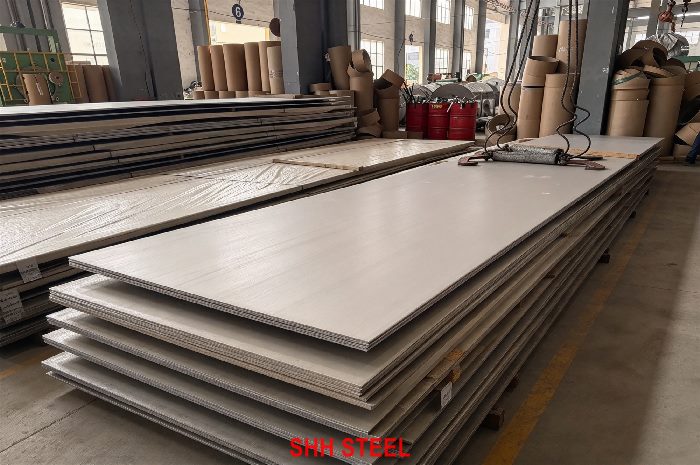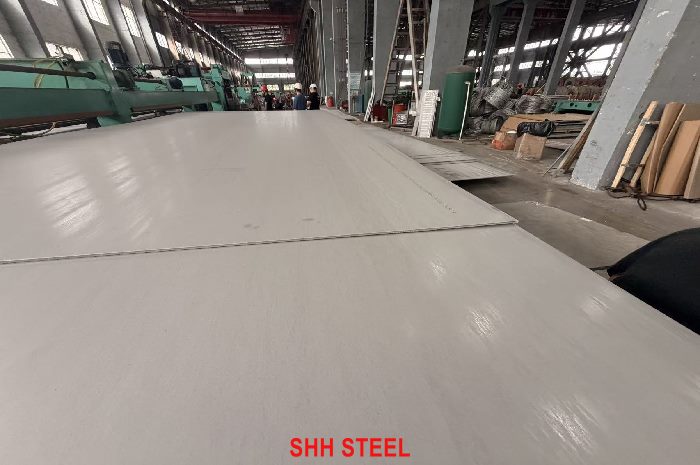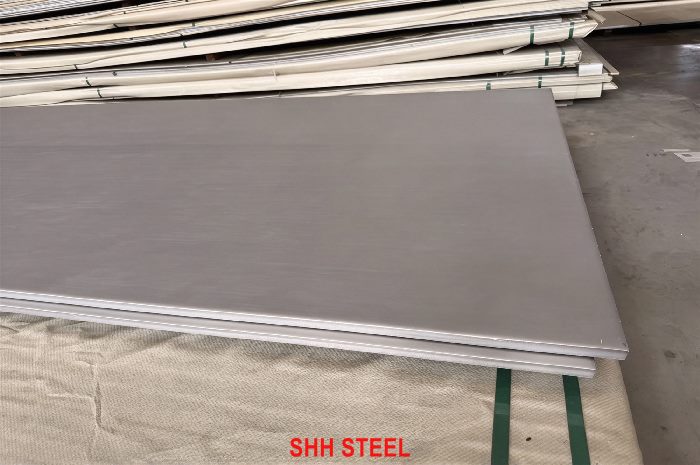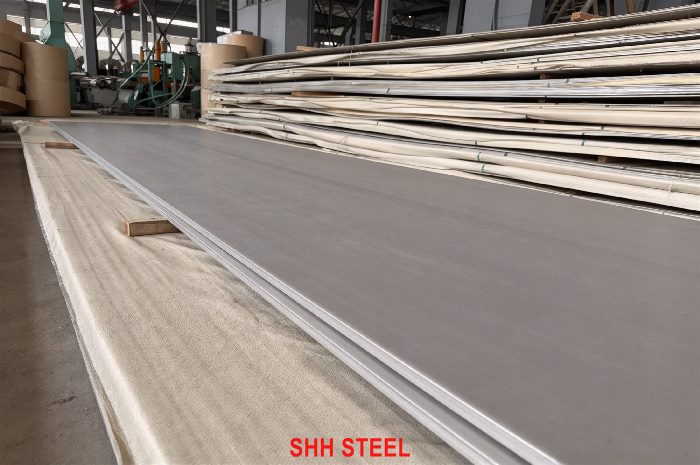

GB/T 713.7 06Cr19Ni9NbN S30478 Pressure Vessel Stainless Plate
GB/T 713.7 06Cr19Ni9NbN: what it is and who uses it
06Cr19Ni9NbN S30478 is listed in GB/T 713.7-2023, the Chinese standard for pressure equipment stainless steel plate, as the nitrogen-strengthened version of its family, with higher proof strength. As a GB/T 713.7-2023 stainless plate it is ordered by vessel and heat-exchanger shops that design to GB/T 150 and the TSG 21 safety rules, and by EPC contractors who must deliver Chinese-code equipment abroad. There is no direct ASTM A240 twin, so foreign substitutes must be judged on chemistry and properties.
Reading the designation: the leading digits give the carbon level (≤ 0.08%); the element symbols that follow give the approximate contents of the main alloying elements in percent. S30478 is the unified numeric code (ISC). The grade was previously certified as GB/T 24511 S30478 until GB/T 24511-2017 was withdrawn on 1 March 2024; most chemistries carried over, but the 2023 edition revised some austenitic strength values and added impact data, so old certificates should be checked against the new tables. In short, S30478 stainless steel is the GB/T 713.7 designation of this grade. Every 06Cr19Ni9NbN pressure vessel plate is tested and certified to the 2023 edition.
SHH STEEL produces and exports stainless plate from Shanghai, works as a sales agent for mills including TISCO, Baosteel and POSCO, and runs its own processing warehouse for cutting and polishing. 06Cr19Ni9NbN is part of our GB/T 713.7-2023 pressure vessel stainless plate range; for the general-purpose version of the same grade see GB/T 4237 06Cr19Ni9NbN S30478.
Why designers specify S30478
Material selection for a Chinese-code pressure vessel starts with the design conditions: medium, temperature, pressure and the minimum design metal temperature. Austenitic grades such as this one are chosen when the medium needs stainless corrosion resistance and when toughness at low temperature matters, because austenite stays ductile without a transition temperature. GB/T 150 lists the permitted plate standards and allowable stresses, and the material must be supplied with a certificate that ties every plate to its heat. Because 06Cr19Ni9NbN is listed in GB/T 713.7-2023, it can be used directly under GB/T 150 without a separate material evaluation, which saves time on approvals compared with a foreign grade.
Who buys it
Our customers for this grade include pressure vessel fabricators in China and Southeast Asia, EPC contractors building Chinese-designed plants in the Middle East, Africa and Central Asia, and maintenance teams that need like-for-like replacement plate for equipment originally built to GB/T 24511 or GB/T 713.7. Export buyers often need the plate certified to GB/T 713.7 and checked against an ASTM or EN grade at the same time, which we arrange with the mill before rolling.
What the standard covers for this grade
| Item | GB/T 713.7-2023 requirement / SHH STEEL supply |
|---|---|
| Standard | GB/T 713.7-2023 (in force since 1 March 2024; replaces GB/T 24511-2017) |
| Grade / unified code | 06Cr19Ni9NbN / S30478 |
| Steel class | Austenitic |
| Chemical composition | Table 13 (heat analysis); product analysis deviations per GB/T 713.1 |
| Mechanical properties | Table 16: Rp0.2 ≥ 275 MPa, Rm ≥ 585 MPa, A ≥ 30% |
| Product forms | Hot-rolled thick plate, hot-rolled plate and strip, cold-rolled plate and strip, width ≥ 600 mm |
| Thickness (Table 1) | 0.30 – 8.00 mm cold rolled; 2.00 – 14.0 mm hot-rolled strip; 6.00 – 100 mm hot-rolled thick plate |
| Delivery condition | Solution treated (Annex C gives the regime) |
| Edge / accuracy | EC trimmed or EM untrimmed; PT.A or PT.B thickness accuracy |
| Density | 7.93 g/cm³ |
| Certificate | EN 10204 3.1; 3.2 with third-party witness on request |
The table is a summary; the purchase order should cite the full standard and edition. Clause 4.2 of GB/T 713.7 requires the surface finish to be named on the order, and the edge and thickness-accuracy codes decide the tolerance class used for acceptance. For coil-cut plate, flatness and camber follow the general rules of GB/T 713.1, which every part of GB/T 713 refers to.
Heat and product analysis limits for 06Cr19Ni9NbN
The S30478 chemical composition is the heat (melting) analysis the mill reports for each heat, and it must meet GB/T 713.7-2023 Table 13 in weight percent.
| Element | 06Cr19Ni9NbN heat analysis, % (Table 13) | Why it matters |
|---|---|---|
| C | ≤ 0.08 | Strength, weldability and sensitization risk |
| Si | ≤ 1.00 | Deoxidation; in heat-resisting grades, oxidation resistance |
| Mn | ≤ 2.50 | Austenite stability and hot workability |
| P | ≤ 0.035 | Kept low for weld soundness |
| S | ≤ 0.015 | Kept low for toughness and weld cracking resistance |
| Cr | 18.00 – 20.00 | Passive film and oxidation resistance |
| Ni | 7.50 – 10.50 | Austenite stability and toughness |
| N | 0.15 – 0.30 | Strength and pitting resistance |
| Nb | ≤ 0.15 | Ties up carbon; strength at temperature |
The product analysis is a check on the finished plate. Clause 7.2.2 of GB/T 713.7 refers to GB/T 713.1 for the permitted deviations; the values below are the customary GB/T 222 / ASTM A480 deviations applied to 06Cr19Ni9NbN and should be confirmed against the edition cited in the contract.
| Element | Heat analysis limit (%) | Permitted deviation | Product analysis limit (%) |
|---|---|---|---|
| C | ≤ 0.08 | +0.01 | ≤ 0.09 |
| Si | ≤ 1.00 | +0.05 | ≤ 1.05 |
| Mn | ≤ 2.50 | +0.04 | ≤ 2.54 |
| P | ≤ 0.035 | +0.005 | ≤ 0.040 |
| S | ≤ 0.015 | +0.005 | ≤ 0.020 |
| Cr | 18.00 – 20.00 | −0.2 / +0.2 | 17.80 – 20.20 |
| Ni | 7.50 – 10.50 | −0.1 / +0.15 | 7.40 – 10.65 |
| N | 0.15 – 0.30 | −0.01 / +0.03 | 0.140 – 0.330 |
| Nb | ≤ 0.15 | by agreement | by agreement |
PREN (Cr + 3.3Mo + 16N) calculated from the minimum chemistry is 20.4. Notes in Table 13 state that some compositions were adjusted compared with GB/T 3280 and GB/T 4237, so a heat certified to GB/T 4237 does not automatically meet GB/T 713.7.
Product (check) analysis and PMI
Product (check) analysis is the chemistry measured on a sample taken from the finished plate rather than from the ladle, and it is how a buyer proves the plate matches the certificate.
Under GB/T 713.7 the mill reports the heat analysis as standard. A product analysis is made when the purchase order calls for it, and the result is judged against the heat limits widened by the permitted deviations shown above. Deviations apply to one side of a range only; a heat may not exceed both the lower and upper limit of the same element. Elements marked ‘by agreement’ have no tabulated deviation and should be settled in the contract.
SHH STEEL runs positive material identification (PMI) on every plate in our Shanghai warehouse before it ships. PMI by handheld XRF confirms Cr, Ni and other alloying elements; it cannot measure carbon or nitrogen, so when low carbon matters we arrange laboratory spark-OES or combustion analysis through our steel testing service. Product analysis results are added to the 3.1 certificate or reported by the third-party inspector on a 3.2 certificate.
Sampling and acceptance
Samples for product analysis are taken across the thickness or from millings so that the result represents the whole plate, not only the surface. If a product analysis falls outside the permitted range, the usual practice under GB/T 713.1 is to retest on additional samples before the plate or batch is rejected. We keep retained samples from tested heats for a period agreed with the customer, which helps when questions arise during fabrication or inspection.
Mechanical properties of 06Cr19Ni9NbN plate
The S30478 mechanical properties are the room-temperature values that GB/T 713.7-2023 Table 16 sets for solution treated plate.
| Property | GB/T 713.7 S30478 (Table 16) |
|---|---|
| Rp0.2, MPa | ≥ 275 |
| Rm, MPa | ≥ 585 |
| A, % | ≥ 30 |
| Hardness | HBW ≤ 241, HRB 100 max, HV ≤ 242 |
| Impact (KV2) | Not tabulated for this grade; by agreement |
Elongation for thickness ≤ 3.00 mm is measured on A50 mm specimens per GB/T 228.1 P5. Rp1.0 is tested only when the buyer requires it in the contract. Impact energy is not a mandatory test under clause 7.4.2; it is agreed between buyer and supplier and stated in the contract, and is tested per GB/T 713.1. Design stresses are not taken from this table directly: the vessel designer uses the allowable-stress tables of GB/T 150.2, which are derived from these minimums and from the elevated-temperature data in Annex D where given.
How designers use these values
The room-temperature minimums are the basis of the allowable stresses in GB/T 150.2. The designer takes the lower of the stress derived from tensile strength and the stress derived from proof strength, applies the code safety factors, and for elevated temperatures uses the temperature-dependent proof strength. For austenitic grades, GB/T 150 also allows a higher allowable stress at temperature where some permanent deformation is acceptable, but this is not used for flanges or parts where small deformation could cause leakage. Hardness limits on the certificate are a quick check that the plate has been correctly heat treated: a plate above the maximum hardness has usually been under-treated or cold worked.
Testing frequency
Tensile and hardness tests are made per batch as defined in the inspection rules of GB/T 713.7 clause 9 and GB/T 713.1. A batch is plate from the same heat, the same thickness and the same heat-treatment condition. When the order calls for testing of each plate or each rolled plate, state this explicitly, as it affects cost and lead time.
Annealing / solution treatment
S30478 heat treatment solution treatment is the final heat treatment that sets the structure and properties of the plate, and GB/T 713.7-2023 Annex C gives the recommended regime for 06Cr19Ni9NbN. Mills typically solution treat this grade at about 1 040 – 1 100 °C followed by water quench or rapid cooling, so it is supplied as a solution treated stainless plate. The actual temperature and cooling method are recorded on the mill certificate.
Clause 7.1.2 allows hot-rolled strip 14.0 – 25.0 mm thick to be levelled and heat treated sheet by sheet. After heavy cold forming or hot forming of heads, the fabricator should follow GB/T 150.4 on whether re-treatment is needed; for austenitic plate this usually means a new solution treatment rather than a stress relief.
What can go wrong
An incorrectly heat-treated plate shows up as high hardness, low elongation or, in corrosion tests, as intergranular attack. Slow cooling through the sensitizing range of about 450 – 850 °C allows chromium carbides to form at grain boundaries, so cooling must be fast enough to avoid it. When we receive plate, our engineers check the heat-treatment record on the certificate against Annex C and the hardness result before releasing the material.
Toughness and thickness limits
Toughness is the main design limit for ferritic 06Cr19Ni9NbN: like other ferritic stainless steels it has a ductile-to-brittle transition, and the transition moves to higher temperatures as thickness increases.
| Point | Guidance |
|---|---|
| Thickness | 0.30 – 8.00 mm cold rolled; 2.00 – 14.0 mm hot-rolled strip; 6.00 – 100 mm hot-rolled thick plate |
| Bend test | D = 2a when ordered (Table 18) |
| Weld HAZ | Grain growth reduces toughness; limit heat input |
| Service | Not for cryogenic duty; check the minimum design temperature |
For low-temperature or impact-critical parts, an austenitic grade is the safer choice.
Design checklist for this service
- Confirm the minimum and maximum design metal temperatures against the limits in GB/T 150 for this material.
- State on the order every test that the design relies on, because tests that are ‘by agreement’ are not performed unless they are written into the contract.
- Check that weld procedures, filler metals and any post-weld treatment are qualified for the same temperature range as the base metal.
- Keep the mill certificate, the inspection report and the weld records together in the vessel data book, as required for registration with the special-equipment authority.
06Cr19Ni9NbN equivalent grades: ASTM, EN, former China
A 06Cr19Ni9NbN equivalent grade is a grade in another standard with similar chemistry and properties, not an interchangeable certificate.
| Standard system | Equivalent / closest grade |
|---|---|
| GB/T 713.7-2023 | 06Cr19Ni9NbN, S30478 |
| GB/T 24511-2017 (superseded) | 06Cr19Ni9NbN, S30478 |
Equivalence is by alloy family, not certificate. Replacing S30478 with a foreign grade in a Chinese-code vessel needs approval from the designer and, where required, the special-equipment inspection authority; the reverse also applies to ASME or PED equipment built from GB/T plate.
Because no foreign standard lists an exact twin, export projects normally buy this grade to GB/T 713.7 directly, with a 3.2 certificate.
Welding and fabrication of 06Cr19Ni9NbN
Welding of 06Cr19Ni9NbN is done by GTAW, SMAW, GMAW or SAW with matching nitrogen-bearing or 308/316-type filler metal. No preheat is needed; keep interpass temperature below about 150 °C and heat input moderate to limit distortion and hot cracking. Pickle and passivate welds for corrosive service.
Weld procedures are qualified to NB/T 47014 for Chinese-code equipment, or to ASME IX for export projects. Cold forming of heads and shells is normal for this grade; austenitic plate work-hardens quickly, so press capacity must allow for it. Plasma, laser and waterjet cutting are all suitable; remove heat-tinted edges before welding.
Practical welding notes
- Clean the joint area with stainless-only brushes and solvent; carbon steel contamination causes rust spots.
- Back purge with argon on root passes to avoid oxidized roots.
- Control ferrite in austenitic weld metal (typically a few percent) to avoid hot cracking, except where fully austenitic weld metal is required for corrosion or cryogenic reasons.
- Post-weld heat treatment is not normally required; where the code calls for it, discuss the effect on sensitization with the designer.
Our warehouse can supply bevelled edges and cut blanks ready for welding, which reduces work in the fabrication shop.
Corrosion resistance and PREN of 06Cr19Ni9NbN
Corrosion resistance of 06Cr19Ni9NbN is set by its chromium and nitrogen content: it has the general corrosion resistance of its parent grade; nitrogen slightly improves pitting resistance. Its minimum PREN is 20.4.
For welded parts in sensitizing media, an intergranular corrosion test to GB/T 4334 can be ordered. Austenitic grades of this class are susceptible to chloride stress-corrosion cracking above about 60 °C; where that risk exists, duplex grades are often preferred. Hydrotest water chloride content should be controlled as required by GB/T 150.4.
Media guide
| Medium | Typical suitability |
|---|---|
| Atmosphere, fresh water | Good |
| Nitric acid, oxidizing media | Generally good for Cr-Ni grades |
| Warm chlorides, seawater | Limited; check pitting and SCC risk |
| Reducing acids | Limited |
The table is general guidance. Final material selection should be based on the actual medium, temperature and concentration, and where possible on plant experience or corrosion testing.
Where this plate goes
Applications of 06Cr19Ni9NbN follow from its corrosion and temperature behaviour as a pressure equipment stainless steel plate. Typical uses:
- High-pressure vessels where a higher design stress saves wall thickness
- Cryogenic storage
- Process vessels and columns
Buyers specifying 06Cr19Ni9NbN for these jobs often compare it with GB/T 713.7 06Cr19Ni10N S30458 and GB/T 713.7 06Cr19Ni10 S30408; the comparison table on this page shows the differences.
Other GB/T 713.7 grades buyers request alongside it: GB/T 713.7 06Cr17Ni12Mo2N S31658.
Selection guidance by application
For storage tanks and low-pressure vessels the decision is usually driven by corrosion resistance and cost, and the plate thickness is moderate. For high-pressure or large-diameter vessels, strength becomes important and nitrogen-bearing or duplex grades can reduce wall thickness. For heat exchangers the tube sheets, shells and channels often use different grades, and we can supply all of them in one order with consistent certification.
Choosing between 06Cr19Ni9NbN and its neighbours
Choosing between 06Cr19Ni9NbN and its neighbours comes down to carbon, nitrogen and alloy content. The table compares the grades buyers most often weigh it against, using GB/T 713.7-2023 values.
| Grade | Key chemistry, % | Rp0.2 min, MPa | Rm, MPa |
|---|---|---|---|
| GB/T 713.7 S30478 | C ≤ 0.08, Cr 18.00 – 20.00, Ni 7.50 – 10.50, N 0.15 – 0.30 | 275 | ≥ 585 |
| GB/T 713.7 06Cr19Ni10N S30458 | C ≤ 0.08, Cr 18.00 – 20.00, Ni 8.00 – 11.00, N 0.10 – 0.16 | 240 | ≥ 550 |
| GB/T 713.7 06Cr19Ni10 S30408 | C ≤ 0.08, Cr 18.00 – 20.00, Ni 8.00 – 10.50 | 230 | 520 – 720 |
| GB/T 713.7 06Cr17Ni12Mo2N S31658 | C ≤ 0.08, Cr 16.00 – 18.00, Ni 10.00 – 13.00, Mo 2.00 – 3.00, N 0.10 – 0.16 | 240 | ≥ 550 |
How to choose
Start from the corrosion requirement and the design temperature, then compare strength, availability and cost. A higher-alloy grade is only worth its price when the medium or temperature needs it; a lower-alloy grade that is readily available often gives a shorter lead time. Low-carbon and stabilized grades are preferred for welded parts in corrosive media, nitrogen-bearing grades when strength saves wall thickness, and H-grades only where creep governs. Our engineers can review your design conditions and suggest the most economical grade that meets the code.
Dimensions and plate weight
| Dimension | Typical supply |
|---|---|
| Thickness | 0.30 – 8.00 mm cold rolled; 2.00 – 14.0 mm hot-rolled strip; 6.00 – 100 mm hot-rolled thick plate |
| Width | 600 – 2 100 mm strip; up to 4 800 mm thick plate |
| Length | Cut to length or coil |
| Tolerances | GB/T 708 / GB/T 709, PT.A or PT.B |
| Weight | thickness (mm) × density (g/cm³) = kg/m²; density 7.93 |
Weight example: a 10 mm plate at 7.9 – 8.0 g/cm³ weighs about 79 – 80 kg/m². Ask for cut-to-size blanks to reduce scrap on heads and shells.
Tolerance and flatness notes
PT.A is the normal thickness accuracy class; PT.B gives a tighter tolerance and is useful when the designer has little corrosion allowance or when plates are rolled into shells with close fit-up requirements. Flatness depends on thickness and width, and cut-to-length plate from coil is usually flatter than as-rolled thick plate. For heads and dished ends, ask us for circular blanks cut to the developed diameter, which reduces handling and scrap at the fabricator.
Surface finish and processing
| Finish | Description | Availability for this grade |
|---|---|---|
| No.1 | Hot rolled, heat treated, pickled | Hot-rolled plate |
| 2B | Cold rolled, heat treated, skin passed | Cold-rolled sheet, by mill |
| 2D | Cold rolled, heat treated, matt | Cold-rolled sheet, by mill |
| No.4 | Mechanically polished | On request in our warehouse |
We offer steel cutting services and stainless surface finishing services in our Shanghai warehouse.
Choosing a finish
No.1 is the standard finish for hot-rolled pressure vessel plate; it is suitable for shells, heads and parts that will be pickled or machined after fabrication. Cold-rolled 2B is used for thin vessels, liners and parts where a smoother surface helps cleaning. Polished finishes are specified for hygienic vessels in food and pharmaceutical plants, where surface roughness limits are part of the design. Plates can be supplied with PE film protection to prevent scratching during fabrication.
Testing and certification
- Heat chemical analysis on every heat; product analysis by agreement
- Tensile test and hardness per Table 16
- Impact test by agreement
- Intergranular corrosion (GB/T 4334) and UT on request
- 100% PMI and dimensional check by SHH STEEL
- EN 10204 3.1 certificate; 3.2 with SGS, BV, TUV or a named inspector
Every test result appears on the certificate with the heat number, so the plate can be traced from mill to finished vessel.
Third-party inspection
For export projects, a 3.2 certificate is often required. In that case an independent inspector witnesses sampling and testing at the mill and countersigns the certificate. We coordinate SGS, BV, TUV, Lloyd’s or a client-named inspector, and we schedule witness points so that inspection does not delay rolling. In our warehouse we check dimensions, flatness, surface condition and marking, and repeat PMI on each plate before packing.
What to put on a 06Cr19Ni9NbN purchase order
- Standard and edition: GB/T 713.7-2023
- Grade and code: 06Cr19Ni9NbN / S30478
- Thickness, width, length and quantity
- Edge EC or EM; thickness accuracy PT.A or PT.B
- Surface finish (clause 4.2)
- Extra tests: impact temperature, IGC, UT, product analysis
- Certificate type: EN 10204 3.1 or 3.2
Send the list to SHH STEEL and we return a quotation with mill, lead time and stock options.
Common ordering mistakes
- Citing GB/T 24511 instead of GB/T 713.7-2023 on new orders.
- Leaving out the surface finish, which clause 4.2 requires.
- Not stating impact test temperature when the design needs it.
- Ordering to GB/T 4237 for pressure parts; GB/T 4237 plate is not certified for pressure equipment.
A short technical review before order placement avoids these problems, and our engineering team does this free of charge.
Mill sourcing and lead time
06Cr19Ni9NbN is produced by a smaller number of Chinese mills; we place mill orders through the producers we represent and confirm minimum quantities per thickness. Lead time is typically 30-40 days for mill production (production can be scheduled within 30-40 days), and we confirm the rolling slot with the quotation.
Because there is no direct ASTM counterpart, 06Cr19Ni9NbN stainless steel plate is bought to GB/T 713.7 directly, and we confirm availability with the mill at enquiry stage.
Every plate is traceable to its heat number, and copies of the mill certificates stay on file for repeat orders and audits. Mixed-grade and mixed-standard orders can be consolidated in one shipment.
Packing and export documents
Plates are packed on steel or fumigated wooden pallets with waterproof wrapping, edge protectors and steel straps, and each bundle carries labels with grade, standard, heat number, size and weight. Export documents include the commercial invoice, packing list, mill certificates, certificate of origin and, when required, inspection certificates. We ship from Shanghai port in containers or break bulk, and can consolidate mixed grades in one shipment.
FAQ
- What is S30478 stainless steel?
- S30478 is the unified numeric code for 06Cr19Ni9NbN, an austenitic stainless grade listed in GB/T 713.7-2023 for pressure equipment plate. It is supplied solution treated with Rp0.2 ≥275 MPa and Rm ≥ 585 MPa per Table 16.
- What is the ASTM equivalent of 06Cr19Ni9NbN?
- There is no exact ASTM A240 equivalent for 06Cr19Ni9NbN. Export projects therefore usually buy it to GB/T 713.7 directly, with a 3.2 certificate.
- What is the yield strength of S30478 plate to GB/T 713.7?
- Rp0.2 is at least 275 MPa at room temperature, with Rm ≥ 585 MPa and A ≥30%, per GB/T 713.7-2023 Table 16. Design allowable stresses are taken from GB/T 150.2, not directly from these minimums.
- Is GB/T 24511 still valid?
- No. GB/T 24511-2017 was replaced by GB/T 713.7-2023 with effect from 1 March 2024. New orders and designs should cite GB/T 713.7-2023.
- What thickness of 06Cr19Ni9NbN plate can you supply?
- GB/T 713.7 covers 0.30 mm to 100 mm in widths of 600 mm and over. Cold-rolled sheet runs 0.30 – 8.00 mm and hot-rolled thick plate 6.00 – 100 mm; availability by thickness depends on the mill.
- What certificate comes with 06Cr19Ni9NbN plate?
- SHH STEEL supplies it with an EN 10204 3.1 certificate, or 3.2 with third-party witness on request. The certificate shows heat number, heat analysis, tensile and hardness results and the heat-treatment record.
Conclusion
GB/T 713.7 06Cr19Ni9NbN (S30478) is an austenitic pressure-vessel plate grade. It is defined by Table 13 chemistry (C ≤ 0.08, Cr 18.00 – 20.00, Ni 7.50 – 10.50, N 0.15 – 0.30, Nb ≤ 0.15) and Table 16 properties of Rp0.2 ≥275 MPa, Rm ≥ 585 MPa and A ≥30%. Typical uses include high-pressure vessels where a higher design stress saves wall thickness, cryogenic storage and process vessels and columns.
Before ordering, state the standard edition, the grade name with its code, and any extra tests, so that the mill certificate matches your design documents. SHH STEEL supplies 06Cr19Ni9NbN plate from stock and by mill order, cut to size and finished in our own warehouse, with EN 10204 3.1 certificates. For related grades see GB/T 713.7 06Cr19Ni10N S30458 and GB/T 713.7 06Cr19Ni10 S30408, our GB/T 713.7-2023 category and GB/T 4237 06Cr19Ni9NbN S30478. Send your sizes and quantities for a quotation.
Quality Steel Needed? Inquire for Offers
Related Products