
NK KF500 Shipbuilding Steel Plate
NK KF500 shipbuilding steel plate — overview
NK KF500 is the −60 °C grade of the 500 level, for Arctic and polar service. ClassNK names its extra-high-strength steels with the K prefix, the toughness letter and the yield in N/mm²: KA, KD, KE or KF followed by 500. The 500 level is mostly used on offshore units and special vessels rather than mainstream merchant hulls. It follows IACS UR W16: ReH ≥ 500 N/mm², Rm 610–770 N/mm², A ≥ 16 %.
Equivalent grades: ASTM A131 (no direct grade at this strength) · ABS FH50 / FQ51 · DNV NV F500 · LR FH50 · BV F500 · CCS FH500 · KR RF51 · RINA F500 · GB 712 Grade FH500.
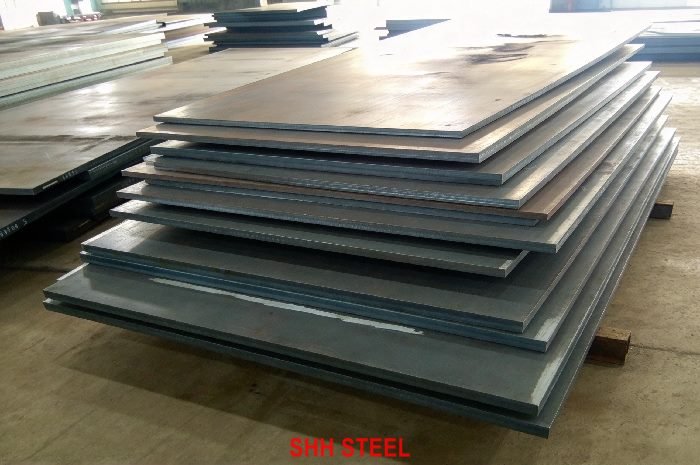
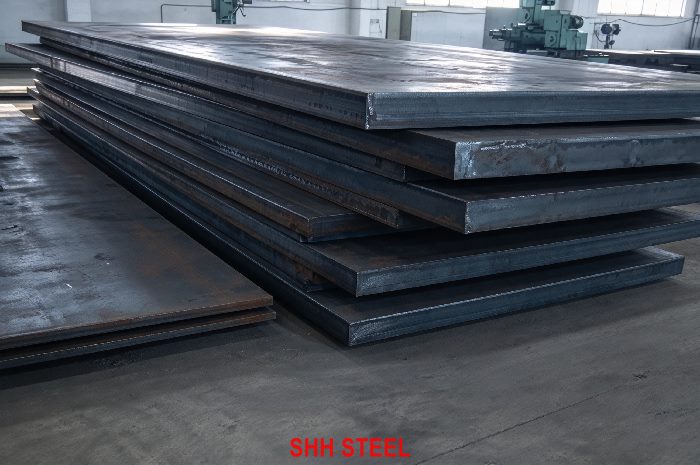
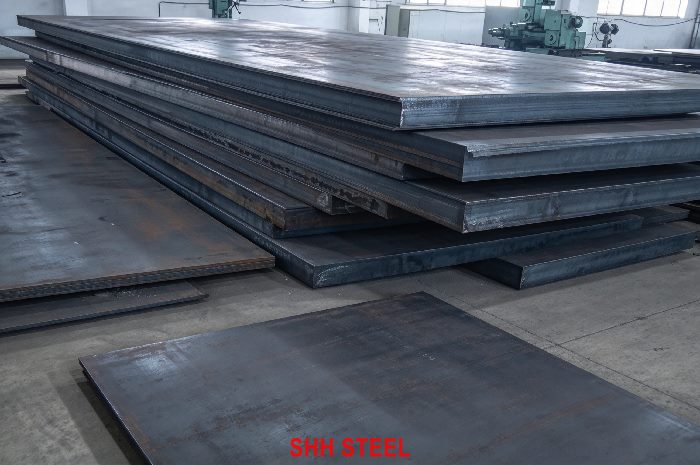
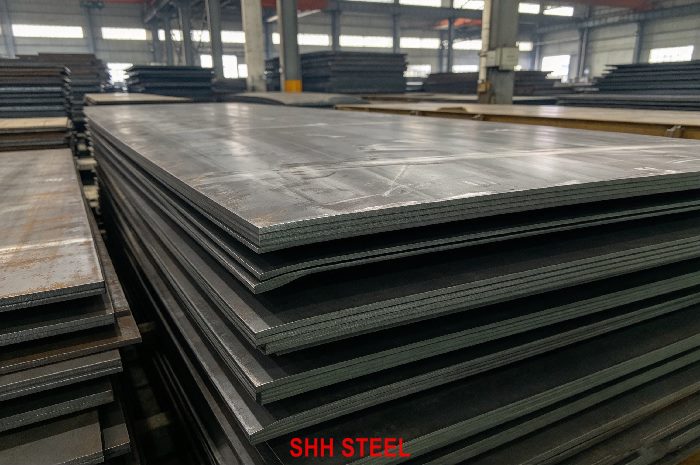
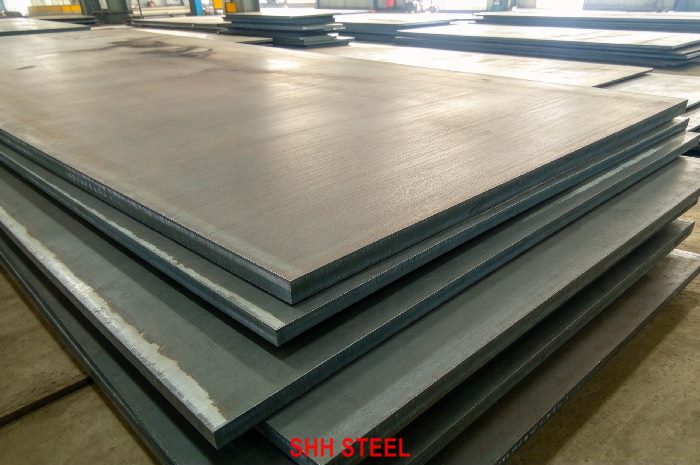
KF500 is made TMCP or quenched and tempered at a mill whose NK approval covers this exact grade and thickness range. It is rolled to order rather than held in stock. SHH STEEL places the order at an NK-approved Chinese mill and arranges the NK survey, with dual class and 3.2 inspection on request.
KF500 key data
| Item | NK KF500 |
|---|---|
| Governing rules | ClassNK Rules Part K, extra-high-strength rolled steel; IACS UR W16 (Part K numbering UNCERTAIN) |
| Designation | KF500: K + toughness letter F + yield 500 N/mm² |
| Strength | ReH ≥ 500, Rm 610–770 N/mm², A ≥ 16 % |
| Charpy V | −60 °C; avg. ≥ 50 J L / 33 J T (UR W16-aligned; confirm) |
| Delivery condition | TM or QT within approved thickness (N only if specially approved) |
| Steelmaking | killed, fine-grain; vacuum degassing typical |
| UT | usually ordered for this class — agree standard and level |
| Tolerance | IACS UR W13 (confirm class) |
| Documents | NK-endorsed certificate incl. Ceq / CET / Pcm; EN 10204 3.2 on request |
The maximum thickness depends on the mill’s approval. TM KF500 is often approved to about 50–80 mm and QT thicker, but treat the approval sheet as the limit (UNCERTAIN).
KF500 chemical composition — full alloy list
| Element | Heat (ladle) analysis, % | Product (check) analysis, % | Remark |
|---|---|---|---|
| C | 0.18 max. (often tighter than AH/DH/EH; TM/QT may further tighten) | numeric tolerance not tabulated in ClassNK Part K – agree on order / mill certificate | |
| Mn | 1.70 max. (typically 1.00–1.70) | numeric tolerance not tabulated in ClassNK Part K – agree on order / mill certificate | |
| Si | 0.55 max. (QT may differ — confirm on mill approval) | numeric tolerance not tabulated in ClassNK Part K – agree on order / mill certificate | |
| P | 0.020–0.025 max. (FH-route typically tighter — confirm) | numeric tolerance not tabulated in ClassNK Part K – agree on order / mill certificate | |
| S | 0.020–0.025 max. (FH-route typically tighter — confirm) | numeric tolerance not tabulated in ClassNK Part K – agree on order / mill certificate | |
| Al | 0.015 min. acid-soluble / ≈0.020 total Al (fine-grain; Al/N control) | numeric tolerance not tabulated in ClassNK Part K – agree on order / mill certificate | grain refiner / N binder |
| Nb | 0.05 max. (when used; combined microalloy caps apply) | numeric tolerance not tabulated in ClassNK Part K – agree on order / mill certificate | |
| V | 0.10 max. (when used; combined caps apply) | numeric tolerance not tabulated in ClassNK Part K – agree on order / mill certificate | |
| Ti | 0.05 max. (when used; combined caps apply) | numeric tolerance not tabulated in ClassNK Part K – agree on order / mill certificate | |
| Cu | 0.50 max. (route-dependent) | numeric tolerance not tabulated in ClassNK Part K – agree on order / mill certificate | |
| Cr | 0.20–0.25 max. (route-dependent) | numeric tolerance not tabulated in ClassNK Part K – agree on order / mill certificate | |
| Ni | 2.00 max. or per mill approval (FH often allows higher Ni for toughness) | numeric tolerance not tabulated in ClassNK Part K – agree on order / mill certificate | toughness |
| Mo | 0.08–0.50 (route-dependent) | numeric tolerance not tabulated in ClassNK Part K – agree on order / mill certificate | hardenability (QT) |
| B | 0.005 max. (when intentionally added) | numeric tolerance not tabulated in ClassNK Part K – agree on order / mill certificate | hardenability (QT) |
| N | 0.012 max. typical with Al present (tighter FH control — confirm) | numeric tolerance not tabulated in ClassNK Part K – agree on order / mill certificate | |
| Nb+V+Ti | Nb+V+Ti typically < 0.26 % for N/TM routes (not QT) — confirm UR W16 / mill approval | not applicable (calculated from heat analysis) | combined |
| Ceq / CET / Pcm | Ceq / CET / Pcm maxima by category and condition on mill approval — report on certificate | not applicable (calculated from heat analysis) | calculated |
Product (check) analysis column: ClassNK Part K specify heat (ladle) limits; no numeric product-analysis tolerance is tabulated in the rule text reviewed, so product (check) limits are agreed on the order or taken from the approved mill specification and certificate.
These rows give the UR W16 envelope. ClassNK fixes the exact limits for each mill at approval, so the approval sheet and the order govern (UNCERTAIN vs Part K text). At 500, Ni and Mo begin to appear, and thicker plate moves to QT. Every intentionally added element must appear on the certificate, along with Ceq, CET or Pcm.
KF500 tensile and impact requirements
| Property | Value |
|---|---|
| ReH (or Rp0.2) | 500 N/mm² min. |
| Rm | 610–770 N/mm² |
| A | 16 % min. (transverse) |
| Charpy | −60 °C, ≥ 50 J L / 33 J T |
Tests are taken per heat-treatment batch or rolled length, as the approval requires. Thick plate may need extra mid-thickness tests. Results are as per standard and mill certificate.
KF500: toughness and delivery condition
Charpy specimens are usually taken at quarter thickness and tested at −60 °C. Delivery is TM or QT. The choice changes the mill, price and welding behaviour, so state it on the order. At this toughness level, many owners also ask for CTOD or brittle-crack-arrest data. Those are separate requirements (UNCERTAIN), so specify them.
Thickness tolerance and surface quality
Minus tolerance follows UR W13. Plus tolerance and flatness follow the agreed standard. QT plate is flatter than heavy TM plate but harder to straighten, so agree the flatness class at enquiry.
KF500 mill-roll supply
| Thickness (mm) | Width (mm) | Condition | Typical lot |
|---|---|---|---|
| 12 | 2000 / 2500 | TM / QT | per heat / rolling |
| 16 | 2200 / 2500 | TM / QT | per heat / rolling |
| 20 | 2500 | TM / QT | per heat / rolling |
| 25 | 2500 | TM / QT | per heat / rolling |
| 30 | 2200 / 2500 | TM / QT | per heat / rolling |
| 40 | 2200 | TM / QT | per heat / rolling |
| 50 | 2200 | TM / QT | per heat / rolling |
KF500 is not held as open stock. These are the sizes we normally quote against mill rolling slots. Lead time is about 6–10 weeks including NK survey (commercial estimate).
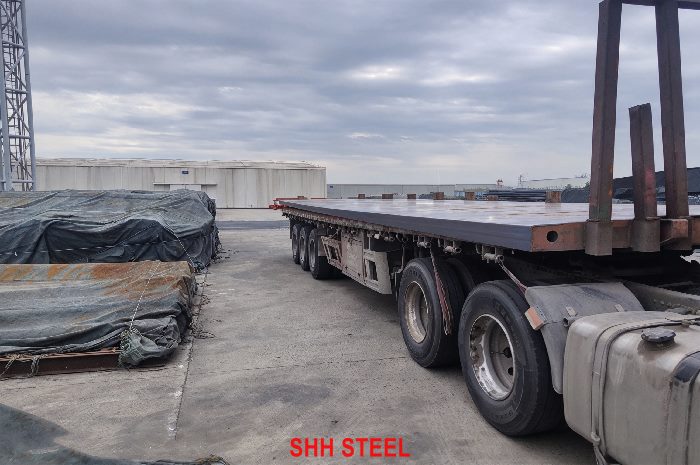
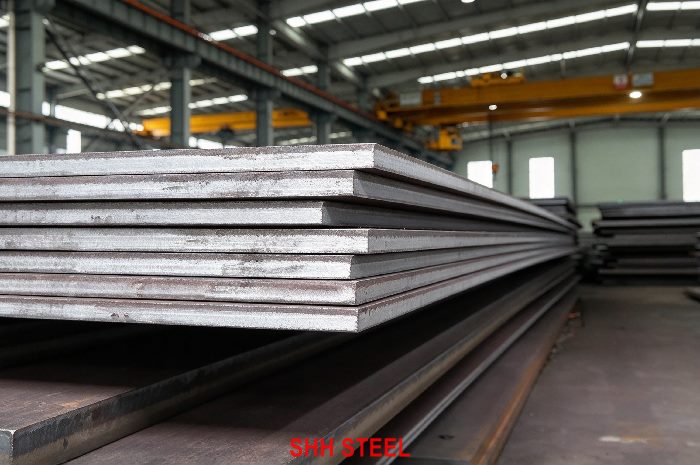
Packing: bundled by size with steel strapping, painted with grade and heat number, shipped in containers (≤11.8 m) or break bulk.
NK KF500 compared with other societies
| Society / standard | Grade | Note |
|---|---|---|
| ClassNK | NK KF500 | this page |
| DNV | DNV VL F500 | |
| LR | LR FH50 | LR numbers by yield/10 |
| BV | BV F500 | no H |
| CCS | CCS FH500 | |
| KR | KR RF51 | KR yield-class number |
| ABS | ABS FH50 / FQ51 | ABS commercial / official |
| RINA | RINA (per rules) | not verified |
| ASTM A131 | no equivalent | stops at FH40 |
| GB 712 | GB 712 Grade FH500 | product standard |
All sit in the same UR W16 band. The names differ, and only the NK stamp counts for ClassNK.
Where KF500 sits in the ClassNK extra-high-strength series
The neighbours are KF460 below and KF550 above. Within level 500, the letter sets the test temperature: KA 0 °C, KD −20 °C, KE −40 °C, KF −60 °C. Moving to a different level needs ClassNK plan approval. Typical uses: ice-class and polar hulls, Arctic LNG carriers and cold-region offshore units needing −60 °C, at extra-high strength. See NK Steel Plates and offshore platform steel plates.
Fabricating KF500
Welding needs a procedure qualified on KF500 and approved by ClassNK, with low-hydrogen consumables of matching strength and −60 °C toughness. Heat input must be limited to protect HAZ toughness in QT plate. Preheat is usually needed on thick sections. Do not hot form or stress relieve above the tempering temperature without agreement from the mill and ClassNK.
NK survey, certificates and receiving checks
The certificate gives the full alloy analysis, Ceq/CET/Pcm, tensile results, −60 °C Charpy results, delivery condition, UT result and plate numbers, with the NK endorsement. On receipt, check the KF500 stamp, impact temperature and NK endorsement. Dual class with ABS, DNV, LR or BV and 3.2 witness are available.
Ordering errors seen with KF500
- Writing AH500 or A500 without ClassNK, so the plate gets the wrong stamp
- Leaving TM vs QT open
- No UT requirement
- Ceq/Pcm not requested
- Ordering from a mill whose NK approval does not cover the thickness
- Expecting an ASTM A131 dual certificate
Buying KF500 from China: concerns and answers
| Concern | Answer |
|---|---|
| Is the NK stamp genuine? | Only mills with ClassNK approval for KF500; certificate and stamp traceable to the heat; third-party witness on request |
| Payment safety | T/T with balance after inspection, or L/C at sight |
| Small or mixed orders | sizes grouped onto one heat where possible |
| Delivery visibility | weekly photos from rolling to loading |
| Ready-to-fit parts | cutting, bevelling and drilling in our own workshop |
Ordering KF500
State NK KF500, TM or QT, sizes and quantities, UT level, dual class, certificate type and port. Send to SHH STEEL.
Sample line: “Plate to ClassNK Rules Part K, grade KF500, QT, 40 × 2500 × 10000 mm, 8 pcs, UT EN 10160 S1E1, NK-endorsed certificate with Pcm, EN 10204 3.2.”
FAQ
Conclusion
NK KF500 (KF500) is ClassNK extra-high-strength hull steel under Part K of the Rules for the Survey and Construction of Steel Ships: yield 500 N/mm², tensile 610–770 N/mm², Charpy −60 °C. An NK-classed hull accepts it only with the NK stamp and an endorsed certificate.
SHH STEEL supplies KF500 from NK-approved Chinese mills, with cutting, dual class, UT and EN 10204 3.2 on request. Send grade, sizes, quantities and port for a quotation.
Quality Steel Needed? Inquire for Offers
Related Products