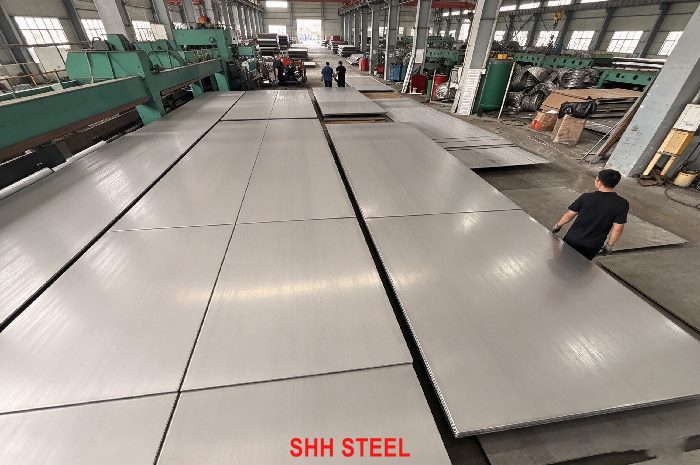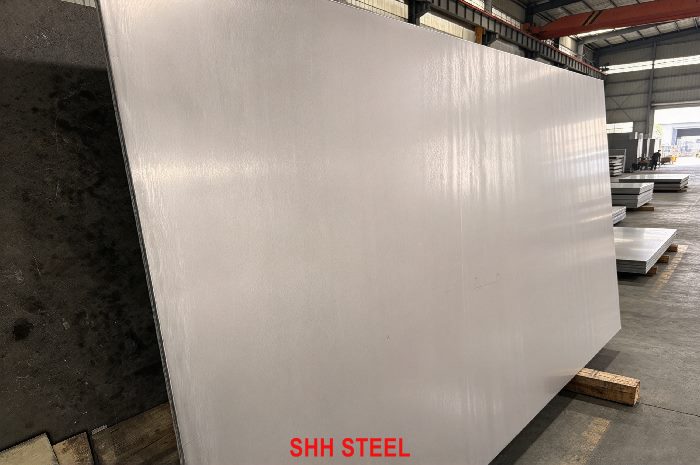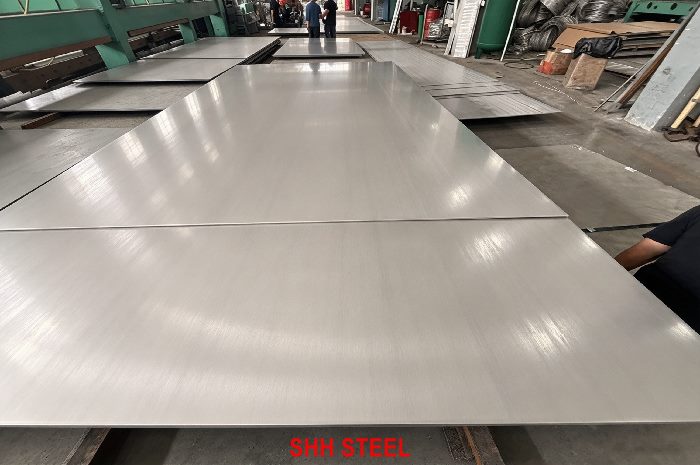
JIS G4304 SUS317J2 Hot Rolled Stainless Steel Plate
What is JIS G4304 SUS317J2 hot rolled stainless steel plate?
JIS G4304 SUS317J2 hot rolled stainless steel plate is a JIS-specific high-chromium (23.00–26.00 %) austenitic grade with 12.00–16.00 % nickel, 0.50–1.20 % molybdenum and 0.25–0.40 % nitrogen, giving 345 N/mm² minimum proof stress. It is one of the 66 grades in JIS G 4304:2021, the Japanese Industrial Standard for hot-rolled stainless steel plate, sheet and strip, where it belongs to the austenitic group listed in Table 3. Under the standard, plate and strip are hot rolled, heat treated, then pickled or given an equivalent descaling treatment, which produces the No.1 finish, and the standard thickness range for plate starts at 2.0 mm and runs into heavy gauges, with thickness tolerances tabulated up to 200 mm. In the solution-treated condition JIS G4304 requires a minimum 0.2 % proof stress of 345 N/mm² (applied when the purchaser specifies it) and a minimum tensile strength of 690 N/mm². It is a JIS-specific grade with no recognised EN, ASTM/UNS or GB/T equivalent, so it should be ordered by its JIS designation. Buyers use SUS317J2 plate for chemical equipment that needs high strength and corrosion resistance. Because the grade is ordered by its JIS symbol, the order must state JIS G4304, the grade, the dimensions and tolerance class, the finish and any supplementary tests such as product analysis or intergranular corrosion testing, which are applied only when the purchaser asks for them. This page sets out those requirements from the standard in the order a buyer needs them: specification, heat and product analysis, mechanical properties, heat treatment, tolerances, equivalents, applications, fabrication and inspection.
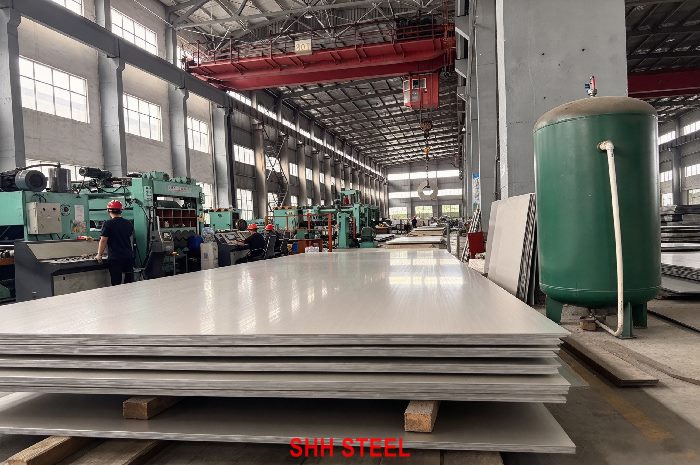
SHH STEEL supplies JIS G4304 SUS317J2 plate mill-direct, with mill test certificates to JIS G 0415 and optional third-party witness. We can cut plate to size, bevel edges and machine parts in our own workshop before shipment.
Values on this page are taken from JIS G 4304:2021 and JIS G 0321:2017. Where the standard leaves a point to agreement, or where a cross-reference is not exact, the page says so instead of giving a figure. Data note: SUS317J2 is a JIS-specific grade with no recognised EN, ASTM/UNS or GB/T equivalent.
JIS G4304 SUS317J2 plate: specification summary
JIS G4304 covers hot-rolled stainless steel plate and strip in one standard. Plate means cut lengths and strip means coil; the cold-rolled counterpart is JIS G4305, so SUS317J2 plate thinner than the hot-rolled range, or with a cold-rolled 2B or BA finish, is ordered to JIS G4305 instead. The summary below collects the clauses that matter for a SUS317J2 plate order.
| Item | JIS G4304 requirement for SUS317J2 |
|---|---|
| Standard | JIS G 4304:2021, Hot-rolled stainless steel plate, sheet and strip |
| Grade symbol | SUS317J2 (add “-HP” for plate or “-HS” for strip when the product form must be shown, e.g. SUS317J2-HP) |
| Classification | Austenitic (Table 3 chemistry) |
| Corresponding ISO standards | ISO 16143-1:2014, ISO 9444-1:2009, ISO 9444-2:2009 and ISO 18286:2008 (all MOD) |
| Manufacturing route | Hot rolled, heat treated, pickled or equivalent descaling; straightening, grinding or skin-pass rolling allowed (clause 4) |
| Heat treatment | Solution treated unless otherwise specified. Heat treatment may be omitted by agreement, marked “AR”. |
| Surface finish | No.1 (hot rolled, heat treated and pickled); polished finishes such as No.3, No.4, #240, #320 and #400 by manufacturer’s practice |
| Standard plate thicknesses | 2.0, 2.5, 3.0, 4.0, 5.0, 6.0, 7.0, 8.0, 9.0, 10.0, 12.0, 15.0, 20.0, 25.0, 30.0, 35.0 mm (Table 16); others by agreement |
| Standard plate sizes | 1 000 × 2 000, 1 219 × 2 438, 1 219 × 3 048, 1 524 × 3 048 mm (Table 16) |
| Thickness tolerance | Class A (±) Table 20 by default; class B (Table 21) or class C (Table 22) when specified; tabulated from 2.00 to 200 mm |
| Flatness | Table 29 when the purchaser requires it; stricter class EF may be specified |
| Product analysis | On request, heat-analysis limits widened by JIS G 0321 Table 5 tolerances (clause 5.2) |
| Tests | Heat analysis; tensile test (JIS Z 2241) and hardness (JIS Z 2243-1, Z 2244-1 or Z 2245) |
| Corrosion test | Intergranular corrosion test only when specified (JIS G 0571/0572/0573/0575) |
| Inspection document | JIS G 0415 type 3.1 unless otherwise specified (clause 14); 3.2 with third-party witness on request |
| Standard mass (density) | 7.98 kg/(mm·m²) for plate mass calculation (Table 19) |
SUS317J2 plate chemistry: heat analysis vs product analysis
JIS G4304 sets the heat (ladle) analysis of SUS317J2 in Table 3. When the purchaser asks for a product (check) analysis on the finished plate, clause 5.2 applies the permitted variations of JIS G 0321 Table 5 for stainless and heat-resisting steels. Under JIS G 0321 the variation is chosen from the band that contains the specified maximum, or the specified minimum when only a minimum is given, and the product analysis may lie outside the heat-analysis range only by that amount. The table compares the two, in mass %.
| Element | Heat analysis (JIS G4304) | JIS G 0321 variation | Product analysis (permitted) |
|---|---|---|---|
| C | ≤ 0.06 | +0.010 | ≤ 0.07 |
| Si | ≤ 1.50 | +0.10 | ≤ 1.60 |
| Mn | ≤ 2.00 | +0.040 | ≤ 2.04 |
| P | ≤ 0.045 | +0.005 | ≤ 0.05 |
| S | ≤ 0.030 | +0.005 | ≤ 0.035 |
| Ni | 12.00–16.00 | −0.15 / +0.15 | 11.85–16.15 |
| Cr | 23.00–26.00 | −0.25 / +0.25 | 22.75–26.25 |
| Mo | 0.50–1.20 | −0.05 / +0.05 | 0.45–1.25 |
| N | 0.25–0.40 | −0.040 / +0.040 | 0.21–0.44 |
Notes: elements not listed are not specified. Where an element or combination is not covered by JIS G 0321 Table 5, the product-analysis tolerance is agreed between purchaser and manufacturer (JIS G4304 5.2).
For comparison, the pitting resistance equivalent number calculated with PREN = Cr + 3.3 Mo + 16 N from the heat-analysis limits is about 28.6 at the minimum and 36.4 at the maximum of the ranges. JIS G4304 does not specify PREN; it is a ranking tool only, and a guaranteed minimum PREN must be agreed as a supplementary requirement.
A single heat analysis on the mill certificate is the acceptance basis under JIS G4304. If PMI or check analysis is required on receipt, the purchaser should say so in the order and refer to the product-analysis limits above; SHH STEEL can arrange PMI and laboratory chemistry through partner laboratories.
Mechanical properties of JIS G4304 SUS317J2 plate
Mechanical properties of SUS317J2 plate are verified on one sample per heat and heat-treatment lot (clause 11.2), using JIS Z 2241 tensile test pieces No. 4, No. 10 or No. 13B (or No. 14A, 14B or 5) at 23 ± 5 °C. The proof stress applies when the purchaser specifies it; tensile strength, elongation and hardness always apply. Any one of the hardness scales may be used, at the manufacturer’s choice unless specified.
| Property | Requirement (Table 8, solution treated) |
|---|---|
| 0.2 % proof stress | ≥ 345 N/mm² |
| Tensile strength | ≥ 690 N/mm² |
| Elongation | ≥ 40 % |
| Hardness | ≤ 250 HBW, or ≤ 100 HRBW/HRBS, or ≤ 260 HV |
1 N/mm² = 1 MPa. JIS G4304 does not specify elevated-temperature or impact properties for SUS317J2; where a design code needs them, they must be added to the order. The standard also does not specify properties after any heat treatment done by the buyer after delivery.
Heat treatment of SUS317J2 plate
JIS G4304 Annex JA (informative) gives the following example heat-treatment condition for SUS317J2: Solution treatment 1 030–1 180 °C, rapid cooling. Because Annex JA is informative, the mill chooses the actual temperatures within its own practice, and the certificate records the heat-treatment condition.
Unless the purchaser specifies otherwise, austenitic plate is solution treated. With the purchaser’s approval the mill may solution treat on the rolling line and quench immediately, which is marked “LS”. Heat treatment may also be omitted by agreement, in which case the plate is marked “AR” (as rolled) and the mechanical-property requirements are agreed between the parties.
Thickness, width, length and flatness tolerances for SUS317J2 plate
Clause 9.3 gives the dimensional and shape tolerances for SUS317J2 plate. The default thickness tolerance is class A in Table 20 below (mm, by width in mm). The purchaser may instead specify class B (Table 21: plus-only tolerances with −0.25 mm on the minus side) or class C (Table 22: plus-only tolerances with 0 mm on the minus side), which are used when a minimum thickness must be guaranteed. Thickness is measured at least 15 mm in from a cut edge, or 25 mm from a mill edge on plate cut from strip.
| Thickness | w < 1 000 | 1 000–<1 250 | 1 250–<1 600 | 1 600–<2 000 | 2 000–<2 500 | 2 500–<3 150 | 3 150–4 000 |
|---|---|---|---|---|---|---|---|
| 2.00–<2.50 | ±0.25 | ±0.30 | — | — | — | — | — |
| 2.50–<3.15 | ±0.30 | ±0.35 | ±0.40 | — | — | — | — |
| 3.15–<4.00 | ±0.35 | ±0.40 | ±0.45 | — | — | — | — |
| 4.00–<5.00 | ±0.40 | ±0.45 | ±0.50 | ±0.60 | ±0.80 | ±1.0 | — |
| 5.00–<6.00 | ±0.50 | ±0.55 | ±0.60 | ±0.70 | ±0.90 | ±1.1 | — |
| 6.00–<8.00 | ±0.60 | ±0.65 | ±0.65 | ±0.75 | ±1.0 | ±1.2 | ±1.4 |
| 8.00–<10.0 | ±0.65 | ±0.65 | ±0.65 | ±0.80 | ±1.2 | ±1.5 | ±1.6 |
| 10.0–<16.0 | ±0.70 | ±0.70 | ±0.70 | ±0.85 | ±1.2 | ±1.5 | ±1.6 |
| 16.0–<25.0 | ±0.80 | ±0.80 | ±0.80 | ±0.95 | ±1.3 | ±1.5 | ±1.6 |
| 25.0–<40.0 | ±0.90 | ±0.90 | ±0.90 | ±1.1 | ±1.3 | ±1.5 | ±1.6 |
| 40.0–<63.0 | ±1.0 | ±1.0 | ±1.2 | ±1.2 | ±1.4 | ±1.5 | ±1.6 |
| 63.0–<100 | ±1.1 | ±1.2 | ±1.3 | ±1.3 | ±1.5 | ±1.6 | ±1.7 |
| 100–<160 | ±1.3 | ±1.3 | ±1.4 | ±1.4 | ±1.6 | ±1.7 | ±1.8 |
| 160–200 | ±1.6 | ±1.6 | ±1.7 | ±1.7 | ±1.9 | ±2.0 | ±2.1 |
Width and length tolerances depend on the cutting method. For plate cut by mechanical, plasma, laser or waterjet cutting under 10.0 mm thick, Table 25 gives +10/0 mm on width for lengths up to 3 500 mm and widths under 2 000 mm, increasing with length and width; flame (powder) cut plate has wider tolerances, for example +30/+5 mm. Length tolerances in Table 27 follow the same pattern. As-rolled plate (mill edge) has width and length tolerances specified on the plus side only.
Flatness is measured only when the purchaser requires it (Table 29), as the maximum deviation over any 3 500 mm length. For plate up to 1 000 mm wide and up to 2 000 mm long the limit is 15 mm, or 3 mm for the stricter class EF; for widths over 1 000 and up to 1 600 mm it is 20 mm, or 6 mm for EF. Wider plate has limits from 25 to 50 mm and no EF class. Buyers who need flat plate for machining or laser cutting should specify EF, or ask for leveling, at the enquiry stage.
SUS317J2 plate surface finish and weight calculation
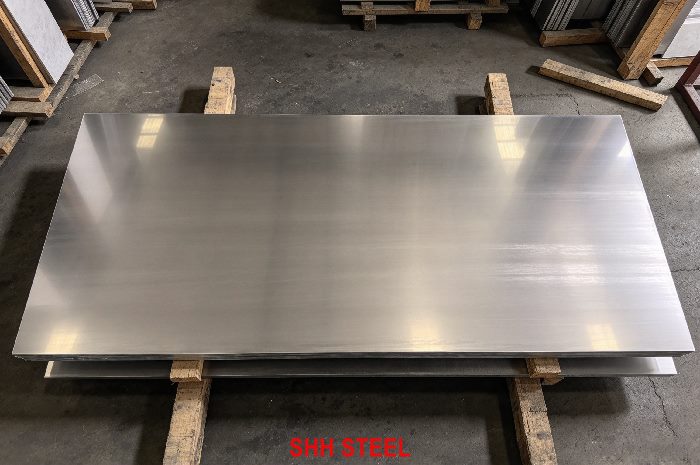
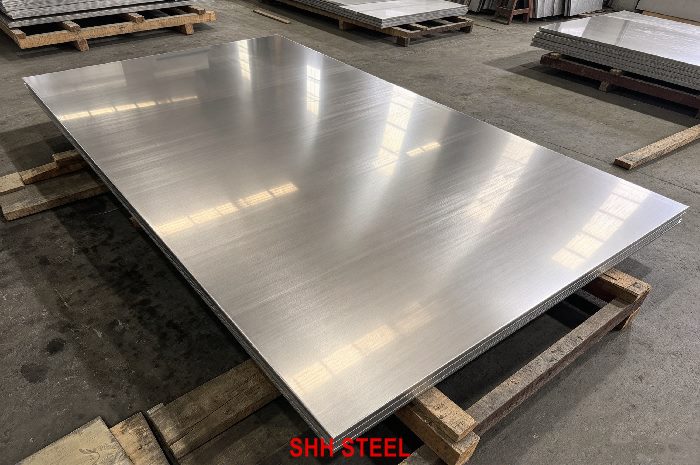
The standard surface finish for JIS G4304 plate is No.1: hot rolled, heat treated, then pickled or given an equivalent treatment. It has a dull, slightly rough appearance and is the normal finish for SUS317J2 plate in tanks, structures and process equipment. Polished finishes such as No.3, No.4, #240, #320 and #400, and any other finish not in Table 15, follow the manufacturer’s practice and should be defined in the order, including which side is polished and whether protective film is required.
When the purchaser asks for calculated mass, clause 9.2 and Table 18 apply. The basic mass for SUS317J2 is 7.98 kg/(mm·m²). The unit mass is basic mass × thickness, rounded to four significant figures; the area is rounded to four significant figures; and the plate mass is rounded to three significant figures (or to whole kilograms above 1 000 kg). For class B and C tolerances, Tables 23 and 24 add an allowance to the nominal thickness before calculation. For example, one SUS317J2 plate of 10.0 × 1 219 × 2 438 mm has a unit mass of 7.98 × 10.0 = 79.8 kg/m², an area of 1.219 × 2.438 = 2.972 m², and a calculated mass of 79.8 × 2.972 ≈ 237 kg, rounded as Table 18 requires.
SUS317J2 plate supply forms, sizes and packing
JIS G4304 plate is produced in two ways. Thinner plate, from about 2 mm up to roughly 12 mm in many mills, is cut from continuously hot-rolled, annealed and pickled coil (No.1 coil), and is supplied either as cut-to-length plate or as coil. Thicker plate is usually rolled as discrete plates on a plate (quarto) mill, then heat treated and pickled. The route affects the edge condition (mill edge or cut edge), the available widths and lengths, and the flatness that can be achieved, so the enquiry should state which tolerances and edges are acceptable.
For SUS317J2, the realistic supply range depends on how widely the grade is produced. Common austenitic grades are rolled by most stainless plate mills, while JIS-specific or special austenitic grades are rolled in campaigns, with minimum quantities per heat. Standard sizes of 1 219 × 2 438 mm and 1 524 × 3 048 mm are the most widely available; wider plate up to about 2 000 mm and longer lengths can be rolled to order, and any size can be cut from larger plate in our workshop.
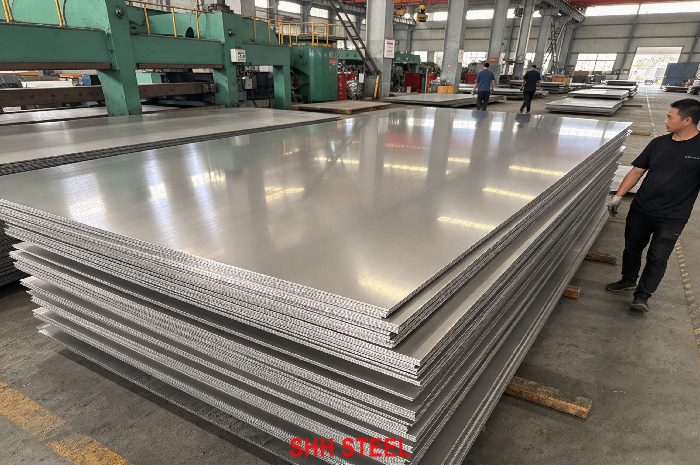
Packing for export normally means plates stacked on wooden or steel pallets with interleaving where needed, steel strapping, edge protection and waterproof wrapping, and coils packed eye-to-wall or eye-to-sky. Each bundle carries a label with the grade symbol, size, heat number and bundle weight, which matches the marking required by clause 13 and the inspection certificate.
How SUS317J2 plate performs in service
As an austenitic grade, SUS317J2 has a face-centred cubic structure in the solution-treated condition. It is essentially non-magnetic as supplied, although cold work, and for leaner grades even forming or flattening, can introduce some magnetic response through strain-induced martensite. The austenitic structure keeps its toughness down to very low temperatures and does not show a ductile-to-brittle transition, which is why austenitic plate is used for cryogenic as well as ambient service.
Corrosion resistance comes from the chromium-rich passive film, helped by nickel and, where present, molybdenum, copper and nitrogen. In chloride service the usual risks for austenitic plate are pitting, crevice corrosion and chloride stress-corrosion cracking above roughly 60 °C. JIS G4304 does not set corrosion-test limits by default; under clause 7 an intergranular corrosion test (JIS G 0571, G 0572, G 0573 or G 0575) is applied only when the purchaser specifies it, and the acceptance criteria are agreed between the parties.
Thermal expansion of austenitic grades is higher, and thermal conductivity lower, than for carbon steel and ferritic stainless steel. Designers should allow for this in welded assemblies, and fabricators should control heat input to limit distortion of thin plate.
SUS317J2 equivalent grades: EN, ASTM/UNS and GB/T compared
Buyers often need to know whether SUS317J2 plate can replace, or be replaced by, an EN, ASTM or Chinese grade. The table lists the nearest grades in each system. Cross-references are a guide only: the standards differ in chemical limits, mechanical requirements, tolerances and testing, so dual-certified material must meet every limit of both standards on the same heat.
| System | Equivalent of SUS317J2 |
|---|---|
| JIS (this page) | SUS317J2, JIS G4304 (hot rolled) / JIS G4305 (cold rolled) |
| EN (EN 10088-2 / EN 10095) | No recognised equivalent |
| ASTM / UNS (ASTM A240) | No recognised equivalent |
| GB/T (GB/T 4237 hot-rolled plate) | No recognised equivalent |
| ISO | ISO 16143-1 is the corresponding international standard for corrosion-resistant flat products; JIS keeps its own designation system |
Uncertainty: SUS317J2 is a JIS-specific grade with no recognised EN, ASTM/UNS or GB/T equivalent.
Because SUS317J2 has no recognised equivalent, it should be ordered by its JIS designation. Where a project allows substitution, the engineer should approve the alternative grade on the basis of corrosion data for the actual service.
The same grade made as cold-rolled plate and sheet is covered by JIS G4305; the standard JIS G4305 chemistry for SUS317J2 matches JIS G4304, but mechanical properties, finishes and tolerances are specified separately for cold-rolled material.
Other JIS G4304 grades related to SUS317J2
SUS317J2 sits within the austenitic group of JIS G4304. These related hot-rolled grades are often compared with it when choosing plate:
- JIS G4304 SUS317LN hot rolled plate: SUS317L with 0.10–0.22 % nitrogen, which adds strength and pitting resistance.
- JIS G4304 SUS317J1 hot rolled plate: a JIS-specific high-molybdenum (4.00–6.00 % Mo) austenitic grade with 15.00–17.00 % nickel and carbon up to 0.040 %, for strong chloride pitting resistance.
- JIS G4304 SUS321 hot rolled plate: an 18-8 austenitic grade stabilised with titanium (at least 5 × C %), which protects against intergranular corrosion after exposure in the 425–815 °C sensitising range.
- JIS G4304 SUS347 hot rolled plate: an 18-8 austenitic grade stabilised with niobium (at least 10 × C %), used like SUS321 for welded parts exposed to the sensitising temperature range.
- JIS G4304 SUS304 hot rolled plate: the basic 18Cr-8Ni austenitic stainless steel and by far the most widely used grade in JIS G4304, balancing corrosion resistance, weldability, formability and cost.
- JIS G4304 SUS316L hot rolled plate: the low-carbon (C ≤ 0.030 %) version of SUS316 and the most common molybdenum grade for welded plate, keeping weld-zone corrosion resistance without post-weld treatment.
For the most widely stocked plate grades, see ASTM A240 Type 304 plate, AISI 316L plate and ASTM A240 2205 duplex plate. All JIS G4304 grades are grouped in the JIS G4304 plate category.
More plate pages on this site: AISI 304 plate, JIS G4305 cold-rolled plate range, EN 10088-2 plate range.
Applications of JIS G4304 SUS317J2 plate
SUS317J2 plate is chosen for chemical equipment that needs high strength and corrosion resistance. Typical uses include:
- Chemical equipment that needs high strength
- Corrosion resistance
In each case the selection rests on the corrosion resistance and toughness of the austenitic structure, the availability of SUS317J2 in hot-rolled thicknesses, and the ease of welding. Where chloride levels, temperature or acid concentration are close to the limit of the grade, compare it with a more highly alloyed grade before ordering.
Cutting, forming and welding SUS317J2 plate
Cutting. SUS317J2 plate is cut by plasma, laser, waterjet or shearing. JIS G4304 Table 25 distinguishes flame (powder) cutting from other methods when setting width tolerances, and gives tighter limits for mechanical, plasma, laser and waterjet cutting. Oxy-fuel cutting does not work on stainless steel without powder injection.
Forming. Annealed austenitic plate has high elongation and can be bent, rolled and pressed cold. It work-hardens as it is formed, so heavy forming needs more power than carbon steel, and springback is larger. Hot forming is done within the mill-recommended temperature range, followed by solution treatment when required.
Welding. Austenitic grades are readily welded by GTAW, GMAW, SMAW, FCAW and SAW with matching or over-alloyed filler. Low-carbon (L) and stabilised grades are chosen where welds must resist intergranular corrosion without post-weld solution treatment. Interpass temperature is kept low, and weld discoloration is removed by pickling or mechanical cleaning to restore corrosion resistance.
Testing, marking and certificates for SUS317J2 plate
Clause 11 of JIS G4304 sets the test rules. Heat analysis follows JIS G 0404 and JIS G 0320; a product analysis to JIS G 0321 is made when the purchaser requests it. One sample is taken per heat and heat-treatment lot for mechanical testing, and one test piece is used for each test.
- Tensile test to JIS Z 2241 at 23 ± 5 °C, with a controlled strain rate for non-martensitic grades.
- Hardness test to JIS Z 2243-1 (Brinell), JIS Z 2244-1 (Vickers) or JIS Z 2245 (Rockwell) at 23 ± 5 °C.
- Intergranular corrosion test to JIS G 0571, G 0572, G 0573 or G 0575 only when specified.
- Inspection of chemistry, properties, finish, dimensions and appearance under clause 12.
Under clause 13 each plate or bundle is marked with the grade symbol, dimensions, any special tolerance or flatness symbols (B, C, EF), the surface finish, the heat-treatment symbol where applicable (AR, LS, Q or the ageing symbol), the manufacturer’s name or mark, and the heat or inspection number. Under clause 14 the inspection document is JIS G 0415 type 3.1 unless another type is ordered. SHH STEEL checks the marking against the certificate before shipment and can arrange 3.2 certification with an independent inspector.
Sourcing SUS317J2 plate: buyer concerns and SHH STEEL solutions
These are the questions buyers of JIS G4304 SUS317J2 plate ask most often, and how we handle each one:
| Buyer Concern | SHH STEEL Solution |
|---|---|
| Quality worries: is the plate and certificate genuine? | Every lot can be witnessed by TUV, ABS or CCS, and partner testing labs run PMI, chemistry and tensile checks on SUS317J2 plate against JIS G4304. Third-party witness and EN 10204 3.2 certificates available. |
| Deposit risk on a new supplier | TT and LC are accepted, and can be combined (part TT, part LC). On large projects you may sign directly with the mill, with SHH STEEL handling documents and follow-up for a small fee. |
| Small orders below mill MOQ | Small SUS317J2 plate quantities are combined with other customers’ orders of the same grade so they can be produced even below the mill MOQ, with full heat traceability. |
| Slow delivery | Dedicated staff follow up with the mill through rolling, heat treatment, pickling, testing and packing, and report progress at each stage. |
| Processing needs | Our own workshop provides cutting to size, bevelling and machining to drawings as a value-added service, so plates arrive ready for fabrication. |
How to order JIS G4304 SUS317J2 plate
A complete order for SUS317J2 plate avoids queries and delays at the mill. Include:
- Standard and grade: JIS G 4304:2021, SUS317J2 (or SUS317J2-HP)
- Dimensions: thickness × width × length in mm, and quantity in pieces and tonnes.
- Thickness tolerance class (A, B or C) and flatness class (standard or EF) if not the default.
- Heat-treatment condition, surface finish (No.1, or a polished finish with side and film).
- Supplementary requirements: proof stress, product analysis, intergranular corrosion test, PMI, ultrasonic testing, dual certification.
- Inspection document: JIS G 0415 3.1 or EN 10204 3.2, inspector, marking and packing.
SHH STEEL reviews the order against JIS G4304 before placing it with the mill, confirms whether dual certification is possible on the heat, and proposes cutting, bevelling or machining where that saves the buyer time. Send your SUS317J2 plate enquiry with sizes and quantity for a quotation, lead time and inspection plan.
FAQ
-
What is JIS G4304 SUS317J2?
- It is SUS317J2 stainless steel made as hot-rolled plate, sheet or strip to JIS G 4304:2021. The plate is hot rolled, heat treated and pickled to a No.1 finish, with chemistry from Table 3 and the mechanical properties of the matching property table.
-
What is the equivalent of SUS317J2 in ASTM, EN and GB?
- SUS317J2 is a JIS-specific grade with no recognised EN, ASTM/UNS or GB/T equivalent. Order it by its JIS designation, and get the engineer’s approval before using any alternative grade.
-
Is SUS317J2 plate magnetic?
- No, not in the solution-treated condition. Annealed SUS317J2 plate is essentially non-magnetic, but cold work or forming can make it slightly magnetic.
-
What is the density or weight of SUS317J2 plate?
- The standard mass used for plate weight in JIS G4304 Table 19 is 7.98 kg per mm of thickness per m², which corresponds to a density of 7.98 g/cm³. A 10 mm plate therefore weighs about 79.8 kg/m².
-
What is the difference between JIS G4304 and JIS G4305 SUS317J2?
- JIS G4304 covers hot-rolled plate and strip with a No.1 finish, from 2.0 mm and up into heavy thicknesses. JIS G4305 covers cold-rolled plate, sheet and strip with finishes such as 2D, 2B and BA. The chemistry of SUS317J2 is the same in both, but properties and tolerances are specified separately.
-
What certificate comes with JIS G4304 SUS317J2 plate?
- Unless another type is ordered, the mill supplies an inspection certificate type 3.1 to JIS G 0415, showing heat analysis and test results. SHH STEEL can arrange EN 10204 3.2 certificates with TUV, ABS or CCS witness on request.
Conclusion
JIS G4304 SUS317J2 hot rolled stainless steel plate is defined by its Table 3 chemistry, the property table for its group, and the dimensional tolerances of clause 9. A good order states the grade and edition, the tolerance and flatness class, the finish and any supplementary tests. SHH STEEL supplies SUS317J2 plate mill-direct with third-party inspection, consolidation of small orders and in-house cutting, bevelling and machining.
Quality Steel Needed? Inquire for Offers
Related Products