
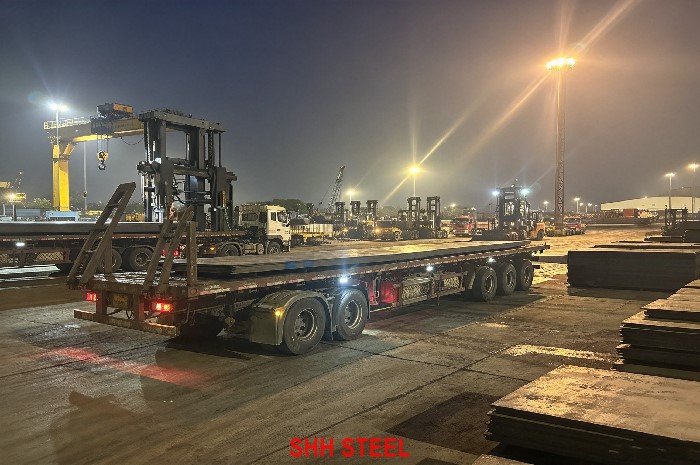
GB 712 Grade E shipbuilding steel plate
GB 712 Grade E shipbuilding steel plate — overview
GB 712 Grade E is the toughest normal-strength grade in GB 712: carbon capped at 0.18 %, killed and fine-grain at every thickness, and Charpy tested at −40 °C. It still gives only 235 N/mm² yield, so it is bought for toughness — crack-arrest strakes and cold-exposed members — not for strength. Many Chinese plate mills make it on the same controlled-rolling lines they use for high-tensile EH grades.
Equivalent grades: ASTM A131 Grade E · ABS E · DNV NV E · LR Grade E · BV Grade E · CCS Grade E · NK KE · KR RE · RINA Grade E.
Current edition: GB/T 712-2022 (Structural steel for ships and ocean engineering) (replaced GB 712-2011; implementation date 2023-05-01). English page titles keep the form “GB 712 Grade …”. Chemistry and tensile figures on this page are verified against the GB 712-2011 OCR tables and Caishuku consensus; full 2022 tables were not obtained free — do not assume 2022-only UHSS grades beyond this pack.
Grade E is the end of the mild-steel series. If your scantlings need more than 235 N/mm², move to EH32, EH36 or EH40 rather than thickening Grade E.
GB 712 is a national standard (the GB prefix without “/T”), and it sits next to — not inside — the general structural steel standard GB/T 1591. That separation matters: a Q235 or Q355 plate is not hull steel, even when the numbers look close, because it has no hull-steel deoxidation, toughness grading or marking rules.
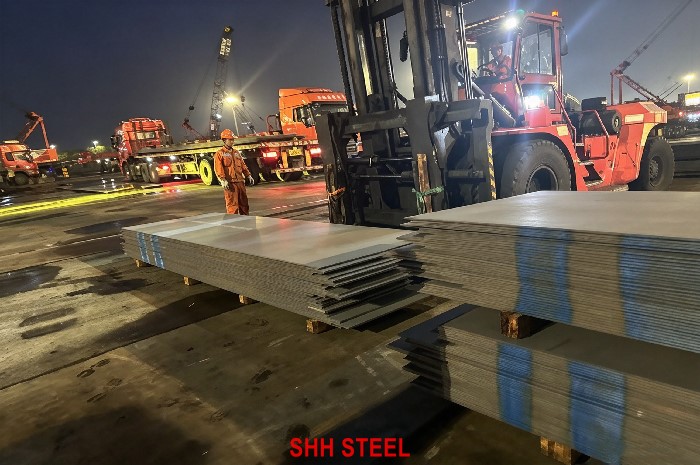
SHH STEEL supplies GB 712 Grade E from Chinese plate mills, as plain GB 712 plate for domestic-style projects or with a classification certificate added on the same heat for export. Common sizes are in stock; the rest is rolled to order. The full range is under GB 712 Grade E.
How GB 712 names it. For normal-strength steel GB 712 uses the bare letter — A, B, D or E — and the plate is stencilled “GB 712 E” with the mill mark. There is no prefix or number to decode, so mistakes come from mixing the hull grade up with a Q-grade, not from the name itself.
GB 712 Grade E: key data at a glance
| Item | GB 712 Grade E |
|---|---|
| Standard | GB 712 (Chinese national standard for hull and offshore structural steel), normal-strength Grade E; values on the IACS UR W11 basis (GB 712 table/clause numbers not quoted — UNCERTAIN) |
| Designation | Grade E: same letter as IACS UR W11 |
| Strength class | normal strength, ReH ≥ 235 N/mm² |
| Deoxidation | killed and fine grain (all thicknesses) |
| Grain refinement | required |
| Condition of supply | AR / CR / N / TM as permitted for the ordered thickness |
| Charpy V | CVN at −40 °C; each plate when N/TM |
| Thickness range | plates typically up to 100 mm; sections are also covered by GB 712 |
| Dimensions | GB/T 709 for hot-rolled plate dimensions (minus tolerance per hull-steel practice — confirm) |
| Certificate | GB 712 mill quality certificate (EN 10204 3.1 type); class certificate or 3.2 on request |
Size window. Chinese mills roll GB 712 Grade E from about 5 mm to 100 mm thick, 1500–4000 mm wide on wide-plate mills, and up to about 18 m long. Plate below 6 mm may come from a hot strip mill as cut-to-length coil; confirm that the mill’s certification covers that route.
Reading the table. For Grade E the deoxidation and grain-refinement lines matter more than the strength lines, which are the same for all four mild letters. They decide whether a plate from a given heat can be certified as Grade E at the ordered thickness.
GB 712 Grade E chemistry — every element on the certificate
| Element | Heat (ladle) analysis, % | Product (check) analysis, % | Comment |
|---|---|---|---|
| C | 0.18 max. | 0.20 max. (0.18 + 0.02) | |
| Si | 0.10–0.35 (min. waived if Al sol. ≥0.015 %) | 0.07–0.38 (0.10 − 0.03; 0.35 + 0.03) | |
| Mn | 0.70 min. | 0.70 min. (GB/T 222 Table 1 has no minimum-only row for Mn – heat limit applies) | |
| P | 0.035 max. | 0.040 max. (0.035 + 0.005) | |
| S | 0.035 max. | 0.040 max. (0.035 + 0.005) | |
| Al (acid-soluble) | 0.015 min. where Al is the grain refiner | 0.012 min. (0.015 − 0.003) | fine-grain practice |
| Nb | may act as grain refiner; report if added | no numeric heat limit – report actual value | |
| V | may act as grain refiner; report if added | no numeric heat limit – report actual value | |
| Ti | report if intentionally added | no numeric heat limit – report actual value | |
| Cu | 0.35 max. (residual) | 0.35 max. (residual element – GB/T 222 §5.1.1: no product tolerance) | residual |
| Cr | 0.30 max. (residual) | 0.30 max. (residual element – GB/T 222 §5.1.1: no product tolerance) | residual |
| Ni | 0.40 max. (residual) | 0.40 max. (residual element – GB/T 222 §5.1.1: no product tolerance) | residual |
| Mo | 0.08 max. (residual) | 0.08 max. (residual element – GB/T 222 §5.1.1: no product tolerance) | residual |
| N | not specified | no heat limit specified – report actual value | report on request |
| Nb+V+Ti | not specified for normal strength (calculated if added) | not applicable (calculated from heat analysis) | |
| C + Mn/6 (Ceq) | 0.40 max. (calculated) | not applicable (calculated from heat analysis) | carbon equivalent cap |
Product (check) analysis column = heat (ladle) limit adjusted by GB/T 222-2006 Table 1 (non-alloy and low-alloy steel), as invoked by GB 712 clause 6.1.3 (upper limit + upper deviation, lower limit − lower deviation; row chosen by the specified upper limit; values for cross-sections up to 6 500 mm², larger sections by agreement); arithmetic shown in brackets.
Limits shown are the IACS UR W11 values that GB 712 follows for normal-strength steel; the published GB 712 text governs where it differs (not checked against a local copy — UNCERTAIN). Grade E has the lowest carbon cap (0.18 %), at least 0.70 % Mn and grain refinement at every thickness. Mills usually stay far inside the P and S caps to make −40 °C reliable.
Chinese mill certificates normally print a fixed element list for the grade — C, Si, Mn, P, S, Als and the residuals — even where GB 712 sets no limit. Read the residual Cu, Cr, Ni and Mo values: electric-arc steel made from scrap runs higher in residuals than converter steel, and that matters for welding.
Chinese converter (BOF) steel made largely from hot metal tends to show low residuals; electric-furnace heats show more Cu and Ni. Both are acceptable if inside the limits, but the welding engineer should see the real values.
GB 712 Grade E tensile requirements
| Property | Requirement |
|---|---|
| Upper yield strength ReH | 235 N/mm² min. |
| Tensile strength Rm | 400–520 N/mm² |
| Elongation A (5.65√S0) | 22 % min. |
| Charpy test temperature | −40 °C |
All four GB 712 mild grades share these tensile values. Chinese certificates report yield as ReH and tensile as Rm in MPa (1 MPa = 1 N/mm²), with elongation as A on a proportional specimen; check that the specimen type is stated, because thin plate is often tested on flat non-proportional pieces with lower elongation minimums.
Tensile tests are taken transversely for plate, one test per batch, with the batch defined by heat, thickness range and condition (GB 712 batch rules not quoted — UNCERTAIN).
Tensile specimens are taken transverse to the rolling direction for plate, following UR W11/W16 practice; the certificate should show the specimen orientation and type. Where no clear yield point appears, Rp0.2 is reported instead of ReH.
GB 712 Grade E: Charpy V-notch and delivery condition
Grade E is tested at −40 °C; in N or TM condition every plate is tested, so the certificate lists results plate by plate.
| Thickness | Avg. longitudinal (J) | Avg. transverse (J) |
|---|---|---|
| ≤ 50 mm | 27 | 20 |
| 50–70 mm | 34 | 24 |
| 70–100 mm | 41 | 27 |
Each value is the average of three full-size specimens; one may be lower but not below 70 % of the required average. Longitudinal specimens are standard unless transverse ones are ordered (UR W11 basis; GB clause not quoted).
On Chinese certificates the condition of supply may appear in Chinese — for example as-rolled, normalized or TMCP (thermo-mechanical controlled processing). Ask the mill to print the English code too, so the receiving inspector abroad can match it to the order.
Where the yard specification adds requirements beyond the standard — for example Charpy on Grade A below 50 mm — that is an order extra and must be written on the purchase order.
Thickness tolerance, flatness and surface
Dimensions and plus tolerances of GB 712 plate are usually supplied to GB/T 709, the Chinese standard for hot-rolled plate dimensions, while hull-steel practice limits the minus tolerance (commonly quoted as −0.3 mm following IACS UR W13 — confirm on the order). For export, buyers often ask for EN 10029 Class B or ASTM A6 tolerances instead; that is fine provided it is agreed before rolling.
Surface defects may be ground out as long as the remaining thickness stays inside the minus tolerance. Weld repair of plate surfaces needs the purchaser’s agreement and, for classed work, the surveyor’s.
If the plate is ordered with a classification certificate, the class minus tolerance applies whatever dimension standard is named, so state both on the order. For thin plate under 10 mm, also state the flatness requirement; GB/T 709 flatness classes differ from EN 10029.
GB 712 Grade E stock and lead time
| Thickness (mm) | Width (mm) | Length (mm) | Condition | Approx. qty |
|---|---|---|---|---|
| 5 | 1500 / 1800 | 6000–12000 | AR / CR / N / TM | 80+ t |
| 6 | 1800 / 2000 | 6000–12000 | AR / CR / N / TM | 100+ t |
| 8 | 2000 | 6000–12000 | AR / CR / N / TM | 150+ t |
| 10 | 2000 / 2200 | 6000–12000 | AR / CR / N / TM | 200+ t |
| 12 | 2000 / 2500 | 6000–12000 | AR / CR / N / TM | 250+ t |
| 16 | 2200 / 2500 | 6000–12000 | AR / CR / N / TM | 200+ t |
| 20 | 2500 | 6000–12000 | AR / CR / N / TM | 150+ t |
| 25 | 2500 | 6000–12000 | AR / CR / N / TM | 120+ t |
| 30 | 2200 / 2500 | 6000–12000 | AR / CR / N / TM | 100+ t |
| 40 | 2200 | 6000–12000 | AR / CR / N / TM | 60+ t |
| 50 | 2200 | 6000–12000 | AR / CR / N / TM | 40+ t |
Quantities change weekly — confirm before booking. Stock plate is sold as GB 712 Grade E with the original mill certificate. Other sizes go into the next mill campaign: about 3–5 weeks.
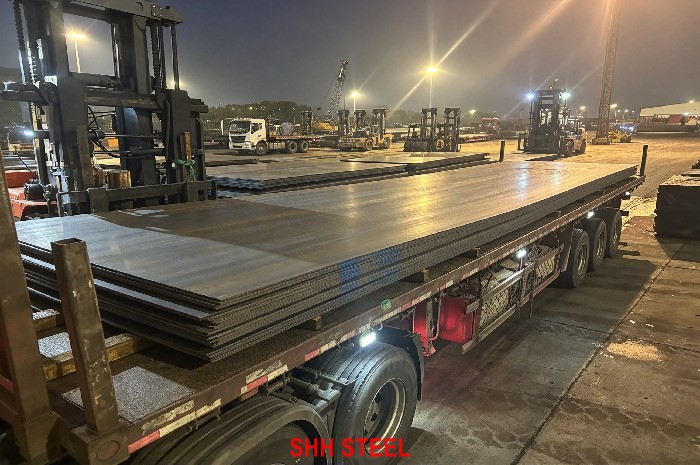
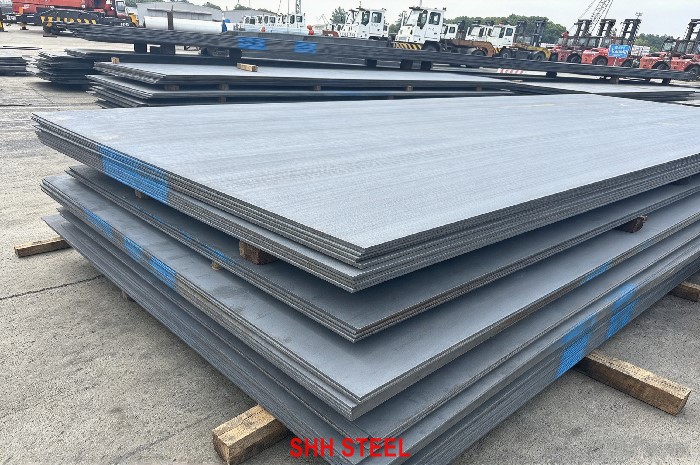
Packing and shipping: bundled by size with steel strapping, stencilled with standard, grade and heat number, and shipped from Shanghai, Tianjin, Qingdao or other Chinese ports in containers (≤ 11.8 m) or break bulk.
Processing before shipping. We cut Grade E to drawing by plasma or oxy-fuel, bevel edges, shot-blast and prime, and transfer grade, heat and plate number to every piece so that GB 712 traceability survives cutting. Cut parts ship with a cutting list cross-referencing each piece to its mother plate and certificate.
GB 712 Grade E against class societies and ASTM A131
| Standard / society | Designation | Remark |
|---|---|---|
| GB 712 (this page) | GB 712 Grade E | Chinese national product standard; no class stamp by itself |
| CCS | CCS Grade E | same letters as GB 712; the usual class mark on domestic Chinese hulls |
| ABS | ABS E | |
| DNV | DNV VL E | VL prefix |
| LR | LR Grade E | |
| BV | BV Grade E | |
| KR | KR Grade E (RE) | R-prefix |
| NK | NK Grade E (KE) | K-prefix |
| RINA | RINA Grade E | |
| ASTM A131 | ASTM A131/A131M Grade E | US product standard |
GB 712 and the CCS Rules. GB 712 was drafted to mirror the IACS unified requirements, which the China Classification Society (CCS) also applies in its Rules for Materials and Welding. In practice a Chinese mill rolls one heat to the shared chemistry and test plan; the plate becomes GB 712 Grade E through the national standard and CCS E through CCS survey. The two are parallel documents, not one replacing the other (CCS chapter numbering not quoted — UNCERTAIN).
Class certification on a GB 712 base. Export buyers often order “GB 712 E with CCS, ABS or DNV certificate” (or another IACS society). The class surveyor must witness or audit the tests at the mill before shipment; a plain GB 712 certificate cannot be converted into a class certificate afterwards. Several marks on one plate are possible when every society is booked in advance and the mill holds the relevant approvals.
Choosing A, B, D or E within GB 712
Grade E closes the normal-strength series; beyond it you change strength, not letter. The letter is fixed by the structural category and thickness on the approved drawing; GB 712 supplies the material, it does not choose it.
GB 712 or GB/T 1591? Shore structures, steel buildings and machinery frames use GB/T 1591 grades such as Q355; hull structure uses GB 712. A Q235B plate is not interchangeable with GB 712 Grade E, even though the yield level is the same, because the hull grade adds deoxidation, toughness and identification rules.
Typical uses of GB 712 Grade E: crack-arrest strakes in mild-steel designs, members on ships trading to northern Chinese, Korean or Russian Far East ports in winter, and heavy mild-steel parts that need −40 °C toughness.
Using a higher mild letter than needed adds cost without improving the design; using a lower one is a non-conformity. Follow the drawing exactly and let the purchase order repeat it.
Cutting, forming and welding GB 712 Grade E
GB 712 Grade E cuts by oxy-fuel, plasma or laser without preheat and forms easily, including cold flanging. Weld with consumables suited to normal-strength hull steel of matching toughness — for example GB/T 5117 or GB/T 10045 classifications chosen in the yard’s WPS — or class-approved consumables when the hull is classed.
Because the carbon equivalent is capped at 0.40, preheat is normally not needed, but thick restrained joints and cold, damp shop conditions in northern Chinese winters can still call for a modest preheat set by the procedure.
For offshore steelwork see offshore platform steel plates.
Where Grade E fits. Grade E goes into crack-arrest and cold-exposed members where strength is not the limit. Grade E carries the most test data of the mild letters, so expect a longer certificate. Keep mild and high-tensile plates of similar thickness clearly apart in the yard: they look identical and differ only in the stencil.
GB 712 tests, certificate and receiving checks
Each GB 712 delivery carries the mill quality certificate giving the standard and grade, heat number, plate numbers, sizes, heat analysis, tensile results, Charpy results where required, condition of supply and the mill’s quality stamp. Plates are marked with the mill’s logo, standard, grade, heat and plate number by stencil or hard stamp.
On receipt: check that the stencil reads GB 712 and Grade E, that heat and plate numbers match the certificate, that Charpy results (if required) are at −40 °C, and measure thickness at several points. An independent inspection company or your own inspector can witness tests at the mill if booked before rolling.
Mill quality system. Chinese plate mills supplying GB 712 normally run ISO 9001-certified quality systems and hold their own national product certification; when a class certificate is wanted, the mill must also hold that society’s works approval for the grade and thickness (details per mill — UNCERTAIN). Ask for that approval scope before ordering; it is the single most useful check a buyer can make.
Mistakes we see on GB 712 Grade E orders
- Plate supplied without per-plate impact tests in N/TM condition
- Using E where EH32–EH40 strength is needed
- Mixing up Grade E with EH36
- P and S near the cap on thick plate
- No class survey booked before testing
Write the full standard and grade, the condition of supply, the certificate type and any class requirement on the purchase order and the pro-forma invoice. Most problems start where one document differs from the other.
With mild plate the expensive mistakes are rarely about strength; they are about the toughness letter, the certificate type and the condition of supply. A rejected certificate at the yard can stop a block for weeks.
Buying GB 712 Grade E from China: concerns and answers
| Concern | Answer |
|---|---|
| Is the certificate genuine? | Original mill certificate for GB 712 Grade E, traceable by heat and plate number; mill verification and third-party witness on request |
| Will a foreign yard or inspector read it? | Bilingual Chinese/English certificate; supply-condition codes translated |
| Export paperwork | commercial invoice, packing list, bill of lading, certificate of origin (Form E or general CO on request) |
| Payment safety | T/T with balance after inspection, or L/C at sight |
| Small or mixed orders | several sizes and grades in one container |
| Ready-to-fit parts | cutting, bevelling, shot-blasting and priming in our own workshop |
If you have not bought GB 712 plate from China before, we can send sample certificates in advance, arrange a trial lot, and let your inspector visit the mill during rolling and testing. For buyers outside China we also check that the bilingual certificate wording matches the purchase order line by line before shipment.
Ordering GB 712 Grade E
Send SHH STEEL: standard and grade (GB 712 Grade E), sizes and quantity per size, condition of supply, tolerance standard, any class certificate, UT or third-party inspection, surface finish and destination port.
Sample line: “Hull structural steel plate to GB 712, Grade E, 12 × 2500 × 12000 mm, 50 pcs, mill certificate in Chinese and English, EN 10204 3.1, FOB Shanghai.”
Order checklist:
- Standard: GB 712 (state edition if your contract requires one)
- Grade: Grade E
- Condition of supply (AR / N / TMCP as allowed)
- Sizes and quantity per size; tolerance standard and flatness class
- Certificate: bilingual GB 712 mill certificate, EN 10204 3.1 or 3.2; class certificate if required
- Extras: UT, Z-direction, shot-blast/prime, cutting
- Delivery terms, destination port and documents (CO, Form E)
FAQ
Conclusion
GB 712 Grade E is the normal-strength hull structural steel of the Chinese national standard GB 712, on the IACS UR W11 basis: yield 235 N/mm², tensile 400–520 N/mm², Charpy at −40 °C. Order it by standard and grade, and add a classification certificate on the same heat when the hull is classed.
SHH STEEL supplies GB 712 Grade E from Chinese mills with bilingual certificates, cutting, UT and EN 10204 3.2 on request. Send grade, sizes, quantities and port for a quotation.
Quality Steel Needed? Inquire for Offers
Related Products