BS 7191 275E Offshore Steel Plate
BS 7191 275E — offshore platform steel plate overview
BS 7191 275E is a grade of the British offshore specification BS 7191:1989 (now superseded by EN 10225): yield 275 MPa minimum, tensile 430–560 MPa, impact class E — tested at −40 °C.
Equivalent grades: EN 10025-2 S275J2 / EN 10025-3 S275NL (non-offshore nearest) · no EN 10225 S275 grade · no API 2H/2W/2Y grade (nearest designations, plain text — not certificate-equivalent; confirm against the project specification). More grades: Offshore Platform Steel Plates.
BS 7191:1989 was the British specification for weldable structural steels for fixed offshore structures, developed from North Sea experience in the 1970s and 1980s. It defined grades by yield level (275, 355, 450) and a letter for impact class — D, E and the improved EM — with Z denoting guaranteed through-thickness ductility. It has been superseded by EN 10225, but many refurbishment, life-extension and spare-part drawings still call it up.
Offshore steel is bought differently from ship plate or building steel. The structure cannot be docked for repair, it is loaded by waves millions of times over a 25–40 year design life, and its joints are thick, highly restrained and inspected by NDT for fatigue cracks. BS 7191 275E therefore carries three guarantees beyond strength: toughness at low temperature, weldability with a controlled carbon equivalent, and — where ordered — resistance to lamellar tearing through the thickness.
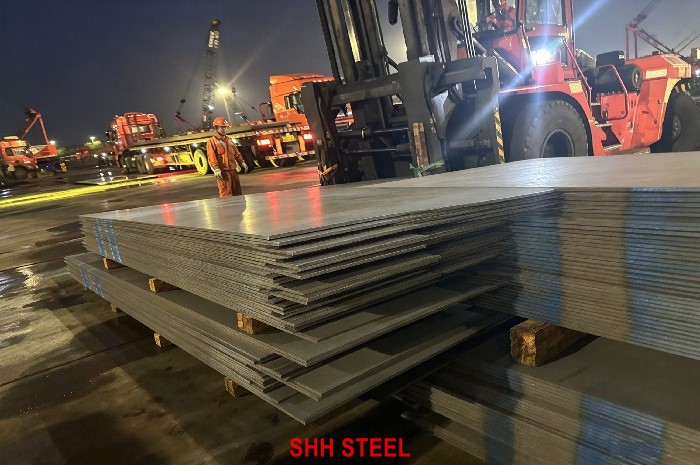
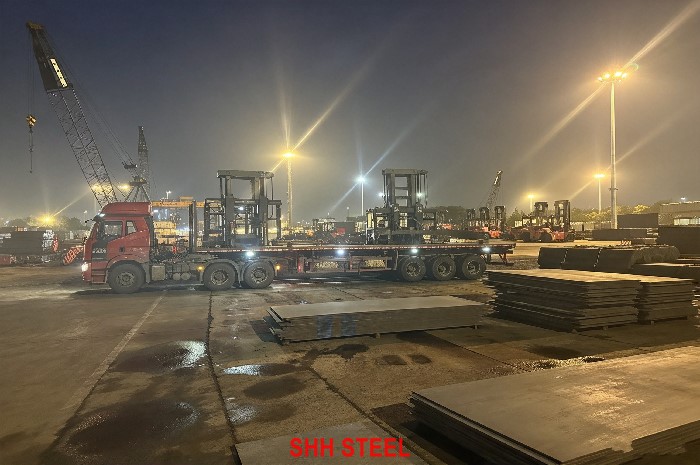
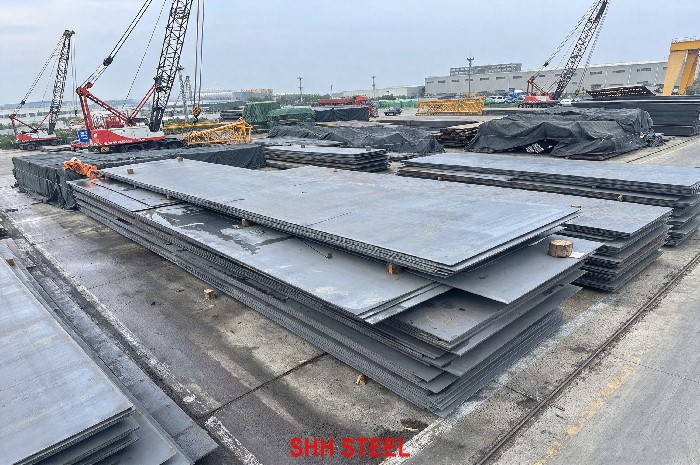
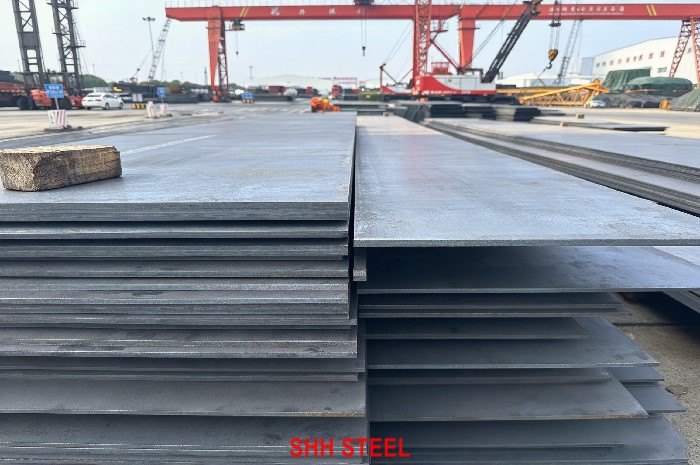
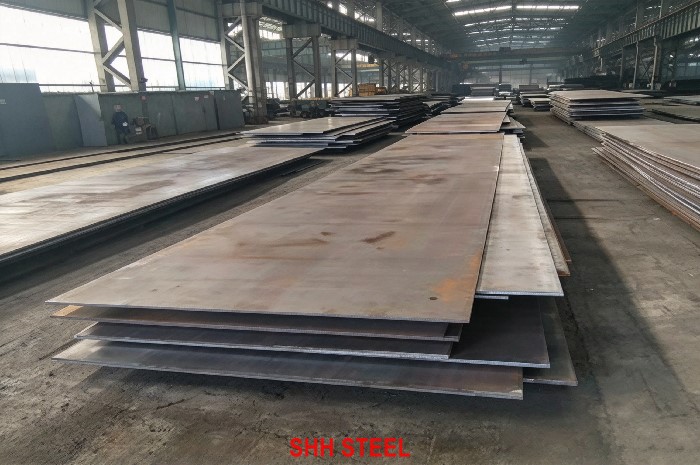
SHH STEEL supplies BS 7191 275E as mill-direct plate with EN 10204 3.1 or 3.2 certification, ultrasonic testing, Z-direction testing and cutting to drawing. The full range is under Offshore Platform Steel Plates.
Where BS 7191 275E sits. The E letter means impact testing at −40 °C, the class used for North Sea primary structure. Typical members: repair inserts, life-extension strengthening and replacement members on older UK-sector platforms whose original drawings cite BS 7191.
BS 7191 275E: key data at a glance
| Item | BS 7191 275E |
|---|---|
| Standard | BS 7191:1989 |
| Grade | 275E |
| Yield strength, min. | 275 MPa min. (≤ 16 mm; reduces stepwise with thickness) |
| Tensile strength | 430–560 MPa |
| Elongation, min. | 22 % (indicative) |
| Charpy V-notch | 27 J at −40 °C (indicative) |
| Delivery condition | normalized or controlled rolled |
| Through-thickness | no through-thickness guarantee (order the Z variant if needed) |
| Thickness range | up to about 100–150 mm |
| Certification | EN 10204 3.1 / 3.2; third-party or operator witness on request |
All values are typical of the BS 7191:1989 grade table and must be checked against the edition named on the purchase order (no local copy of the standard was available for this page — see the note in the ordering section). Yield decreases in steps as thickness increases; for heavy plate the order must state the design thickness so the correct band applies.
For BS 7191 orders the grade letter fixes the impact class; Z-grades fix the through-thickness requirement. Modern mills usually roll to EN 10225 and certify both, so the order should name BS 7191 explicitly to get it on the certificate.
BS 7191 275E chemical composition — every alloy element
| Element | Heat analysis, % (typical limit) | Product (check) analysis, % | Note |
|---|---|---|---|
| C | 0.18 max. | numeric tolerance not tabulated in BS 7191:1989 – agree on order / mill certificate | |
| Si | 0.15–0.55 | numeric tolerance not tabulated in BS 7191:1989 – agree on order / mill certificate | |
| Mn | 1.00–1.65 | numeric tolerance not tabulated in BS 7191:1989 – agree on order / mill certificate | |
| P | 0.025 max. | numeric tolerance not tabulated in BS 7191:1989 – agree on order / mill certificate | low P for toughness and HAZ |
| S | 0.015 max. (0.008 or lower for Z grades) | numeric tolerance not tabulated in BS 7191:1989 – agree on order / mill certificate | low S for Z-direction ductility |
| Al (total) | 0.015–0.055 | numeric tolerance not tabulated in BS 7191:1989 – agree on order / mill certificate | grain refiner |
| Nb | 0.04 max. | numeric tolerance not tabulated in BS 7191:1989 – agree on order / mill certificate | microalloy |
| V | 0.06–0.08 max. | numeric tolerance not tabulated in BS 7191:1989 – agree on order / mill certificate | microalloy |
| Ti | 0.025 max. | numeric tolerance not tabulated in BS 7191:1989 – agree on order / mill certificate | N-binding |
| Cu | 0.30 max. | numeric tolerance not tabulated in BS 7191:1989 – agree on order / mill certificate | residual / alloy |
| Cr | 0.25 max. | numeric tolerance not tabulated in BS 7191:1989 – agree on order / mill certificate | residual / alloy |
| Ni | 0.50 max. | numeric tolerance not tabulated in BS 7191:1989 – agree on order / mill certificate | toughness |
| Mo | 0.08 max. | numeric tolerance not tabulated in BS 7191:1989 – agree on order / mill certificate | hardenability |
| N | 0.010 max. | numeric tolerance not tabulated in BS 7191:1989 – agree on order / mill certificate | free N harms CTOD |
| Nb+V+Ti | 0.06–0.12 max. (calculated) | not applicable (calculated from heat analysis) | |
| B | 0.0005 max. | numeric tolerance not tabulated in BS 7191:1989 – agree on order / mill certificate | residual unless QT |
| Ca | report if Ca-treated | numeric tolerance not tabulated in BS 7191:1989 – agree on order / mill certificate | sulphide shape control |
| Ceq (IIW) | 0.36 max. (calculated; thickness-dependent) | not applicable (calculated from heat analysis) | |
| Pcm | 0.19 max. (calculated) | not applicable (calculated from heat analysis) | weldability index |
Product (check) analysis column: the BS 7191:1989 product-analysis tolerances were not available from a verifiable free source; agree product limits on the order and confirm on the mill certificate.
Offshore chemistries are defined more tightly than general structural steel because every element affects either weldability (C, Mn, Cr, Mo, V, Cu, Ni, B through Ceq and Pcm), heat-affected-zone toughness (N, Ti, Nb, Al) or through-thickness ductility (S, Ca, P). For BS 7191 275E the table lists every element the certificate should report; limits shown are indicative values for the BS 7191:1989 grade family and must be verified against the governing table.
BS 7191 EM and EMZ grades introduced tighter carbon, sulphur and carbon equivalent than D and E; mills rolling today usually meet the even tighter EN 10225 limits.
BS 7191 275E tensile properties by thickness
| Thickness (mm) | Yield ReH min. (MPa) | Tensile Rm (MPa) | Elongation min. |
|---|---|---|---|
| ≤ 16 | 275 | 430–560 MPa | 22 % |
| 16–25 | 265 | 430–560 MPa | 22 % |
| 25–40 | 255 | 430–560 MPa | 22 % |
| 40–63 | 245 | 430–560 MPa | 22 % |
| 63–100 | 235 | 430–560 MPa | 22 % |
Thickness steps are indicative and must be checked: European offshore standards reduce the minimum yield in steps as thickness grows. Designers working to ISO 19902, API RP 2A or NORSOK N-004 use the yield of the actual thickness band, so the reduction matters for heavy chords and cans.
Many offshore projects add a maximum yield-to-tensile ratio (often 0.85–0.90, grade-dependent) and an upper yield limit to keep weld metal overmatching. For BS 7191 275E these are project requirements, not always standard requirements, and must be ordered explicitly.
The 275 MPa level is the light end of offshore steel: walkways, secondary bracing, stairs, cable trays supports and outfitting where toughness and weldability matter but strength does not govern scantlings. It is cheap to weld and forgiving in fit-up, but it is rarely the economical choice for primary members today.
When BS 7191 plate is bought for a repair, compare the original as-built material certificates with the new plate: the new plate should not be dramatically stronger than the existing structure, or weld overmatching and stiffness distribution around the repair may change.
BS 7191 275E: Charpy at −40 °C and delivery condition
BS 7191 275E is delivered normalized or controlled rolled. Impact requirement: 27 J at −40 °C (indicative). Each value is the mean of three full-size specimens; single values must not fall below the minimum fraction stated in the standard (commonly 70 %).
Normalized plate is the safest route when the fabricator will hot-form or stress-relieve; properties are restored by the same heat treatment cycle.
For heavy plate, offshore projects often require Charpy specimens from mid-thickness as well as near the surface, and testing in the transverse direction. These additions change test cost and lead time, so ask for them in the enquiry for BS 7191 275E.
A test temperature of −40 °C is chosen to sit well below the lowest anticipated service temperature of the structure, giving margin for the strain-ageing, residual stress and constraint present in welded offshore joints. If the project design temperature is lower than usual — Arctic or sub-Arctic fields — the order should specify a lower test temperature or a higher energy, and the mill must confirm it can certify it for BS 7191 275E in the ordered thickness.
BS 7191 275E: Z-direction quality and lamellar tearing
Through-thickness status for BS 7191 275E: no through-thickness guarantee (order the Z variant if needed). Tubular joints, padeyes, brace-to-chord connections and deck girder flanges carry load perpendicular to the plate surface; plate made from a cast slab has its weakest direction there.
The Z-quality test follows EN 10164 practice (Z15, Z25, Z35 classes by reduction of area) or the equivalent API supplementary requirement; the class must be stated on the order, together with whether testing is per plate or per heat.
For BS 7191 275E the mill test is a tensile specimen machined across the plate thickness with friction-welded extensions; the reduction of area is the acceptance value. Low sulphur, calcium treatment and controlled centreline segregation are the levers that make the value reachable in thick plate. At yield level 275 the stiffeners and brace stubs that land on a chord can pull a plate apart through its thickness if inclusions are elongated — lamellar tearing is a fabrication defect that appears during welding, not in service, so it must be prevented by steel choice.
BS 7191 275E: CTOD and low-temperature toughness
CTOD is not a standard requirement for this grade but can be added as an option. In offshore practice CTOD may be required both for steel qualification (per mill and route) and for welding procedure qualification at the node.
Charpy energy at −40 °C is a quality-control test; CTOD is an engineering test. For BS 7191 275E, the designer decides whether CTOD testing of parent plate and weld HAZ is required — typically for nodes, thick-walled joint cans and members where fatigue cracks could grow to a critical size. The project specification sets the test temperature (often −10 °C or the lowest design temperature) and the required CTOD value (0.25 mm is frequently quoted — project-specific, UNCERTAIN).
BS 7191 275E within BS 7191:1989
BS 7191 is withdrawn but remains in contracts for older platforms. When 275E is required, mills normally roll to a current EN 10225 grade that also satisfies the BS 7191 table and certify both. The certificate should state BS 7191 275E explicitly.
Operators often overlay their own documents: NORSOK M-120 material data sheets (e.g. MDS for structural plate), NORSOK M-101 for fabrication and M-650 for qualification of manufacturers. Where these apply to BS 7191 275E, they add test frequency, chemistry limits and documentation beyond the base standard (MDS numbers not quoted here — confirm with the project).
Because BS 7191 is withdrawn, its tables cannot be revised, and some modern test practices (e.g. EN 10164 Z-classes or current CTOD procedures) are applied by agreement rather than by the standard. Life-extension engineers usually prefer to buy a current EN 10225 grade that is at least as good as the original BS 7191 material, with the certificate cross-referenced to the old designation.
BS 7191 275E against other offshore designations
| Standard | Nearest designation | Remark |
|---|---|---|
| BS 7191:1989 (this page) | BS 7191 275E | ordered grade |
| EN 10025-2 | EN 10025-2 S275J2 / EN 10025-3 S275NL (non-offshore nearest) | nearest — verify chemistry, impact and Z requirements |
| — | no EN 10225 S275 grade | nearest — verify chemistry, impact and Z requirements |
| — | no API 2H/2W/2Y grade | nearest — verify chemistry, impact and Z requirements |
BS 7191 family: 275D/E/EZ, 355D/E/EM/EMZ, 450EM/EMZ. Nearest designations are similar in strength and intent but not interchangeable on paper: impact temperature, Z-quality, CTOD scope and chemistry limits differ. A plate can carry two designations only if one heat meets every requirement of both and the certificate names both.
Ship-plate grades such as EH36 are sometimes offered against offshore orders; they meet a similar strength and −40 °C impact level but lack the offshore chemistry limits, Z-testing and CTOD scope, so they are not substitutes for primary offshore structure.
Welding and fabrication of BS 7191 275E
Weld BS 7191 275E with low-hydrogen processes (SMAW with basic electrodes, FCAW, SAW) and consumables whose weld-metal Charpy and, where specified, CTOD properties meet the project at −40 °C. Preheat is calculated from Ceq or Pcm, combined thickness and heat input (EN 1011-2 or AWS D1.1 Annex methods) and recorded in the WPS.
For repair and life-extension welds on BS 7191 structures, the procedure must also match the existing steel in place; old plate may have higher Ceq than new plate.
For BS 7191 275E the WPS is qualified on plate from the actual supplier and route where possible, covering the heat-input window, preheat, interpass temperature and any PWHT. Offshore projects typically require Charpy tests in weld metal, fusion line and fusion line +2 / +5 mm, plus hardness surveys (often 325 or 350 HV10 max. — project-specific) and, for critical joints, HAZ CTOD.
Normalized plate can be hot formed and normalized again in the yard if the procedure demands it; its properties are restored by the same thermal cycle, which makes it attractive for heavily formed cans and cones.
BS 7191 275E: testing, marking and certificates
BS 7191 plate was supplied with an inspection certificate witnessed by the purchaser or a certifying authority. Today it is typically produced as a dual-certified EN 10225 / BS 7191 plate with an EN 10204 3.2 certificate.
Each plate of BS 7191 275E is marked with the manufacturer, standard, grade, heat and plate number and inspector’s stamp. Receiving inspection should match the stencil to the certificate, check thickness at several points, confirm UT class and Z-test results where ordered, and verify Ceq/Pcm against the WPS range.
BS 7191 275E sizes, stock and lead time
| Thickness (mm) | Width (mm) | Length (mm) | Condition |
|---|---|---|---|
| 10 | 2500 | 6000–12000 | N / TM |
| 12 | 2500 / 3000 | 6000–12000 | N / TM |
| 16 | 2500 / 3000 | 6000–12000 | N / TM |
| 20 | 2500 / 3000 | 6000–12000 | N / TM |
| 25 | 3000 | 6000–12000 | N / TM |
| 30 | 3000 | 8000–12000 | N / TM |
| 40 | 3000 | 8000–12000 | N / TM |
| 50 | 3000 | 8000–12000 | N / TM |
| 60 | 2500 / 3000 | 6000–12000 | N / TM |
| 80 | 2500 | 6000–10000 | N / TM |
Offshore plate is mostly rolled to order against a project specification; stock covers common thicknesses only. Mill-campaign lead time for BS 7191 275E is typically 6–10 weeks plus testing and freight (commercial estimate).
We cut BS 7191 275E to drawing, bevel, shot-blast and prime, transfer heat numbers to every piece and arrange third-party witness on request.
Genuine BS 7191 stock is rare; most supply is fresh EN 10225 plate dual-certified to BS 7191. Allow time for the mill to confirm it can certify the BS designation before rolling.
Mistakes we see on BS 7191 275E orders
- Ordering by strength only (“275 MPa offshore”) without the full designation and route
- Missing Z-quality class for plates loaded through the thickness
- No CTOD or simulated PWHT requirement stated when the project needs it
- Hot forming TMCP or QT plate without checking the mill’s limits
- Accepting ship-plate or general structural grades as substitutes
- Not stating the UT standard and class
For BS 7191 275E the most expensive mistake is late addition of tests — Z, CTOD or simulated PWHT cannot be added once the plates have shipped without re-sampling, and some cannot be done at all.
With BS 7191 the recurring error is ordering the old designation alone and receiving plate certified only to EN 10225, which may be technically acceptable but fails documentation review. Another is assuming the Z-variant is automatic: 355EM and 355EMZ differ precisely in the through-thickness guarantee, and the drawing must state which is required.
Ordering information for BS 7191 275E
Sample line: “Plate, BS 7191:1989 275E, 40 × 3000 × 12000 mm, 20 pcs, Z35, UT EN 10160 S2E3, EN 10204 3.2” — then send it to SHH STEEL.
- Standard and edition: BS 7191:1989
- Grade: 275E
- Thickness, width, length, quantity and tolerance class
- Delivery condition and any limits on fabrication heat treatment
- Impact: temperature (−40 °C), direction and position; project values if higher
- Through-thickness class (Z25/Z35) and test frequency
- CTOD and simulated PWHT if required
- UT standard and class (EN 10160 / ASTM A578)
- Inspection document (EN 10204 3.1 / 3.2) and witnessing party; NORSOK M-120 MDS if applicable
Note: no local copy of the standard was checked for this page; clause and table numbers are deliberately not quoted, and indicative values must be confirmed against the edition on the order.
FAQ
-
What is BS 7191 275E?
- BS 7191 275E is offshore structural plate to BS 7191:1989, with minimum yield 275 MPa min. and tensile 430–560 MPa. The E letter means impact testing at −40 °C, the class used for North Sea primary structure. In practice BS 7191 275E is chosen for repair inserts, life-extension strengthening and replacement members on older UK-sector platforms whose original drawings cite BS 7191. The decision usually comes from the design basis: strength level 275, design temperature, joint classification and fatigue category together point to the required grade, and the project material specification then fixes the remaining options. This positioning follows the original BS 7191 design basis of older UK-sector structures; the project material specification can narrow it further. The 275 MPa level is the light end of offshore steel.
-
What impact toughness does BS 7191 275E guarantee?
- 27 J at −40 °C (indicative). Impact testing at −40 °C demonstrates that the plate stays ductile at the lowest service temperatures expected for offshore structures. The Charpy requirement at −40 °C is the quality-control baseline. Projects may tighten it — a higher average, transverse orientation, testing at the plate quarter-thickness and at mid-thickness for heavy plate — and these must be written into the order before rolling. For BS 7191 275E, record the test temperature, specimen orientation and position on the certificate so the operator’s inspector can verify compliance without re-testing.
-
Does BS 7191 275E need through-thickness (Z) testing?
- No through-thickness guarantee (order the Z variant if needed). Z-testing measures reduction of area across the thickness and is the main protection against lamellar tearing. Lamellar tearing risk rises with plate thickness, joint restraint and weld size. For BS 7191 275E in cruciform or T-joints carrying load through the plate, specify Z-quality and ultrasonic testing of the landing zone; buttering and joint redesign are fabrication-side remedies. Plates for nodes, padeyes and brace landings in BS 7191 275E benefit most from Z-quality; secondary plating rarely needs it.
-
How weldable is BS 7191 275E?
- Weldability is governed by Ceq and Pcm, which for 275 MPa-class offshore steel are capped low; delivered normalized or controlled rolled, it is welded with low-hydrogen processes under a qualified procedure. Low carbon equivalent helps, but the qualified procedure decides. For BS 7191 275E we provide the actual heat analysis with Ceq and Pcm values so the welding engineer can check the preheat calculation against the WPS range before production starts. Hardness limits in the HAZ, often required for sour or cathodically protected structures, are checked during procedure qualification of BS 7191 275E.
-
What are the nearest equivalents to BS 7191 275E?
- Nearest designations: EN 10025-2 S275J2 / EN 10025-3 S275NL (non-offshore nearest); no EN 10225 S275 grade; no API 2H/2W/2Y grade. These are near matches, not certificate equivalents. Substitution between offshore families is a project decision, not a supplier decision: BS 7191 275E can be dual-certified with other offshore grades if one heat meets every requirement of both documents, and the certificate must list both designations. When a project changes standard mid-stream, a written concession listing the replacement grade and any extra tests avoids disputes at final documentation review.
-
Which certificate comes with BS 7191 275E?
- EN 10204 3.1 as standard, 3.2 with witness by the purchaser, operator or a classification society on request. The inspector’s stamp and certificate number should be transferred to cut pieces so traceability survives fabrication. Certification is fixed before rolling. BS 7191 plate was supplied with an inspection certificate witnessed by the purchaser or a certifying authority. Today it is typically produced as a dual-certified EN 10225 / BS 7191 plate with an EN 10204 3.2 certificate. All certificates for BS 7191 275E are issued in English with heat analysis, mechanical results and option results on one document.
-
Is ultrasonic testing included for BS 7191 275E?
- UT is an order option for BS 7191 275E; offshore projects almost always specify it, usually as a full-body scan plus edge-zone scan, with acceptance class agreed with the engineering contractor before rolling. Ultrasonic testing is normally ordered to EN 10160 (class S2/E3 or better) or ASTM A578 for offshore plate; for BS 7191 275E in node areas the edge zone and the full body are both scanned (class to be stated on the order). UT results for BS 7191 275E are reported plate by plate with the standard and acceptance class named on the certificate.
-
What are sizes, lead times and payment terms?
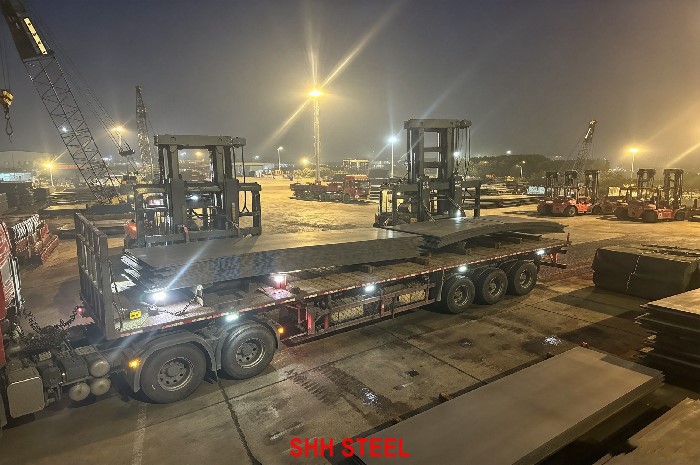
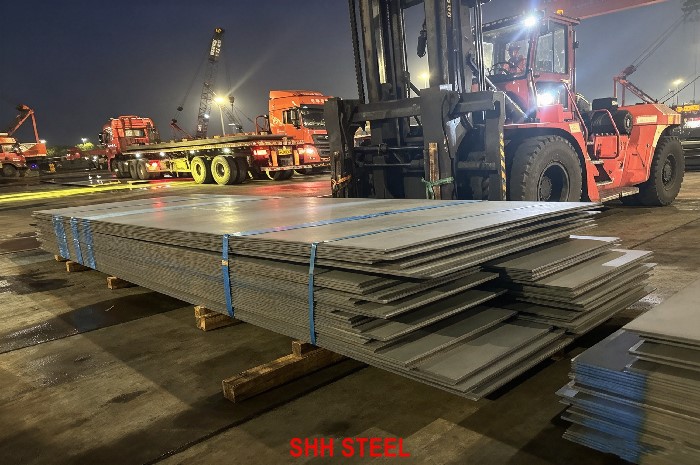
- Plates 8–150 mm thick, widths to about 3000–4000 mm and lengths to 12–18 m depending on mill. Payment by T/T or L/C at sight; third-party inspection on request. Minimum rolling quantities apply per thickness and grade, and project orders are scheduled into the mill campaign once the specification review is complete. For BS 7191 275E we cut to drawing, bevel and shot-blast in our own workshop, keep heat-number traceability on every piece and pack plate flat with timber spacers for sea freight. Quantities, weights and the document list are confirmed in writing before loading, and the operator’s inspector can witness at the mill or at our yard. Mixed-thickness orders of BS 7191 275E can be consolidated per mill campaign to reduce minimum-quantity surcharges.
Conclusion
BS 7191 275E is a BS 7191:1989 offshore structural plate: yield 275 MPa min., impact at −40 °C, delivered normalized or controlled rolled. Order it with the full designation, Z-quality, UT and certification stated before rolling.
SHH STEEL supplies BS 7191 275E with EN 10204 certificates, third-party witness, cutting and UT. Send grade, sizes, quantities and project specification for a quotation.
Quality Steel Needed? Inquire for Offers
Related Products