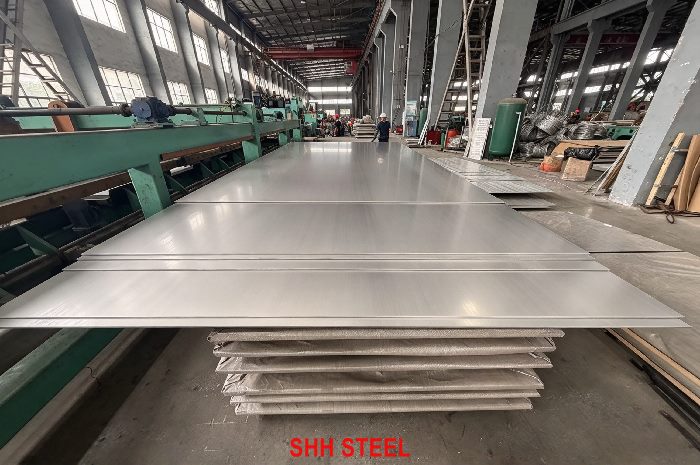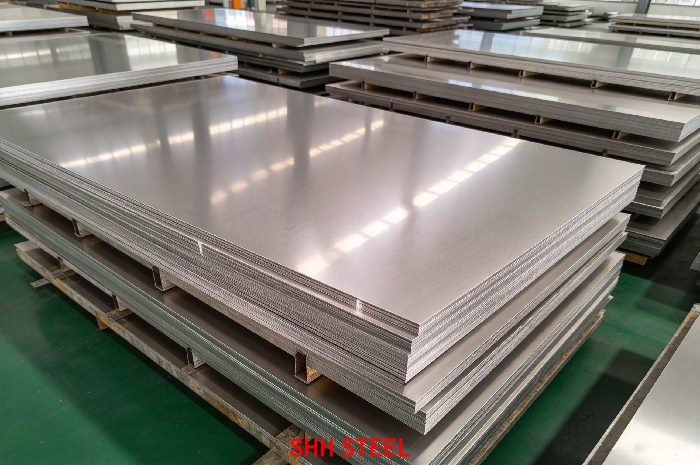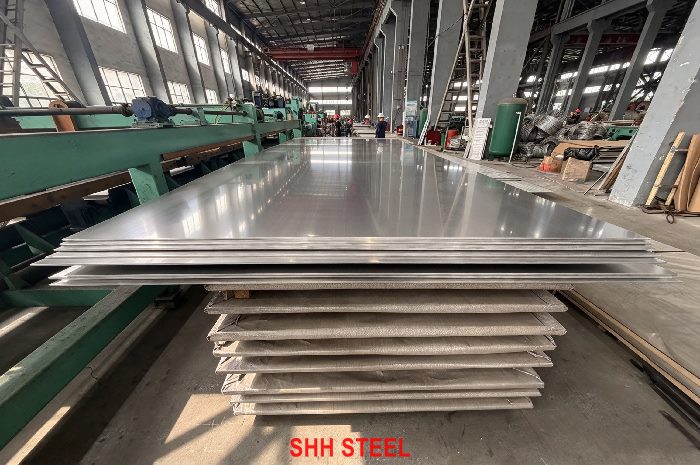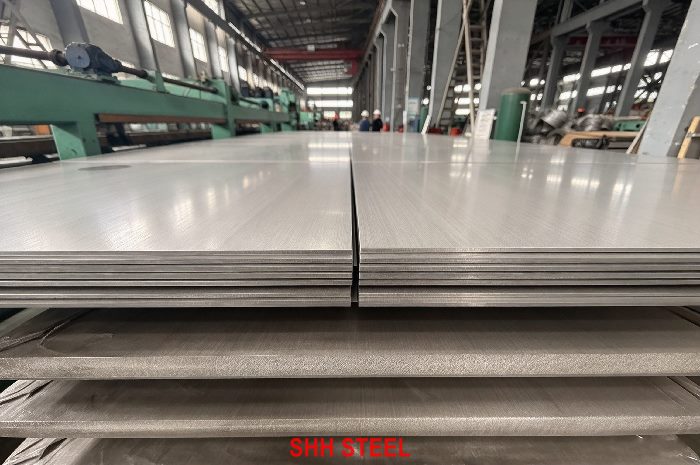
ASME SA240 UNS S17400 Stainless Steel Plate
What is ASME SA240 UNS S17400 stainless steel plate?
UNS S17400 (Type 630) is a precipitation-hardening martensitic stainless steel with 15.00–17.50 % Cr, 3.00–5.00 % Ni, 3.00–5.00 % Cu and Nb+Ta 0.15–0.45 %. It is not listed in ASME SA-240 or ASTM A240. Plate, sheet and strip in this grade are covered by ASME SA-693 / ASTM A693, which give its chemistry, heat treatments and age-hardened properties. This page keeps the requested SA240 title for search reference, but every technical value below is quoted from SA-693. Precipitation-hardening martensitic steels are supplied solution treated (Condition A). They reach their final strength through a single low-temperature ageing treatment, during which copper-rich particles precipitate in the martensite. Because ageing is done at 482–621 °C, distortion is small, so parts can be machined close to size first and aged afterwards. For buyers, the practical point is that UNS S17400 (Type 630) is ordered, tested and certified as SA-693 / A693 plate, so the purchase order, the mill test report and the plate marking must all name that specification.
This page sets out the SA-693 and A480 requirements for UNS S17400 (Type 630) plate, sheet and strip: specification data, heat and product analysis limits, mechanical properties, heat treatment, the nearest EN, JIS and GB/T grades, sizes, testing and the documents that come with each shipment. SHH STEEL supplies S17400 plate mill-direct from long-term mill partners and advises buyers on grade selection, dual certification and inspection before the order is placed.
Every value on this page is taken from the specification named in each table; where a standard leaves a point to agreement, the page says so. SHH STEEL engineers can check a drawing or tender requirement against these limits before quotation.
UNS S17400 (Type 630) specification data
UNS S17400 is not listed in the chemical-composition table of ASME SA-240 / ASTM A240, which covers chromium, chromium-nickel and chromium-manganese-nickel plate, sheet and strip but not the precipitation-hardening grades. Plate, sheet and strip of UNS S17400 (Type 630) are specified to ASME SA-693 / ASTM A693. Purchase orders, mill certificates and code calculations should therefore name SA-693 / A693, not SA-240.
Buyers who search for “SA240 S17400” usually need S17400 plate for machined high-strength parts. SHH STEEL supplies it to SA-693 / A693 with the same inspection and documentation options as its SA-240 grades. See also the ASTM A693/A693M product range.
The table summarises how UNS S17400 (Type 630) is specified and supplied:
| Item | Requirement / supply information |
|---|---|
| Product specification | ASME SA-693 / ASTM A693 (SA-693 is the ASME Section II, Part A adoption of A693); not covered by SA-240 / A240 |
| General requirements | ASTM A480/A480M (ASME SA-480): ordering, heat treatment, product analysis, tolerances, finish, testing, marking and certification |
| UNS designation | UNS S17400 |
| Type | Type 630 |
| Steel family | Precipitation-hardening martensitic stainless steel |
| Product forms (A480 definitions) | Plate: 5.00 mm and over in thickness and over 250 mm wide. Sheet: under 5.00 mm thick and 600 mm and over wide. Strip: cold-rolled, under 5.00 mm thick and under 600 mm wide |
| Typical supply range | Plate 3–100 mm and sheet supplied to SA-693 / A693, normally solution treated (Condition A). |
| Width / length (typical) | 1000–2000 mm wide (wider plate by mill campaign); 2000–6000 mm long, coil, or cut to size |
| Heat-treatment condition | Solution treated at 1050 ± 25 °C, cooled as required (SA-693 Table 3); precipitation hardening at 482 to 621 °C as ordered |
| Finish | Solution treated (Condition A), descaled; machined on request |
| Mandatory tests | Heat analysis; hardness in the solution-treated condition (SA-693 Table 4); tensile and hardness after ageing when the order specifies an aged condition (SA-693 Table 5) |
| Optional tests (when ordered) | PMI, ultrasonic testing, Charpy impact |
| Dimensional tolerances | A480 Annex A2 (inch-pound) or Annex A3 (A480M, SI), by production route and product width |
| Marking | Specification, type or UNS designation, material identification (heat) number and manufacturer’s name or mark (A480 25.1) |
| Certificates | Material test report to A480 Section 8; EN 10204 3.1 as standard; EN 10204 3.2 with third-party witness on request |
Under A480 1.2, the product specification prevails over A480 when the two conflict, and a more stringent purchase-order requirement prevails over both. The purchase order cannot waive a test or relax a requirement of either specification. State the unit system (A240 or A240M) on the order.
UNS S17400 chemical composition: heat analysis and product analysis
The heat analysis limits for UNS S17400 (Type 630) are below, in percent by mass (maximum unless a range or minimum is shown), from SA-693 Table 1:
| Grade | C | Mn | P | S | Si | Cr | Ni | Cu | Other |
|---|---|---|---|---|---|---|---|---|---|
| UNS S17400 | 0.07 | 1.00 | 0.040 | 0.030 | 1.00 | 15.00–17.50 | 3.00–5.00 | 3.00–5.00 | Nb+Ta 0.15–0.45 |
Heat analysis versus product analysis. The heat (melt or ladle) analysis is made by the steel producer on a sample taken during pouring or from in-process product (A480 6.2). It must meet the Table 1 limits exactly, and it is the analysis reported on the mill test report. A product (check) analysis is an analysis of the finished plate, which the purchaser may make to verify its identity (A480 7.1). Because of segregation and sampling, it is allowed to fall slightly outside the Table 1 limits by the tolerances of A480 Table A1.1. These tolerances do not apply to the heat analysis. The comparison below applies them to S17400:
| Element | Heat (melt/ladle) analysis, % — SA-693 Table 1 | Product analysis tolerance — A480/SA-480 Table A1.1 | Permitted product (check) analysis, % |
|---|---|---|---|
| Carbon (C) | 0.07 max | 0.01 over max | ≤ 0.08 |
| Manganese (Mn) | 1.00 max | 0.03 over max | ≤ 1.03 |
| Phosphorus (P) | 0.040 max | 0.005 over max | ≤ 0.045 |
| Sulfur (S) | 0.030 max | 0.005 over max | ≤ 0.035 |
| Silicon (Si) | 1.00 max | 0.05 over max | ≤ 1.05 |
| Chromium (Cr) | 15.00–17.50 | 0.20 under min / 0.20 over max | 14.80–17.70 |
| Nickel (Ni) | 3.00–5.00 | 0.07 under min / 0.07 over max | 2.93–5.07 |
| Copper (Cu) | 3.00–5.00 | 0.15 under min / 0.15 over max | 2.85–5.15 |
| Nb+Ta | 0.15–0.45 | combined limit: Table A1.1 gives tolerances for individual elements only; agree treatment with the supplier (Nb alone: 0.05) | by agreement |
How to read the table: the tolerance band is chosen by the specified limit, or by the maximum of a specified range, and is applied below the minimum and above the maximum. Under A480 7.2, several determinations of one element in a heat must show the same tendency; they may not fall both above and below the range. Where a requirement is a ratio, such as Ti ≥ 5×(C+N), the ratio found by product analysis must be at least 0.90× the specified minimum (A480 A1.1).
A480 6.3.1 also sets allowances for unspecified copper, molybdenum, titanium and niobium (Cu 0.75 %, Mo 0.75 %, Ti 0.10 %, Nb 0.10 %). These prevent one grade being certified when it actually meets another grade’s composition. Handheld XRF PMI confirms alloy identity but cannot measure carbon or nitrogen. When an L, H or nitrogen-controlled grade must be proven, a laboratory or spark-OES product analysis is needed.
What the main elements do in S17400:
- Carbon ≤ 0.07 %: a standard carbon level. Keep holding time in the sensitising range short when corrosion resistance after welding matters.
- Chromium 15.00–17.50 %: forms the passive film that makes the steel stainless; higher chromium improves resistance to corrosion and oxidation.
- Nickel 3.00–5.00 %: balances the microstructure and improves toughness.
- Copper 3.00–5.00 %: provides the copper-rich precipitates that harden the steel during ageing.
- Niobium: contributes to the precipitation-hardening response and ties up carbon.
UNS S17400 mechanical properties after ageing (SA-693)
In the solution-treated condition (solution treatment 1050 ± 25 °C, cool as required), SA-693 Table 4 limits UNS S17400 (Type 630) plate to 363 HBW / C38 maximum and sets no minimum strength. After precipitation hardening, SA-693 Table 5 requires:
| Ageing condition (SA-693) | Tensile, min | Yield 0.2 %, min | Elongation, min (4.76–15.88 mm) | Reduction of area, min | Rockwell min / max |
|---|---|---|---|---|---|
| H900 — 482 °C, 1 h | 1310 MPa | 1170 MPa | 8 % | 25 % | C40 / C48 |
| H925 — 496 °C, 4 h | 1170 MPa | 1070 MPa | 8 % | 25 % | C38 / C47 |
| H1025 — 552 °C, 4 h | 1070 MPa | 1000 MPa | 8 % | 30 % | C33 / C42 |
| H1075 — 579 °C, 4 h | 1000 MPa | 860 MPa | 9 % | 30 % | C29 / C38 |
| H1100 — 593 °C, 4 h | 965 MPa | 790 MPa | 10 % | 30 % | C29 / C38 |
| H1150 — 621 °C, 4 h | 930 MPa | 725 MPa | 10 % | 35 % | C26 / C36 |
Elongation and reduction of area are shown for 4.76–15.88 mm plate; thinner and thicker bands have different minimums in SA-693 Table 5, and Charpy minimums apply to H1025 and higher ageing conditions.
Tension specimens are taken from finished material and tested to ASTM A370 (A480 17.1). For cut-length plate, A480 16.1.2 requires one tension test and one or more hardness tests for each 100 pieces or fewer of the same heat and nominal thickness heat treated together; coil product is tested from each coil. Retests follow A370 and A480 Section 20.
Heat treatment of UNS S17400 plate
Heat treatment for UNS S17400 (Type 630): solution treated at 1050 ± 25 °C, cooled as required (SA-693 Table 3); precipitation hardening at 482 to 621 °C as ordered.
After machining, the user ages the parts at the temperature for the required condition: 482 °C for 1 h (H900), or 4 h at 496, 552, 579, 593 or 621 °C (H925 to H1150), all air cooled (SA-693 Table 3). SA-693 also lists a double treatment of 760 °C for 2 h plus 621 °C for 4 h.
Key characteristics of UNS S17400 (Type 630)
UNS S17400 (Type 630) is a precipitation-hardening Cr-Ni-Cu grade. The points that matter most when specifying it:
- Not listed in SA-240 / A240; the governing plate specification is SA-693 / A693, Type 630.
- Solution treatment 1050 ± 25 °C, then ageing from 482 °C (H900) up to 621 °C (H1150), per SA-693 Table 3.
- After H900 ageing SA-693 requires 1310 MPa tensile and 1170 MPa yield minimum.
- Solution-treated plate is limited to 363 HBW (C38) maximum.
Corrosion resistance is generally comparable to that of Type 304 in many atmospheric and mild environments. Strength and toughness are set by the ageing condition. H900 gives the highest strength, while higher ageing temperatures (H1025 to H1150) are usually chosen where toughness and resistance to stress-corrosion cracking matter more than peak strength.
UNS S17400 equivalent grades: ASTM/ASME, EN, JIS and GB/T compared
Equivalent grades are cross-references, not interchangeable specifications. Each standard sets its own element ranges, minimum properties, test methods and product-form rules, so a plate certified to one standard is only certified to another when the same heat has been tested against both and the certificate says so. SHH STEEL checks every dual- or multi-standard request against each standard line by line before confirming the order.
| System | Standard | Designation | Closeness | What to check |
|---|---|---|---|---|
| ASME / ASTM | SA-693 / A693 with A480 / SA-480 | UNS S17400 (Type 630) | reference grade | Ageing condition and the specification edition |
| EN | EN 10088-2 / EN 10028-7 | 1.4542 X5CrNiCuNb16-4 | nearest equivalent; not identical | Steel number and name; proof strengths Rp0.2/Rp1.0 depend on product form (C, H or P) and thickness; elongation is measured on a different gauge length |
| JIS | JIS G4304 (hot-rolled) / G4305 (cold-rolled) | SUS630 | commonly cross-referenced; not identical | SUS designation; chemistry ranges set independently; check carbon, nitrogen and nickel against the A240 row |
| GB/T | GB/T 4237 (hot-rolled) / GB/T 3280 (cold-rolled) | 05Cr17Ni4Cu4Nb (S51740) | commonly cross-referenced; not identical | GB/T 20878 name and numeric code; the numeric code is not a UNS number even when it looks similar |
European standards. EN 10088-2 covers corrosion-resisting stainless steel sheet, plate and strip for general purposes. EN 10028-7 covers flat stainless products for pressure purposes and is the flat-product standard normally used for pressure equipment in Europe. Both use a steel number (1.4xxx) and a steel name built from the composition, and many steel numbers appear in both, but confirm that the steel number is listed in the edition you need. EN values for 0.2 % and 1 % proof strength depend on product form (cold-rolled strip C, hot-rolled strip H, hot-rolled plate P) and thickness. EN elongation is measured on proportional or 80 mm gauge lengths, so it cannot be compared directly with the A240 elongation in 50 mm.
Japanese standards. JIS G4304 covers hot-rolled and JIS G4305 cold-rolled stainless plate, sheet and strip, both with SUS designations. JIS chemistry ranges are close to the AISI-type grades but are set independently, so carbon, nitrogen and nickel limits should be checked against the A240 row whenever a heat must meet both.
Chinese standards. GB/T 4237 covers hot-rolled and GB/T 3280 cold-rolled stainless plate, sheet and strip, using GB/T 20878 grade names such as 06Cr19Ni10 and numeric codes such as S30408. The numeric code is a Chinese designation and is not a UNS number, even where the digits look similar. Always state the standard next to the code on purchase orders and certificates.
Related ASTM and ASME specifications. A240 and SA-240 share the same technical content; ASME adopts a specific A240 edition for each Code edition, so Code work should name SA-240. General requirements come from A480 / SA-480. Precipitation-hardening plate falls under A693 / SA-693. Other product forms use their own specifications (pipe, forgings, bar), so check that the UNS number is listed in each one before ordering a matching set.
In practice, SHH STEEL offers dual-certified plate (for example A240 / EN 10088-2) when a mill heat is designed to meet both standards. When it cannot be, we recommend ordering to the single standard the design code requires and treating the others as reference only.
UNS S17400 (Type 630) compared with related grades
Grades buyers most often compare with UNS S17400 (Type 630):
- ASME SA240 UNS S15500 stainless steel plate — UNS S15500 (Type XM-12): C ≤ 0.07 %, Cr 14.00–15.50 %, Ni 3.50–5.50 %, Nb+Ta 0.15–0.45
- ASME SA240 UNS S41500 stainless steel plate — UNS S41500: C ≤ 0.05 %, Cr 11.5–14.0 %, Ni 3.5–5.5 %, Mo 0.50–1.00 %; minimum yield 620 MPa
The site also has pages organised by type designation for the same or closely related material: ASTM A693 Type 630 stainless steel plate. These cover the same grade under its governing specification.
Applications of SA240 UNS S17400 plate
Typical uses of UNS S17400 (Type 630) plate, sheet and strip:
- Shafts, valve parts and pump components machined from plate
- Aerospace and defence parts
- Offshore and petrochemical high-strength parts
- Moulds, tooling and wear parts
The final choice should always be checked against the service medium, temperature and design code; SHH STEEL can share mill corrosion data and reference projects on request.
These grades are chosen for machined high-strength parts such as shafts, valve and pump components, aerospace fittings and tooling. The ageing condition is selected for the required balance of strength, toughness and corrosion resistance. Plate is ordered to SA-693 / A693, not SA-240.
UNS S17400 (Type 630) sizes, finishes and supply forms
Size ranges below are typical mill capabilities for UNS S17400 (Type 630), not limits set by the specification; actual availability depends on the mill campaign and is confirmed at quotation.
| Item | Typical supply range |
|---|---|
| Product forms | Plate 3–100 mm and sheet supplied to SA-693 / A693, normally solution treated (Condition A). |
| Width | 1000, 1219, 1250, 1500, 1800, 2000 mm; wider plate by mill |
| Length | 2000, 2438, 3000, 6000 mm, coil, or cut to size |
| Surface finish | Solution treated (Condition A), descaled or machined |
| Tolerances | ASTM A480/A480M as referenced by SA-693 / A693, or tighter by agreement |
For weight estimates, plate weight (kg) ≈ thickness (mm) × width (m) × length (m) × density, with density about 7.8 g/cm³ for this grade family. The mill certificate weight governs invoicing.
Plate finishes under A480 Section 13 range from heat treated with scale left on, which is used for heat-resisting service because scale impairs corrosion resistance, to blast-cleaned or pickled, which is essentially a No. 1 finish and the usual choice for corrosion service. Sheet finishes under Section 11 include No. 1, 2D (dull, good for deep drawing), 2B (smooth, moderately reflective), bright annealed, and polished No. 3, 4, 6, 7 and 8. Thickness should be ordered as a decimal or fractional dimension, not a gauge number (A480 4.1.7).
Forming, welding and heat treatment of UNS S17400
Machine in the solution-treated condition (Condition A), then age at the temperature that gives the required strength and toughness.
Ageing causes a small, predictable dimensional change; allow for it on finished parts.
Welded parts are normally re-solution-treated and aged; qualify the procedure for the condition required.
Cutting is normally by plasma, waterjet or abrasive saw; avoid oxy-fuel cutting on stainless steel. Keep stainless plate away from carbon-steel dust and tools during handling and fabrication, because embedded iron causes rust staining. Pickling and passivation after fabrication restore the passive surface.
Testing, inspection and certificates for S17400 plate
Each heat is tested to SA-693 / A693 and ASTM A480/A480M: heat analysis, tension tests and hardness, plus the surface and dimensional checks for the product form.
Mill test certificates to EN 10204 3.1 are standard. EN 10204 3.2 certificates with third-party witness (TUV, ABS, CCS, BV, DNV, LR or an inspector named by the buyer) can be arranged, together with optional tests such as PMI, ultrasonic testing, hardness after ageing and the Charpy tests that SA-693 Table 5 sets for H1025 and higher ageing conditions.
Plate is marked in two places near the ends, or line-marked along one edge, with the specification, type or UNS number, heat number and manufacturer; material under 6.4 mm is not die-stamped (A480 25.1). The supplier must pass on a copy of the original mill test report (A480 8.4), and test-based rejections must be reported within 60 working days of receipt (A480 23.1).
Common buyer concerns and SHH STEEL solutions
The concerns below come up most often when buyers source UNS S17400 (Type 630) plate from China, together with how SHH STEEL deals with each one.
| Buyer Concern | SHH STEEL Solution |
|---|---|
| Fake material or certificates | Each heat can be checked by TUV, ABS, CCS or another class society as third-party witness, and partner laboratories run PMI, chemical and mechanical tests against the order. Third-party witness and EN 10204 3.2 certificates available. |
| Unsafe deposit | TT and LC are both accepted, including TT + LC combinations. For large projects the buyer can sign directly with the mill, and SHH STEEL handles coordination and documents for a small service fee. |
| Small orders below mill MOQ | Small quantities are consolidated with other customers’ orders of the same grade and thickness, so even lots below the mill MOQ are rolled as genuine mill production with full traceability. |
| Slow delivery | Dedicated staff chase the mill delivery schedule and report progress at melting, rolling, heat treatment, testing and packing, so delays are seen early. |
| Processing needs | Our own workshop provides cutting, bevelling, machining to drawings and surface pretreatment as value-added services, so plates arrive ready for fabrication. |
How to order UNS S17400 plate from SHH STEEL
A480 4.1 makes the purchaser responsible for stating every requirement. A complete enquiry for S17400 plate should include:
- Quantity (weight and number of pieces).
- Specification and edition: ASME SA-693 / ASTM A693; add “M” for SI units.
- Type or UNS designation: UNS S17400 (Type 630).
- Condition (hot-rolled or cold-rolled, annealed or heat treated) and finish; for polished finishes, one or both sides.
- Form (plate, sheet or strip) and dimensions (thickness, width and length, in the same units).
- Supplementary requirements and special tests (Charpy, intergranular corrosion, phase tests, UT, PMI).
- Inspection document (EN 10204 3.1 or 3.2), third-party inspector, marking and packing requirements.
SHH STEEL works as a sourcing and supply partner with long-term mill relationships. We help select the grade, check dual-certification options, consolidate small lots, follow production at the mill and process plates in our own workshop before shipment. Payment by TT or LC is accepted.
For S17400, the SHH STEEL team can also share recent mill test reports for reference, confirm which thicknesses are in the current rolling campaign and propose a cutting plan that reduces scrap. Send your enquiry with drawings or a cutting list and we will reply with a quotation, lead time and inspection plan.
FAQ
-
Is S17400 covered by ASME SA240?
- No. UNS S17400 is not in the SA-240 / A240 tables; plate, sheet and strip are ordered to ASME SA-693 or ASTM A693 Type 630.
-
What does H1150 mean for Type 630 plate?
- H1150 means ageing at 1150 °F (621 °C) for 4 hours with air cooling. SA-693 then requires 930 MPa tensile and 725 MPa yield minimum, with the highest Charpy minimum of the single-step ageing conditions (34 J for 4.76–15.88 mm plate).
-
Is Type 630 supplied hardened?
- It is usually supplied solution treated (Condition A, max 363 HBW). The user ages it after machining to the condition the design requires.
-
Where can I buy UNS S17400 plate in small quantities?
- SHH STEEL consolidates small orders of S17400 with other customers’ orders of the same grade, so lots below the mill MOQ can still be placed against mill production. Cut-to-size pieces can be supplied from our workshop.
-
What certificates come with S17400 stainless steel plate?
- Plates are supplied with EN 10204 3.1 mill test certificates to SA-693 / A693. Third-party witness and EN 10204 3.2 certificates available, issued with TUV, ABS, CCS or another nominated inspector.
-
What is the lead time for S17400 plate from China?
- Lead time depends on the mill rolling schedule, thickness and the tests ordered, and is confirmed with the quotation. Dedicated SHH STEEL staff follow the mill schedule and report progress until shipment.
Conclusion
ASME SA240 UNS S17400 Stainless Steel Plate is ordered as UNS S17400 (Type 630), a precipitation-hardening Cr-Ni-Cu grade governed by ASME SA-693 / ASTM A693 rather than SA-240. Specify the standard and edition, the UNS number, the inspection document and any supplementary tests on the order so the certificate can be checked line by line. SHH STEEL supports the order from grade check to delivery, and you can contact SHH STEEL for a quotation, mill-direct supply and processing to your drawings.
Quality Steel Needed? Inquire for Offers
Related Products