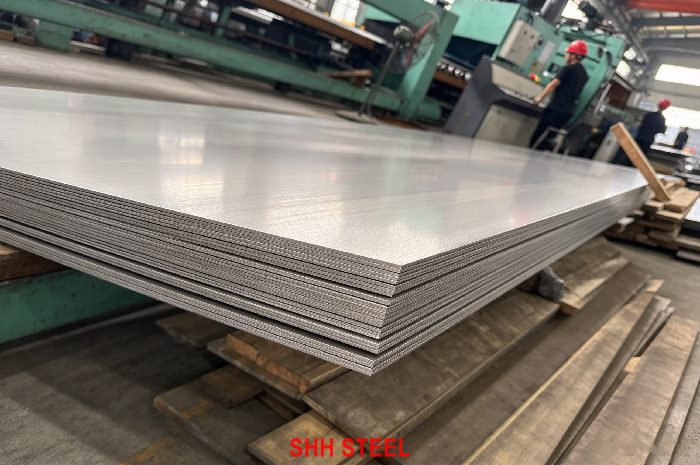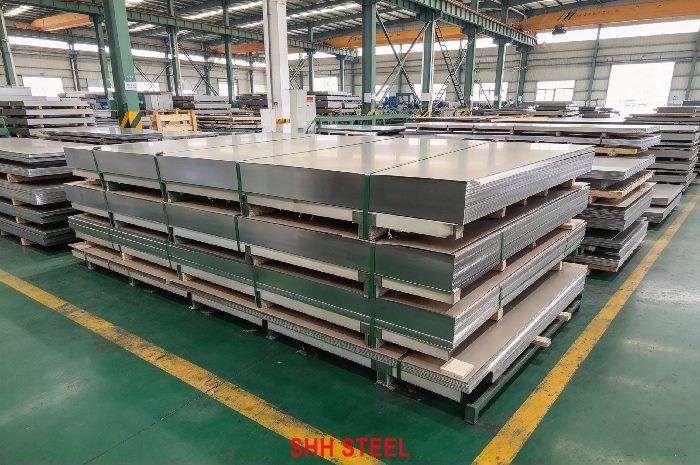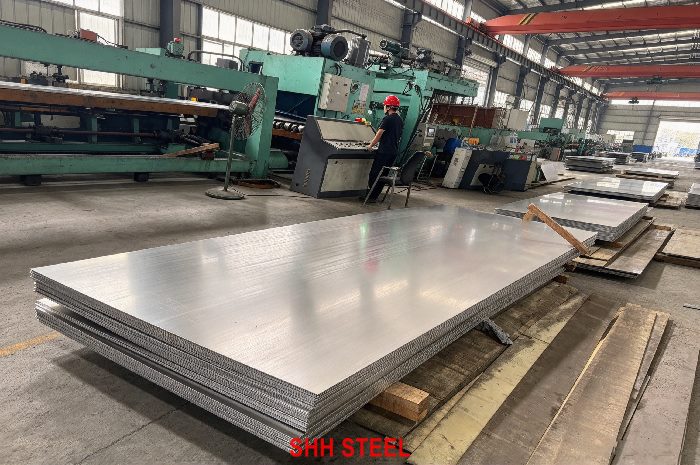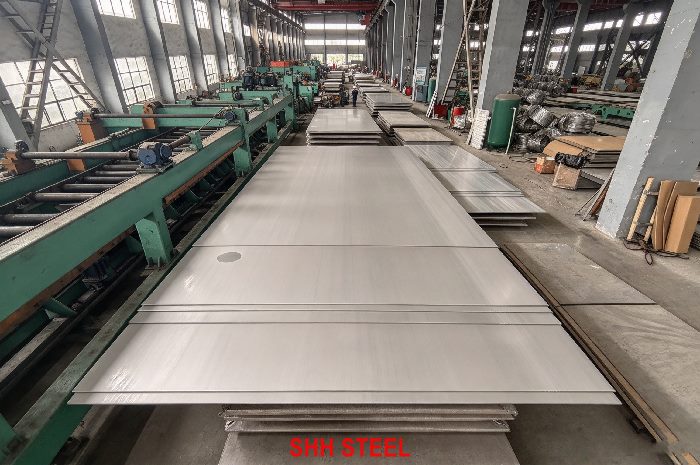
EN 10095 X9CrNiSiNCe21-11-2 1.4835 Heat Resistant Steel Plate
What is EN 10095 X9CrNiSiNCe21-11-2 1.4835 Heat Resistant Steel Plate?
Equivalent grades: 1.4835 X9CrNiSiNCe21-11-2 ≈ UNS S30815 ≈ GB/T 08Cr21Ni11Si2CeN (S30859).
1.4835 X9CrNiSiNCe21-11-2 is a heat-resistant grade. 1.4835 is a 21Cr-11Ni heat-resisting steel micro-alloyed with nitrogen and cerium. The rare-earth addition forms a thin, adherent oxide that resists scaling up to about 1150 °C, and nitrogen gives high creep strength, so it often replaces 310S at lower nickel cost.
EN 10095 is the European standard for heat-resisting steels and nickel alloys. Unlike EN 10088-2, which is aimed at corrosion resistance, EN 10095 covers grades chosen for oxidation resistance and strength above about 550 °C, and gives informative scaling temperatures and creep data. Plate is supplied solution annealed and descaled.
This page sets out the EN 10095 requirements for 1.4835 X9CrNiSiNCe21-11-2 plate: specification summary, chemistry, mechanical properties, high-temperature behaviour, heat treatment, finishes and tolerances, current stock, equivalents, fabrication and testing. SHH STEEL supplies it mill-direct from China with EN 10204 3.1 certificates, optional third-party inspection and in-house cutting.
1.4835 X9CrNiSiNCe21-11-2 plate: specification summary
| Item | 1.4835 X9CrNiSiNCe21-11-2 data |
|---|---|
| Standard | EN 10095:1999, heat resisting steels and nickel alloys |
| Product forms | hot-rolled plate, hot- and cold-rolled strip and sheet, bars and sections |
| Delivery condition | solution annealed (austenitic) or annealed (ferritic), descaled |
| Typical thickness | 0.5–6 mm cold rolled; 3–80 mm hot-rolled plate |
| Dimensions and tolerances | EN 10029, EN 10051, EN ISO 9445 |
| Required tests | cast analysis, tensile test at room temperature |
| Inspection documents | EN 10204 3.1 or 3.2 |
| Grade family | heat-resistant |
Size range. Plate is produced on Steckel or reversing mills from about 5 mm up to 80–100 mm depending on grade, with widths of 1500–2500 mm and lengths up to 12 m; thinner plate of 3–12 mm is often cut from hot-rolled coil. Very heavy or wide plates, and plates with tight flatness, should be confirmed before ordering. 1.4835 X9CrNiSiNCe21-11-2 is a specialty grade made by a limited number of mills in campaign rolling. Stock covers the common sizes listed below; for project quantities or unusual sizes, plan for a mill campaign and reserve the heat early.
Chemical composition of 1.4835 X9CrNiSiNCe21-11-2 (EN 10095)
| Element | wt % |
|---|---|
| C | 0.05–0.12 |
| Si | 1.40–2.50 |
| Mn | 1.00 max |
| P | 0.045 max |
| S | 0.015 max |
| Cr | 20.0–22.0 |
| Ni | 10.0–12.0 |
| N | 0.12–0.20 |
| Ce | 0.03–0.08 |
Single values are maximums unless marked min. Ranges are heat (cast) analysis limits.
For heat-resistant grades the key elements are chromium (oxide scale), nickel (austenite stability, carburisation resistance) and silicon, aluminium or rare earths where present (scale adhesion). Sulfur and phosphorus are kept low to protect hot ductility and weldability.
Mechanical properties of 1.4835 X9CrNiSiNCe21-11-2 plate
| Product form / thickness | Rp0.2 min, MPa | Rm, MPa | A min, % (flat products, a > 3 mm) |
|---|---|---|---|
| flat products ≤ 75 mm, +AT | 310 | 650–850 | 40 |
The minimum proof strength is 310 MPa. For high-temperature design, room-temperature values are only an acceptance check; use creep and stress-rupture data from the standard’s informative annexes or the ASME allowable stresses where Code rules apply. Tension tests are taken in the direction stated in the standard; where a hardness limit is given, it is a maximum that confirms correct annealing.
High-temperature behaviour of 1.4835 X9CrNiSiNCe21-11-2
This is a heat-resistant grade: it is selected for oxidation resistance, strength and structural stability at high temperature rather than for wet corrosion. Chromium forms the protective oxide, nickel stabilises the austenite against thermal cycling and carburisation, and silicon, rare earths or nitrogen, where present, improve scale adhesion or creep strength. The maximum useful temperature in air depends on atmosphere, thermal cycling and load, so published scaling temperatures are a guide, not a design value.
Sulfur-bearing gases attack high-nickel alloys, while carburising or nitriding atmospheres favour higher nickel; vanadium-bearing ash and molten salts need special evaluation. Long exposure in the 600–900 °C range can form sigma phase in high-chromium grades and reduce room-temperature toughness, which matters for parts that are cleaned or repaired cold. Creep-rupture values are given in the standard’s informative annexes or by the mill and should be used for design instead of room-temperature strength.
How 1.4835 X9CrNiSiNCe21-11-2 compares with related grades
| Grade | Cr | Ni | Mo | N | PREN (min) | YS / Rp0.2 min, MPa |
|---|---|---|---|---|---|---|
| 1.4835 X9CrNiSiNCe21-11-2 | 20.0–22.0 | 10.0–12.0 | — | 0.12–0.20 | — | 310 |
| 1.4845 X8CrNi25-21 | 24.0–26.0 | 19.0–22.0 | — | 0.11 max | — | 210 |
| 1.4828 X15CrNiSi20-12 | 19.0–21.0 | 11.0–13.0 | — | 0.11 max | — | 230 |
| 1.4833 X12CrNi23-13 | 22.0–24.0 | 12.0–14.0 | — | 0.11 max | — | 210 |
| 1.4841 X15CrNiSi25-21 | 24.0–26.0 | 19.0–22.0 | — | 0.11 max | — | 230 |
Choose 1.4835 X9CrNiSiNCe21-11-2 when oxidation resistance and strength at temperature drive the selection. For wet corrosion at room temperature, a low-carbon corrosion-resistant grade is usually a better choice, and in sulfur-rich gases a lower-nickel grade may outperform a high-nickel one.
The table uses specification limits, not typical mill values, so it shows the guaranteed position of each grade. Final selection should also consider product availability in the thickness you need, welding consumables, and the inspection requirements of your project.
Heat treatment and delivery condition of 1.4835 X9CrNiSiNCe21-11-2
Heat treatment: 1020–1120 °C, water or air.
Heat-resistant plate is supplied solution annealed. For high-temperature service, a coarser grain size improves creep strength, while a finer grain improves fatigue and room-temperature ductility; where it matters, state the grain-size requirement on the order. Stress relief is not normally needed.
Surface finishes for 1.4835 X9CrNiSiNCe21-11-2 plate
Heat-resistant plate is supplied hot rolled, solution annealed and pickled (1D), or mechanically descaled (1E). Thin gauges are available cold rolled in 2D or 2B. Because the steel is used in furnaces, surface finish matters less than flatness and edge condition; ask for levelled plate when parts will be laser cut or welded into large panels.
Dimensions, tolerances and flatness
Dimensional tolerances follow EN 10029 for plate, EN 10051 for hot-rolled strip and sheet, and EN ISO 9445 for cold-rolled material. Large furnace panels are sensitive to residual stress and flatness; specify flatness class S (special) on EN 10029 plate where needed.
Design data in EN 10095. The room-temperature properties in the standard are acceptance values. For design, EN 10095 gives informative data: the scaling temperature in air, typical elevated-temperature strength and creep-rupture values. These are useful for selecting a grade, but the standard does not guarantee them, so for load-bearing furnace parts the designer should apply safety factors and, where available, use mill test data at temperature. For pressure equipment, EN 10028-7 lists some creep-resistant austenitic grades with guaranteed elevated-temperature properties.
1.4835 X9CrNiSiNCe21-11-2 plate stock in China
| Thickness (mm) | Width (mm) | Length (mm) | Finish | Approx. quantity | Location |
|---|---|---|---|---|---|
| 6 | 1500 / 2000 | 6000 | 1D | 100+ t | China |
| 8 | 1500 / 2000 | 6000 | 1D | 100+ t | China |
| 10 | 2000 | 6000 | 1D | 100+ t | China |
| 12 | 2000 | 6000 | 1D | 100+ t | China |
| 16 | 2000 / 2500 | 6000 | 1D | 100+ t | China |
| 20 | 2000 / 2500 | 6000 / 8000 | 1D | 100+ t | China |
| 30 | 2000 / 2500 | 6000 | 1D | 100+ t | China |
Quantities are approximate and stock changes daily. Send your size list for current availability; other thicknesses, widths and cut sizes can be supplied from mill production.
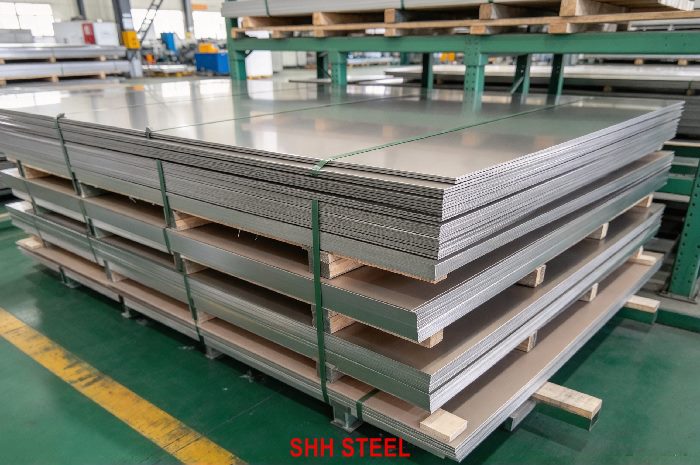
Packing and logistics. Plate is bundled on steel or wooden skids with steel bands and edge protection, typically 3–8 t per bundle, and marked with heat and plate numbers. Cut pieces are crated. Heavy and wide plate ships in open-top or flat-rack containers or by break-bulk; we send loading photos with the shipping documents.
1.4835 X9CrNiSiNCe21-11-2 equivalents in other standards
| Standard | Designation | Comment |
|---|---|---|
| ASTM / UNS | UNS S30815 | same alloy family and limits closely matched; compare each limit on the certificate |
| GB/T | 08Cr21Ni11Si2CeN (S30859) | same alloy family and limits closely matched; compare each limit on the certificate |
Equivalents are close, not identical. When a project names one standard, order to that standard or ask for multiple certification and check every limit on the certificate.
Related grades by alloy family
Heat-resistant
Heat-resistant grades ranked by chromium, nickel and silicon: A240 S30908, A240 S31008, A240 S30909, A240 S31009, 1.4948 (EN 10028-7), 1.4950 (EN 10028-7), 1.4951 (EN 10028-7).
Same standard
Other grades in this standard: 1.4845 (EN 10095), 1.4828 (EN 10095), 1.4833 (EN 10095), 1.4841 (EN 10095), 1.4876 (EN 10095), 1.4878 (EN 10095).
Applications, forming and welding of 1.4835 X9CrNiSiNCe21-11-2
Typical uses: furnace muffles and conveyor parts, kiln linings, cyclone parts, recuperators, burners and heat-treatment fixtures.
Heat-resistant plate is usually cut by plasma or waterjet, formed hot or cold, and welded with matching heat-resistant consumables. Cut by plasma, laser or waterjet and remove heat tint by pickling or grinding. For welding use a matching heat-resistant filler such as ER309, ER310 or ERNiCr-3 according to the service temperature. Keep the weld area clean and free of carbon-steel contamination, and pickle and passivate after welding where corrosion resistance matters.
Fabrication at temperature. Design furnace parts to allow for thermal expansion, which is about 1.5 times that of carbon steel, and avoid sharp corners where scale can spall. Welds should be full penetration where they carry load at temperature. For high-silicon grades, use low heat input to limit hot cracking. After long service, high-chromium plate may be embrittled by sigma phase, so repair welding of old parts needs care and sometimes a solution anneal first.
Certificates, testing and receiving inspection
Every delivery carries a mill certificate to EN 10095 with heat analysis, tensile results and hardness, and the grade and standard as ordered. Supplementary tests we can arrange: PMI, grain-size measurement (ASTM E112) where the grade requires it, elevated-temperature tensile tests by agreement, and ultrasonic testing of heavy plate. Third-party witness by SGS, BV, TÜV, DNV, ABS or LR is available with EN 10204 3.2 certificates.
On receipt, check marking and heat number against the certificate, measure thickness at several points and confirm the finish and edge condition before cutting.
Common mistakes when specifying 1.4835 X9CrNiSiNCe21-11-2
- Selecting by room-temperature strength instead of creep data.
- Substituting a low-carbon corrosion grade (for example 310S for 310) without checking creep strength.
- Ignoring the atmosphere: sulfur, carburising gas and vanadium ash change the ranking of grades.
Each of these can be avoided by writing the requirement into the purchase order and checking it on the certificate before the material is cut.
Sourcing 1.4835 X9CrNiSiNCe21-11-2: buyer concerns and SHH STEEL solutions
| Concern | How SHH STEEL handles it |
|---|---|
| Wrong grade substitution (for example 304 for 309/310) | PMI of every plate before dispatch |
| Distortion of large furnace panels | levelled plate and cut-to-size blanks with low-stress cutting |
| Small quantities across many sizes | mixed thicknesses and grades combined in one shipment |
| Cutting and edge preparation | in-house shearing, plasma, laser and waterjet cutting, bevelling |
| Delivery delays | weekly production and shipping updates with photos |
How to order 1.4835 X9CrNiSiNCe21-11-2 plate
State the standard and edition (EN 10095), the grade (1.4835 X9CrNiSiNCe21-11-2), thickness, width and length or coil, finish, quantity, tolerance class, any added chemistry limits, the supplementary tests and acceptance values from your specification, the certificate type and inspection agency, and packing. Send the list to SHH STEEL and we will reply with price, available stock and lead time.
FAQ
-
Why order 1.4835 to EN 10095 instead of EN 10088-2?
- EN 10095 is the standard for heat-resisting steels. It defines the chemistry and properties used for high-temperature design and gives informative scaling and creep data; 1.4835 is a heat-resisting grade and is ordered to EN 10095.
-
Is 1.4835 X9CrNiSiNCe21-11-2 equivalent to UNS S30815?
- They are the same alloy designation in different standards. Limits are closely matched, but always order to the standard named in your specification or ask for multiple certification.
-
What is the maximum service temperature of 1.4835 X9CrNiSiNCe21-11-2?
- It depends on the atmosphere, thermal cycling and load. Published scaling temperatures are a guide for oxidation in air only; for load-bearing parts use creep-rupture data.
-
Can I order small quantities or cut sizes?
- Yes. We combine mixed thicknesses and grades into one shipment and cut plate and sheet to size in our workshop.
-
Which certificates and tests can you provide?
- Every order ships with a mill certificate (EN 10204 3.1 type) showing heat analysis and mechanical tests. Supplementary tests and 3.2 certificates with SGS, BV, TÜV or another agency are available by agreement.
Conclusion
1.4835 X9CrNiSiNCe21-11-2 plate should be ordered with the points the standard leaves open written into the contract: finish, tolerance class, any extra chemistry limits and the supplementary tests your application needs. With those fixed, stock material from China is a fast and reliable route.
Quality Steel Needed? Inquire for Offers
Related Products