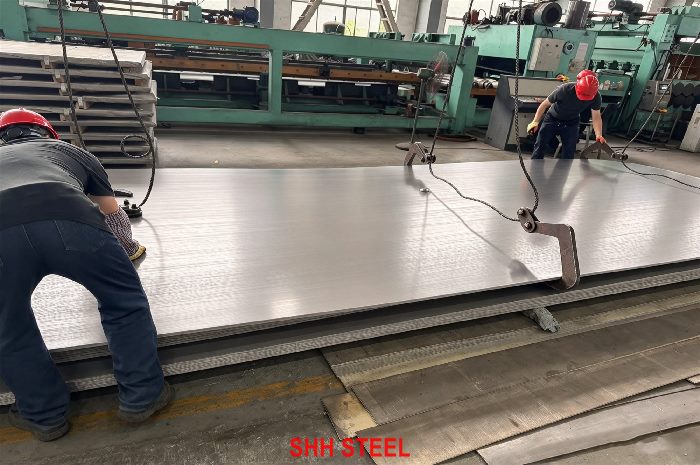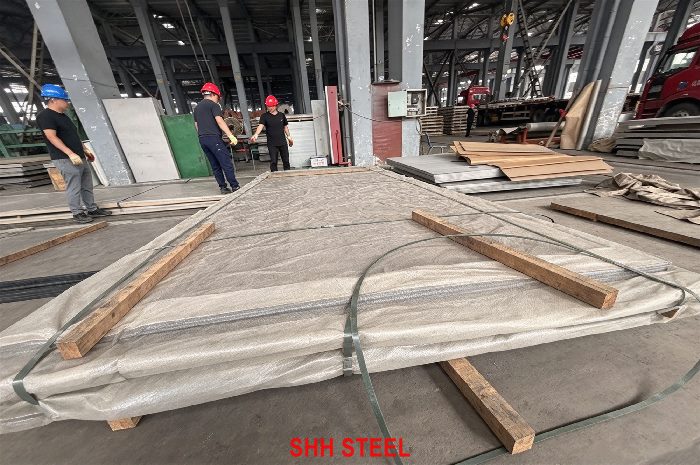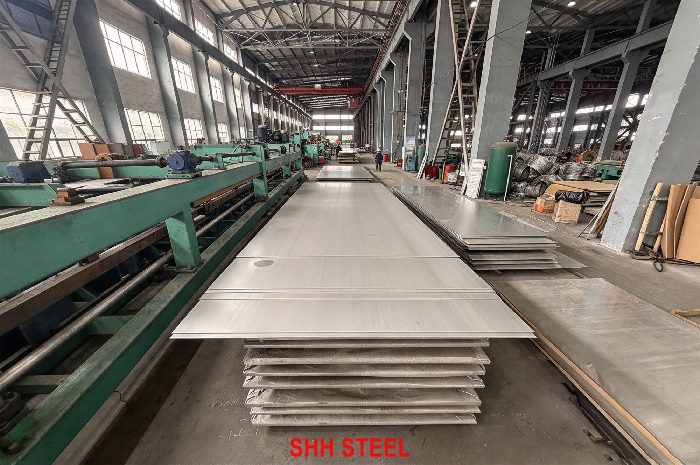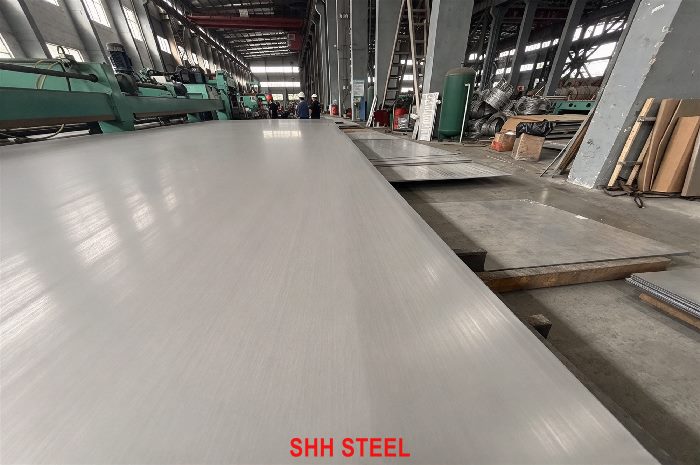

GB/T 4237 015Cr21Ni26Mo5Cu2 S39042 Stainless Steel Plate
GB/T 4237 015Cr21Ni26Mo5Cu2 under the S39042 code: what buyers need to know
This page is written for buyers who meet 015Cr21Ni26Mo5Cu2 on a drawing, tender or mill certificate under the numeric code S39042 and need to know how that code relates to the plate standard. The steel itself is the familiar 904L: a fully austenitic, low-carbon chromium-nickel-molybdenum-copper grade, internationally UNS N08904 and EN 1.4539. As a hot-rolled product it is covered by GB/T 4237-2015, the Chinese standard for hot-rolled stainless steel plate, sheet and strip, and we supply it as 015Cr21Ni26Mo5Cu2 stainless steel plate with heat and product analysis on the certificate.
The short version of the code question: GB/T 4237-2015 itself lists 015Cr21Ni26Mo5Cu2 with the unified numeric code S31782. The code S39042 comes from GB/T 20878, the Chinese standard that catalogues stainless steel designations and codes; its 2024 edition maps the old code S31782 to the new code S39042 for this same chemistry. So 015Cr21Ni26Mo5Cu2 S31782 and 015Cr21Ni26Mo5Cu2 S39042 describe one grade, written in two numbering schemes. Some customer documents, datasheets and project files in circulation already carry S39042 with this grade, which is why we keep a separate page for it. In practice the code on a document tells you which numbering table its author used, not a different steel.
SHH STEEL produces and exports stainless plate from China, acts as a sales agent for major Chinese stainless mills and runs its own processing warehouse for cutting and finishing. For the grade page written around the S31782 code of the plate standard, with its own data tables, see GB/T 4237 015Cr21Ni26Mo5Cu2 S31782. This page focuses on the S39042 designation, document reconciliation, certification and the practical choices around 904L hot rolled plate.
What GB/T 4237-2015 covers for this grade
| Item | Requirement / practice |
|---|---|
| Standard | GB/T 4237-2015 Hot rolled stainless steel plate, sheet and strip |
| Grade name | 015Cr21Ni26Mo5Cu2 |
| Numeric code in GB/T 4237-2015 | S31782 |
| Numeric code in GB/T 20878-2024 | S39042 (same grade, new code) |
| Structure | Austenitic (high-alloy / super austenitic family) |
| Product form | Hot-rolled plate (also sheet and strip under the same standard) |
| Delivery condition | Solution treated and pickled; surface No.1 / 1D |
| Chemistry | Heat analysis per the austenitic chemistry table of GB/T 4237-2015; product analysis per GB/T 222 |
| Mechanical tests | Rp0.2, Rm, elongation, hardness per the austenitic property table |
| Dimensions and tolerances | Per GB/T 4237-2015 and its referenced dimensional standard; tighter by agreement |
| Certificate | EN 10204 3.1 standard; 3.2 with third-party inspection on request |
Edition note: GB/T 4237-2015 is, to our knowledge, the edition in force for hot-rolled stainless plate at the time of writing. If a newer edition is published and adopts the GB/T 20878-2024 codes, the S39042 code may then appear in the plate standard itself; until then, a certificate to GB/T 4237-2015 should show S31782, optionally with S39042 added as a cross-reference.
015Cr21Ni26Mo5Cu2 S39042 heat analysis
The chemical composition below is the ladle (heat) analysis of GB/T 4237-2015 for 015Cr21Ni26Mo5Cu2. It is identical whichever code the order uses, S31782 or S39042: the recoding in GB/T 20878-2024 did not change the composition limits for this grade as far as our comparison of the two documents shows.
| Element | Heat analysis, % (GB/T 4237-2015) | Note |
|---|---|---|
| C | ≤ 0.020 | Very low carbon limits carbide precipitation in welds and heat-affected zones |
| Si | ≤ 1.00 | Deoxidiser |
| Mn | ≤ 2.00 | Deoxidiser, helps hot working |
| P | ≤ 0.045 | Impurity |
| S | ≤ 0.035 | Impurity; mills usually melt well below the limit for this grade |
| Cr | 19.00 – 23.00 | Passive film, general corrosion and oxidation resistance |
| Ni | 23.00 – 28.00 | Stable austenite, resistance to reducing acids and chloride stress corrosion cracking |
| Mo | 4.00 – 5.00 | Pitting and crevice resistance in chloride media |
| Cu | 1.00 – 2.00 | Resistance to sulfuric acid and other reducing media |
| N | ≤ 0.10 | Not deliberately added at a high level in this grade |
Values are maximum unless a range is given. Calculated PREN (Cr + 3.3Mo + 16N) is about 32.2 at the minimum of each range and about 35.9 at mid-range; this is a ranking figure, not a requirement of the standard. Compared with ASTM A240 N08904, the Chinese limits are close but not word-for-word identical, so plate certified to both standards must meet the tighter value of each element.
Product (check) analysis tolerances
A product analysis is taken from the finished plate, not from the ladle, and may differ slightly from the heat analysis. GB/T 4237 refers to GB/T 222 for the permitted deviations. The table applies the deviations as we read them to the 015Cr21Ni26Mo5Cu2 limits. A deviation may be used on one side of a range only; for a single heat, results cannot fall outside both the lower and upper limit.
| Element | Heat analysis limit, % | Permitted deviation | Product analysis limit, % |
|---|---|---|---|
| C | ≤ 0.020 | +0.005 | ≤ 0.025 |
| Si | ≤ 1.00 | +0.05 | ≤ 1.05 |
| Mn | ≤ 2.00 | +0.04 | ≤ 2.04 |
| P | ≤ 0.045 | +0.010 | ≤ 0.055 |
| S | ≤ 0.035 | +0.005 | ≤ 0.040 |
| Cr | 19.00 – 23.00 | −0.20 / +0.25 | 18.80 – 23.25 |
| Ni | 23.00 – 28.00 | ±0.20 | 22.80 – 28.20 |
| Mo | 4.00 – 5.00 | ±0.10 | 3.90 – 5.10 |
| Cu | 1.00 – 2.00 | −0.05 / +0.10 | 0.95 – 2.10 |
| N | ≤ 0.10 | +0.01 | ≤ 0.11 |
The deviation values follow our implementation of the GB/T 222 stainless table and should be confirmed against the official GB/T 222 text when a contract depends on them. If the order also invokes ASTM A240, the product analysis tolerances of ASTM A480 apply to that part of the certification.
Room-temperature properties of solution-treated plate
| Property | GB/T 4237-2015 requirement |
|---|---|
| Proof strength Rp0.2, MPa | ≥ 220 |
| Tensile strength Rm, MPa | ≥ 490 |
| Elongation A, % | ≥ 35 |
| Hardness HRB | ≤ 90 |
| Hardness HV | ≤ 200 |
| Hardness HBW | Not specified for this grade in our reading of the table |
These are minimums (or maximums for hardness) for plate in the solution-treated delivery condition, tested at room temperature per GB/T 228.1. Hardness is normally checked by one method chosen by the mill. The strength level is modest compared with nitrogen-alloyed 6Mo grades, which matters when a design was sized for a stronger alloy. Elevated-temperature strength values are not part of GB/T 4237; when a pressure design needs them, the design code or a pressure-equipment standard sets them.
Solution treatment and what it does
GB/T 4237-2015 delivers austenitic plate in the solution-treated condition. For 015Cr21Ni26Mo5Cu2 the recommended solution treatment, as read from the heat treatment annex of the standard, is about 1 030 – 1 180 °C followed by rapid cooling. Treat the exact range as indicative and confirm it against the purchased edition of the standard if a procedure qualification depends on it.
Solution treatment dissolves secondary phases, restores corrosion resistance after hot rolling and gives the low hardness needed for forming. Because the grade carries about 4 – 5% molybdenum on a high-nickel base, slow cooling or long holding between roughly 600 and 1 000 °C can precipitate sigma and other intermetallic phases that reduce toughness and corrosion resistance. Fabricators normally avoid stress relieving in that range and, after heavy cold forming or hot forming, re-solution-treat the part with rapid cooling.
S39042, S31782 and N08904: how the codes fit together
| Document | Designation used for this grade | Comment |
|---|---|---|
| GB/T 4237-2015 (plate standard) | 015Cr21Ni26Mo5Cu2, S31782 | The plate standard in force; certificates to this standard use S31782 |
| GB/T 20878-2024 (designation catalogue) | 015Cr21Ni26Mo5Cu2, S39042 | Lists the former code S31782 next to the new code S39042 |
| Former Chinese practice | 00Cr20Ni25Mo4.5Cu (old-style name, commonly cited) | Old-style name before the current naming system; quoted for reference |
| ASTM / UNS | N08904, Type 904L | UNS uses an N-prefix (nickel-alloy series) for this grade |
| EN 10088 | X1NiCrMoCu25-20-5, 1.4539 | European name and number |
| JIS | SUS890L | Japanese counterpart |
The Chinese unified numeric code (ISC) consists of a letter and five digits. Under the older numbering this grade sat in the S317xx block, near the 317-type molybdenum austenitics, hence S31782. In GB/T 20878-2024 the code list was reorganised and high-alloy austenitics received new codes; this grade became S39042. The grade name 015Cr21Ni26Mo5Cu2 did not change, which is why the name, not the code, is the safest identifier to put first on a purchase order.
How to handle documents in practice: when a drawing or datasheet asks for S39042 stainless steel plate to GB/T 4237, we certify the plate to GB/T 4237-2015 as 015Cr21Ni26Mo5Cu2 (S31782) and add S39042 as a cross-reference on the certificate, so that the document trail matches without misquoting the plate standard. We do not certify S39042 as a GB/T 4237-2015 code, because the 2015 text does not contain it. If your quality plan requires the GB/T 20878-2024 code alone, tell us before order so the certificate wording can be agreed with the mill.
The N08904 link is also worth a note: UNS lists 904L under the N-series because its nickel content is high, but in Chinese, ASTM and EN systems it is classed and specified as a stainless steel, not as a nickel alloy, and it is ordered to stainless plate standards such as GB/T 4237 and ASTM A240.
015Cr21Ni26Mo5Cu2 S39042 equivalent grades
| System | Grade |
|---|---|
| China GB/T 4237-2015 | 015Cr21Ni26Mo5Cu2 (S31782) |
| China GB/T 20878-2024 | 015Cr21Ni26Mo5Cu2 (S39042) |
| USA ASTM A240 / UNS | 904L / N08904 |
| Europe EN 10088-2 | X1NiCrMoCu25-20-5 / 1.4539 |
| Japan JIS | SUS890L |
| ISO 15510 (reference) | X1NiCrMoCu25-20-5 |
Equivalent grades are close in chemistry and properties but never identical. The minimum strength values differ between standards, and the ASTM and EN limits for elements such as carbon, copper and nitrogen are not copied exactly from the Chinese table. For dual certification, the heat must satisfy every standard named on the order; we check that from the heat chemistry and test results before confirming. For the ASTM route see ASTM A240 Type 904L and ASME SA240 904L; for other ASTM sizes and grades, browse our ASTM A240/A240M plate range.
Welding and fabrication of 904L hot rolled plate
015Cr21Ni26Mo5Cu2 is fully austenitic, so it is welded without preheat and without post-weld heat treatment in most applications. The main risk is hot cracking (solidification cracking), because a fully austenitic weld metal has no delta ferrite to absorb impurities. Common practice is low heat input, stringer beads, interpass temperature kept low (often quoted as below about 100 – 150 °C) and clean joint preparation free of oil, paint and sulfur-bearing contamination.
Filler metals in common use are matching 904L-type consumables (for example ER385 in AWS terms) or, for better pitting resistance of the weld, a nickel-based filler such as ERNiCrMo-3. Molybdenum segregates during solidification, so an over-alloyed filler helps the weld match the pitting resistance of the base plate in chloride service. These are industry practices, not GB/T 4237 requirements; the welding procedure should be qualified to the project code.
Cold forming is straightforward thanks to the high elongation, though the grade work-hardens and needs more press force than 304. Machining calls for sharp tools, positive rake and steady feeds. After cutting with plasma or laser, remove heat tint and the oxide layer by pickling or grinding, because a discoloured surface loses corrosion resistance.
Corrosion behaviour of 015Cr21Ni26Mo5Cu2
The grade was developed for sulfuric acid service. Copper and high nickel give it good resistance to dilute and medium-strength sulfuric acid over a wider temperature range than 316L or 317L, and it performs well in phosphoric acid, many organic acids and in process streams that carry chlorides alongside the acid. The high nickel level also gives much better resistance to chloride stress corrosion cracking than the 18-8 and 316-type grades.
With a PREN of roughly 32 – 36 calculated from the GB/T 4237 limits, it sits between 317L-type steels and the 6Mo super austenitics. It is not a seawater grade: in warm seawater, crevices and high-chloride brines, a nitrogen-alloyed 6Mo grade or a super duplex is usually the safer choice. PREN is a ranking tool only; temperature, oxidisers, deposits and weld quality decide real performance.
Intergranular corrosion testing is not a mandatory acceptance test for this grade in our reading of GB/T 4237-2015; when required, the method (for example GB/T 4334 or ASTM A262) and the acceptance criteria are agreed in the order. For critical chloride service, ASTM G48 pitting or critical pitting temperature tests can be ordered on the heat.
Where S39042 stainless steel plate goes
Typical uses of 015Cr21Ni26Mo5Cu2 plate, based on industry experience with 904L rather than on GB/T 4237 itself:
- Sulfuric acid plant equipment: coolers, tanks, piping supports and acid distribution parts
- Phosphoric acid and fertilizer plants: evaporators, reactors and agitators
- Flue gas desulfurization: absorber internals, dampers and ducts where acid condensate forms
- Pulp and paper bleach plant components with moderate chloride levels
- Pickling lines and metal-finishing equipment
- Pharmaceutical and fine-chemical vessels where copper-bearing alloys are acceptable
- Offshore and coastal components that are not in warm seawater immersion
- Heat exchanger tubesheets and baffles in brackish cooling water, subject to design review
When a project moves from 316L to 904L because of sulfuric acid or chloride stress corrosion cracking, the plate thickness, welding procedure and inspection plan often change too, so involve the fabricator early. For thin gauges and cold-rolled finishes, ask for sheet rather than hot-rolled plate. Related plate grades from the same standard are listed under our GB/T 4237 stainless plate grades.
Choosing between 904L and its neighbours in GB/T 4237
The table compares 015Cr21Ni26Mo5Cu2 with other plate grades of GB/T 4237-2015. Values are from the standard’s chemistry and property tables as we read them; PREN is calculated from minimum chemistry.
| Grade | Main chemistry, % | PREN min | Rp0.2 min, MPa | Rm min, MPa |
|---|---|---|---|---|
| 015Cr21Ni26Mo5Cu2 (S31782 / S39042) | Cr 19 – 23, Ni 23 – 28, Mo 4 – 5, Cu 1 – 2, N ≤ 0.10 | 32.2 | 220 | 490 |
| GB/T 4237 015Cr20Ni18Mo6CuN S31252 | Cr 19.5 – 20.5, Ni 17.5 – 18.5, Mo 6.0 – 6.5, N 0.18 – 0.25 | 42.2 | 310 | 655 |
| GB/T 4237 015Cr20Ni25Mo7CuN S38926 | Cr 19 – 21, Ni 24 – 26, Mo 6 – 7, N 0.15 – 0.25 | 41.2 | 295 | 650 |
| GB/T 4237 022Cr21Ni25Mo7N S38367 | Cr 20 – 22, Ni 23.5 – 25.5, Mo 6 – 7, N 0.18 – 0.25 | 42.7 | 310 | 655 |
| GB/T 4237 022Cr19Ni13Mo3 S31703 | Cr 18 – 20, Ni 11 – 15, Mo 3 – 4 | 27.9 | 205 | 515 |
| GB/T 4237 022Cr17Ni12Mo2 S31603 | Cr 16 – 18, Ni 10 – 14, Mo 2 – 3 | 22.6 | 180 | 485 |
| GB/T 4237 022Cr23Ni5Mo3N S22053 | Cr 22 – 23, Ni 4.5 – 6.5, Mo 3.0 – 3.5, N 0.14 – 0.20 | 34.1 | 450 | 655 |
| GB/T 4237 06Cr18Ni12Mo2Cu2 S31688 | Cr 17 – 19, Ni 10 – 14, Mo 1.2 – 2.75, Cu 1.0 – 2.5 | 21.0 | 205 | 520 |
Rules of thumb: move up from 316L or 317L to 904L for sulfuric acid, for chloride stress corrosion cracking and for mixed acid-chloride streams. Move from 904L to a 6Mo grade for seawater, hot brines and crevice-prone designs. Consider 2205 duplex when strength matters and the medium is chloride rather than reducing acid; its higher proof strength often allows thinner plate. 06Cr18Ni12Mo2Cu2 is a lower-cost copper-bearing option for milder sulfuric acid duty. For pressure-equipment plate rather than general hot-rolled plate, see GB/T 713.7 015Cr20Ni18Mo6CuN S31252.
Dimensions and plate weight
| Dimension | Typical supply (SHH STEEL) |
|---|---|
| Thickness | About 3 – 50 mm hot rolled; other thicknesses by mill enquiry |
| Width | 1 000 / 1 250 / 1 500 / 2 000 mm; other widths by mill order |
| Length | 2 000 / 3 000 / 6 000 mm or cut to size |
| Thickness tolerance | Per GB/T 4237-2015 and its referenced tolerance standard; tighter class by agreement |
| Flatness | Per the standard unless a tighter value is agreed |
| Edge | Mill edge (EM) or cut edge (EC) |
Thickness and width ranges are our typical supply, not limits of the standard, and depend on mill rolling schedules. Plate mass in kg/m² ≈ thickness in mm × 8.0 (density about 8.0 g/cm³). Example: a 12 mm plate weighs about 96 kg/m², so a 1 500 × 6 000 × 12 mm plate weighs about 864 kg.
Surface finish and processing
| Finish / service | Description | Availability |
|---|---|---|
| No.1 / 1D | Hot rolled, solution treated, descaled (pickled); the standard hot-rolled plate surface | Standard |
| Ground or polished | Mechanical finish on No.1 plate for appearance or cleanability | On request |
| Cut to size | Plasma, waterjet or saw cutting in our warehouse | On request |
| Edge bevelling | Weld preparation to drawing | On request |
| PVC film | Protective film for polished surfaces | On request |
Only hot-rolled surfaces apply to GB/T 4237 plate; cold-rolled finishes such as 2B belong to cold-rolled sheet and are not offered under this page. Processed pieces keep the mill heat number marked so they stay traceable to the certificate. Because 904L is sensitive to iron contamination in acid service, cutting is done with tools and supports kept separate from carbon steel where practicable.
Testing and certification
- Heat analysis on every heat, reported against the GB/T 4237-2015 limits
- Product analysis on the plate when ordered, evaluated with the deviations above
- Tensile test (Rp0.2, Rm, A) and hardness per batch
- Intergranular corrosion test by agreement (method and acceptance stated in the order)
- ASTM G48 pitting or critical pitting temperature test when specified
- Ultrasonic testing to an agreed standard when specified
- Positive material identification (PMI) of Ni, Mo and Cu on plates leaving our warehouse
- Visual and dimensional inspection; third-party inspection at the buyer’s request
Certificates are issued to EN 10204 3.1, or 3.2 with an inspection body. The grade field shows 015Cr21Ni26Mo5Cu2 with S31782 as the GB/T 4237-2015 code; where requested we add S39042 (GB/T 20878-2024) and N08904 / 1.4539 as cross-references, so the certificate matches drawings written in either numbering scheme.
How to order 015Cr21Ni26Mo5Cu2 S39042 plate
- Standard and edition: GB/T 4237-2015
- Grade name first: 015Cr21Ni26Mo5Cu2; code S31782, with S39042 as a cross-reference if your documents use it
- Dual certification if needed (for example ASTM A240 N08904 or EN 10088-2 1.4539)
- Thickness × width × length, number of pieces or tonnage
- Surface: No.1 / 1D, or ground / polished on request
- Product analysis, IGC, pitting, ultrasonic or PMI requirements
- Certificate type (EN 10204 3.1 or 3.2) and inspection body
- Packing, marking and delivery terms
If you are unsure whether a tender asking for S39042 means this grade, send us the document page; we will confirm against the code tables before quoting. As an experienced 015Cr21Ni26Mo5Cu2 supplier, SHH STEEL can combine this plate with other grades of the same standard in one shipment; see the GB/T 4237 category.
Mill sourcing and lead time
We supply 015Cr21Ni26Mo5Cu2 from stock where available and by mill order from established Chinese stainless producers for which we act as a sales agent. Lead time for mill orders is generally 30 – 40 days, depending on thickness, width and the rolling schedule; stock plate is cut and shipped faster. Exact availability and lead time are confirmed with each quotation.
Each plate is traceable to its heat number, and certificates are kept on file for repeat orders and audits. Because 904L is a high-nickel, high-molybdenum grade, the price follows nickel and molybdenum markets closely; quotations are usually valid for a short period and are refreshed when alloy prices move.
FAQ
- Is S39042 the same grade as S31782?
- Yes. Both codes refer to 015Cr21Ni26Mo5Cu2. GB/T 4237-2015 lists the grade as S31782, while GB/T 20878-2024 assigns it the new code S39042; the chemistry limits are the same.
- Can you certify plate as S39042 to GB/T 4237?
- We certify to GB/T 4237-2015 as 015Cr21Ni26Mo5Cu2 (S31782), because that is the code in the plate standard. On request we add S39042 as a cross-reference so the certificate matches documents using the GB/T 20878-2024 code.
- Is 015Cr21Ni26Mo5Cu2 equivalent to 904L?
- Yes, it is the Chinese counterpart of 904L, UNS N08904 and EN 1.4539. The limits are close but not identical, so dual-certified plate must meet each standard named on the order.
- What are the mechanical properties of 015Cr21Ni26Mo5Cu2 plate?
- GB/T 4237-2015 requires proof strength Rp0.2 of at least 220 MPa, tensile strength of at least 490 MPa and elongation of at least 35%, with hardness up to 90 HRB or 200 HV, for solution-treated plate.
- Which surface finish is supplied?
- Hot-rolled GB/T 4237 plate is supplied in No.1 / 1D: hot rolled, solution treated and pickled. Grinding or polishing can be added; cold-rolled finishes such as 2B belong to sheet, not to this plate.
- What is the lead time for 015Cr21Ni26Mo5Cu2 plate?
- Mill orders generally take 30 to 40 days depending on size and rolling schedule. Stock plate cut in our warehouse ships faster; we confirm lead time with each quotation.
Conclusion
015Cr21Ni26Mo5Cu2 is the GB/T 4237 version of 904L (UNS N08904, EN 1.4539): C ≤ 0.020%, Cr 19 – 23%, Ni 23 – 28%, Mo 4 – 5% and Cu 1 – 2%, with at least 220 MPa proof strength and 490 MPa tensile strength in the solution-treated condition. GB/T 4237-2015 lists it as S31782, and GB/T 20878-2024 recodes it as S39042, so documents that show 015Cr21Ni26Mo5Cu2 S39042 and certificates that show S31782 describe the same steel. It is chosen for sulfuric and phosphoric acid, FGD and chloride stress corrosion cracking service, while 6Mo grades remain the better choice for seawater.
Put the grade name first on the order, state GB/T 4237-2015 and add the S39042 code as a cross-reference if your documents need it. SHH STEEL supplies the plate in No.1/1D finish, cut to size, with heat and product analysis on EN 10204 3.1 certificates and a general mill lead time of 30 – 40 days. Compare it with GB/T 4237 015Cr20Ni18Mo6CuN S31252 and GB/T 4237 015Cr20Ni25Mo7CuN S38926, or see the GB/T 4237 category. Send your sizes and quantities for a quotation.
Quality Steel Needed? Inquire for Offers
Related Products