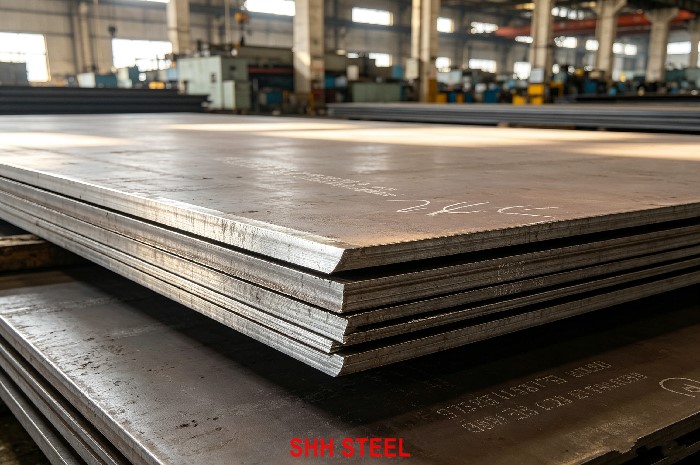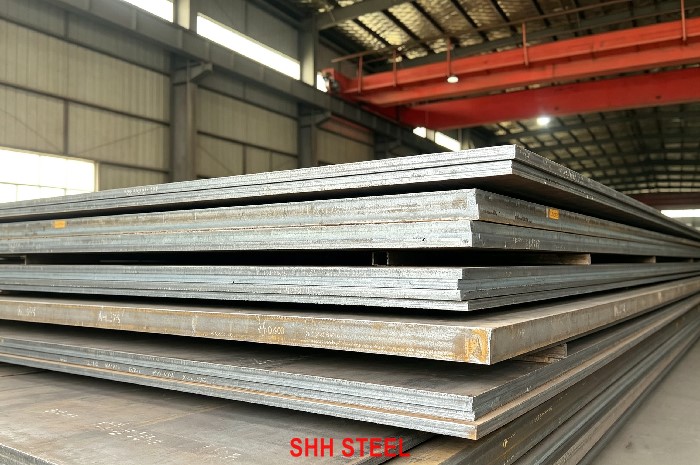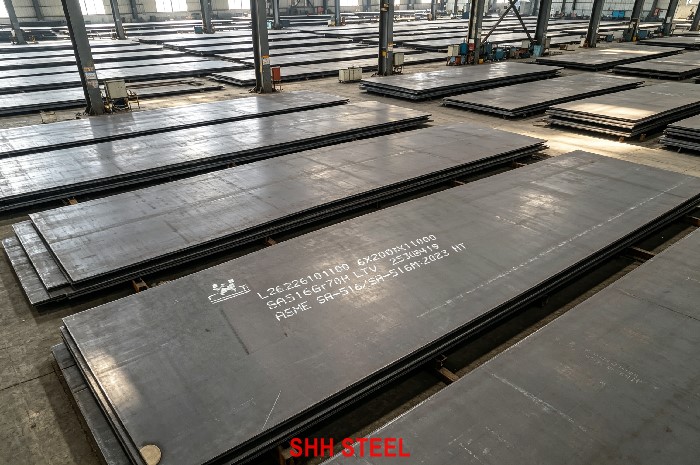
GB/T 711 25 Steel Plate | 25# Quality Carbon Structural Steel Plate
What is GB/T 711-2017 25 steel plate?
GB/T 711 25 Steel Plate is a quality carbon structural plate under GB/T 711-2017, Hot-Rolled Quality Carbon Structural Steel Plates Sheets and Strips. The 2017 edition is the current national standard as of 12 November 2026. It was issued on 28 February 2017 and implemented on 1 November 2017, replacing GB/T 711-2008 and GB/T 710-2008.
GB/T 711-2026, Hot rolled quality carbon structural steel plate, sheet and strip, was issued on 2 July 2026 and is scheduled for implementation on 1 February 2027, when it will replace GB/T 711-2017 and GB/T 8749-2021. It is not yet the applicable edition. The 2026 foreword states that designations and chemical composition are changed, and that delivery-condition and scope provisions are also revised. This page does not reproduce 2026 Table 1 values. The product is specified here under the 2017 designation and the 2017 edition.
Designation 25 sits between GB/T 711 20 Steel Plate and GB/T 711 30 Steel Plate. It is the first plain-carbon designation in this 2017 series to use the 0.50–0.80 % manganese band, together with a higher carbon range and a higher specified tensile strength than designation 20. It is not the manganese-alloyed designation 25Mn, and it is not interchangeable with either neighbour on a grade name alone.
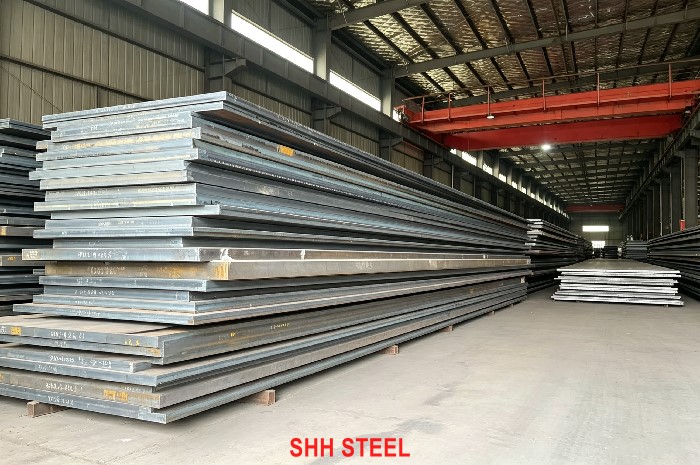
SHH STEEL supplies this plate in the GB/T 711 range. Related structural-plate hubs on this site are GB/T 700 and GB/T 1591; they are different standards, not substitute specifications.
Material specification for GB/T 711 25
The applicable product standard for this page is GB/T 711-2017. The official English title is Hot-Rolled Quality Carbon Structural Steel Plates Sheets and Strips. Orders should state that edition, the designation 25, dimensions, quantity and any agreed options. A designation without an edition is incomplete.
The 2017 scope covers hot-rolled quality carbon structural steel plates, sheets and strips with thickness not greater than 100 mm and width not less than 600 mm. That is the standard scope, not a stock promise. The 2026 edition changes the scope of application; until 1 February 2027 the 2017 scope remains the one used here.
Dimensions, shape, mass and permissible deviations of the 2017 product follow GB/T 709. Steel is melted in an oxygen converter or an electric furnace.
Inspection is by batch: the same designation, the same heat, the same thickness, and the same rolling schedule or heat treatment, with a batch mass not greater than 60 t. Re-inspection follows GB/T 17505. Rounding of chemical and mechanical results follows GB/T 8170. Packaging, marking and the quality certificate follow GB/T 247.
GB/T 711 is a quality carbon structural plate standard. It is not a pressure-vessel plate standard and it is not GB/T 699, which covers quality carbon structural steel in other product forms. Do not copy bar-steel or vessel-steel figures onto a GB/T 711 order.
Chemical composition of GB/T 711-2017 25
The following heat-analysis limits are given for designation 25 under GB/T 711-2017. Confirm each cell against the official 2017 Table 1.
| Element | Heat analysis, wt. % |
|---|---|
| C | 0.22–0.29 |
| Si | 0.17–0.37 |
| Mn | 0.50–0.80 |
| P | ≤0.035 |
| S | ≤0.030 |
| Cr | ≤0.20 |
| Ni | ≤0.30 |
| Cu | ≤0.25 |
Values are heat (smelting) analysis, mass percent, given for this designation under GB/T 711-2017. A maximum sign is an upper limit, not a target addition. Product-analysis deviations are assessed separately under GB/T 222 and must not be used to widen the heat-analysis order limits. Residual chromium, nickel and copper need not be analysed if the supplier guarantees compliance. Confirm each cell against the official 2017 Table 1. This page is not a substitute for the official table.
From designation 25 onward in the plain-carbon series, manganese is 0.50–0.80 %, a step up from the 0.35–0.65 % band of designation 20. The manganese-alloyed designation 25Mn is a different 2017 product, with a higher manganese range, and is not this plate.
Mechanical properties of GB/T 711-2017 25
The following tensile requirements are given for designation 25 under GB/T 711-2017. They are given as 2017-edition figures, not 2026-edition figures and not GB/T 699 properties. Confirm them against the official 2017 Table 3.
| Property | Requirement |
|---|---|
| Tensile strength Rm, MPa | ≥450 |
| Elongation after fracture A, % | ≥24 |
The table reports tensile strength and elongation after fracture. A yield strength is not tabulated on this page. If a yield value is required for design, confirm it against the official GB/T 711-2017 Table 3 and do not take a figure from another product standard.
For plate delivered in the heat-treated condition, when elongation is more than 2 % (absolute) above the specified minimum, tensile strength may be 40 MPa lower than the specified minimum.
When thickness is greater than 20 mm, elongation may be reduced by 0.25 % (absolute) for each additional 1 mm. The total reduction is not more than 2 % (absolute) for thickness not greater than 32 mm, and not more than 3 % (absolute) for thickness greater than 32 mm.
By agreement, material of thickness not less than 6 mm may be impact-tested at 20 °C or −20 °C. Impact energy and any other test temperature are agreed; no impact acceptance energy is tabulated on this page.
These are GB/T 711-2017 mechanical provisions. They are not GB/T 699 bar-steel properties and are not 2026-edition values.
Delivery conditions for GB/T 711 25
Under GB/T 711-2017 clause 5.3.1, steel strip and plate cut from coil are delivered in the hot-rolled condition. The delivery condition of single-rolled plate shall conform to Table 2. Grade-specific Table 2 cells are not tabulated on this page; state the required condition on the order and confirm it against the official 2017 Table 2.
When heat treatment is required, it should be stated in the contract. In this standard, heat treatment means normalizing, annealing or high-temperature tempering. If heat treatment is not stated, do not assume a heat-treated delivery from the designation alone.
A usual hot-rolled delivery for strip or cut-from-coil plate is not a substitute for an agreed heat-treatment condition on single-rolled plate. Record the actual condition on the quality document.
The 2026 edition changes the delivery-condition content. Until 1 February 2027, clause 5.3 of the 2017 edition remains the rule used here.
Weldability and fabrication heat treatment
Designation 25 has a higher carbon range than designation 20, and welding procedure qualification is essential for the actual thickness, joint and design code. This page does not give preheat, interpass or heat-input limits, and a qualitative weldability remark is not a qualification.
The fabricator is responsible for welding-procedure qualification, consumable selection, preheat and any post-weld heat treatment required by the project specification. Do not take preheat or PWHT figures from a different standard or from a bar-steel handbook and apply them as GB/T 711 rules.
Thermal cutting is permitted in normal carbon-steel practice. For plates thicker than 30 mm, GB/T 711-2017 allows flame trimming; when heat treatment is required, flame trimming is carried out before that treatment.
Dimensions, surface quality and inspection
Dimensional, shape, mass and deviation requirements for the 2017 product follow GB/T 709. State the required thickness-tolerance class, edge condition and any flatness agreement on the order.
The steel shall not show visible lamination. The surface shall be free from defects such as cracks, blisters, folds, inclusions, scabs and rolled-in scale. Local surface defects may be dressed provided the dressed area is smooth and the minimum permissible thickness is maintained.
On continuously produced strip, some local defects may not be found and removed before coiling; delivery with such defects is allowed, but the defective length shall not exceed 6 % of the length of each coil.
Ultrasonic testing, where agreed, is carried out to GB/T 2970. The test standard and the acceptance class must be written in the contract; they are not implied by the designation.
Decarburization testing is an agreed option in GB/T 711-2017 for designation 35 and steels of higher carbon content. It is not a default requirement for designation 25.
Applications and specification limits of 25
Designation 25 is used for shafts, couplings, lightly loaded gears and other machinery parts where a 0.22–0.29 % carbon quality structural plate, with the 0.50–0.80 % manganese band, is specified. Typical use is not a design approval.
GB/T 711 is not a boiler or pressure-vessel material standard. Do not treat a GB/T 711 plate as a substitute for a vessel-steel specification without a documented design-code review.
The 2017 thickness scope is not greater than 100 mm, with width not less than 600 mm. Service temperature, toughness and forming limits are set by the project specification, not by a generic maximum-temperature claim on this page. Impact testing is by agreement. Until 1 February 2027, acceptance is against the ordered 2017 edition unless the contract states otherwise.
Compare GB/T 711 25 with related quality carbon plates
Neighbouring plain-carbon designations in the same GB/T 711-2017 set are compared below. The comparison is a product guide, not an equivalence. Chemistry and tensile figures below are given for these 2017 designations; confirm them against official Table 1 and Table 3. Designation 15 is included as the lower-carbon neighbour in the same 2017 series; manganese rises from 0.35–0.65 % on designations 15 and 20 to 0.50–0.80 % on designations 25 and 30.
| Material | Heat analysis (selected) | Tensile (Table 3) | Relationship |
|---|---|---|---|
| GB/T 711 15 Steel Plate | C 0.12–0.18; Si 0.17–0.37; Mn 0.35–0.65 | Rm ≥370 MPa; A ≥30 % | 2017 edition; related, not interchangeable |
| GB/T 711 20 Steel Plate | C 0.17–0.23; Si 0.17–0.37; Mn 0.35–0.65 | Rm ≥410 MPa; A ≥28 % | 2017 edition; related, not interchangeable |
| GB/T 711 25 Steel Plate (this plate) | C 0.22–0.29; Si 0.17–0.37; Mn 0.50–0.80 | Rm ≥450 MPa; A ≥24 % | GB/T 711-2017; this product |
| GB/T 711 30 Steel Plate | C 0.27–0.34; Si 0.17–0.37; Mn 0.50–0.80 | Rm ≥490 MPa; A ≥22 % | 2017 edition; related, not interchangeable |
Lower-carbon plates in the same 2017 set include GB/T 711 08Al Steel Plate and GB/T 711 10 Steel Plate. The next higher plain-carbon designation is GB/T 711 35 Steel Plate. Manganese-alloyed sisters such as GB/T 711 20Mn Steel Plate, GB/T 711 25Mn Steel Plate and GB/T 711 30Mn Steel Plate follow their own 2017 chemistry and tensile rows and are not substitutes for the plain-carbon plates of the same number. GB/T 700 ordinary carbon structural steel and GB/T 1591 high-strength low-alloy structural steel are different standards with different chemistry and property systems. A similar carbon content or a similar tensile class does not authorise substitution.
Equivalent grades and related products — not equivalent
No formal equivalence has been verified for the designations below. They are related in carbon class only and are not equivalent to this GB/T 711-2017 plate. There is no live product page on this site for GB/T 699, JIS G4051 or EN 10083, and this page does not link any external catalogue.
GB/T 699 uses some of the same designation numbers (including 25) for quality carbon structural steel in other product forms, typically bars. That is a different product standard. A shared number does not transfer bar-steel mechanicals, heat-treatment schedules, yield values or sampling rules onto plate.
JIS G4051 carbon steels such as S25C, and similarly numbered ASTM carbon grades such as 1025, are sometimes listed on comparison charts. A chart cannot replace a review of chemistry, product form, delivery condition, mechanical tests and the project specification. Engineer approval is required before any substitution.
Within this site, compare the present plate with GB/T 711 15 Steel Plate, GB/T 711 20 Steel Plate, GB/T 711 25 Steel Plate and GB/T 711 30 Steel Plate in the GB/T 711 range, and with the different structural systems under GB/T 700 and GB/T 1591.
Why choose SHH STEEL for GB/T 711 25
- SHH STEEL produces and exports 25 quality carbon structural plate to the ordered GB/T 711-2017 specification
- We quote against the 2017 edition that is still current, and we record the published 2026 replacement date without treating 2026 as already in force
- Chemistry and tensile figures on this page are kept separate from GB/T 699 bar-steel values, from manganese-alloyed 711 designations of the same number, and from ordinary carbon structural grades under GB/T 700
- The quotation states thickness, width, delivery condition, any agreed impact or ultrasonic test, and the inspection document — not a generic stock grade alone
- We review cutting, packaging, traceability and export documentation before confirming the order
How to enquire for GB/T 711 25 plate
Send the drawing or material schedule with the following details. Production feasibility, dimensions, documentation and delivery are confirmed against the enquiry.
| Item | What to specify |
|---|---|
| Edition and designation | GB/T 711-2017 25; do not assume the 2026 edition or dual certification |
| Dimensions and quantity | Thickness, width, length and tonnage, within the 2017 scope of thickness not greater than 100 mm and width not less than 600 mm |
| Product form | Plate, sheet or strip; single-rolled plate or cut-from-coil, as applicable |
| Delivery condition | Hot-rolled, or a stated heat treatment (normalizing, annealing or high-temperature tempering); confirm single-rolled plate against Table 2 |
| Impact tests | If required: 20 °C or −20 °C, or another agreed temperature, for thickness not less than 6 mm, with the agreed acceptance energy |
| Ultrasonic examination | GB/T 2970 class as ordered; not implied by the designation |
| Surface and tolerances | GB/T 709 dimensional class, edge condition, and any agreed surface class |
| Documentation | Quality-certificate requirements, heat traceability, and any third-party inspection |
FAQ
-
What is GB/T 711 25 steel plate?
- It is a quality carbon structural plate supplied under GB/T 711-2017, Hot-Rolled Quality Carbon Structural Steel Plates Sheets and Strips. The 2017 edition is current as of 12 November 2026. GB/T 711-2026 has been published for implementation on 1 February 2027 and is not yet the applicable edition. This page specifies the 2017 designation 25.
-
What thickness and width does GB/T 711-2017 specify for 25?
- The 2017 scope is thickness not greater than 100 mm and width not less than 600 mm. That is the standard scope, not a stock range. Confirm available sizes on the enquiry. The 2026 edition changes the scope; it is not used here before 1 February 2027.
-
How is GB/T 711 25 plate delivered?
- Strip and plate cut from coil are delivered hot-rolled under clause 5.3.1. Single-rolled plate follows Table 2; state the required condition on the order. When heat treatment is ordered, it is normalizing, annealing or high-temperature tempering. Do not assume a heat-treated delivery from the designation alone.
-
What is the chemical composition of GB/T 711 25 steel plate?
- The following heat-analysis limits are given for designation 25 under GB/T 711-2017: C 0.22–0.29 %, Si 0.17–0.37 %, Mn 0.50–0.80 %, P ≤0.035 %, S ≤0.030 %, Cr ≤0.20 %, Ni ≤0.30 % and Cu ≤0.25 %. Confirm each cell against the official 2017 Table 1. These are not 2026 values. Designation 25Mn is a different product.
-
What should a quotation enquiry include?
- GB/T 711-2017 25, plate or strip dimensions and quantity, product form (including whether the plate is single-rolled or cut from coil), delivery condition, any agreed impact or ultrasonic test, GB/T 709 tolerance class, and the inspection document. If a related designation or another standard is being considered, send the design requirements; we do not assume interchangeability.
Request a quotation for GB/T 711 25 plate
Contact SHH STEEL for a quotation for GB/T 711-2017 25 quality carbon structural plate. Send thickness, width, length, quantity, destination and the project material specification.
Specify the 2017 edition, the product form, the delivery condition, any agreed impact or ultrasonic test, and the quality-document requirement. Do not assume the 2026 edition or dual certification unless the contract says so.
If a related grade or another standard is being considered, send the design requirements for review. We do not assume interchangeability from a grade comparison alone.
Contact: admin@steelspecs.com
Quality Steel Needed? Inquire for Offers
Related Products