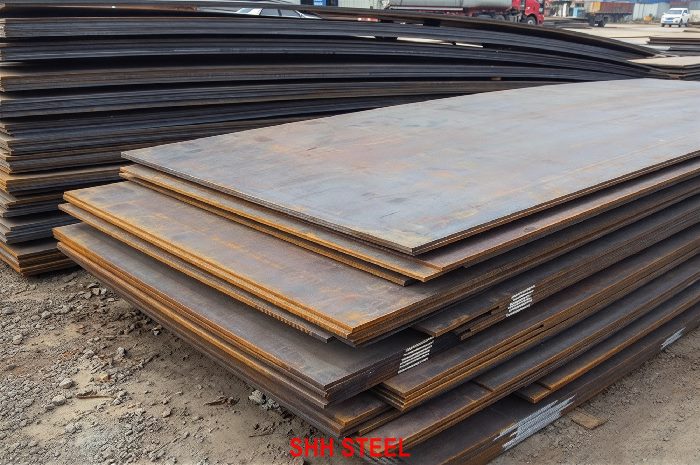
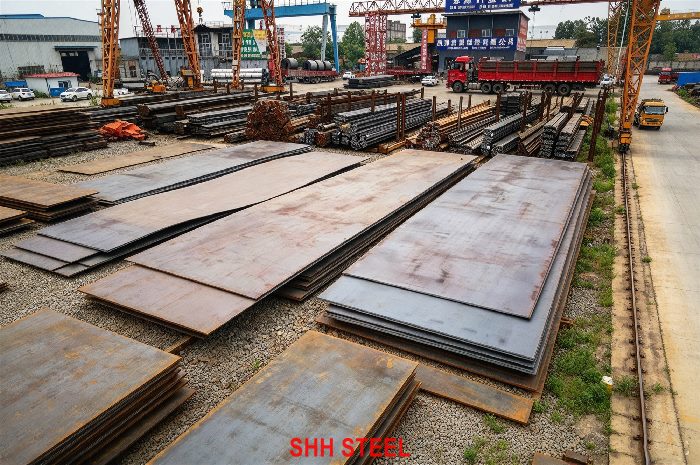
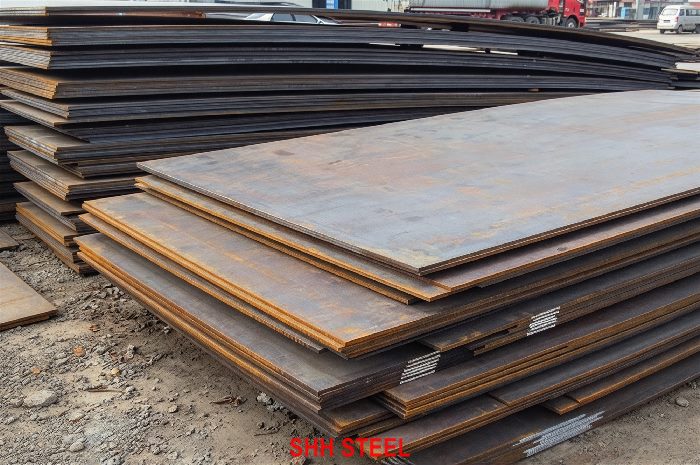
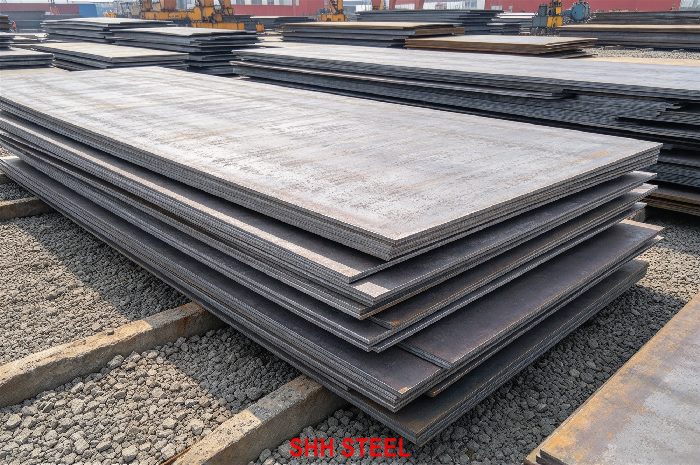
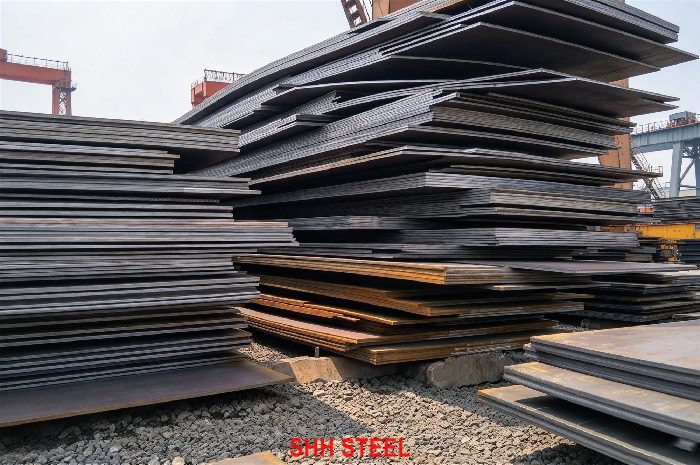
GB/T 19879 Q550GJC Building Steel Plate Supplier
What is GB/T 19879 Q550GJC Building Steel Plate?
Q550GJC, also written Q550GJ-C or Q550 GJC, is high-strength plate for building structures under GB/T 19879-2023. Q means yield, 550 is the minimum yield in MPa, GJ (gao jian) marks high-performance building steel, and C is the quality grade: Charpy V-notch at 0°C, at least 55 J.
The GJ rules still apply at this strength. Q550GJC has a yield ceiling of 690 MPa above 20 mm, a CEV cap of 0.54% for QT plate and low P and S. Unlike Q235GJ–Q460GJ, it is made only by quenching and tempering or TMCP, only from 12 to 50 mm, and its yield ratio is agreed in the contract.
Q550GJC moves the yield floor to 550 MPa and the tensile range to 670–830 MPa. It is a QT or TMCP plate for weight-critical members up to 50 mm, and its C letter calls for 55 J at 0°C.
GB/T 19879-2023 replaced GB/T 19879-2015 on 1 April 2024. Q550GJ entered GB/T 19879 in the 2015 edition; the 2005 edition stopped at Q460GJ. In 2015 the grade covered 12–40 mm and reported ReL. The 2023 edition keeps the same chemistry, extends the range to 50 mm, reports ReH, and sets 55 J at 0°C for C and 47 J at −20°C / −40°C for D and E. Sister grades are listed under GB/T 19879, including Q550GJD.
SHH STEEL (Shanghai Shenghonghe Import & Export Co., Ltd.) is a steel manufacturer and exporter and global steel mill sourcing partner, mill-direct, China origin. We ship Q550GJC cut to size with an EN 10204 3.1 or 3.2 certificate.
Material Specification
| Specification element | Requirement | SHH STEEL compliance |
|---|---|---|
| Plate standard | GB/T 19879-2023 Q550GJC (GB/T 19879-2015 when the drawing names it) | Confirmed |
| Thickness for Q550GJ | 12 mm – 50 mm | Confirmed |
| Yield strength | 550 MPa min; 550 – 690 MPa above 20 mm | Confirmed |
| Tensile strength | 670 – 830 MPa | Confirmed |
| Yield ratio | By agreement; we print it on the MTC | Printed on MTC |
| Quality grade | C, Charpy V at 0°C, KV2 ≥ 55 J, longitudinal | Confirmed |
| Delivery condition | QT, TMCP or TMCP+T | As ordered |
| Through-thickness | Z15, Z25 or Z35 to GB/T 5313 | As ordered |
| Dimensions | GB/T 709-2019, thickness tolerance Class B | Confirmed |
| Chemistry report | Heat analysis + CEV; product analysis on request | Confirmed |
| Certificate | EN 10204 3.1 or 3.2 | As ordered |
Grades often confused with it are GB/T 16270 Q550C and GB/T 1591 Q550MC. None of them carries the GJ yield cap.
Chemical Composition: Heat Analysis and Product Analysis
Buyers often reject plate because a third-party lab reads 0.02% more carbon than the MTC. That is usually not a failure. Table 1 is the heat (ladle) limit; plate drilled after rolling is judged as product analysis, with the tolerances of GB/T 222 that clause 7.1.4 calls up.
Table 1 below is the heat analysis for Q550GJC. The columns on the right show the quality-grade groups at Q550GJ.
Table 1. Heat (ladle) analysis, GB/T 19879-2023 Table 1, %
| Element | Q550GJC heat analysis (%) | Q550GJ C | Q550GJ D / E |
|---|---|---|---|
| C, max | 0.18 | 0.18 | 0.18 |
| Si, max | 0.60 | 0.60 | 0.60 |
| Mn, max | 2.00 | 2.00 | 2.00 |
| P, max | 0.025 | 0.025 | 0.020 |
| S, max | 0.015 | 0.015 | 0.010 |
| V, max | 0.120 | 0.120 | 0.120 |
| Nb, max | 0.110 | 0.110 | 0.110 |
| Ti, max | 0.030 | 0.030 | 0.030 |
| Als, min | 0.015 | 0.015 | 0.015 |
| Cr, max | 1.20 | 1.20 | 1.20 |
| Cu, max | 0.50 | 0.50 | 0.50 |
| Ni, max | 2.00 | 2.00 | 2.00 |
| Mo, max | 0.60 | 0.60 | 0.60 |
| B, max (if added) | 0.003 | 0.003 | 0.003 |
Notes to Table 1. Total aluminium (Alt ≥ 0.020%) may replace acid-soluble aluminium. If Al, V, Nb or Ti is added alone or together at 0.015% or more, the minimum aluminium does not apply. When boron is added, and for any QT plate, B ≤ 0.003%. These limits are the same in the 2015 and 2023 editions.
The C and D/E columns differ only in P and S: the D and E letters tighten P to 0.020% and S to 0.010%. Carbon stays at 0.18% for every quality letter at this level.
Table 2. Product analysis limits for Q550GJC, GB/T 19879 clause 7.1.4 with GB/T 222-2025, %
| Element | Heat limit (%) | Permitted deviation, GB/T 222-2025 Table 2 (alloy steel) | Q550GJC product analysis limit (%) |
|---|---|---|---|
| C | ≤ 0.18 | +0.01 | ≤ 0.19 |
| Si | ≤ 0.60 | +0.04 | ≤ 0.64 |
| Mn | ≤ 2.00 | +0.04 | ≤ 2.04 |
| P | ≤ 0.025 | +0.005 | ≤ 0.030 |
| S | ≤ 0.015 | +0.005 | ≤ 0.020 |
| V | ≤ 0.120 | +0.03 | ≤ 0.150 |
| Nb | ≤ 0.110 | Agree in contract | Agree in contract |
| Ti | ≤ 0.030 | +0.02 | ≤ 0.050 |
| Als | ≥ 0.015 | ±0.005 band (Al ≤ 0.10%) | Agree in contract |
| Cr | ≤ 1.20 | +0.05 | ≤ 1.25 |
| Cu | ≤ 0.50 | +0.03 | ≤ 0.53 |
| Ni | ≤ 2.00 | +0.05 | ≤ 2.05 |
| Mo | ≤ 0.60 | +0.02 | ≤ 0.62 |
| B (if added) | ≤ 0.003 | Agree in contract | Agree in contract |
How to read Table 2. Q500GJ–Q690GJ heats carry Ni, Cr, Mo and often B for hardenability, which normally classes them as alloy steel, so the alloy-steel table of GB/T 222 applies. For Q550GJC, Mn ≤2.00% sits in the 1.00–2.00% band (±0.04), and Ni ≤2.00% in the 1.00–2.00% band (±0.05). GB/T 222 clause 5.4 says one steel uses one table only, so the certificate should state which table was applied.
GB/T 222-2025 replaced GB/T 222-2006 on 1 December 2025. One more rule from it matters to buyers: if no reliable heat analysis exists, the product analysis must meet the heat limits with no deviation at all (clause 5.6).
Z-grade plate is cleaner still. GB/T 5313-2023 limits sulfur by heat analysis:
| Z grade | Heat sulfur, max (%) | Reduction of area, avg / single (%) |
|---|---|---|
| Z15 | 0.010 | 15 / 10 |
| Z25 | 0.007 | 25 / 15 |
| Z35 | 0.005 | 35 / 25 |
CEV and Pcm are always worked out from the heat analysis, not the product analysis. SHH STEEL prints the heat values used and adds a product-analysis column on request. This is building steel, not boiler chemistry such as GB/T 713 Q345R in GB/T 713.
Mechanical Properties
Values below follow Table 4 and Table 5 of GB/T 19879-2023 for Q550GJ. Tensile specimens are transverse; Charpy specimens are longitudinal.
| Thickness | Upper yield ReH (MPa) | Tensile Rm (MPa) | Yield ratio, max | Elongation A, min |
|---|---|---|---|---|
| 12 – 20 mm | ≥ 550 | 670 – 830 | By agreement | 17% |
| > 20 – 50 mm | 550 – 690 | 670 – 830 | By agreement | 17% |
Below 20 mm only the 550 MPa minimum applies; from 20 to 50 mm the 550 – 690 MPa window applies. Write the yield-ratio limit into the contract; GB/T 19879-2023 leaves it to agreement for this grade.
| Test | Q550GJC requirement |
|---|---|
| Charpy V-notch, longitudinal | 0°C, KV2 ≥ 55 J, average of 3 |
| Single value | One value may fall below the average requirement, not below 70% of it (GB/T 17505) |
| Sub-size specimens | 7.5 mm or 5 mm wide when plate is too thin: 75% or 50% of the required energy |
| 180° bend | Per Table 6 to GB/T 232; may be omitted when the mill guarantees it (7.4.3.2) |
| Through-thickness (≥ 15 mm) | Z15, Z25 or Z35 to GB/T 5313, when ordered |
Density for theoretical weight is 7.85 g/cm³.
Q550GJC vs S550Q and GB/T 16270 Q550C: What Building Plate Adds
At 550 MPa the plate itself is not unusual. GB/T 16270 Q550C and EN 10025-6 S550Q are standard QT products. What Q550GJC adds is a building-steel frame around them: a yield ceiling of 690 MPa above 20 mm, a tensile floor of 670 MPa, a CEV cap written into the standard, and Charpy at the GB quality letter.
The trade-off is thickness. GB/T 19879 stops at 50 mm for this grade; EN 10025-6 and GB/T 16270 go much thicker.
| Property | S550Q (EN 10025-6) | Q550C (GB/T 16270) | Q550GJC (GB/T 19879-2023) |
|---|---|---|---|
| Delivery | QT | QT | QT or TMCP |
| Thickness range | to 150 mm | to 150 mm | 12 – 50 mm |
| Yield, ≤ 50 mm | ≥ 550 MPa | ≥ 550 MPa | 550 – 690 MPa above 20 mm |
| Tensile, ≤ 50 mm | 640 – 820 MPa | Per GB/T 16270 | 670 – 830 MPa |
| Yield ratio | No limit | No limit | By agreement (write it on the order) |
| Impact | 0°C / −20°C (Q) | 0°C | 0°C, 55 J |
| Elongation A | 16% | Per GB/T 16270 | 17% |
| CEV ≤ 50 mm | Per EN 10025-6 | Per GB/T 16270 | 0.54% QT / 0.47% TMCP |
If a member is thicker than 50 mm, it cannot be Q550GJC. The designer either splits the plate, or moves to GB/T 16270 Q550C or the EN grade with project-specific yield-cap rules. The TMCP comparison in GB/T 1591 is GB/T 1591 Q550MC.
QT or TMCP? Delivery Condition, CEV and Weldability of Q550GJC
| Route | CEV max (≤ 50 mm) | Pcm max (≤ 50 mm) | Typical use |
|---|---|---|---|
| QT (incl. direct quench) | 0.54% | By agreement | Full strength through 50 mm; highest alloy |
| TMCP, TMCP+T | 0.47% | 0.29% (reference value) | Leaner chemistry; easier welding on thinner plate |
Q550GJ cannot be made as plain hot-rolled or normalized plate; GB/T 19879-2023 lists only QT and TMCP routes for it. The two routes are not equal at the welding bay.
QT Q550GJC carries up to 0.54% CEV, because the mill adds Mn, Ni, Cr, Mo and sometimes B for hardenability. TMCP plate is capped at 0.47%. For welding procedure purposes those are different steels.
The 2023 edition lets TMCP plate ship against Pcm instead of CEV only when buyer and mill agree in the contract. The Pcm figure in the standard for TMCP plate is given for reference.
Q550GJC, Q550GJD or Q550GJE: Which Quality Grade?
| Grade | Impact temperature | Energy, min | C / P / S max (%) | Typical use |
|---|---|---|---|---|
| Q550GJC | 0°C | 55 J | 0.18 / 0.025 / 0.015 | Cold regions, exposed frames |
| Q550GJD | −20°C | 47 J | 0.18 / 0.020 / 0.010 | Severe winters, thick welded nodes |
| Q550GJE | −40°C | 47 J | 0.18 / 0.020 / 0.010 | Arctic and low-temperature sites |
Strength, yield window and CEV do not change from C to E. Only the impact temperature, the C-grade energy (55 J) and the D/E P and S limits move. Choose the letter from the site climate and plate thickness, not from habit.
Q550GJC is the usual letter for temperate sites and for frames that see some frost during erection. For the same letter at another strength level: one level up, Q620GJC; one level down, Q500GJC.
Q550GJCZ15, Q550GJCZ25 and Q550GJCZ35: Through-Thickness Plate
A weld on the face of a thick plate shrinks and pulls the plate apart through its thickness. If the steel holds sulfide stringers, it tears in steps. Z15, Z25 and Z35 prove through-thickness ductility with a short-transverse tensile test.
The designation adds the Z level to the grade, for example Q550GJCZ25. Z tests apply to plate 15–50 mm and follow GB/T 5313-2023.
| Z grade | Heat sulfur, max (%) | Reduction of area, avg / single (%) |
|---|---|---|
| Z15 | 0.010 | 15 / 10 |
| Z25 | 0.007 | 25 / 15 |
| Z35 | 0.005 | 35 / 25 |
B and C chemistry allows S up to 0.015%, so even Z15 needs extra desulfurization.
GB/T 19879-2023 clause 7.6 requires every Z plate to be ultrasonic tested one by one to GB/T 2970, acceptance level III. Z35 costs most: lowest sulfur, more rejects, and a Z test on each plate.
Most projects need Z only on flange and diaphragm plates over about 25–40 mm. Put the Z level on those items alone and keep the rest standard Q550GJC.
Equivalent Material Grades
At 550 MPa every foreign comparison is a QT plate standard, not a building-steel standard. They match strength and toughness temperature. None of them sets a yield ceiling or a yield-ratio rule.
| Designation | Region | Standard | Notes |
|---|---|---|---|
| Q550GJC | China | GB/T 19879-2023 | Grade on this page; 12–50 mm |
| EN 10025-6 S550Q | Europe | EN 10025-6 | QT; closest strength match |
| EN 10025-6 S550QL | Europe | EN 10025-6 | Colder sub-grade |
| GB/T 16270 Q550C | China | GB/T 16270 | QT structural plate; thicker sizes |
| GB/T 1591 Q550MC | China | GB/T 1591-2018 | TMCP route |
See EN 10025-6 and GB/T 16270 for thicker or non-building QT plate.
Weldability
GB/T 19879 makes the mill calculate CEV from the heat analysis and print it, together with the elements used, on every Q550GJC certificate:
CEV = C + Mn/6 + (Cr + Mo + V)/5 + (Ni + Cu)/15
Pcm = C + Si/30 + Mn/20 + Cu/20 + Ni/60 + Cr/20 + Mo/15 + V/10 + 5B
| Delivery condition | CEV, max (≤ 50 mm) | Pcm, max (≤ 50 mm) |
|---|---|---|
| QT (quenched + tempered, incl. direct quench) | 0.54 | By agreement |
| TMCP, TMCP+T | 0.47 | 0.29 (for reference) |
Q550GJ shares the Q500GJ welding logic but with up to 2.00% Mn and Ni. Hydrogen control and heat input are the two numbers the WPS has to pin down.
The impact test on the C letter is at 0°C. Qualify the HAZ Charpy at that temperature, not only the weld metal.
Typical consumables: E62- or E69-class low-hydrogen consumables, matched to the 670 MPa tensile floor. Shops work to GB 50661 or AWS D1.1. Write the CEV basis (actual heat, not table maximum) into the WPS.
Heat Treatment and Delivery Condition
Q550GJC is delivered QT (quenched and tempered, including in-line direct quenching) or TMCP / TMCP+T. Hot-rolled and normalized delivery are not allowed for this grade.
Most building orders at this level ship QT. TMCP plate is possible on thinner sizes and gives a lower CEV cap, but not every mill can hold the GJ yield ceiling on TMCP plate up to 50 mm.
Tempering temperature and time are mill data. We ask for them on the MTC when the fabricator plans post-weld heat treatment, so that PWHT stays below the tempering temperature. QT references: GB/T 16270 Q550C and EN 10025-6 S550Q.
Test lots follow clause 9.2 of GB/T 19879-2023; retests and judgement follow GB/T 17505.
Dimensions
Typical Q550GJC dimensions on our offers:
- Thickness: 12 mm – 50 mm
- Width: 1500 mm – 3000 mm standard; wider by mill confirmation; QT width depends on the mill’s quench line
- Length: 3000 mm – 12000 mm; longer by enquiry
- Edge: mill edge or cut edge
- Weight: theoretical, on the mean of maximum and minimum thickness, 7.85 g/cm³
Column flanges, diaphragms, stiffeners and gussets are cut to drawing. Rolled sections for the same frame are under steel beam profiles and steel structural profiles.
Tolerances
GB/T 709-2019 governs Q550GJC thickness, width, length and flatness. Under Class B, the default, plate may be up to 0.30 mm thin and the plus side grows with thickness and width. Class C gives zero minus by agreement.
| Nominal thickness (mm) | Width ≤ 1500 mm | Width > 1500 – 2500 mm |
|---|---|---|
| > 8 – 15 | −0.30 / +0.80 | −0.30 / +1.00 |
| > 15 – 25 | −0.30 / +1.00 | −0.30 / +1.20 |
| > 25 – 40 | −0.30 / +1.10 | −0.30 / +1.30 |
| > 40 – 60 | −0.30 / +1.30 | −0.30 / +1.50 |
Flatness and width follow GB/T 709. EN 10029 or ASTM A6 tolerances are possible if written on the order.
Supplementary Requirements
Q550GJC already fixes strength, yield window, CEV and 0°C impact. Anything more goes on the purchase order.
- Edition: GB/T 19879-2023 or -2015. Never write only Q550.
- Product analysis: ask for a second chemistry column checked to GB/T 222.
- Through-thickness: add Z15, Z25 or Z35, e.g. Q550GJCZ25.
- Delivery route: QT or TMCP, and the CEV/Pcm basis.
- Yield ratio: the designer’s limit, since the standard leaves it to agreement.
- Tempering data on the MTC if the fabricator plans post-weld heat treatment.
- Impact: extra test positions (e.g. quarter thickness) or transverse tests, if the owner wants them beyond the C letter.
- Tolerance: Class C for zero minus.
- Inspection: EN 10204 3.2 with SGS, BV, TÜV or a named inspector.
Q550GJC Price Factors and How to Order
There is no single Q550GJC price. Mills price GJ plate as base plus extras, and the order details set the extras.
| Cost driver | Effect on price |
|---|---|
| GJ grade over general Q550 plate | Grade extra for cleaner steel, yield control and CEV |
| Quality letter C | Extra for 55 J at 0°C |
| Delivery route | QT line time is the main cost driver at this level |
| Thickness | 12–20 mm and 40–50 mm carry the most care; 20–40 mm is the core range |
| Z15 / Z25 / Z35 | Desulfurization, plate-by-plate Z test and UT; Z35 costs most |
| Width and length | Over 3000 mm wide or 12 m long needs mill confirmation |
| Quantity per size | Mill rolling minimums per size; small lots come from stock or combined rolling |
| Inspection and cutting | 3.2 witness, profile cutting, blasting and priming are quoted per item |
To get a firm quote in one round, send:
- Grade and edition, e.g. Q550GJCZ25 to GB/T 19879-2023
- Thickness × width × length and pieces or tonnes
- Delivery route, UT standard and class
- Certificate type and inspector
- Destination port and Incoterm
We quote plate price, extras and freight line by line, so you can compare like with like. Need a different letter? See Q550GJE.
Applications
| Sector | Typical Q550GJC components |
|---|---|
| Long-span roofs | Compression chords and diagonals where weight governs |
| Tall buildings | Outrigger and belt truss members, hanger plates |
| Heavy industrial buildings | Crane-runway and support members |
| Special structures | Members where crane capacity or connection size limits plate thickness |
C grade suits frames that see winter during erection or in service, and exposed members in temperate climates.
It is not boiler or pressure-vessel plate (pressure vessel steel plates), and members thicker than 50 mm move to GB/T 16270 or EN 10025-6.
Supply Capability and Global Delivery
SHH STEEL sources Q550GJC from first-line building-steel mills: Wuyang (Wugang), a drafting mill of GB/T 19879, plus Valin Xiangtan and Shougang QT lines.
- Certificates: EN 10204 3.1 standard; 3.2 with third-party witness
- Tests: tensile, 0°C Charpy, bend, Z test to GB/T 5313, UT to GB/T 2970, product analysis
- Processing: CNC plasma and flame cutting, bevelling, drilling, shot blast and primer
- Terms: FOB Shanghai, CFR, CIF; TT, LC or TT + LC
- Marking: steel-stamped and paint-marked with grade, heat, size and mill
Buyers of Q550GJC are usually EPC contractors and fabricators working to Chinese drawings overseas. We ship to the United States, Europe, the Middle East, Southeast Asia, Africa and South America.
QT plate is rolled and heat treated to order: about 45–60 days; 3.2 inspection adds about 1–2 weeks. Sea time from Shanghai is about 7–12 days to Singapore and 28–35 days to Rotterdam.
Why Choose SHH STEEL
As a steel manufacturer and exporter and global steel mill sourcing partner, SHH STEEL buys Q550GJC straight from GJ-qualified mills, China origin. No relabelled general plate, no mixed heats.
Before shipment we check four lines on every certificate: yield inside the GJ window, yield ratio inside the agreed limit, CEV inside the thickness band for the delivery route, and 0°C impact at 55 J or more. If one fails, the plate does not ship as GJ.
We also tell buyers when they are over-specifying. If a member is thicker than 50 mm, we tell you before quoting: it cannot be Q550GJC. Browse more structural steel plates and high strength low alloy plates.
FAQ
-
What is Q550GJC steel?
- Q550GJC is high-strength building structure steel plate to GB/T 19879-2023, delivered quenched and tempered or TMCP in 12–50 mm. It has 550 MPa minimum yield, 550–690 MPa yield above 20 mm, 670 – 830 MPa tensile, a CEV cap of 0.54% (QT) and Charpy impact of at least 55 J at 0°C.
-
What is the difference between Q550GJC and S550Q?
- S550Q (EN 10025-6) is QT plate with ≥550 MPa yield up to 50 mm, no yield ceiling and no yield-ratio rule, made to 150 mm. Q550GJC (GB/T 19879-2023) is QT or TMCP building plate, 12–50 mm, with 550–690 MPa yield above 20 mm, 670 – 830 MPa tensile, a CEV cap of 0.54% (QT) and 55 J at 0°C.
-
Why does Q550GJC need 55 J when the D and E grades need 47 J?
- GB/T 19879-2023 Table 5 sets 55 J at 0°C for grade C of Q500GJ to Q690GJ, and 47 J at −20°C (D) and −40°C (E). The C requirement is a higher energy at a warmer temperature. A D-grade certificate tested only at −20°C has not proven 55 J at 0°C, so state the letter you need.
-
Why is Q550GJ limited to 50 mm?
- GB/T 19879-2023 sets 50 mm as the maximum thickness for Q500GJ to Q690GJ. Holding a 550–690 MPa yield window, 47–55 J toughness and the CEV cap through thicker plate is not covered by this standard; thicker plate goes to GB/T 16270 or EN 10025-6.
-
What does Q550GJCZ35 mean?
- Q550GJCZ35 is Q550GJC plate with Z35 through-thickness properties to GB/T 5313-2023: average reduction of area at least 35%, no single value below 25%, and heat sulfur 0.005% max. It applies to plate 15–50 mm, resists lamellar tearing, and each Z plate is ultrasonic tested.
-
What is the ASTM or EN equivalent of Q550GJC?
- The closest European grade is EN 10025-6 S550Q; the closest Chinese non-building grades are GB/T 16270 Q550C (QT) and GB/T 1591 Q550MC (TMCP). They match strength only: Q550GJC adds a 690 MPa yield ceiling, a CEV cap and a 50 mm thickness limit.
Conclusion
Q550GJC steel plate to GB/T 19879 is building structure plate with 550 MPa minimum yield, a capped yield window, a yield ratio agreed in the contract and 55 J impact at 0°C. It shares its chemistry with Q550GJD but proves toughness at its own letter. It is not general structural plate under GB/T 1591 or GB/T 16270.
With SHH STEEL the Q550GJC certificate is complete: heat chemistry, CEV, yield, tensile, yield ratio and Charpy impact, to EN 10204 3.1 or 3.2. Add product analysis to GB/T 222, a Z15, Z25 or Z35 level, a GB/T 2970 UT class, Class C tolerance or profile cutting as the project needs.
We ship from Shanghai to buyers worldwide. Browse the full GB/T 19879 range or other carbon steel plates.
Tell us the grade edition, sizes, tonnage and any Z, UT or inspection needs. We check the request against the standard first, then confirm mill, route, lead time and price. Contact SHH STEEL today for a mill-direct quotation on Q550GJC building steel plate.
Quality Steel Needed? Inquire for Offers
Related Products