Q390D Steel Plate GB/T 1591 Supplier
Q390D steel plate explained
Q390D is where Q390 becomes a cold-weather plate. Charpy tests are run at −20°C, P and S are capped at 0.025%, and the steel must be fine-grain killed (Als ≥ 0.015%). That combination is why Q390D appears on bridge accessories, offshore topside secondary steel, mining equipment and outdoor structures in northern China, Russia and Canada.
Q390D is the lowest-temperature quality that GB/T 1591-2018 still offers in the hot-rolled condition for Q390. Below −20°C you move to Q390ND or Q390MD.
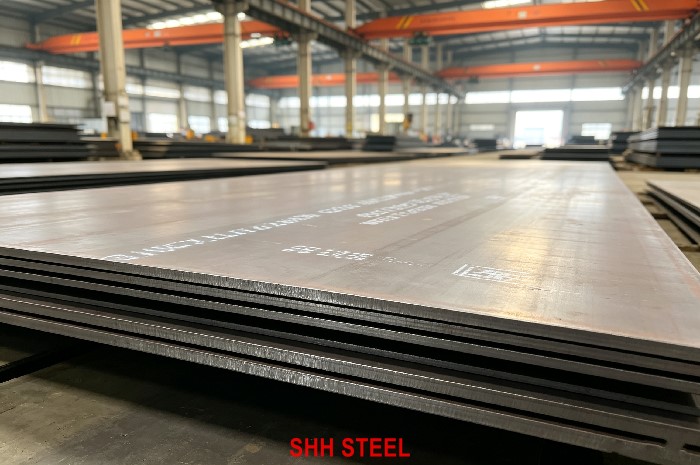
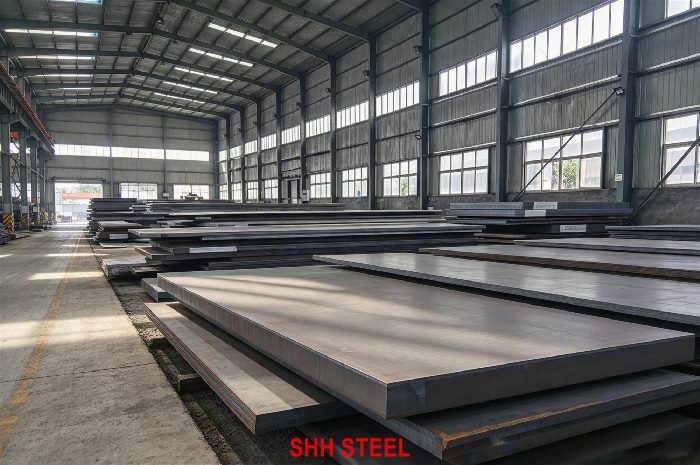
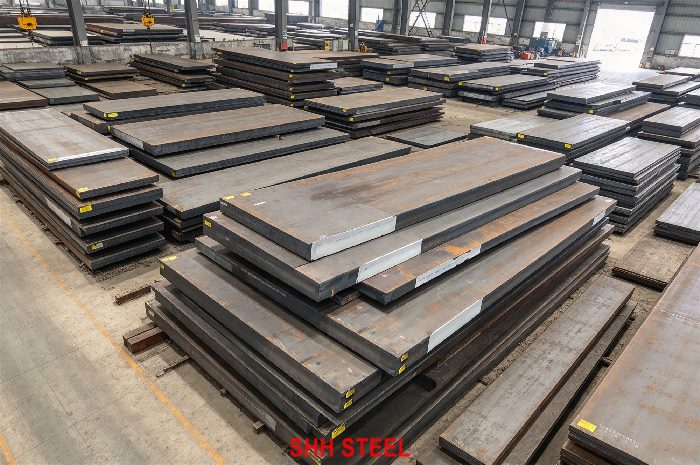
SHH STEEL is a producer and exporter of structural plate and a sales agent for well-known Chinese mills. We keep Q390D plate in our own processing warehouse in Shanghai for cutting, drilling, shot blasting and priming. Q390D belongs to our GB/T 1591 plate range; see also our high-strength low-alloy plates overview.
Q390D chemical composition (heat analysis)
| Element | Q390D heat analysis, % max | Role |
|---|---|---|
| C | ≤ 0.20 | strength and hardenability; kept ≤0.20 for weldability |
| Si | ≤ 0.55 | deoxidiser, adds some strength |
| Mn | ≤ 1.70 | main strengthening element; with C sets the CEV |
| P | ≤ 0.025 | impurity; lower in the tougher quality letters |
| S | ≤ 0.025 | impurity; forms MnS that hurts through-thickness and impact values |
| Nb | ≤ 0.05 | grain refiner, precipitation strengthening |
| V | ≤ 0.13 | precipitation strengthening, helps thick plate keep yield |
| Ti | ≤ 0.05 | fixes N, refines grain in the HAZ |
| Cr | ≤ 0.30 | residual / minor alloy |
| Ni | ≤ 0.50 | residual; helps low-temperature toughness |
| Cu | ≤ 0.40 | residual; limited for hot shortness |
| Mo | ≤ 0.10 | residual / minor alloy |
| N | ≤ 0.015 | kept low; free N harms toughness |
| Als | ≥ 0.015 | fine-grain practice, required for D/E |
Grade D tightens P and S to 0.025% and requires fine-grain aluminium (Als ≥ 0.015%, or total Al ≥ 0.020%). Nb, V and Ti may be used alone or in combination; for Q390/Q420 the sum Nb+V+Ti is limited to 0.22%. Where Cu is used as a residual element the mill must report it. Values are for the ladle (heat) analysis printed on the certificate.
Product (finished plate) analysis and check tolerances for Q390D
A check analysis drilled from the finished plate may differ slightly from the ladle analysis. GB/T 1591 refers to GB/T 222 for the permitted deviations. The table applies them to the Q390D limits. The deviation applies to one side of a limit only.
| Element | Heat analysis limit, % | Permitted deviation | Product analysis limit, % |
|---|---|---|---|
| C | ≤ 0.20 | +0.02 | ≤ 0.22 |
| Si | ≤ 0.55 | +0.03 | ≤ 0.58 |
| Mn | ≤ 1.70 | +0.1 | ≤ 1.80 |
| P | ≤ 0.025 | +0.005 | ≤ 0.030 |
| S | ≤ 0.025 | +0.005 | ≤ 0.030 |
| Nb | ≤ 0.05 | +0.01 | ≤ 0.06 |
| V | ≤ 0.13 | +0.02 | ≤ 0.15 |
| Ti | ≤ 0.05 | +0.01 | ≤ 0.06 |
| Cr | ≤ 0.30 | +0.05 | ≤ 0.35 |
| Ni | ≤ 0.50 | +0.05 | ≤ 0.55 |
| Cu | ≤ 0.40 | +0.05 | ≤ 0.45 |
| Mo | ≤ 0.10 | +0.01 | ≤ 0.11 |
| N | ≤ 0.015 | +0.002 | ≤ 0.017 |
| Als | ≥ 0.015 | −0.005 | ≥ 0.010 |
If your inspector tests a plate in a third-party lab, compare the result with the right-hand column, not with the heat analysis.
Q390D mechanical properties by thickness
| Thickness, mm | Yield ReH, MPa min | Tensile Rm, MPa | Elongation A, % min (long. / trans.) |
|---|---|---|---|
| ≤ 16 | 390 | 490 – 650 | 21 / 20 |
| > 16 – 40 | 380 | 490 – 650 | 21 / 20 |
| > 40 – 63 | 360 | 490 – 650 | 20 / 19 |
| > 63 – 100 | 340 | 490 – 650 | 20 / 19 |
| > 100 – 150 | 320 | 470 – 620 | 19 / 18 |
| Quality | Test temperature | KV2 longitudinal, J min | KV2 transverse, J min |
|---|---|---|---|
| D | −20°C | 34 | 27 |
Yield drops with thickness because thick plate cools slower and gets less rolling reduction. Design with the value for your actual thickness, not the headline 390 MPa. Impact tests use 10×10 mm specimens for plate ≥ 12 mm; thinner plate uses sub-size specimens with reduced values. Tensile tests on plate are transverse by default.
Q390D specification at a glance
| Item | Q390D requirement |
|---|---|
| Standard | GB/T 1591-2018, hot-rolled (AR) condition |
| Steel type | High-strength low-alloy structural steel, killed |
| Minimum yield ReH (≤16 mm) | 390 MPa |
| Tensile strength Rm (≤100 mm) | 490 – 650 MPa |
| Impact test | KV2 ≥ 34 J at −20°C, longitudinal |
| Thickness range (SHH STEEL) | 6 – 150 mm |
| Width / length | 1 500 – 4 020 mm / 6 000 – 18 000 mm |
| Dimensions & tolerance | GB/T 709 (EN 10029 / ASTM A6 on request) |
| Certificate | EN 10204 3.1 (3.2 with third-party inspection) |
Q390D carbon equivalent (CEV) and weldability
| Thickness, mm | ≤ 30 | > 30 – 63 | > 63 – 150 | > 150 – 250 |
|---|---|---|---|---|
| CEV max, % (heat analysis) | 0.45 | 0.47 | 0.48 | — |
CEV = C + Mn/6 + (Cr+Mo+V)/5 + (Ni+Cu)/15. Real heats from our mills usually come in around 0.40 – 0.44 on 20 – 40 mm plate. Q390 plate welds with standard E50/E55-class consumables (AWS E7018 / E8018 type, ER50-6 / ER55 wire). Preheat of 50 – 100°C is common above 25 mm or in restrained joints; low-hydrogen practice is the key point.
Can Q390D replace Q345D or Q355D?
Yes for strength – Q390D exceeds both. Check weldability (slightly higher CEV), section stability and the design code before you switch. Going the other way, Q355D cannot replace Q390D.
Q390D vs Q355D vs Q420D
| Grade | Yield ≤16 mm, MPa | Tensile ≤100 mm, MPa | Impact |
|---|---|---|---|
| Q355D | 355 | 470 – 630 | −20°C |
| Q390D | 390 | 490 – 650 | −20°C |
| Q420D | 420 | 520 – 680 | −20°C |
Q390D vs Q355D: 35 MPa higher yield at the same −20°C test. Q390D vs Q420D: 30 MPa lower yield but cheaper and easier to weld. Q390D vs Q390ND: same temperature; ND is normalized and is preferred when the plate will be hot formed.
Q390D equivalent grades: EN, ASTM, JIS
| System | Grade | Comment |
|---|---|---|
| ASTM | ASTM A572 Gr.55 | Order with S5 Charpy at −20°C / −4°F |
| JIS | JIS G3106 SM520C | 0°C impact only |
| EN 10025-4 | EN 10025-4 S420M (closest) | 420 MPa TMCP, −20°C 40 J |
| GB/T 1591-2018 | Q390ND / Q390MD | N and M versions |
“Equivalent” means similar, not identical. Strength classes, impact temperatures and delivery conditions differ between standards. A plate can be dual-certified only if one heat meets both books in full; ask us before you assume it.
Q390D in cold-climate structures
Q390D plate is used for outdoor steel structures in cold regions, bridge secondary members, offshore topside secondary steel, hydraulic gates, construction machinery, railway wagons.
For building columns with through-thickness loads, compare with Q390GJC building plate to GB/T 19879, which adds Z-direction and yield-ratio control.
Cutting and processing Q390D in our Shanghai warehouse
- Flame, plasma and CNC laser cutting to drawings; bevelling for welding
- Drilling, bending and rolling of shells
- Shot blasting Sa 2.5 and shop primer or full paint system
- Ultrasonic testing to GB/T 2970, EN 10160 or ASTM A578
Processed plates keep heat numbers traceable to the mill certificate.
Q390D plate sizes we supply
| Form | Thickness, mm | Width, mm | Length, mm |
|---|---|---|---|
| Mill plate | 6 – 150 | 1 500 – 4 020 | 6 000 – 18 000 |
| Shanghai stock (common) | 8, 10, 12, 14, 16, 20, 25, 30, 40, 50 | 2 000 / 2 200 / 2 500 | 8 000 – 12 000 |
| Cut pieces | 6 – 150 | to drawing | to drawing |
Mill orders usually take 30 – 45 days from rolling schedule. Stock sizes can ship within a week after cutting.
How Q390D is tested and certified
Each lot carries tensile, Charpy at −20°C and chemistry results. Batches are by heat, thickness and delivery condition, up to 60 t. Optional: Z15/Z25/Z35 through-thickness to GB/T 5313, UT, product analysis, SGS/BV/TÜV witness for EN 10204 3.2.
Why buy Q390D from SHH STEEL
SHH STEEL works as an agent for well-known Chinese mills, so we can book rolling slots for non-stock sizes and still offer warehouse stock for urgent orders. Our team checks every certificate against GB/T 1591 before shipment. We export to Southeast Asia, the Middle East, Africa, Europe and South America, packed for sea freight with sea-worthy marking.
How to order Q390D correctly
State: standard and edition (GB/T 1591-2018 Q390D), thickness × width × length, quantity, tolerance standard, any UT or Z-grade, certificate type and marking. Writing the edition avoids the most common certificate dispute we see.
FAQ
-
What is Q390D material?
- A low-alloy high-strength structural plate to GB/T 1591 with 390 MPa minimum yield and −20°C Charpy impact of 34 J.
-
What is Q390D equivalent to in EN?
- EN 10025-4 S420M is the closest European comparison; ASTM A572 Gr.55 and JIS SM520C are also used.
-
What is the impact test temperature for Q390D?
- −20°C, KV2 ≥ 34 J longitudinal on 10×10 mm specimens.
-
Does Q390D need aluminium?
- Yes. D and E grades are fine-grain steels with Als ≥ 0.015%.
-
What is the maximum thickness of Q390D plate?
- GB/T 1591-2018 covers hot-rolled Q390 up to 150 mm; SHH STEEL supplies 6 – 150 mm.
-
Is Q390D the same as Q390GJD?
- No. Q390GJD is GB/T 19879 building steel with yield-ratio and through-thickness control.
Conclusion
Q390D is a hot-rolled 390 MPa HSLA plate grade of GB/T 1591 with 490 – 650 MPa tensile and −20°C Charpy impact. Check the thickness-dependent yield, the CEV and the product analysis tolerances when you write your purchase order.
SHH STEEL supplies Q390D mill-direct and from our Shanghai processing warehouse, with EN 10204 3.1 certificates. Related pages: Q355D, Q420D, Q390ND, EN 10025-4 S420M and our GB/T 1591 plate range. Send us your sizes for a quotation.
Quality Steel Needed? Inquire for Offers
Related Products