Q390C Steel Plate GB/T 1591 Supplier
What is Q390C steel? A quick definition
Choose Q390C when a structure sees normal outdoor temperatures down to about 0°C and a 390 MPa design yield. Q390C has the same strength table as Q390B; what changes is the Charpy test temperature (0°C instead of +20°C) and a tighter phosphorus and sulfur ceiling of 0.030%.
In practice Q390C is the default specification for crane girders, wind tower flanges sourced in China, storage racks and heavy machinery frames. If your drawing still says GB/T 1591-2008 Q390C, the 2018 hot-rolled Q390C is the direct continuation.
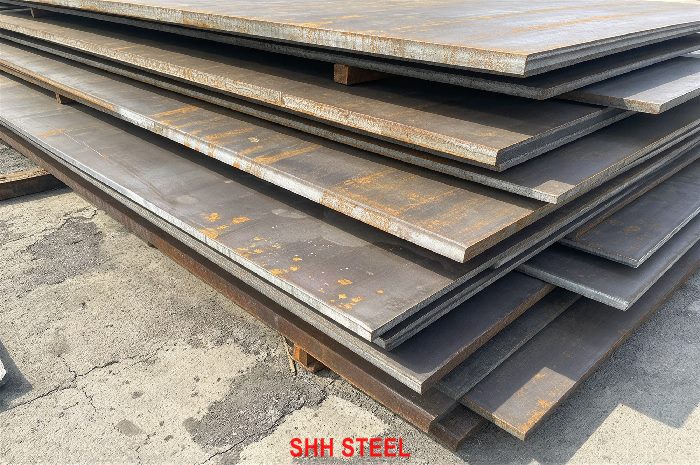
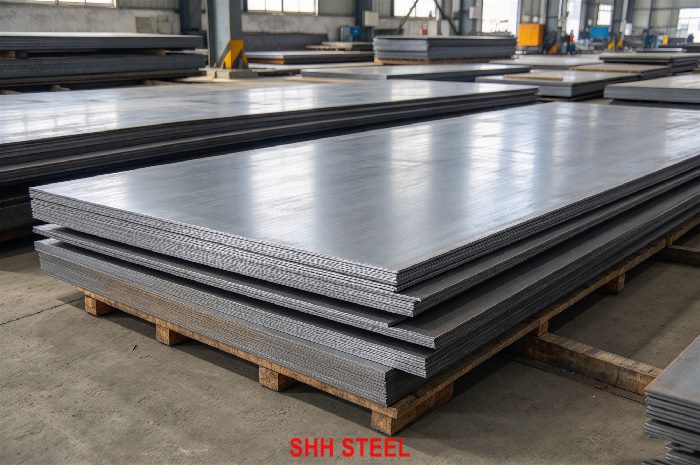
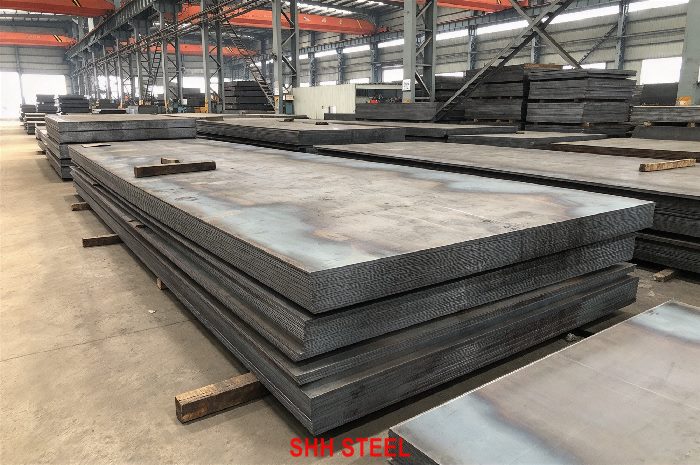
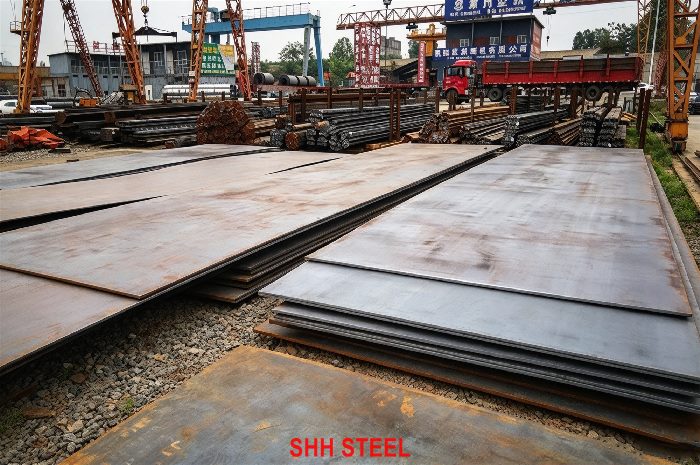
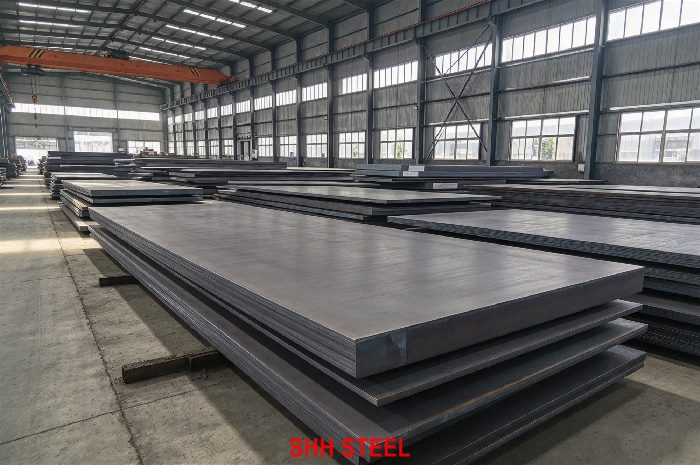
SHH STEEL is a producer and exporter of structural plate and a sales agent for well-known Chinese mills. We keep Q390C plate in our own processing warehouse in Shanghai for cutting, drilling, shot blasting and priming. Q390C belongs to our GB/T 1591 plate range; see also our high-strength low-alloy plates overview.
Q390C specification at a glance
| Item | Q390C requirement |
|---|---|
| Standard | GB/T 1591-2018, hot-rolled (AR) condition |
| Steel type | High-strength low-alloy structural steel, killed |
| Minimum yield ReH (≤16 mm) | 390 MPa |
| Tensile strength Rm (≤100 mm) | 490 – 650 MPa |
| Impact test | KV2 ≥ 34 J at 0°C, longitudinal |
| Thickness range (SHH STEEL) | 6 – 150 mm |
| Width / length | 1 500 – 4 020 mm / 6 000 – 18 000 mm |
| Dimensions & tolerance | GB/T 709 (EN 10029 / ASTM A6 on request) |
| Certificate | EN 10204 3.1 (3.2 with third-party inspection) |
Q390C mechanical properties by thickness
| Thickness, mm | Yield ReH, MPa min | Tensile Rm, MPa | Elongation A, % min (long. / trans.) |
|---|---|---|---|
| ≤ 16 | 390 | 490 – 650 | 21 / 20 |
| > 16 – 40 | 380 | 490 – 650 | 21 / 20 |
| > 40 – 63 | 360 | 490 – 650 | 20 / 19 |
| > 63 – 100 | 340 | 490 – 650 | 20 / 19 |
| > 100 – 150 | 320 | 470 – 620 | 19 / 18 |
| Quality | Test temperature | KV2 longitudinal, J min | KV2 transverse, J min |
|---|---|---|---|
| C | 0°C | 34 | 27 |
Yield drops with thickness because thick plate cools slower and gets less rolling reduction. Design with the value for your actual thickness, not the headline 390 MPa. Impact tests use 10×10 mm specimens for plate ≥ 12 mm; thinner plate uses sub-size specimens with reduced values. Tensile tests on plate are transverse by default.
Q390C chemical composition (heat analysis)
| Element | Q390C heat analysis, % max | Role |
|---|---|---|
| C | ≤ 0.20 | strength and hardenability; kept ≤0.20 for weldability |
| Si | ≤ 0.55 | deoxidiser, adds some strength |
| Mn | ≤ 1.70 | main strengthening element; with C sets the CEV |
| P | ≤ 0.030 | impurity; lower in the tougher quality letters |
| S | ≤ 0.030 | impurity; forms MnS that hurts through-thickness and impact values |
| Nb | ≤ 0.05 | grain refiner, precipitation strengthening |
| V | ≤ 0.13 | precipitation strengthening, helps thick plate keep yield |
| Ti | ≤ 0.05 | fixes N, refines grain in the HAZ |
| Cr | ≤ 0.30 | residual / minor alloy |
| Ni | ≤ 0.50 | residual; helps low-temperature toughness |
| Cu | ≤ 0.40 | residual; limited for hot shortness |
| Mo | ≤ 0.10 | residual / minor alloy |
| N | ≤ 0.015 | kept low; free N harms toughness |
Grade C tightens P and S to 0.030% each. Nb, V and Ti may be used alone or in combination; for Q390/Q420 the sum Nb+V+Ti is limited to 0.22%. Where Cu is used as a residual element the mill must report it. Values are for the ladle (heat) analysis printed on the certificate.
Product (finished plate) analysis and check tolerances for Q390C
A check analysis drilled from the finished plate may differ slightly from the ladle analysis. GB/T 1591 refers to GB/T 222 for the permitted deviations. The table applies them to the Q390C limits. The deviation applies to one side of a limit only.
| Element | Heat analysis limit, % | Permitted deviation | Product analysis limit, % |
|---|---|---|---|
| C | ≤ 0.20 | +0.02 | ≤ 0.22 |
| Si | ≤ 0.55 | +0.03 | ≤ 0.58 |
| Mn | ≤ 1.70 | +0.1 | ≤ 1.80 |
| P | ≤ 0.030 | +0.005 | ≤ 0.035 |
| S | ≤ 0.030 | +0.005 | ≤ 0.035 |
| Nb | ≤ 0.05 | +0.01 | ≤ 0.06 |
| V | ≤ 0.13 | +0.02 | ≤ 0.15 |
| Ti | ≤ 0.05 | +0.01 | ≤ 0.06 |
| Cr | ≤ 0.30 | +0.05 | ≤ 0.35 |
| Ni | ≤ 0.50 | +0.05 | ≤ 0.55 |
| Cu | ≤ 0.40 | +0.05 | ≤ 0.45 |
| Mo | ≤ 0.10 | +0.01 | ≤ 0.11 |
| N | ≤ 0.015 | +0.002 | ≤ 0.017 |
If your inspector tests a plate in a third-party lab, compare the result with the right-hand column, not with the heat analysis.
Q390C equivalent grades: EN, ASTM, JIS
| System | Grade | Comment |
|---|---|---|
| ASTM | ASTM A572 Gr.55 | 380 MPa yield; add S5 Charpy to match 0°C |
| JIS | JIS G3106 SM520B | Tensile 520 MPa class |
| EN 10025-4 | EN 10025-4 S420M (closest) | 420 MPa TMCP, −20°C impact – a step up |
| GB/T 1591-2018 | Q390NC / Q390MC | N and M versions |
“Equivalent” means similar, not identical. Strength classes, impact temperatures and delivery conditions differ between standards. A plate can be dual-certified only if one heat meets both books in full; ask us before you assume it.
Q390C price drivers: what really moves the cost
Q390C usually costs a little more than Q355C, mainly for microalloying (Nb, V) and the 0°C test. Thickness above 60 mm, UT class, Z-grades and narrow width tolerances add more than the grade itself. Ask us for both mill-direct and Shanghai stock prices.
Q390C vs Q355C and Q420B
| Grade | Yield ≤16 mm, MPa | Tensile ≤100 mm, MPa | Impact |
|---|---|---|---|
| Q355C | 355 | 470 – 630 | 0°C |
| Q390C | 390 | 490 – 650 | 0°C |
| Q420C | 420 | 520 – 680 | 0°C |
Q390C vs Q355C: +35 MPa yield, +20 MPa minimum tensile, same 0°C test. Q390C vs Q420B: Q420B is stronger but only tested at +20°C. Q390C vs Q390NC: the NC plate is normalized, which gives more uniform properties through thickness.
Q390C carbon equivalent (CEV) and weldability
| Thickness, mm | ≤ 30 | > 30 – 63 | > 63 – 150 | > 150 – 250 |
|---|---|---|---|---|
| CEV max, % (heat analysis) | 0.45 | 0.47 | 0.48 | — |
CEV = C + Mn/6 + (Cr+Mo+V)/5 + (Ni+Cu)/15. Real heats from our mills usually come in around 0.40 – 0.44 on 20 – 40 mm plate. Q390 plate welds with standard E50/E55-class consumables (AWS E7018 / E8018 type, ER50-6 / ER55 wire). Preheat of 50 – 100°C is common above 25 mm or in restrained joints; low-hydrogen practice is the key point.
Typical Q390C applications
Q390C plate is used for crane girders and runway beams, wind tower internals, port machinery, heavy racks, pressure-free tanks, mining frames.
For building columns with through-thickness loads, compare with Q390GJC building plate to GB/T 19879, which adds Z-direction and yield-ratio control.
Q390C plate sizes we supply
| Form | Thickness, mm | Width, mm | Length, mm |
|---|---|---|---|
| Mill plate | 6 – 150 | 1 500 – 4 020 | 6 000 – 18 000 |
| Shanghai stock (common) | 8, 10, 12, 14, 16, 20, 25, 30, 40, 50 | 2 000 / 2 200 / 2 500 | 8 000 – 12 000 |
| Cut pieces | 6 – 150 | to drawing | to drawing |
Mill orders usually take 30 – 45 days from rolling schedule. Stock sizes can ship within a week after cutting.
How Q390C is tested and certified
Each lot carries tensile, Charpy at 0°C and chemistry results. Batches are by heat, thickness and delivery condition, up to 60 t. Optional: Z15/Z25/Z35 through-thickness to GB/T 5313, UT, product analysis, SGS/BV/TÜV witness for EN 10204 3.2.
Cutting and processing Q390C in our Shanghai warehouse
- Flame, plasma and CNC laser cutting to drawings; bevelling for welding
- Drilling, bending and rolling of shells
- Shot blasting Sa 2.5 and shop primer or full paint system
- Ultrasonic testing to GB/T 2970, EN 10160 or ASTM A578
Processed plates keep heat numbers traceable to the mill certificate.
How to order Q390C correctly
State: standard and edition (GB/T 1591-2018 Q390C), thickness × width × length, quantity, tolerance standard, any UT or Z-grade, certificate type and marking. Writing the edition avoids the most common certificate dispute we see.
Why buy Q390C from SHH STEEL
SHH STEEL works as an agent for well-known Chinese mills, so we can book rolling slots for non-stock sizes and still offer warehouse stock for urgent orders. Our team checks every certificate against GB/T 1591 before shipment. We export to Southeast Asia, the Middle East, Africa, Europe and South America, packed for sea freight with sea-worthy marking.
FAQ
-
What is Q390C steel?
- A GB/T 1591 hot-rolled HSLA plate with 390 MPa minimum yield and KV2 ≥ 34 J at 0°C.
-
What is the ASTM equivalent of Q390C?
- ASTM A572 Gr.55 is the usual comparison; add supplementary S5 Charpy at 0°C (32°F) to match the impact requirement.
-
What is the chemical composition of Q390C?
- C ≤ 0.20, Si ≤ 0.55, Mn ≤ 1.70, P ≤ 0.030, S ≤ 0.030, Nb ≤ 0.05, V ≤ 0.13, Ti ≤ 0.05% (heat analysis).
-
Q390C vs Q390B – which should I choose?
- Same strength; choose C when the structure sees temperatures near 0°C or the code asks for 0°C impact.
-
What is the tensile strength of Q390C?
- 490 – 650 MPa up to 100 mm and 470 – 620 MPa for 100 – 150 mm.
-
Can Q390C be supplied normalized?
- Normalized plate is ordered as Q390NC under GB/T 1591-2018, a separate grade with its own table.
Conclusion
Q390C is a hot-rolled 390 MPa HSLA plate grade of GB/T 1591 with 490 – 650 MPa tensile and 0°C Charpy impact. Check the thickness-dependent yield, the CEV and the product analysis tolerances when you write your purchase order.
SHH STEEL supplies Q390C mill-direct and from our Shanghai processing warehouse, with EN 10204 3.1 certificates. Related pages: Q355C, Q420B, Q390NC, EN 10025-4 S420M and our GB/T 1591 plate range. Send us your sizes for a quotation.
Quality Steel Needed? Inquire for Offers
Related Products